Coco, The Pug in Our World

It is usually not the best idea to give someone a puppy. That didn’t stop me and my sisters eight years ago from giving my dad the cutest little black pug you ever saw.

Coco in chair puppy (2).JPG

Why a pug? Growing up, we had always had German shepherds, beautiful, loyal, trainable dogs. First we had Jesse, then Adam. When Mom and Dad got a pug some years later, we thought they had gone foo-foo, but of course that was their prerogative. Foo-foo is an option. Daphne entertained them for many years. They loved her. They enjoyed her. Then she died and they said, That’s it, no more dogs.

A few years went by. Dad’s 75th birthday was approaching. One of us had the brilliant idea to give him a puppy, a pug again since they had loved Daphne so much, but a black pug this time. In retrospect I am not exactly sure how we justified this, since it is, I repeat, usually not the best idea to give someone a puppy. I think we said, Ah well, if he really doesn’t want her, one of us will take her. Not overly risky. We are not big risk-takers.

The little black pug was born in Virginia. It’s a 7+ hour drive from my home to where Mom and Dad lived in New Jersey, and at the time I had a job with crazy weekend hours. It was hard to find a time to drive up there to present her, which of course had to be a surprise. So this sweet puppy stayed with us for a few weeks. She was a neck-nuzzler. Fur like velvet. Puppy adorableness. How could he not like this gift?
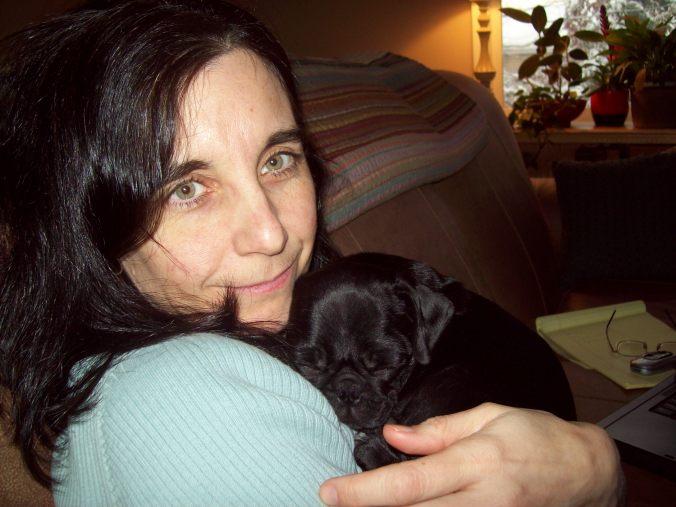
Coco as puppy.jpeg

We finally arranged a time to visit, in no way hinting that we were bringing a life-changing animal. Samuel, still a teenager then, held her as we walked through the front door and greeted two very surprised people. Not only surprised, but resistant.

Dad’s exact (deadpan) words were, “You have got to be kidding.”

But she won him over quickly. Within 24 hours you couldn’t have taken that dog from him for anything (and whew! the plan worked!). They named her Coco after Coco Chanel. It warmed our hearts to see him cuddling with her and whispering silly nothings to her, though Mom had a little trouble with the new order of things. For her it was a Hey, remember me? situation. Wife of 50-some years, the one who takes care of you, the one who’s been here all along? But she let it be. His little schmoozer, his little gizmo was almost always curled up on his lap, scrunched between him and the arm of his chair, parked at his feet on the ottoman or sprawled across his chest with her head tucked into his neck. If she was not bodily next to him, she either 1. needed to go out or 2. had to be hungry.

My sister Lynn remembers that if Coco sat in front of him and stared unblinkingly at him while he was in front of the television, he would say, “She has to go out. Can someone take her out?” He said this even if she had been out five minutes before! Sometimes he himself took her out. It was hilarious to see him carrying the doggie poop bag dispenser on his wrist like a little purse. Only for this dog would he have done such a thing!
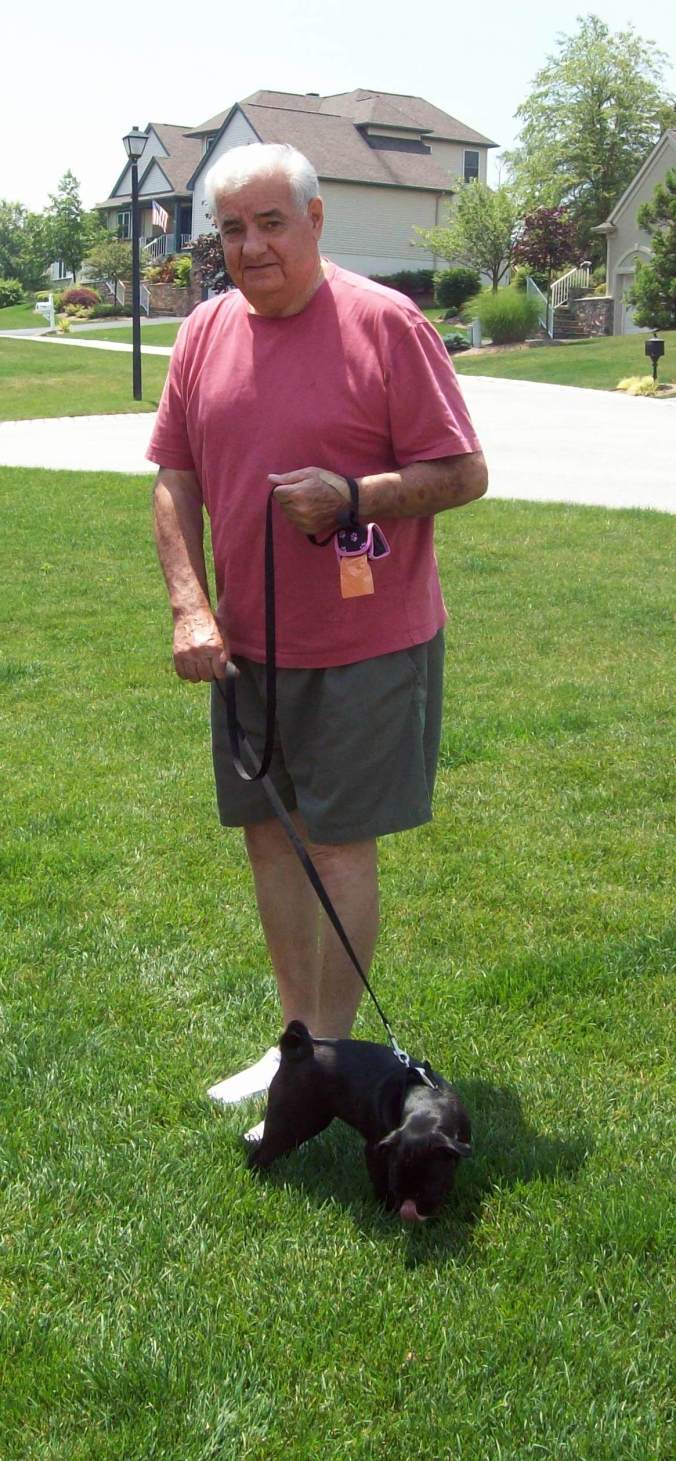
dad with Coco

My sister Joanne remembers taking Coco out one dark night, getting no farther than the driveway and hearing a growl which very well could have been a bear (not uncommon there) so she hightailed it back into the house. When she breathlessly explained what happened, she soon realized that Dad was not the least bit concerned that his firstborn daughter might have been mauled by a bear, but much more concerned that his little doggie might have met her demise. Is she ok? Is she ok?

He held her on his lap at the table while he ate. He fed her off his own fork! It didn’t even matter if friends were there. Lynn’s friend Tracy witnessed this off-the-fork thing too. Dad made sure Coco ate at 4:00pm on the dot because, I mean, look, anyone can see that dog is starving. That 22-pound dog! The vet was always telling them to put her on a diet. Mom tried, really she did, but she couldn’t stop Dad from giving her morsels of his own food or chips or peanuts or whatever snack he had at night.

This is the same man who trained our German shepherds to stay out of the dining room and living room (because those rooms had the good carpeting) and to stay in the yard without our having an electric fence. God help them if they crossed a paw over the line! Dad was an excellent trainer. He just didn’t apply it to Coco. And you know what happens when you let a dog get anything it wants. She quickly became a brat. Mom called her Brat-dog all the time. Dad didn’t care. He loved her just the way she was.

In this family photo taken three or four years ago, you can see who is closest to his heart. Let no one come between man and dog!
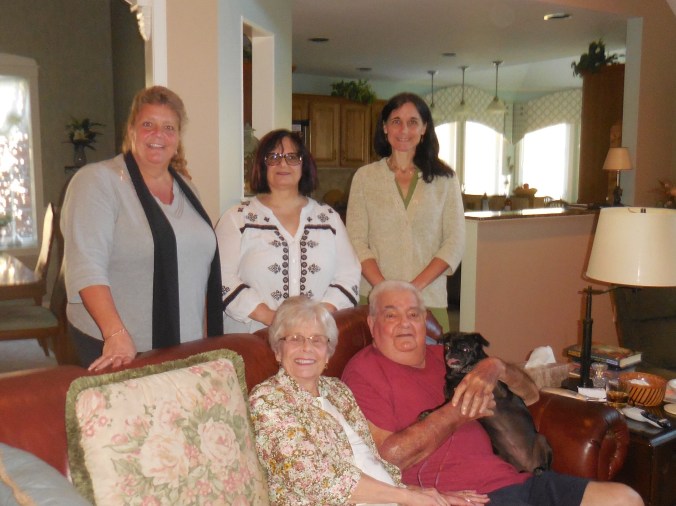
mom dad Lynn Joanne me Coco (2).jpeg

And no one did. She was with him till the end. After Dad passed away in February 2016, Mom preferred not to have to worry about walking Coco in the snow. Joanne was willing to take her to her home in Arizona. But Samuel wanted her. He had had a special attachment to her since she was a puppy. And because of him, only because of him, she is not a brat anymore! Coco’s transformation began in Burlington, Vermont. I said transformation and I mean transformation.

First of all, poor little baby who didn’t want to get her paws cold in the snow, sorry, this is Vermont in February and the ground is frozen. And she had to go out in the very early morning because his job started at 6am. Also her whole Oh listen, other people in the house are up, surely it’s time to get up – not a chance.  She learned to get up on Samuel’s timetable, not her own. She learned to sleep in her own bed. She went on walks measured in miles, not in how many houses you walked past. The extra poundage, the table scraps, the continual treats – those days are over, little girl. He put her on a steady diet of high grade dog food, makes her wait for her dinner until after he has had his (and it doesn’t matter what time that is), makes her sit and wait until he says “okay” before she can go to her bowl and eat, reduced the treat frequency to “occasional” and got her down to a swole 16 pounds. (I just learned that word. Swole is the new buff.)

Interestingly, in an age when mixed breeds are often in need of homes and it is a point of pride to have adopted one (and bravo to all those who do that!), Samuel felt looked down upon as he walked this purebred through the streets of Burlington. I told him to consider her a rescue and never mind about those stares. Mom didn’t want her, and even though Joanne was willing to take her, he is the one who gladly opened his heart and his home to her. I think she knows this somehow.

Oh, the bond they share. She snuggles down in the chair with him when he’s reading. She stays out on the deck with him when he’s doing his yoga. For three months of this year, Samuel was away and Coco stayed with me. Every night, to get her to come into my room (where her bed was) at bedtime, I had to pick her up and carry her in. Her bed is in his room now, as it was before he left. He just calls “Coco!” when he wants her to come to his room at night. And off the comfy couch she goes. Trots right in there. She knows who the alpha is. My human, I go with my human.

She adores him as she did my dad, maybe especially when he makes her look super cool,
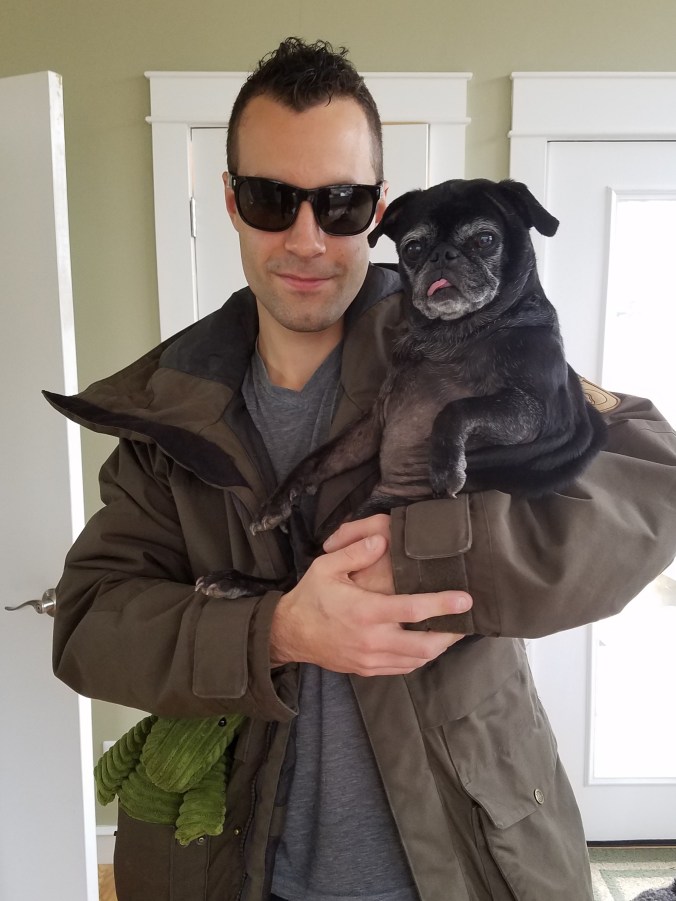
Coco ingognito (2).jpg

and even when he lets little children (Piper in this photo) reach out to touch her pink tongue that doesn’t seem to fit in her mouth.

Coco Piper Samue; Nov 2017.jpg

It’s a different life with Samuel, certainly more active, possibly more amusing. Now you want me to do what?
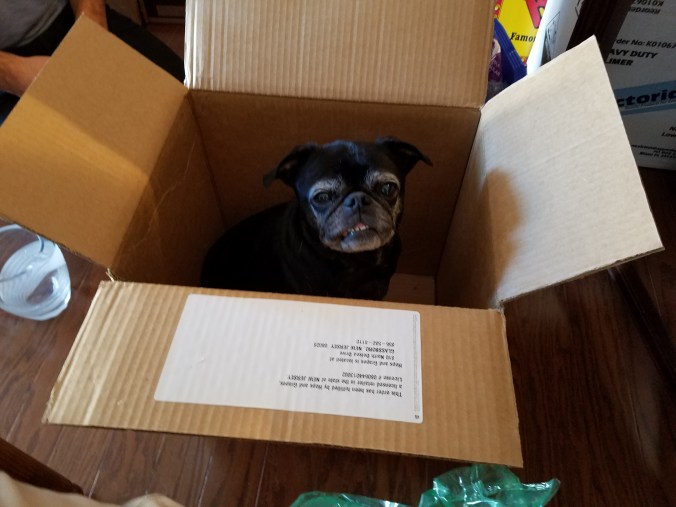
Coco in box.jpg

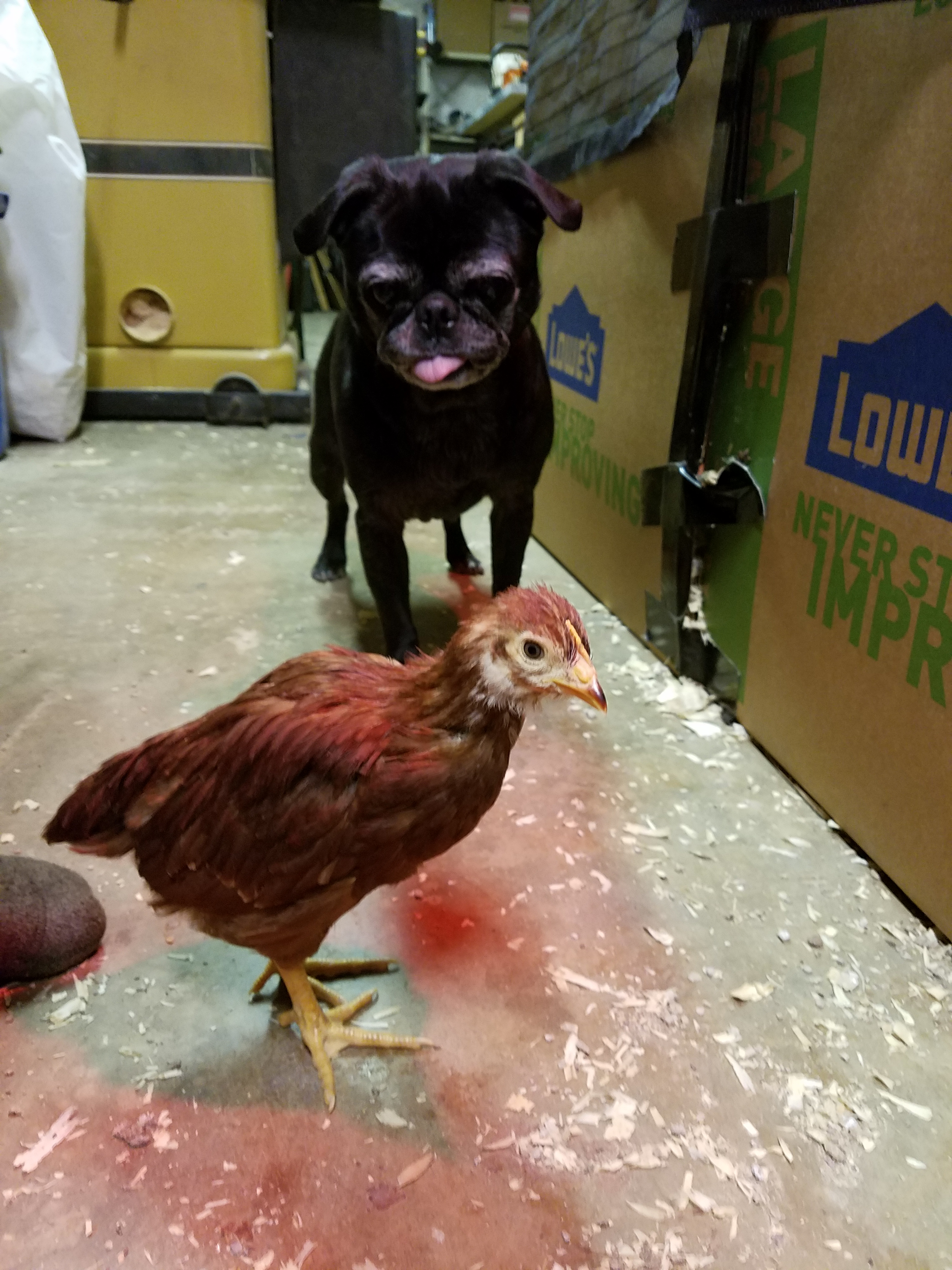
And these chickens? she says. Why are they here?
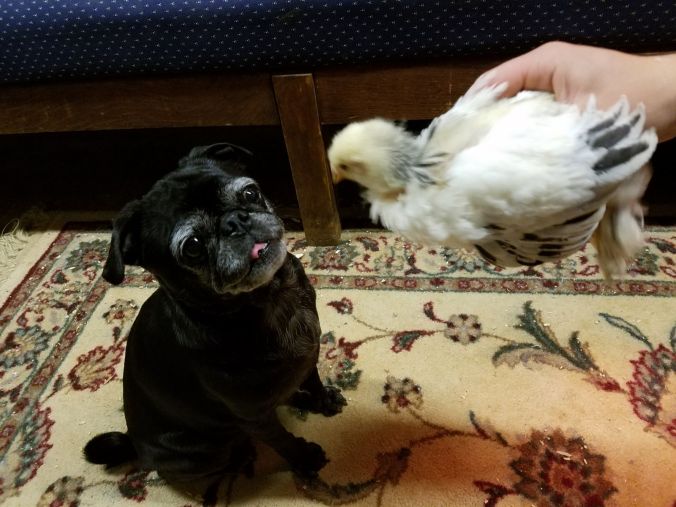
in basement with chicken2.jpg

And here?

in basement with chicken 5.18.jpg

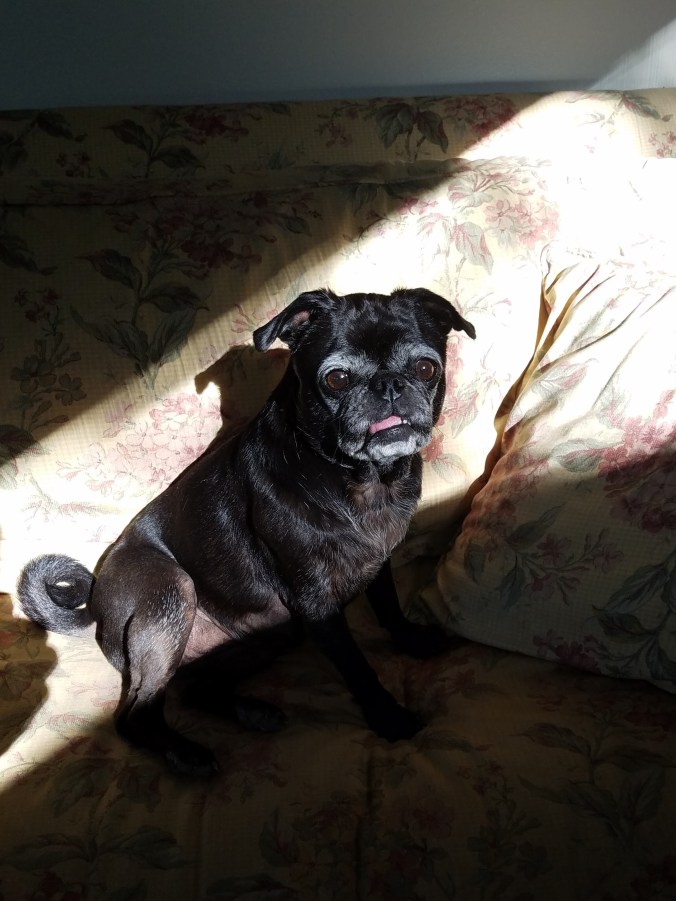
But she still finds the sun spots.

Coco in sunlight (2).jpg

And she still has one lap she loves more than any other. It’s a very good life for this little black pug. And we love her just the way she is.
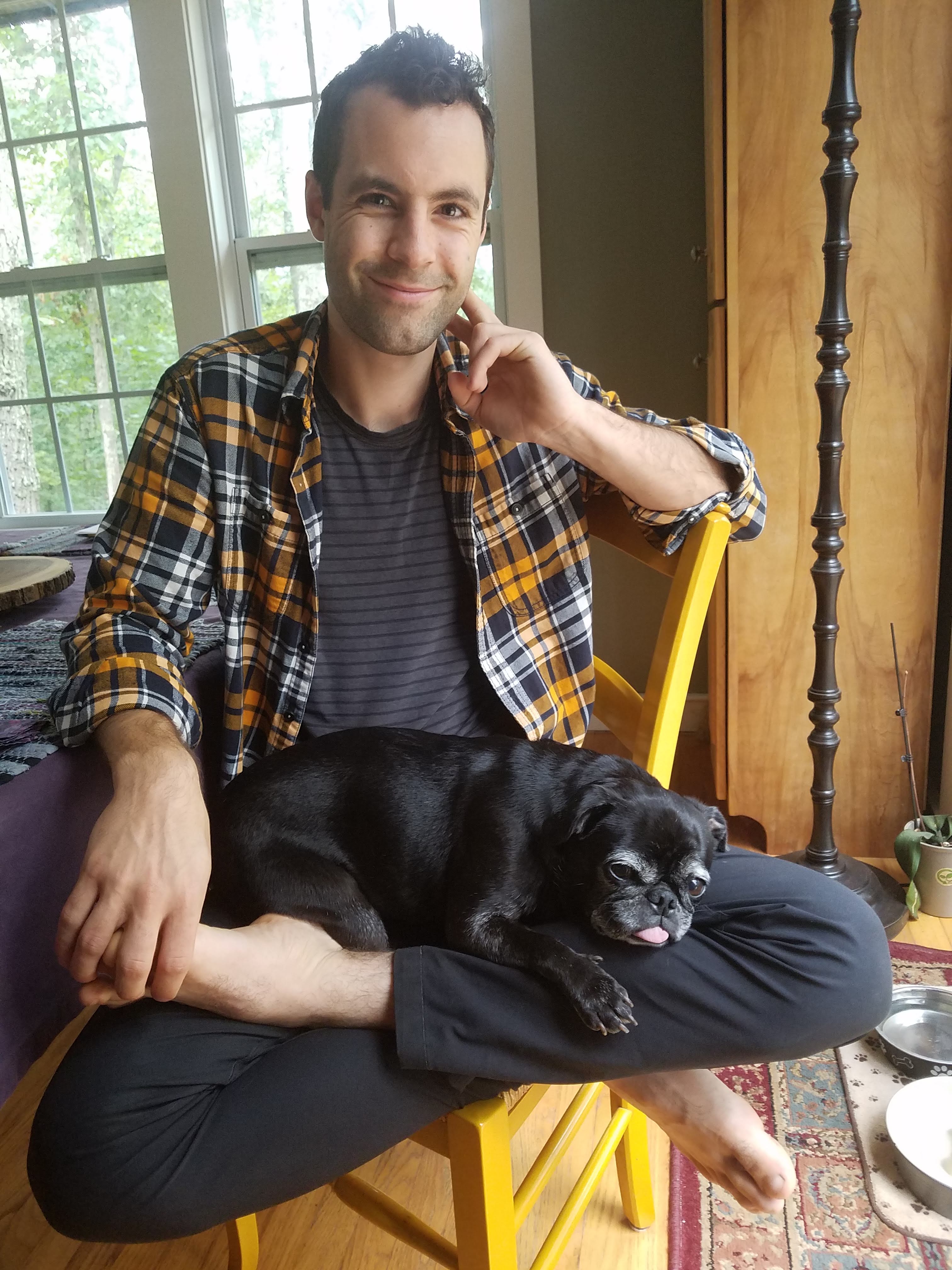
Samuel and Coco on chair.jpg

A Tattered Quilt

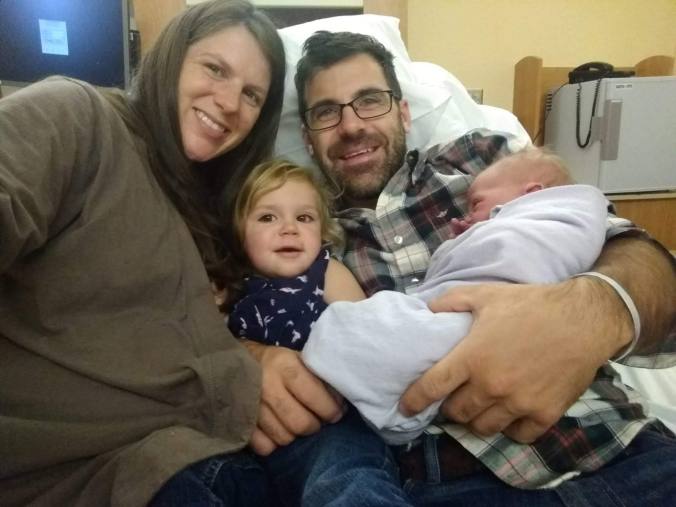
A most fabulous event occurred yesterday in my family – a new granddaughter was born! She is perfect and healthy and blessed to have such wonderful parents, though she is as yet unnamed. Piper is her two-year-old sister, so Brad and Beth have been calling the baby P2 up till now. They said they have to look at her a while before they decide on the name. Fair enough.

My own name, to all my grandbabies, is “Oma” (not Grandma or Grammie or any other sweet name for grandmother). I love being Oma.

Brad Beth Piper and P2.jpg

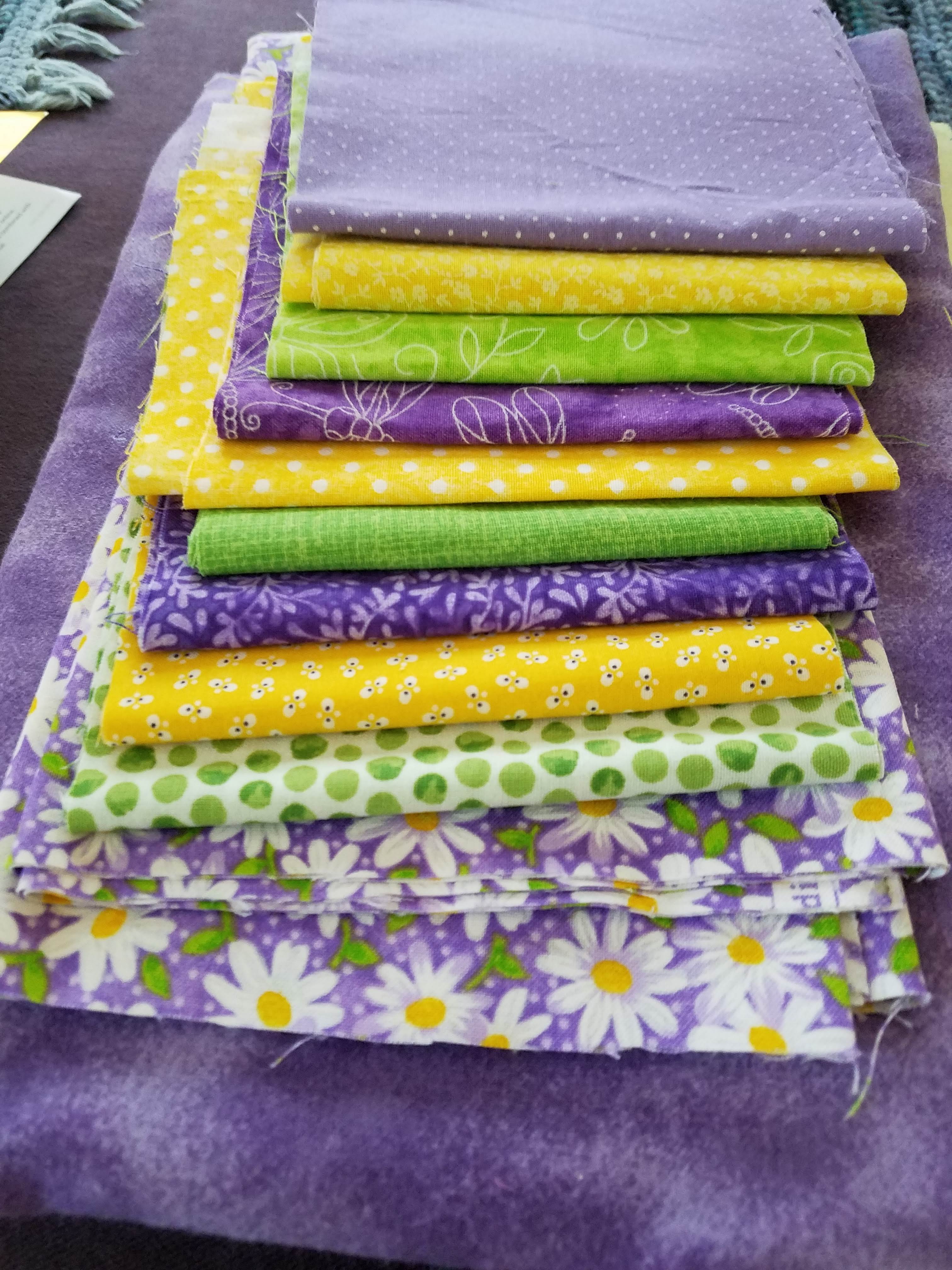
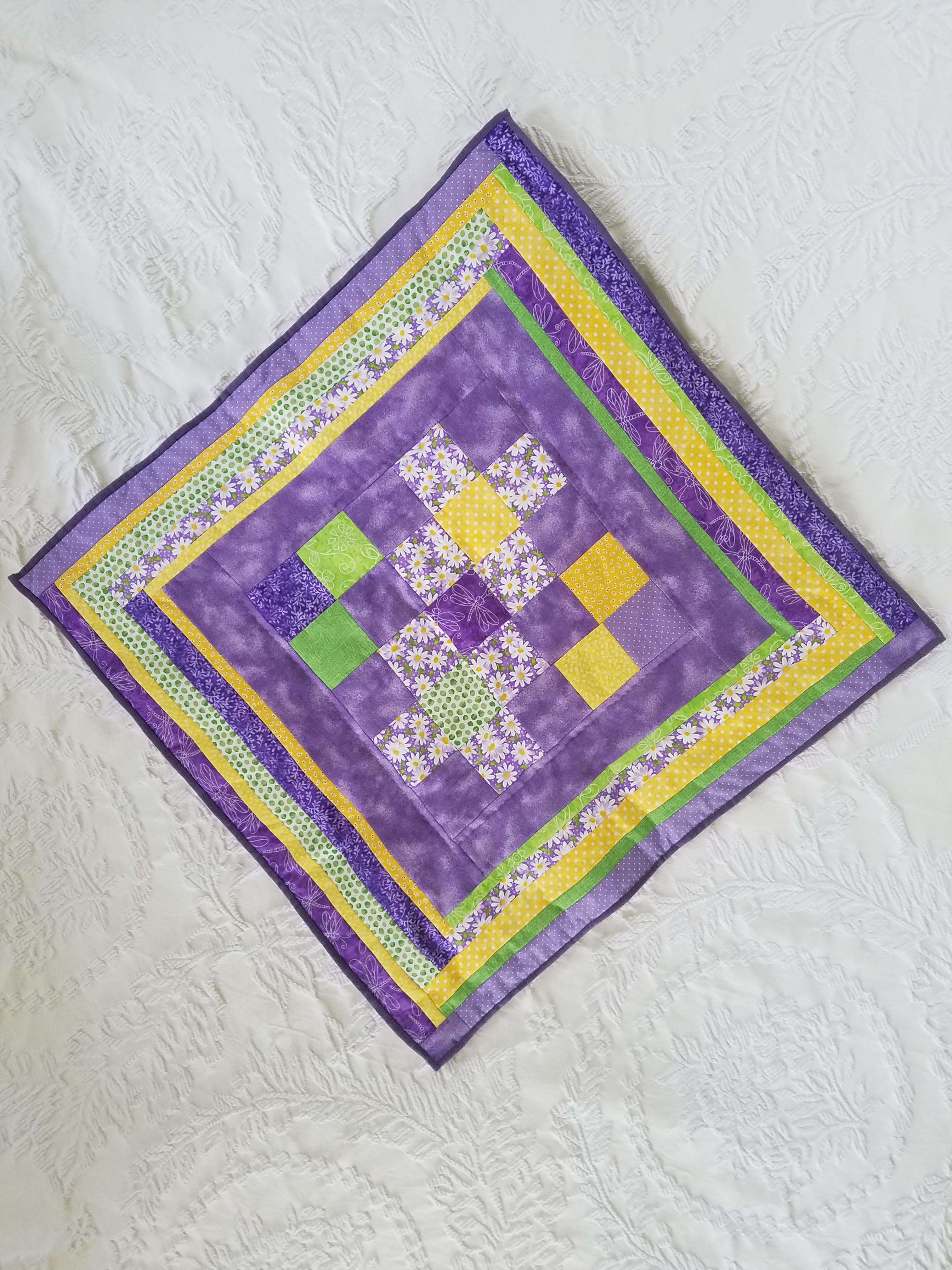
I got it in my head some time ago to make a quilt for this little baby. I finished it and mailed it off yesterday, pleased with how it came out but at the same time kind of nervous. I chose the fabrics. I chose the colors. I know Beth is partial to purple and liked a simple green receiving blanket I had made for Piper. I found a friendly, happy daisy print that’s got purple, green and yellow and decided to build the rest of the quilt around that one.

But colors are funny. Think of the variety you see when you go to buy paint – how many different reds, greens, blues, etc. Colors can be warm and inviting or cold and off-putting. They can make you feel comfortable or give you the creeps. They can calm you down or make you want to want to run in the other direction. So how do you choose? Will they like what I have chosen?

Comfort came unexpectedly from my neighbor Tracy. “I have a quilt my grandmother made for me and I used it until it started falling apart,” she said. “I hope they love yours just as much.”

That’s when I flashed back to two quilts I made many years ago and gave to friends who had had babies. The images that came in my head were of meeting up randomly with both of these moms and their babies after some time had gone by, maybe a year, maybe two. Both quilts that I had so carefully sewn together were right there with each child and both were in tatters – I mean ragged edges and stuffing coming out. Can’t get rid of it, both moms told me in different ways. “She loves this quilt! This is the one she wants.”

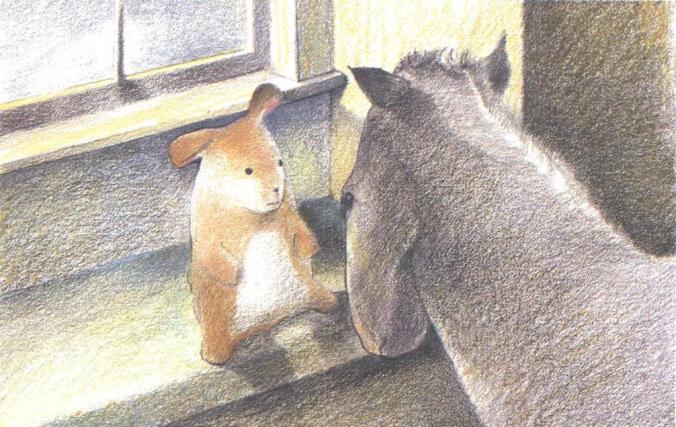
A little bit like The Velveteen Rabbit learns from the Skin Horse, right?* I know I’ve referred to this story before, but it’s pertinent again.

velveteenrabbit-page-001.jpg

“What is REAL?” asked the Rabbit one day. “Does it mean having things that buzz inside you and a stick-out handle?”

“Real isn’t how you are made,” said the Skin Horse. “It’s a thing that happens to you. When a child loves you for a long, long time, not just to play with, but REALLY loves you, then you become REAL.”

“Does it hurt?”

“Sometimes.” For he was always truthful. “When you are real, you don’t mind being hurt.”

“Does it happen all at once, like being wound up, or bit by bit?”

“It doesn’t happen all at once. You become. It takes a long time. That’s why it doesn’t often happen to people who break easily, or who have sharp edges, or who have to be carefully kept. Generally, by the time you are Real, most of your hair has been loved off, and your eyes drop out and you get loose in the joints and very shabby. But these things don’t matter at all, because once you are Real you can’t be ugly, except to people who don’t understand.”

I don’t know if any of them – Brad or Beth or Piper (who has a dolly-size quilt to match) or especially the new baby – will like the colors and the pattern I’ve chosen. Hopefully they will not want to put it in a drawer under a bunch of other stuff! But Tracy’s words about the quilt her grandmother made gave me an image of the quilt I just made, only with its colors faded and its edges worn and its fibers super soft from use and time. By then the colors and the pattern are no longer important. What will matter, what I hope will override any other impression this quilt gives, is the love that went into it, the deep, inexpressible love in my heart. Nothing will make me happier than if it serves as the vehicle of that love, if it speaks to it and of it, and is someday worn, thin, tattered, Real.

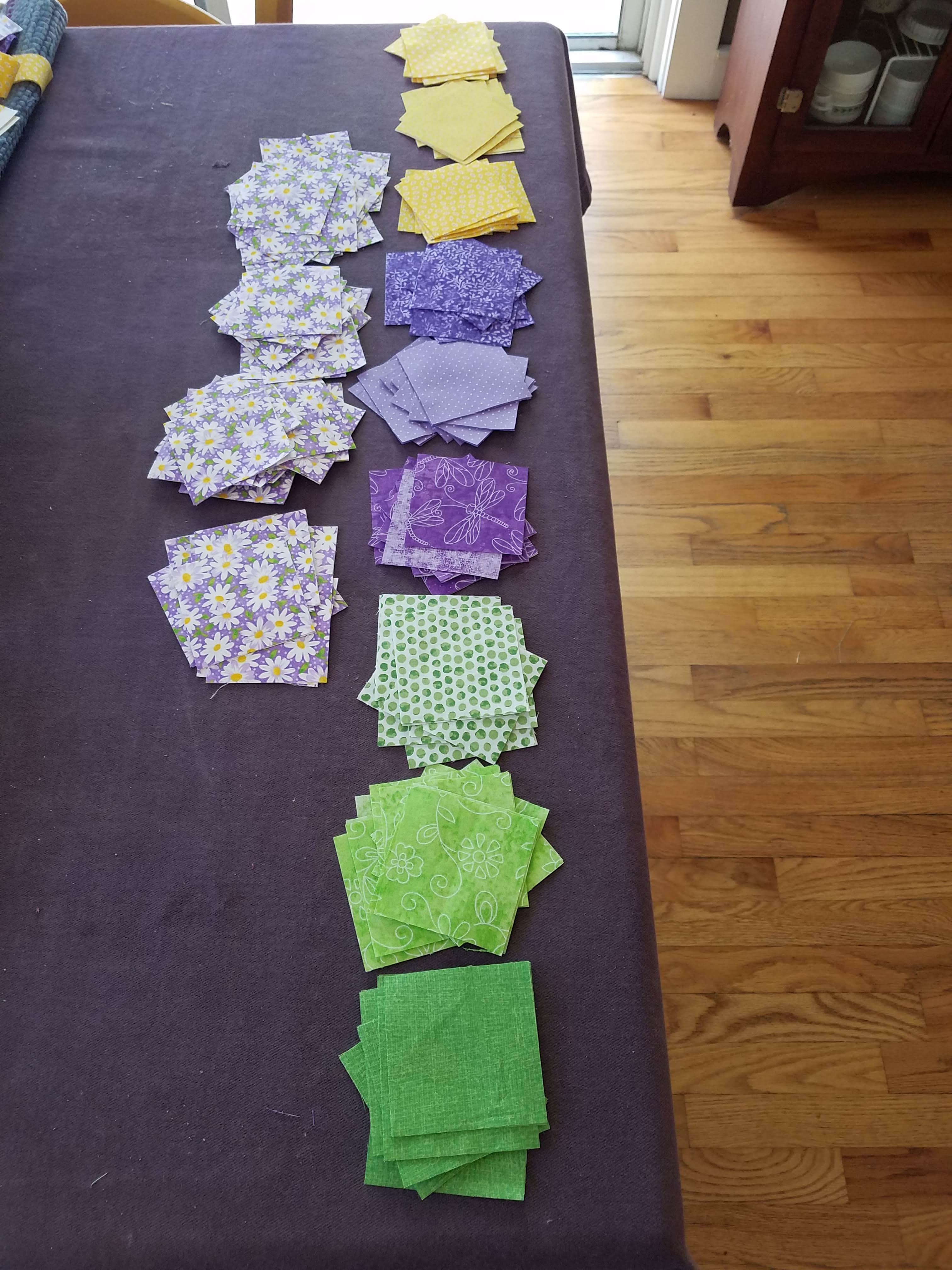
Think what you will of the colors. These are the fabrics I chose.

fabrics.jpg

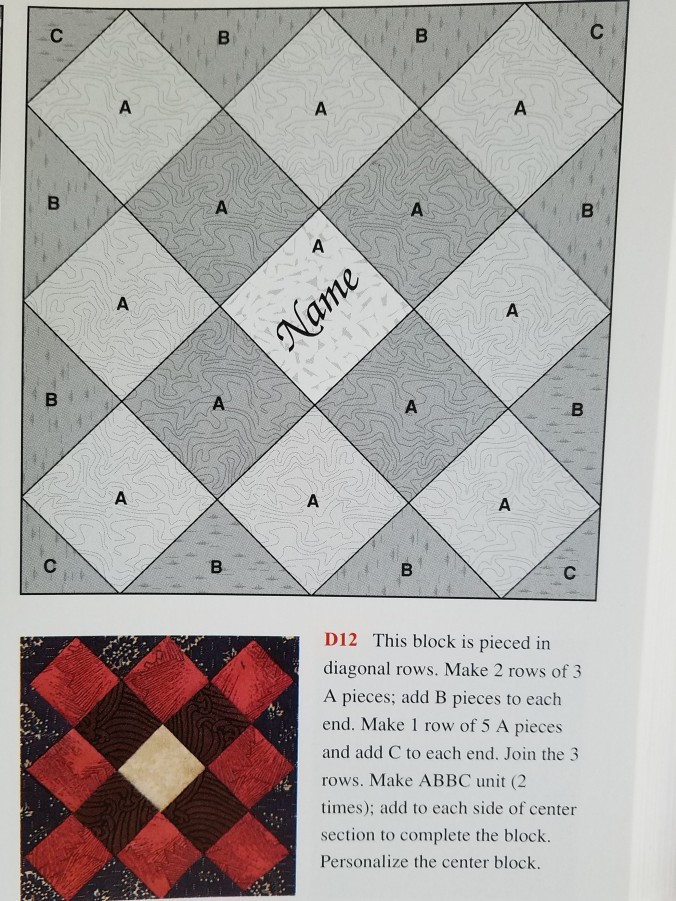
This is the pattern I chose.**

pattern2 (2).jpg

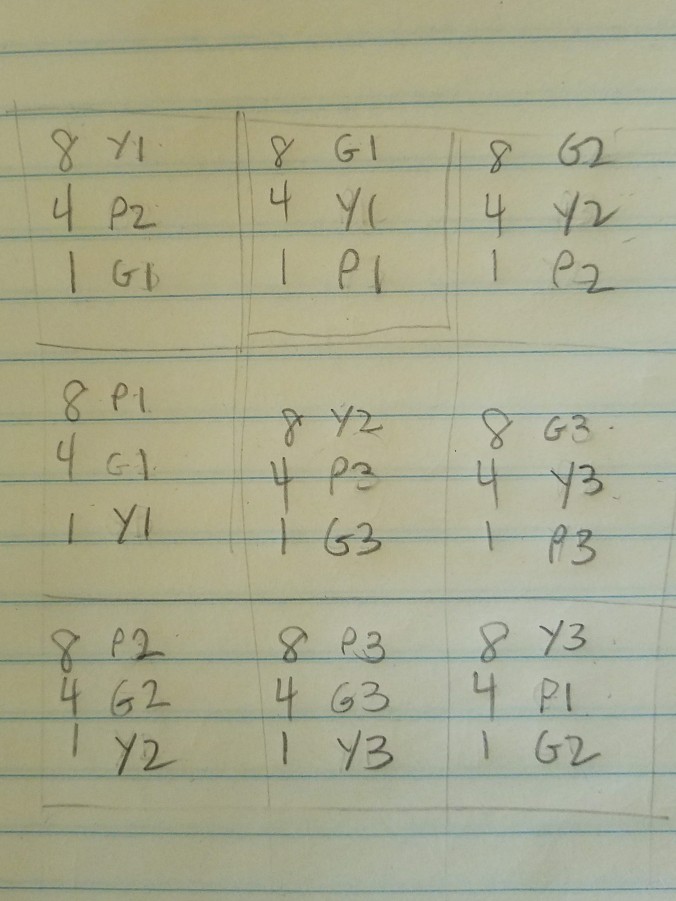
First you make a plan to evenly distribute the three yellows, three purples and three greens, using the daisy print to tie them together. This was my plan. I messed it up by the third block, but was able to recover.

pattern (2).jpg

Then you cut out all the squares with a rolling blade.

squares cut.jpg

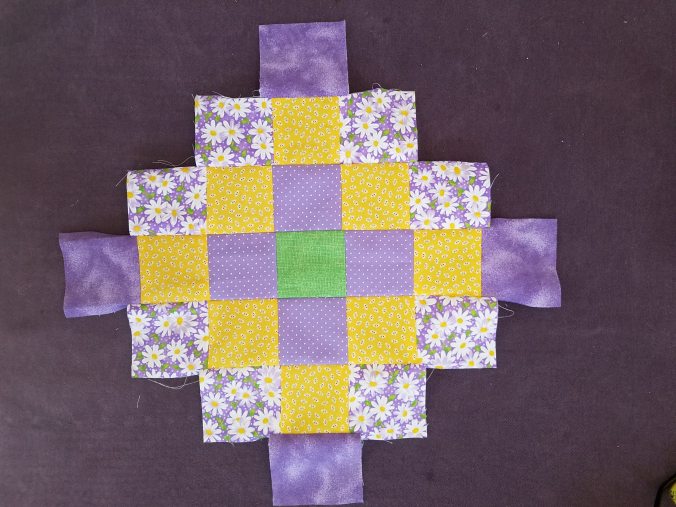
You have to pay close attention during the first block or two. Before trimming, it looks like this, which throws you a bit.

beginning of square.jpg

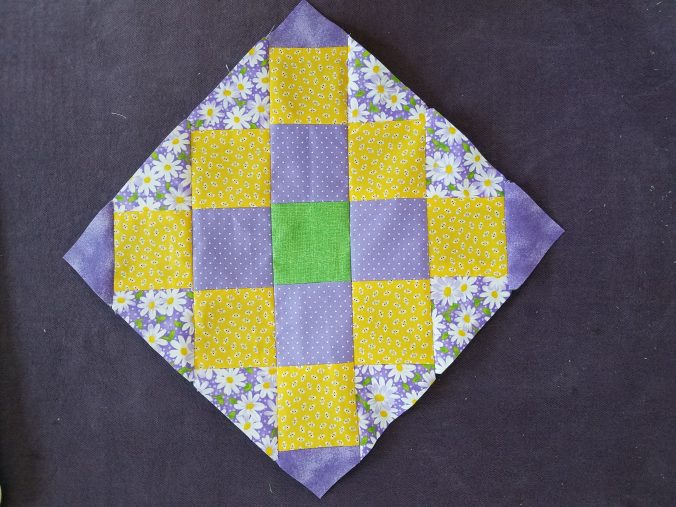
Same block after trimming (ah, that’s better):

finished square2.jpg

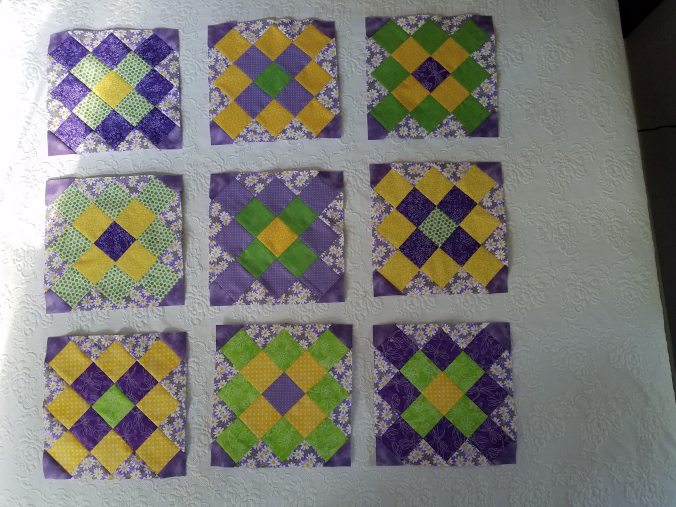
Then you make the other eight blocks and move them all around until you are happy with the balance and distribution of color. It’s never perfect. Lots of the corners are not perfectly joined. I did the best I could with the balance of colors.

nine finished squares.jpg

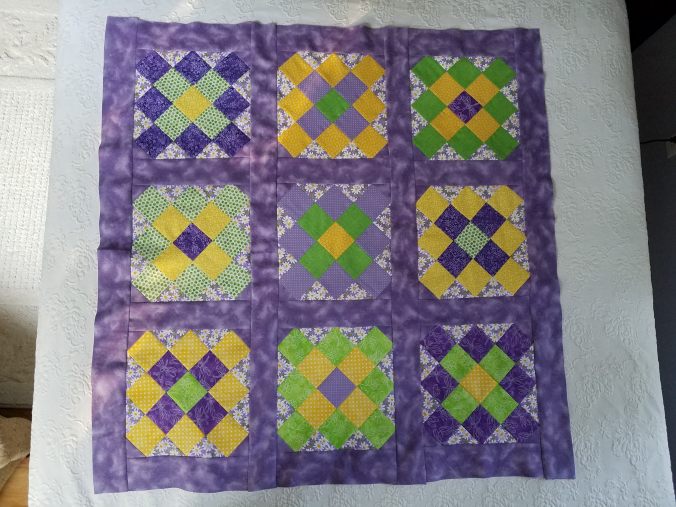
Then you add cross-pieces to hold it all together. I used the same purple (flannel) as the four triangular corners of each block. I hope Beth still likes purple!

squares with binding.jpg

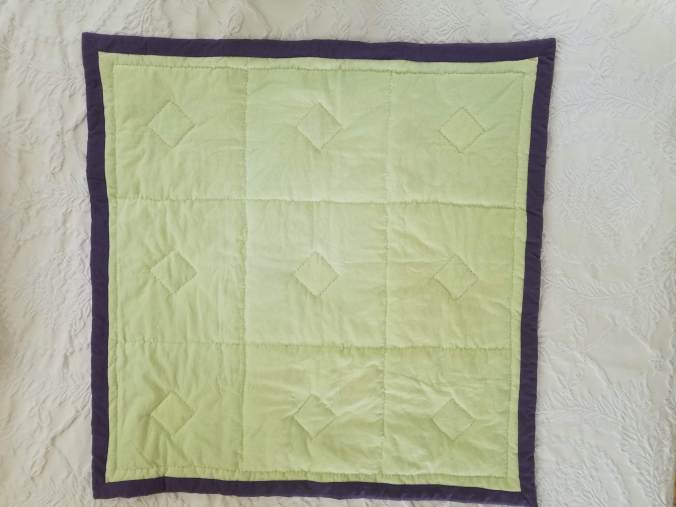
Then you add a middle layer of batting and a backing and you bind it all together. I found a soft green flannel for the backing. From the back it looks like this. Nothing fancy. I am no expert. But it will serve.

back of P2 quilt2.jpg

I had enough leftover pieces to make a small dolly-size quilt and I thought Piper might like it.

finished Piper quilt.jpg

Can you imagine it years from now, faded and tattered? Stained maybe? Much used? Much enjoyed? I hope so!


*The Velveteen Rabbit by Margery Williams and illustrated by David Jorgensen, Alfred A Knopf Publishers, New York, 1985

** from 501 Quilt Blocks, Better Homes and Gardens, Meredith Corporation, Des Moines, Iowa, 1994

Lobster Yolks

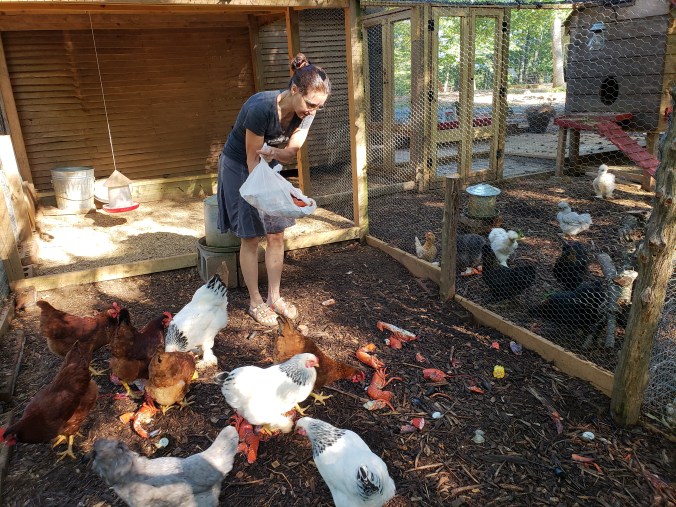
On Labor Day I went to a Lobster Fest and came home with three bags full of claws, heads, bodies, guts and other assorted lobster leftovers. I give everybody who comes – no, not lobster leftovers! – I give all family and friends and all cottage guests the chickens-eat-everything spiel, so I put it to the test. Will chickens eat lobster? You bet they will!

(For future reference, do note the color of the lobster shell.)

lobster1.jpg

Let’s be reasonable though, one bag at a time. If I hadn’t been worried about how long it would take leftover lobster to start stinking up my downstairs fridge, tightly tied up though the bags were, I might have allotted half a bag at a time. But a predetermined plan to do that wouldn’t have mattered. By the time I emptied half the bag, I knew they’d get it all. The chickens in most cases get super excited when you give them food (any food will do!) and that keeps you giving them more and more if you can. Poor babies – you’d think they were half-starved the way they beg! Plus, the bag is icky and all you want to do is finish giving the Sewing Circle half the bag and the Bridge Club the other half, and then throw that bag away!

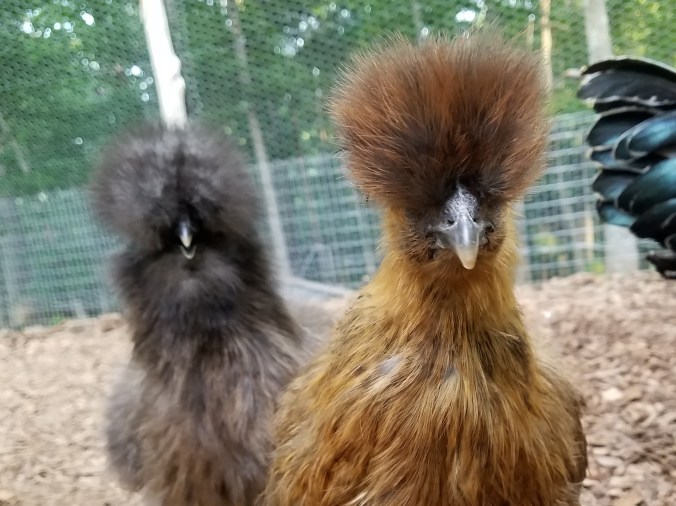
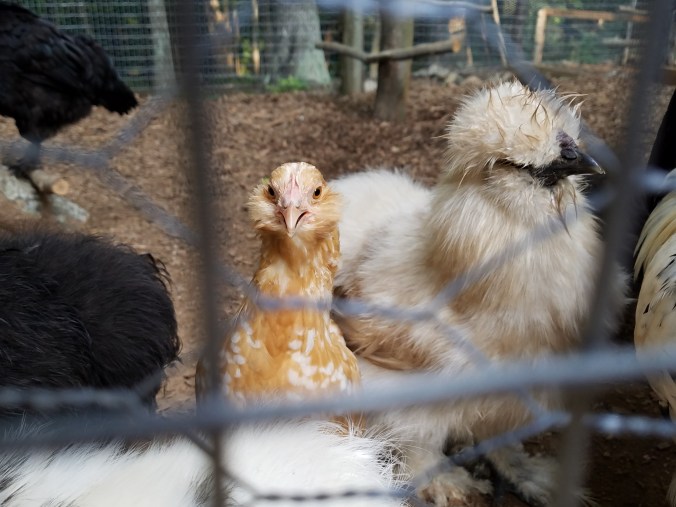
Yes, Sarah, thank you – I love your names for my two groups of hens. Traditionally, ladies sewed in small circles and ladies formed clubs to play bridge together, and my hens are ladies. Besides the eggs that put them in the female camp, I can call them ladies because they are mostly quiet but sometimes squawk, they walk gracefully around thinking/knowing/showing how beautiful they are and they tend to form little groups or clubs among themselves (and not always for benign purposes but sometimes, like Wives of Atlanta or Wives of New York, to establish and maintain pecking order, which is not always pretty, thus the fence between the two groups!). And some of them, like my silkies, are having a bad hair day every day. You may recall.

bad hair day (2).jpg

I like Sewing Circle for the brahmas, cinnamon queens, Rhode Island reds and the lone araucana (old Miss Gray) – the white ones to the left in the first photo – because some of them (the brahmas and the cinnamon queens) have distinctive darker feathers on their heads like a hood, which makes a kind of circle around their necks. I like Bridge Club for the silkies, black copper marans and lone d’uccle because some of them (the silkies and the d’uccle) are in that distinct grouping of chickens called Bantams (lightweights). My brain, along with everything else it remembers and processes, can make short work of Sewing Circle: circle and Bridge Club: Bantam. I think it’s brilliant.

As previously blogged, the Sewing Circle dove into the first round of lobster leftovers with a vengeance, but the Bridge Club was strangely reluctant. It’s all the same to me. Who am I to say that anyone or any chicken should eat lobster or some other decadent, succulent, protein-rich food? Chickens love bugs. They hunt all day for them, prize them, devour them. And what is a lobster but a big, waterbound bug?

But I think the Bridge Club came around. In fact, I have the idea that one chicken lorded it (ladied it??) over the others and got the lion’s share of the meat, and the guilty party is Miss D’uccle. Here she is. Does that look like a face you want to mess with?
Miss D'uccle (2).jpg

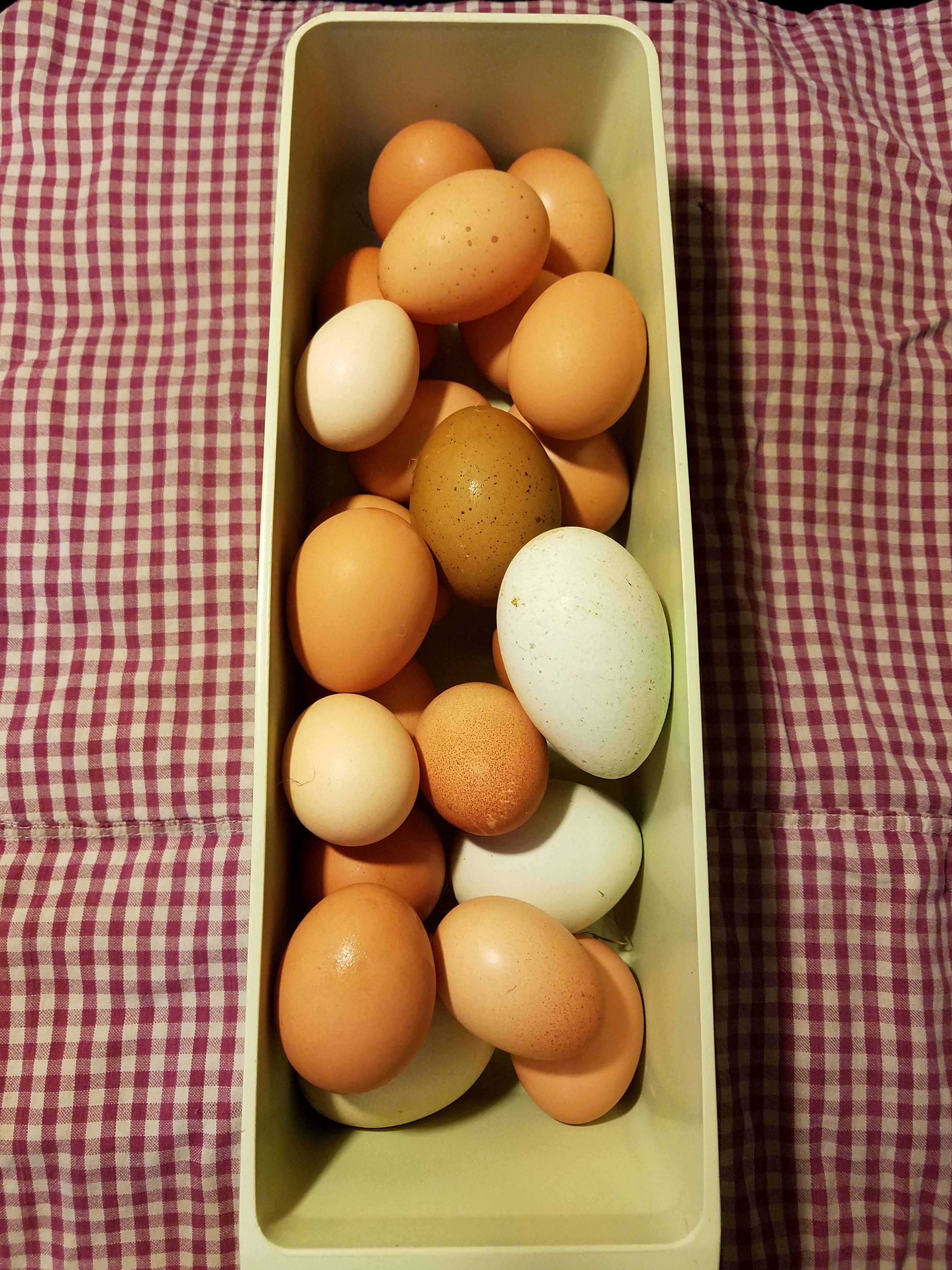
Why do I think this? Miss D’uccle is small, the smallest of the smalls. This does not stop her from being possibly the most obnoxious of all the birds, yakking all day long. I sometimes remind her that I ousted the roosters on account of their noise! Nonetheless she is a contributing member of the flock, though it stands to reason that she would also lay the smallest of the eggs. Can you pick out which one is hers?

in container.jpg

That’s right, it’s the whitish one near the top next to that speckled one. That’s some variety of color, size and speckledness, no? I think they are so beautiful!

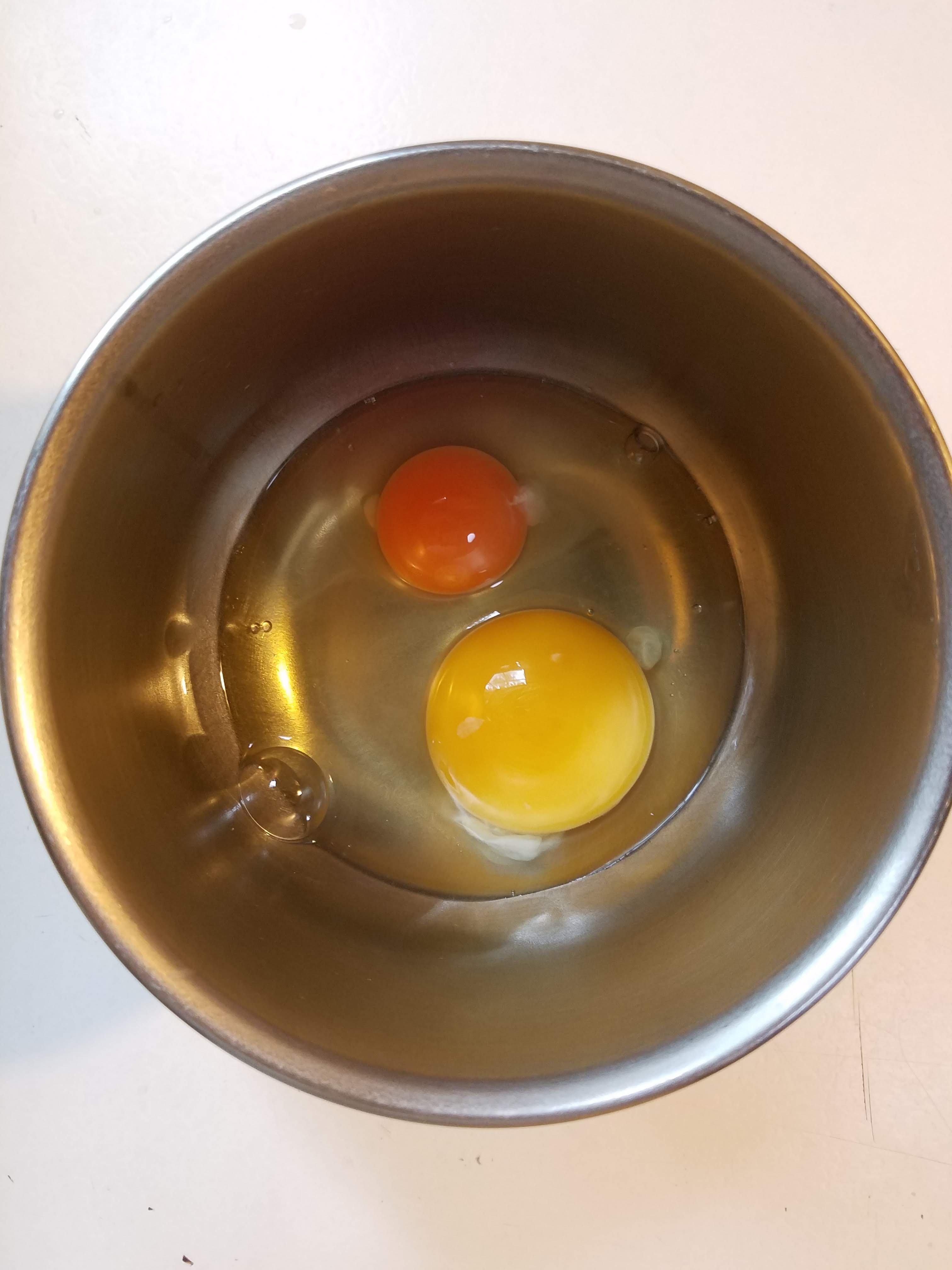
For the contrast, I broke the huge whitish one first (it is actually pale greenish, but my lighting is poor and doesn’t make the subtle difference clear). Then I broke the d’uccle egg. Guess who’s been hogging the lobster! Or maybe just got more than her share?

lobster yolk1.jpg

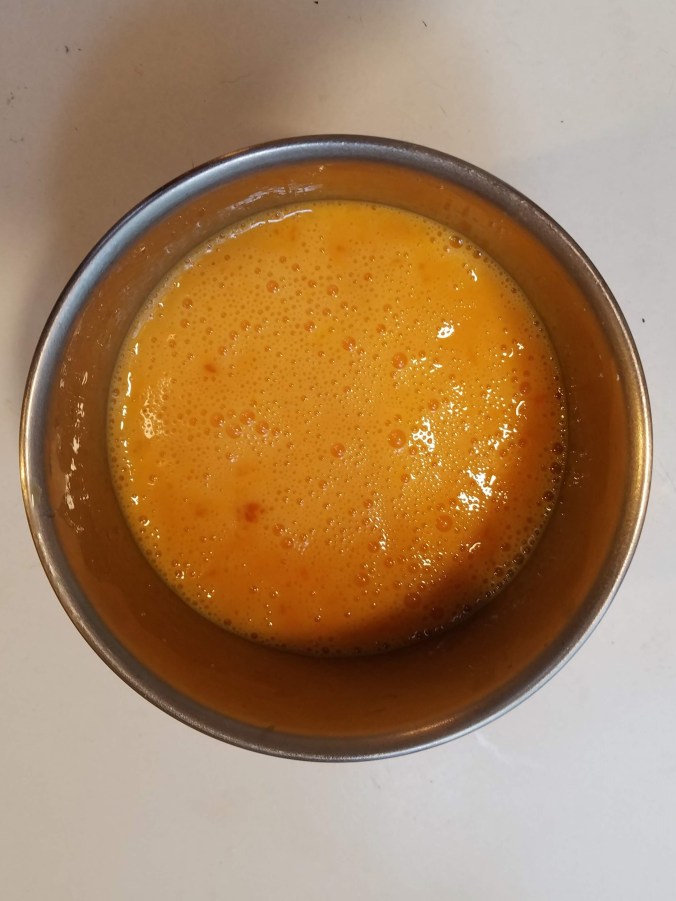
I broke three or four more eggs, all of which were more orange that the huge one but none as orange as Miss D’uccle’s. When beat up, however, they made this rich color. You hardly ever see the likes of that when you are about to scramble eggs. (I promise I did not retouch this photo – I’m lucky I know how to insert them!)

yolks3 scrambled (2).jpg

Now I ask you – are my chickens eating better than most chickens? Better than the chickens whose eggs you eat? Granted, lobster for dinner is a rarity, especially for chickens. But we take what we get and I took the lobster. Kinda makes me want to ask for more leftovers, whatever they might be…

The Certainty of Uncertainty

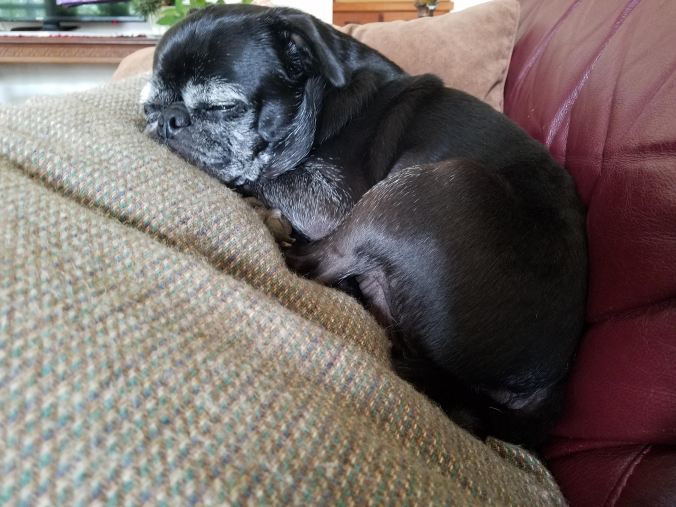
At the moment it’s very quiet here. The trees are not swaying, thrashing, bending. Not a leaf moves, even flutters. The ticking of one of my clocks I can hear. Coco’s sleepy breathing I can hear.

sleeping.jpg

That’s soon to change. If you couldn’t smell it in the air, you’d hear it on the news. We are in the danger zone of Hurricane Florence, though not as dangerous a zone as some are in. Will the pelting rain and fierce wind come? Yes. This much is certain. What’s uncertain is the storm’s exact path and intensity.

Will we flood out? Probably not, as my property sits up on a hill.

Will we lose electricity? Most likely.

Will one of my giant trees fall? Let’s hope not.

“The most precious thing about life is its uncertainty.”

Thanks to Paul Sunstone, I have been introduced to Kenko, a 14th century Japanese writer who produced, in his retirement, 243 essays collected into the classic “Leisure Hour Notes,” including the line above. Paul added, “I think that was what kept him from boredom.” He’s right. Uncertainty is as certain as death and taxes! And it does keep you on your toes!

Last night a young woman who lives along the Virginia coastline booked my cottage because she has to evacuate her area. She was not planning to come here this week, but wants to keep herself and her two dogs safe. The coast will get lots of rain and wind, so will we. Will she be safe here? One thing is certain: I will do everything I can to make sure she is. Starting tomorrow and until Saturday, Miranda will be next door. She – who was unknown to me 12 hours ago – will be my neighbor.
I love thinking of my neighbor as der Nächste, German for “the one next to me.” This doesn’t have to mean a literal “next to” – you can think of co-workers as neighbors, or friends you have contact with through email or texting or blogging, or the people you rub shoulders with in your community. But in the case of Miranda it’s literal, and neighbors look out for each other. Forgive my tangent, but if all of us would truly abide the “love your neighbor as yourself” command, imagine what the world would be like.

So while the storm looms and Miranda is here, much will be – hour to hour – uncertain. Knowing that you don’t know everything is the beginning of wisdom. True, true. But…if you know that you don’t know everything, but you also know that you know some things, you stand a better chance of getting through with less trouble. While storms do sometimes change course and turn out to sea, they sometimes don’t. We will do what we can to prepare. Then ride it out.

My little house in the big woods is as solid as a house on a wooden foundation can be, the wooden part being questionable, but we are getting to that.

9.11 delivery16 pre-delivery.jpg

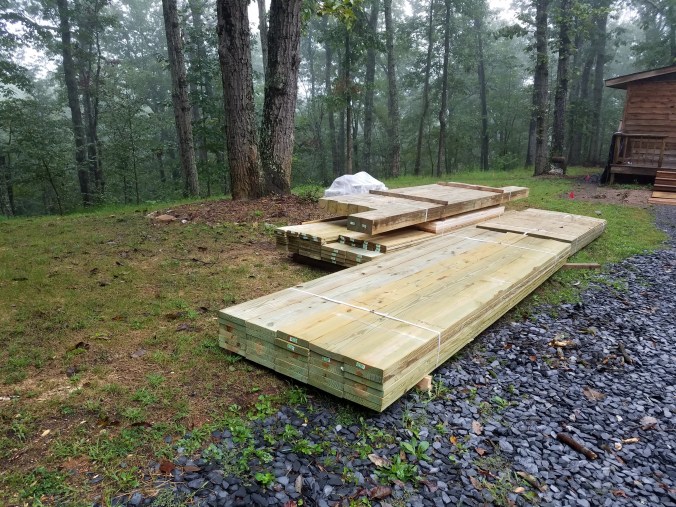
The storm is still out to sea, but supposed to hit us at the end of the week. Ironically, this coming weekend had been set aside to begin “the big dig” at my house – a long-awaited project to investigate why my foundation seems to be bowing inward in one area (not a good sign) and then to do necessary repairs. I ordered the materials last week, a lot of materials because after the big dig we will replace the very old front porch. (I’m glad I ordered last week — what do you think will happen to the price of lumber after the storm?)

9.11 delivery9.jpg

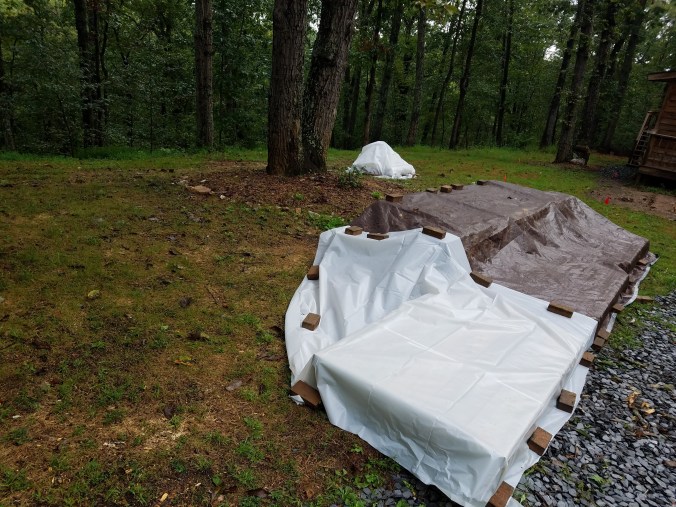
The uncertainty of the storm puts us in a kind of holding pattern. Hold off on big dig projects and hold onto your hat! At the very least, cover your lumber.

9.11 delivery13.jpg

Will the bricks hold the plastic down in a strong wind? I hope so! How strong will the wind be? I am uncertain! With no wind blowing right now, that many bricks seems reasonable. Possibly I will find myself incredulous that I didn’t double this number or use cinder blocks as Sandy suggested. Maybe cinder blocks are a good idea after all….

Today, in the calm, various interpretations of battening down the hatches seem important, including making sure we have enough batteries for the flashlights and enough jugs of water in the event that my electricity goes out (in which case my water also goes out because electricity runs the pump). I have a gas cookstove in both the house and the cottage, so we will eat. And it’s a nice temperature outside so not having AC or heat will not be an issue. What am I forgetting?!

Uncertainty is part of the unboring path we walk. We can watch the news all day (you can, I won’t), we can change out the bricks for cinder blocks or go all out and just add them, we can stockpile supplies, we can put some milk in the freezer now so it’s maybe cold later if we lose power, but we can’t be certain what this coming weekend will bring.

We’re pretty smart though. We can have an idea. And we do. According to our best projections, we can fairly well know what won’t happen, what might happen and what will happen:

In my case the weekend will not include a large and loud excavating machine. Canceled that. Sadly, it will not include Joe, who will operate said machine (unless he comes around anyway, which is fine by me). We will not be

  • digging large quantities of dirt from along the front of the house
  • discovering just exactly what is the problem with the foundation and how extensive the fix needs to be
  • relocating liriope and azalea
  • mixing cement
  • setting footings
  • bracing posts.

We might be (this is the uncertain part)

  • hunkering down
  • watching the trees dance wildly (hoping that if they fall, they do so far from any structure or power line)
  • putting less-than-sensible chickens in their coop (because they are too dumb to go in by themselves!)
  • using matches to light the stove because the electric ignitor is nonfunctional
  • playing board games by lamplight as we wait out the storm. I have a couple of wonderful oil lamps that come out at times like this. Their glow, the swirly patterned shadow they make on the ceiling, their faint scent of burning lamp oil – all combine to create a scene that makes you appreciate what it was like for pioneers. We should do this on purpose now and then just to induce an extra prayer for those in the bucket trucks who keep our lights on, and this weekend in particular for those who will be out in this nasty storm getting fallen limbs off high wires as we sit inside checking our phones for notification that the power is back on.
We will be

  • taking care of one another
  • comforting the dogs who get unsettled in howling wind and torrential rain
  • keeping a close eye on trees, chickens and other outdoor things for signs of trouble
  • praying for safety for all those affected by the storm
  • staying in touch with other neighbors in case we can help in any way
  • enjoying good eggs! More on lobster yolks tomorrow! Oh, how tempted I am to give you a sneak preview, but: YOU are uncertain about lobster yolks (MY lobster yolks, at any rate) and if, to paraphrase Paul, uncertainty keeps us from boredom, I had best wait. Come what may, I aim to keep things unboring!

Lasagna Pizza Galette

Oh, look, ricotta. What can I do with that?

I came home from being away for a few days and opened the fridge to see what might be possible for dinner, and there was a container of ricotta, front and center, staring at me, practically begging. You know you want to use me. I did, not only because I had an idea brewing, but because it had been in there almost too long.

Two experiences contributed to the new concoction I made tonight. New for me anyway.

  1. While in D.C. this past weekend, we stopped for a bite to eat at a pizza place and were intrigued with the one that had pickles on it! That’s right, pickles along with ham, pulled pork, feta cheese and a bit of mustard. They call this a pizza, and I’ll play along. It has a crust like a pizza, is round like a pizza, and has creamy, melted cheese on it like a pizza. The rest is a stretch, but it didn’t matter because it was totally delicious. The server described it as an “open sandwich.” Put whatever you want on a pizza crust. Hmmm.
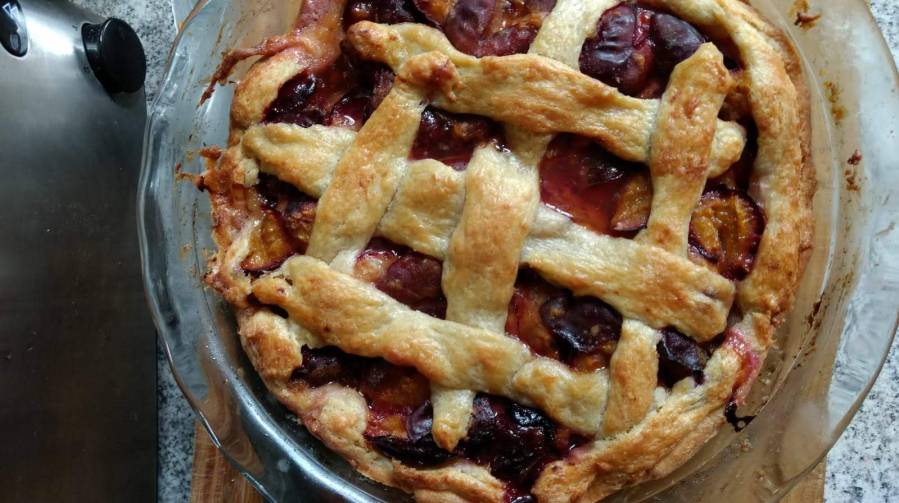
  2. Claudia and I had a conversation about pie vs. galette. I think of galette as the free form version of pie, I said. To me pie has more fruit than galette, she said. Deeper maybe, ok, fair, I said. Look at us, she said. 🙂 Claudia made a plum pie. The sticky dough made with gobs of butter was hard to work with, hard to make pretty, but oh how amazing it must have tasted. I could only dream about it because she lives in Germany. I’m sure it’s long gone.

Claudia's plum galette.jpg

So here I was thinking free form and wanting to do something with my must-be-used ricotta when I saw it in the fridge. That’s all there was at first.

Okay. Start with a pizza dough, which we have discussed in my pizza pile post https://anunboringpath.com/2018/07/31/pizza-pile/. While the dough was resting I gathered basil and oregano from the garden (oh, how glorious basil and oregano are in August!!) and cut it up, took out the ricotta, looked for mozzarella but didn’t happen to have any so settled on a small chunk of asiago (it’s a stronger cheese – don’t need too much, but the flavor works), grated that, chopped up a red pepper and a couple handfuls of spinach, defrosted the half a can of Don Pepino pizza sauce I had put in a jar the last time we made pizza, and took out the jar of grated parmesan that I keep ready to go in the fridge. I oiled the pan with olive oil and sprinkled cornmeal on it. I’m hungry, worked fast.

Ready. I rolled out the rested dough bigger than my pizza pan by about 4” all around. Truth be told, that’s just how big it rolled out. Looked good to me. Not overly picky when I am hungry. I set the pan on the first thing that caught my eye on the counter that would raise it up high enough for the dough to hang down, which happened to be my teapot without its lid waiting by the sink to be rinsed, which you cannot see in this photo, but trust me, the teapot is under the pan and the dough is hanging down the sides.

True confession: I was just making dinner for me and Samuel. That’s all. This is the point where I realized the idea might work and it might be yummy and I ought to be taking some pictures so I could share it!

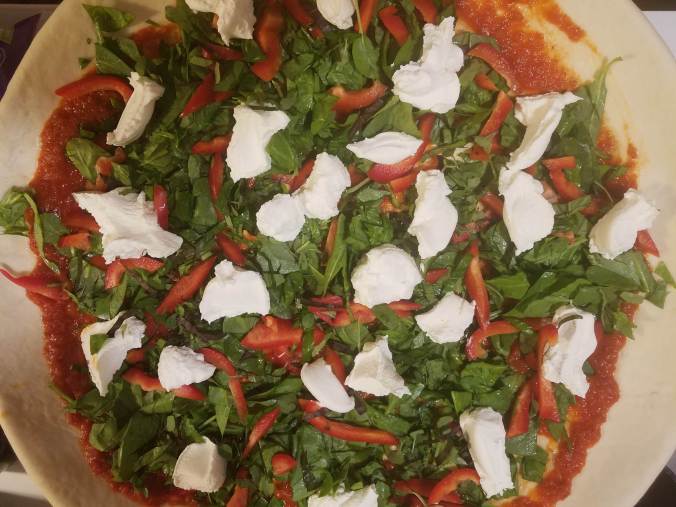
Here it is with the pizza sauce, then the spinach, basil and oregano, then the red pepper, then small blobs of ricotta.

1.jpg

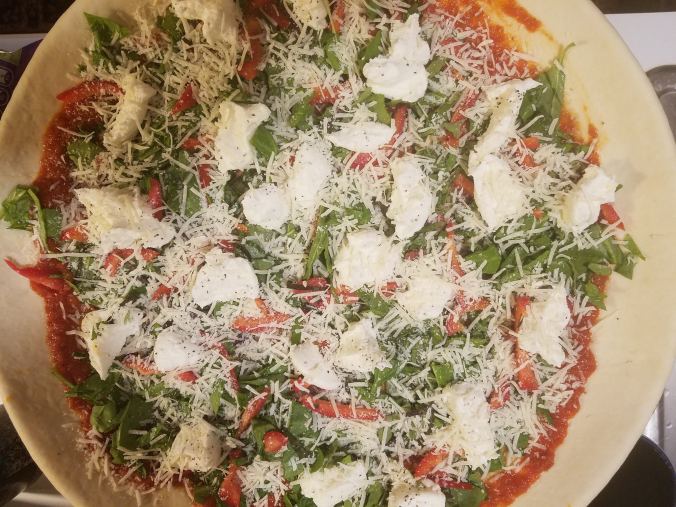
Next came the salt and pepper and parmesan.

2.jpg

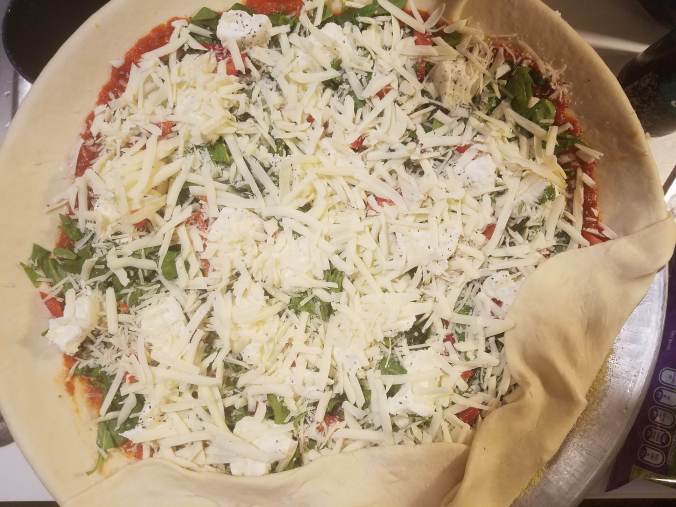
Then the grated asiago. I began flipping the sides up. This is the part that reminds me of a galette. Wherever it lands, it lands. After it’s done, the whole thing is fabulous, but the part encased in the dough all around the edges is extra fabulous. But I am getting ahead of myself. And I know I’m being terribly UN-EXACT this time. So sorry. Been away. Hungry. Slacker!

3.jpg

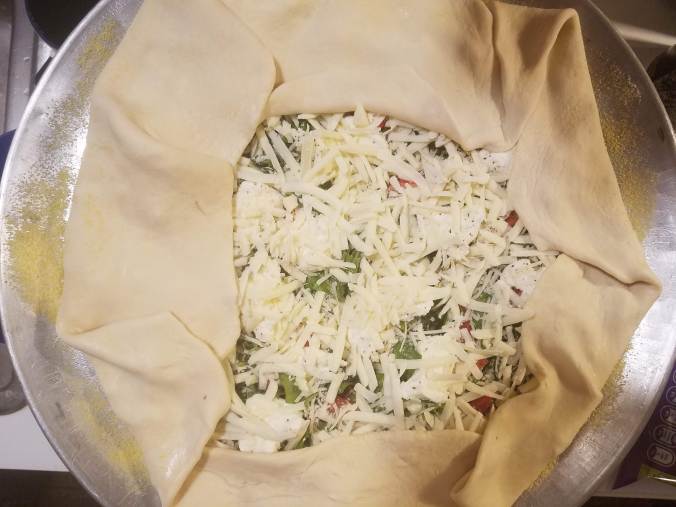
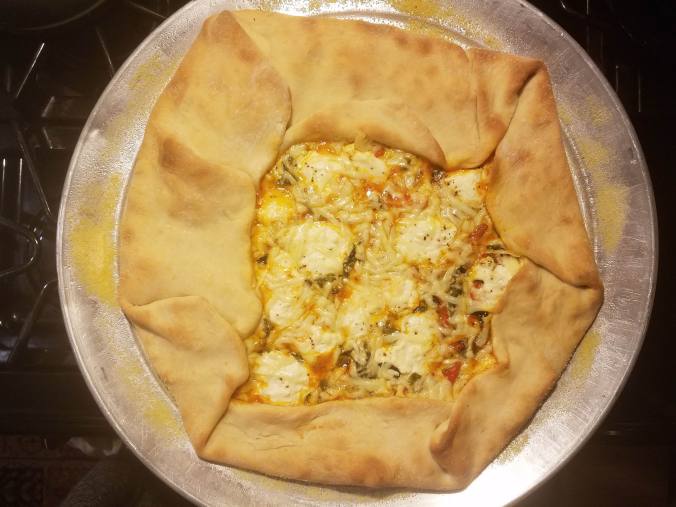
When all the sides are flipped up, it looked like this.

4.jpg

And when it has cooked until it’s almost done, it looks like this.

cooked 1.jpg

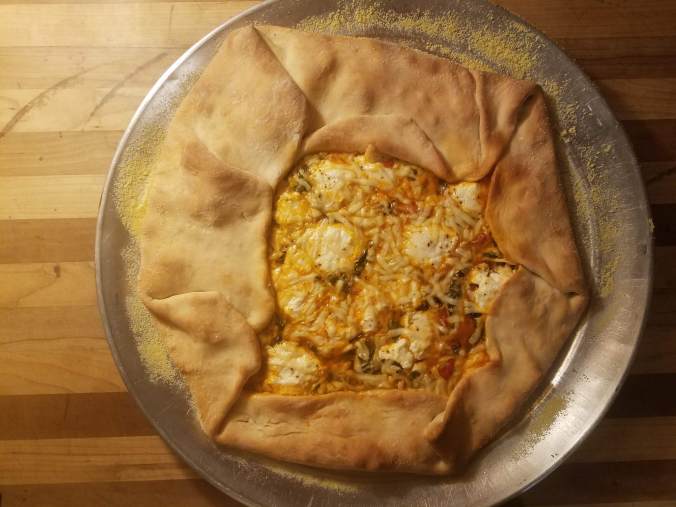
I like mine a little darker and the bottom crust a little crisper, so I slid it off the pan right onto the oven rack and in five more minutes ended up with this.

cooked 2.jpg

Seems to be a combination of pizza, Stromboli, calzone, lasagna and galette.

  • Round, thin crust, creamy cheese on top like a pizza.
  • Crust enveloping cheese like a Stromboli or calzone.
  • Ricotta to remind me of lasagna or calzone.
  • All in a free form that still reminds me of a galette.

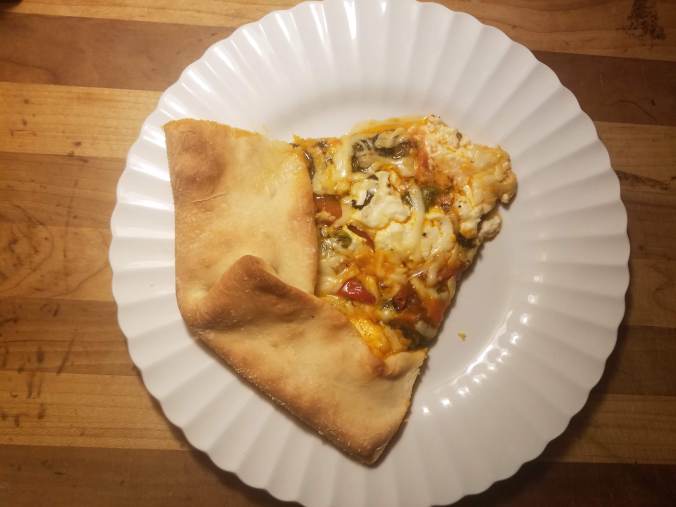
I have no idea what to call this! But it was divine. Note past tense verb was.

piece on a plate.jpg

Botanical Beauties

I never want to see all there is to see or do all there is to do. (Not that I could if I wanted to, but that is another story.) Don’t get me wrong, I want to see a lot, do a lot, fill my world with fun, challenging, delightful, worthwhile, interesting amazing and beautiful things and activities. I want to use every moment I can wisely because you never know what’s around the next bend.

But if I could see it all and do it all, what would be left? In my world, there’s something new every day. The reason for this seems clear: Otherwise I might cease to be astounded at the diversity and majesty of the natural world around me as well as the artistry and cleverness of my fellow humans. Standing in awe at the wonder of creation or the ingenuity of people keeps me on my toes, which is one way to keep things unboring.

Yesterday, for instance, a quick walk through the botanical gardens here in Washington, D.C., included lots of green, lots of spikes, lots of color. None of that is what struck me first though. As you walk in the door, the very air embraces you, tells you a story, encourages you to keep moving forward. It both feels and smells fresh, sweet and in its own way intoxicating. I kept going.

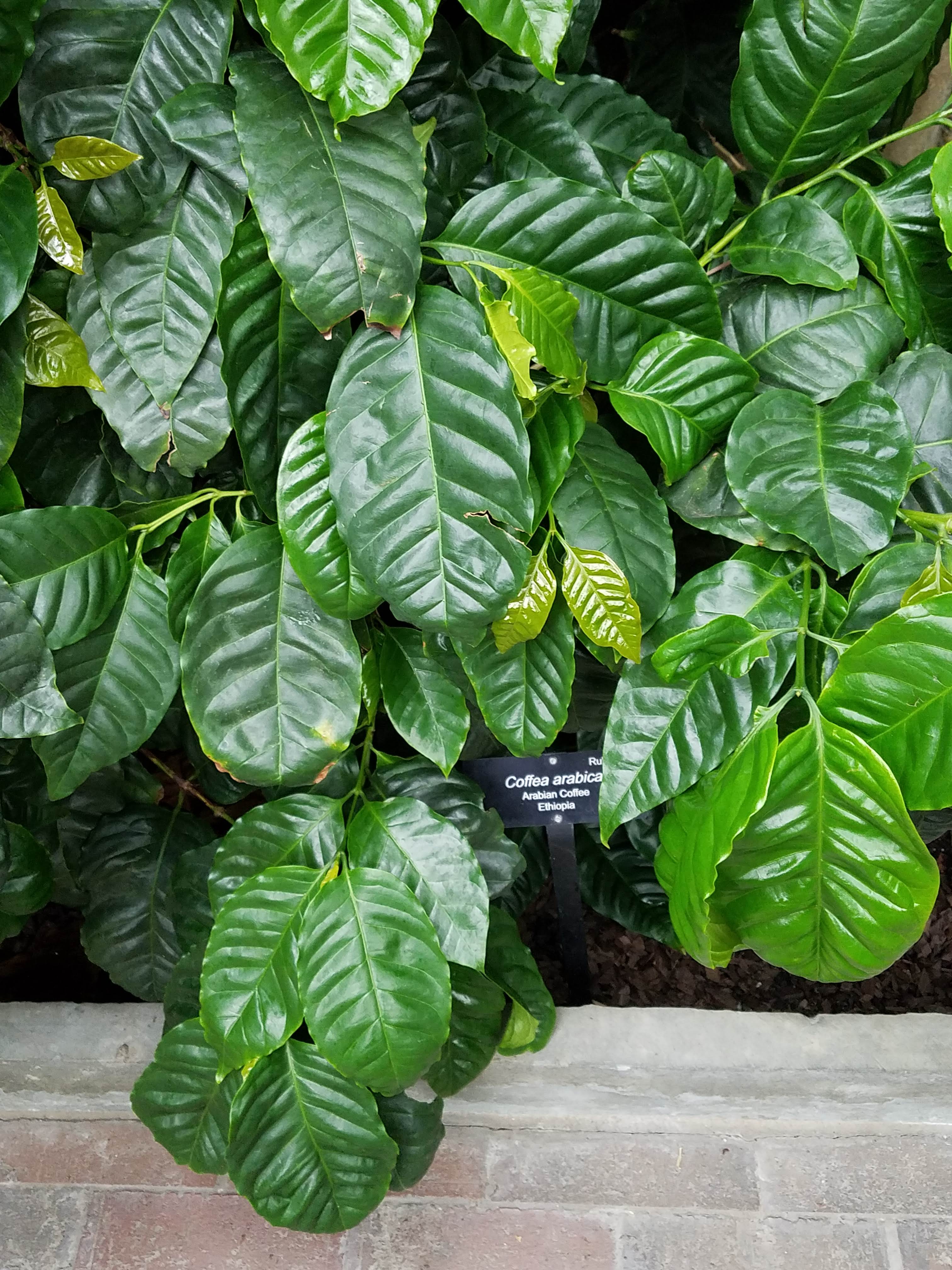
Maybe you have seen how coffee grows, how shiny green its leaves are, but I hadn’t. They might be plastic for as perfect as they looked to me. The staff added those few broken brown edges just to make it look real, right?

coffee plastic.jpg


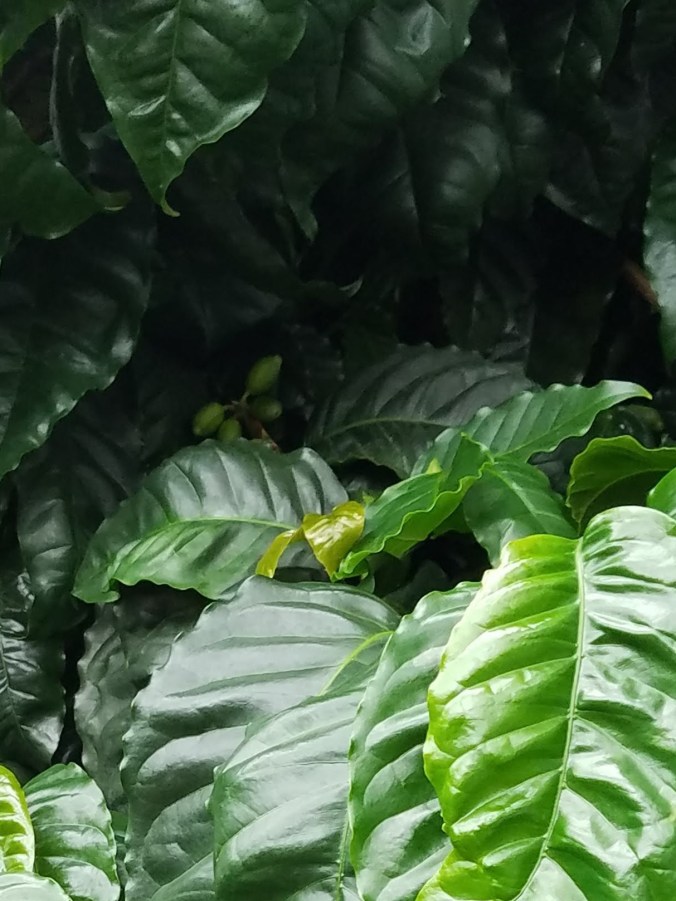
The beans seem to like to hide. Shy maybe? Hoping to escape detection? See them in there?

coffee beans (2).jpg

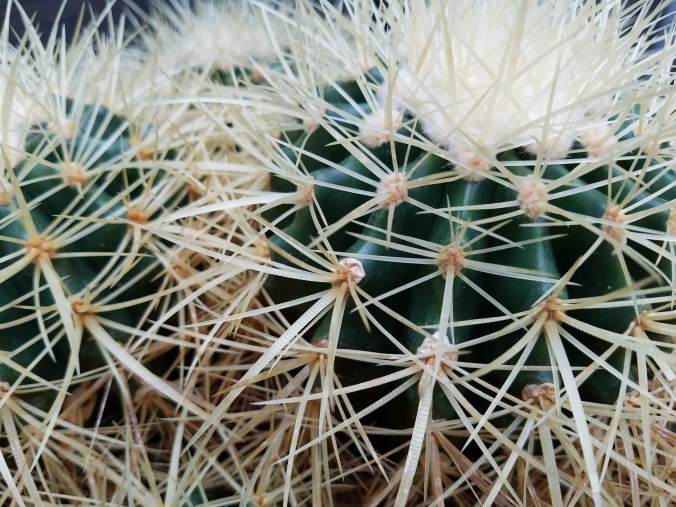
Some of these plants have a very effective way of protecting themselves. Don’t even think of touching me! says the cactus to anyone or anything that comes by. We get the message!

cactus up close.jpg


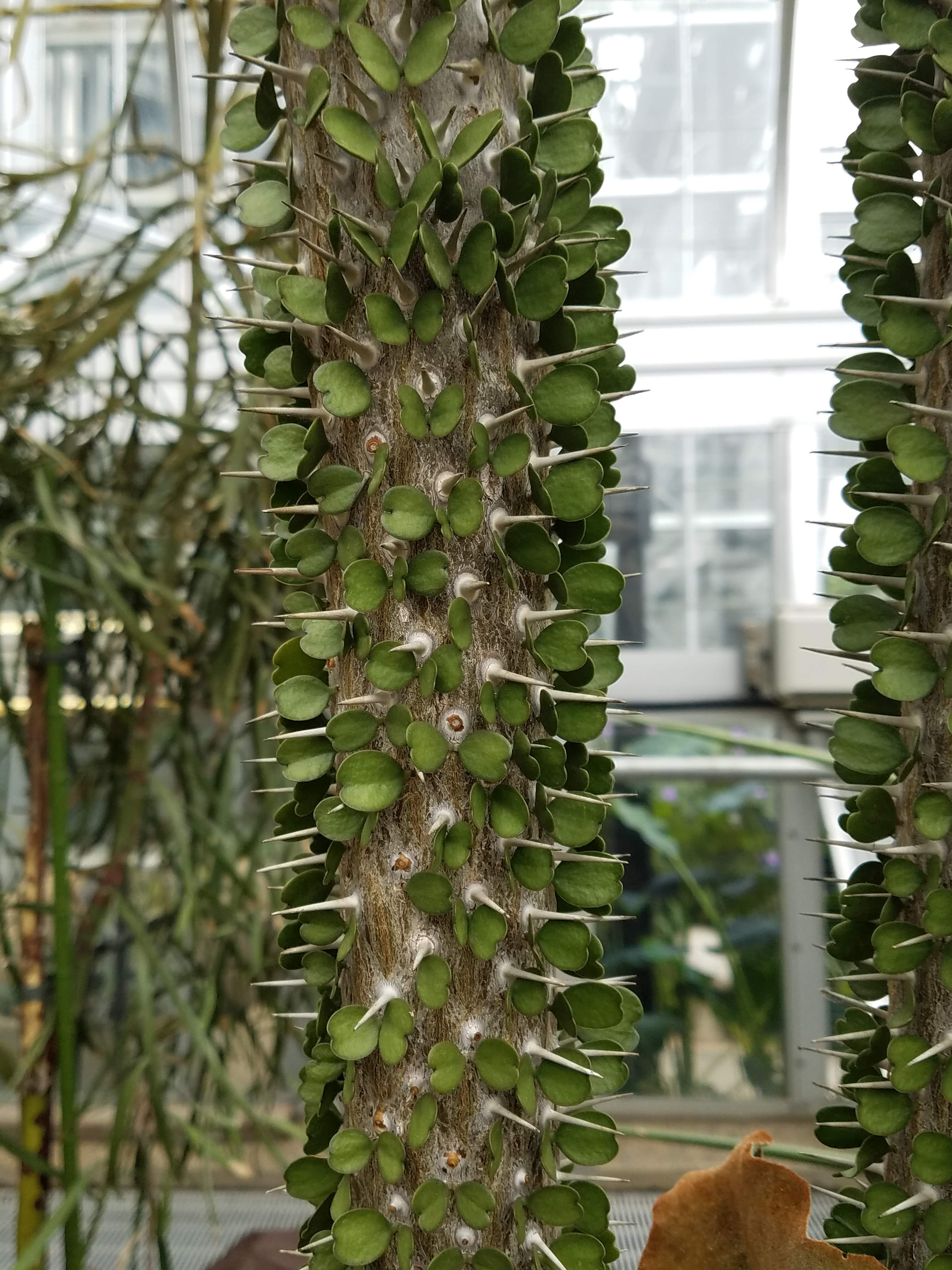
Some plants are aptly named. Botanists sometimes get the fun of assigning a name. Do you think this name works? It’s the “devil’s dagger.” The little heart-shaped green parts looking remarkably like harmless leaves are a bit misleading. They say You know you want to touch me, while the spikes are waiting patiently, in just as plain sight, for you to try it. Just try it!

devil's dagger2.jpg


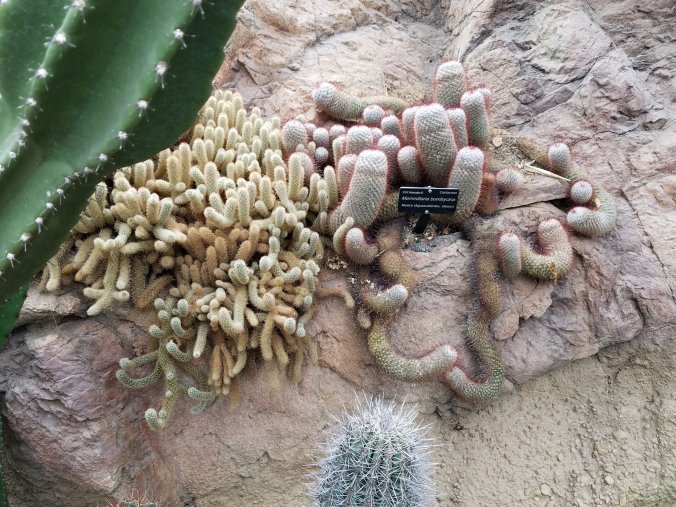
Whoever named these little babies clearly did not have a sense of humor, so I am choosing to call them “sausage cactus.” What would you call them?

sausage cactus.jpg

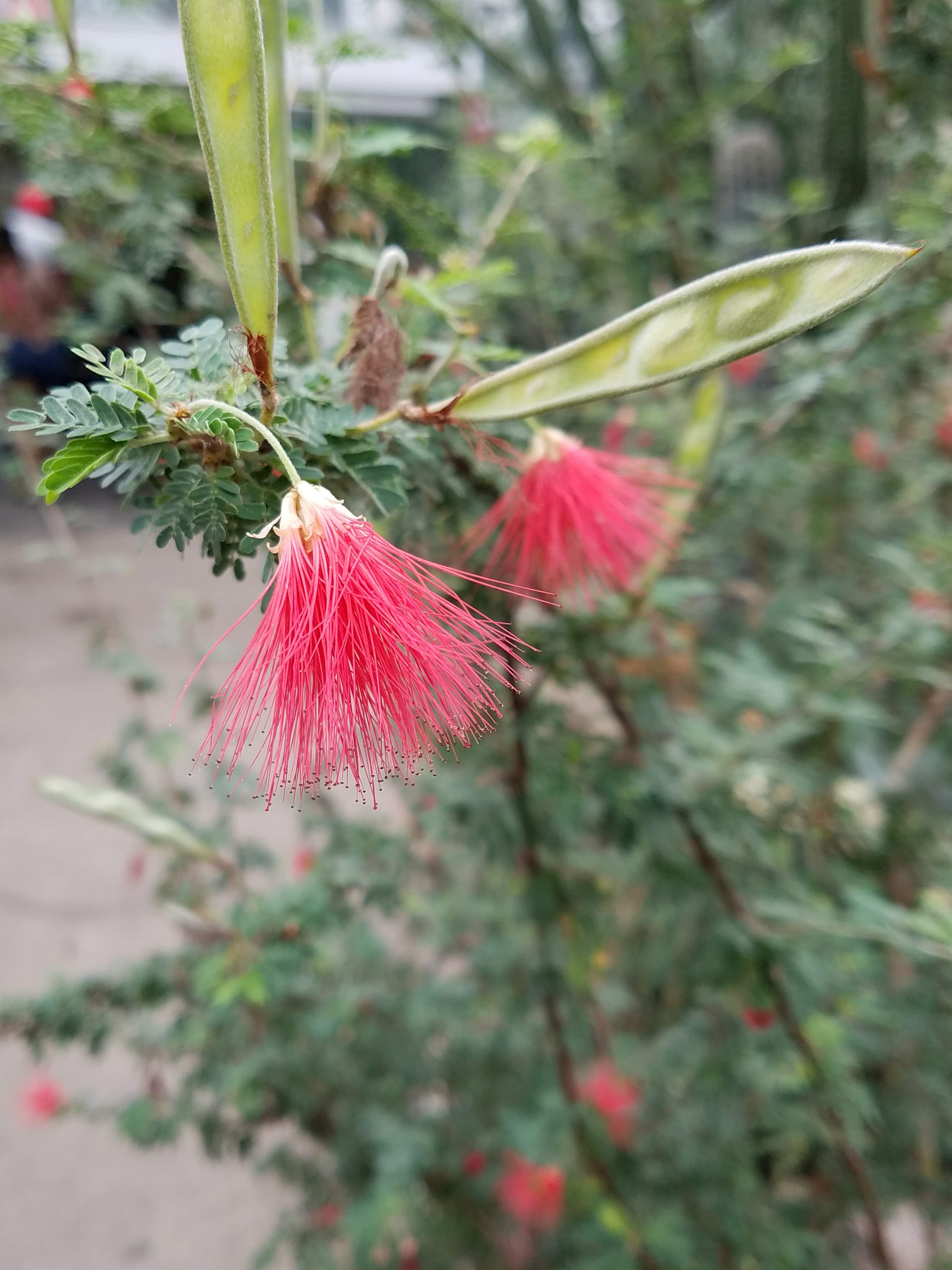
I did not see a name for these beauties, but a fairy who is bent on housekeeping would surely carry one around as she goes flitting from crystal to crystal on your undoubtedly gorgeous but unfortunately dusty chandelier, happily revealing the splendor under the dust with her “fairy duster.”

fairy dusters.jpg

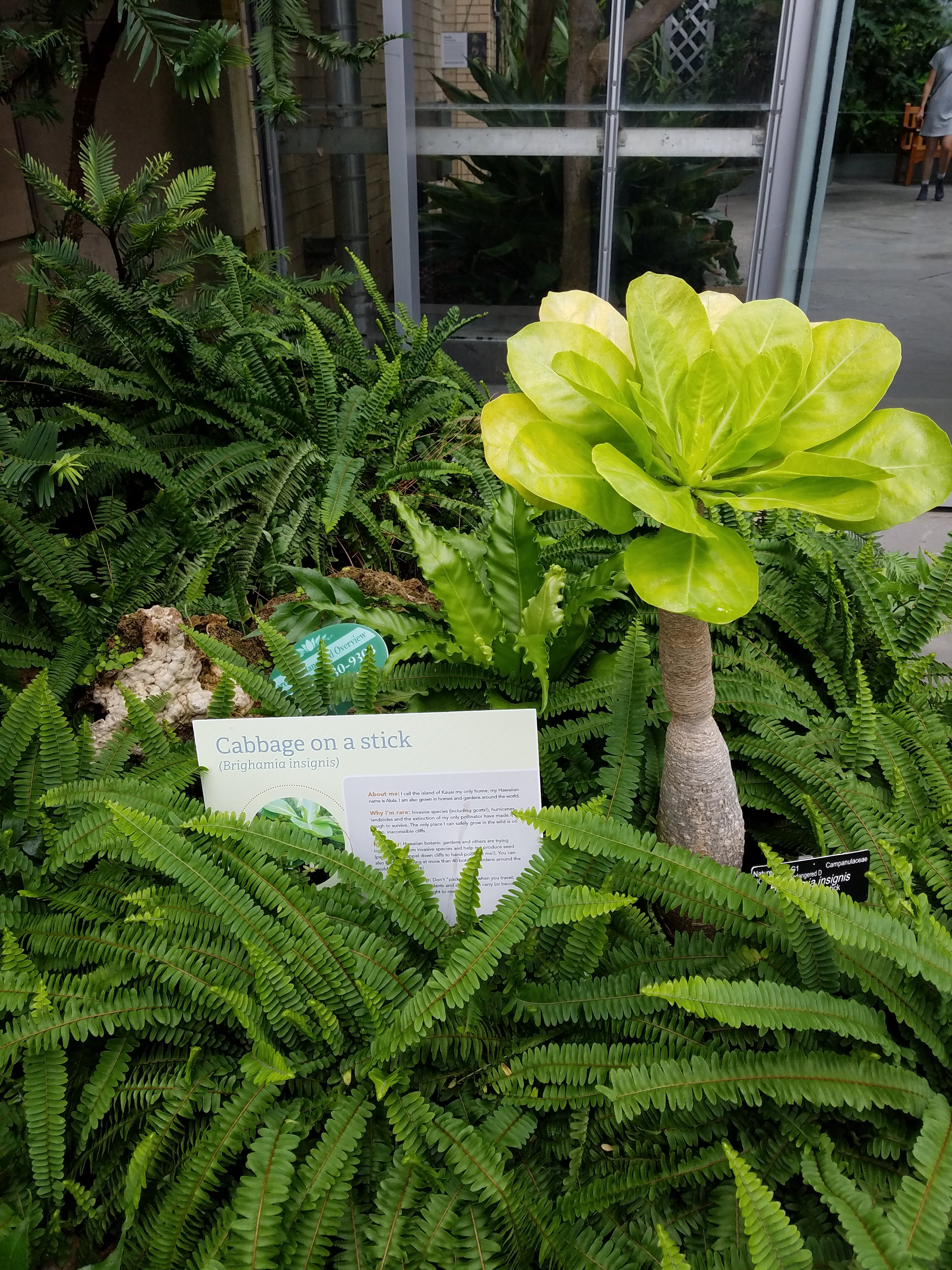
And who could look at the Cabbage on a Stick without wondering who had the fun of naming it?

cabbage on a stick.jpg

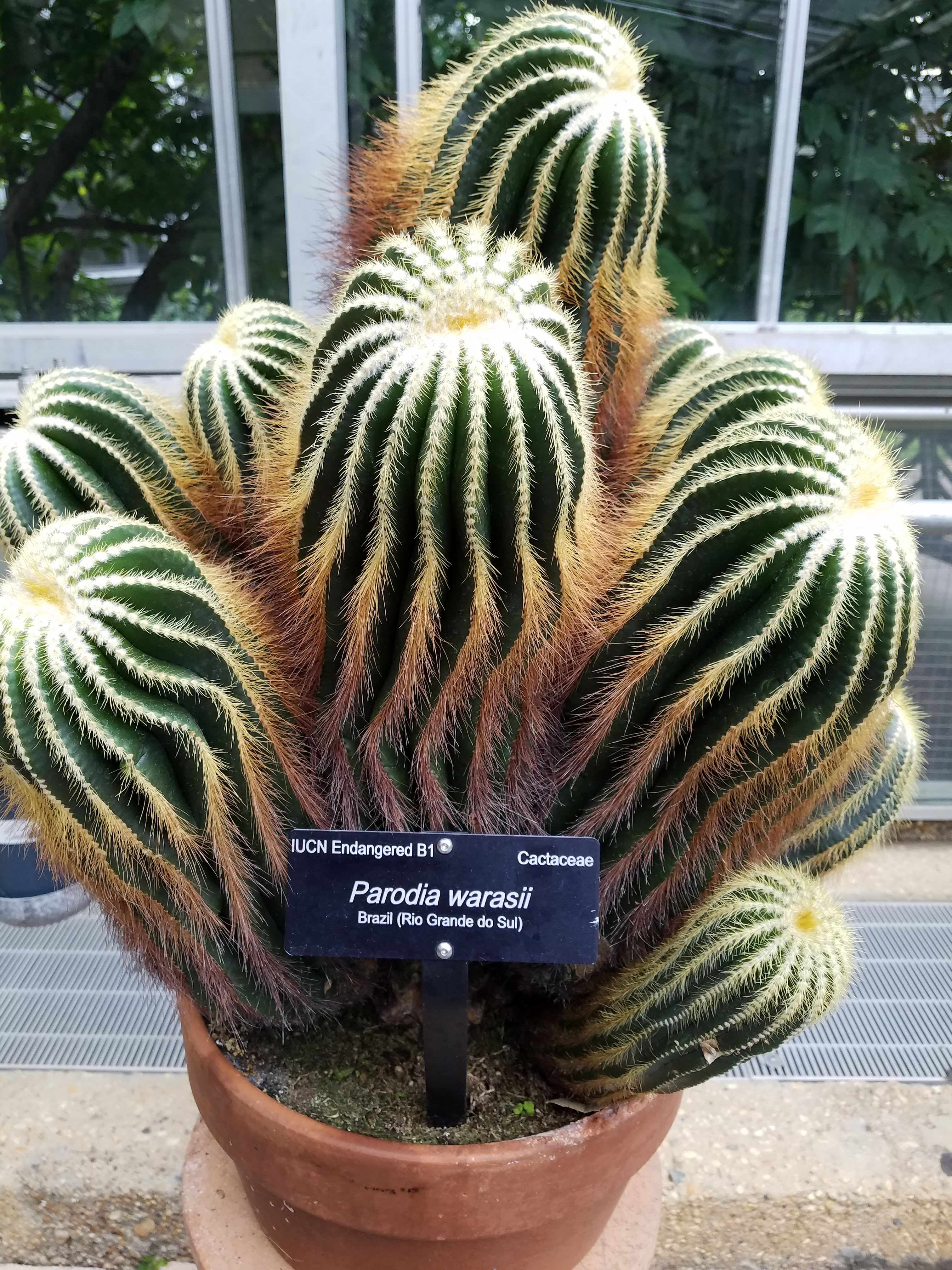
Here’s another great name: parodia warasii. It looks healthy, wispy – don’t those hair-like things look wispy? soft even? It’s very interesting and, yeah… don’t come any closer.

parodia warasii.jpg

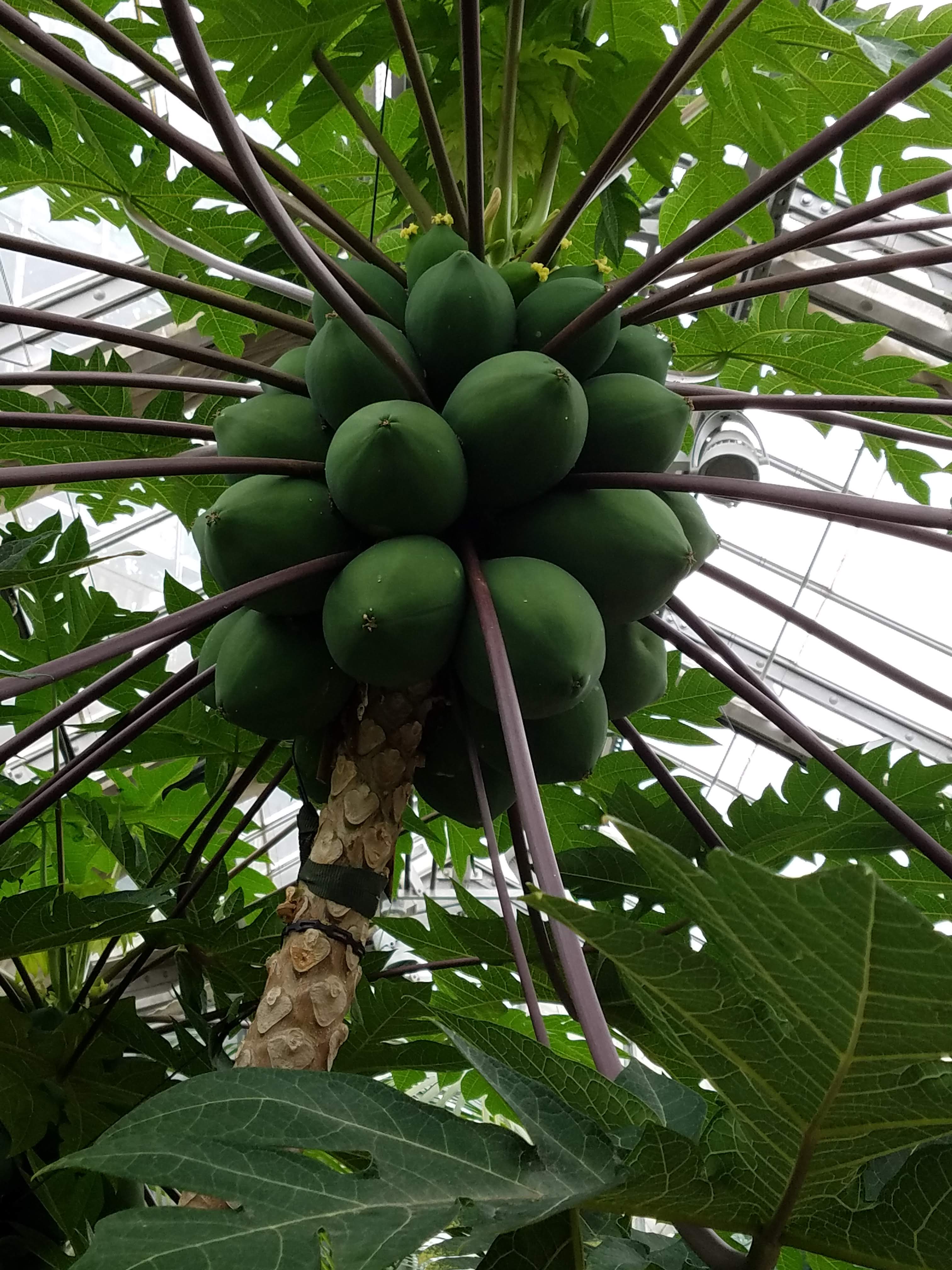
It’s great to see where fruits come from. My education today included papayas. Who knew they look like this when they’re growing on a tree? I admit I didn’t.

papaya2.jpg

This handful of plants is but a drop in the bucket (or a drop in the ocean!) of what’s out there in this marvelous world of ours. Knowing that, taking a moment to grasp the enormity of that, makes me happy to be a part of it, even if my part is just looking and not touching!

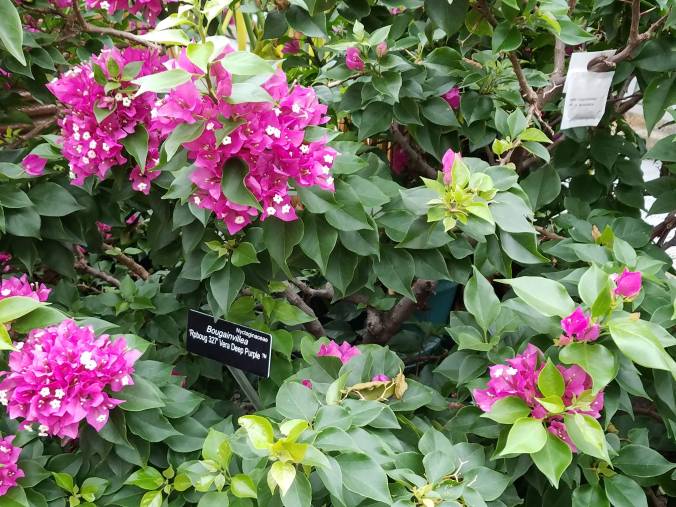
One more — bougainvillea. How beautiful is this?? And who can’t love a plant with a name that rolls off the tongue like boo-gan-viya?

bougainvillea


Unnecessary (Silly!) Things

I was raised in a serious household. We worked hard, got things done, met our goals via the quickest route possible. There was no stopping to smell the roses, shooting the breeze with neighbors or getting in the car with no destination in mind. Something was wrong with a day if you had nothing to show for it.

I do not take issue with people being industrious and productive. Money doesn’t grow on trees, as they say, and generally you get money when you work. Then, not only do you get the things you need (and a few things that you just plain want), you develop a sense of accomplishment, of contributing to the world around you in a positive way, of earning your keep. Walking downtown the other day, I heard some people hanging out in the park (same people who hang out in the park every day), complaining, yelling, insulting one another. I hurried on, thinking they have nothing to do! If only they had something valuable or interesting or important to do!

A classical statue depicting Diligence, the (one of seven) heavenly virtue that represents the “drive to steadfastly move forward with one’s means,” shows a woman holding a whip and spurs. (The fact that a woman is holding them, not a man, is an interesting point all by itself, but outside my scope for today. We might come back to that…) I am all for people showing up for work, keeping the lights on and the wheels of community turning.

But anything taken to an extreme is no good. I even heard (though bear in mind that this could be one of those things you hear that has zero validity) that you can even take the “Drink lots of water” advice too far, that you can kill yourself drinking too much water. Fact check required here, but point here being, All work and no play makes Jack a dull boy. Isn’t that how it goes?

I don’t remember laughter at the dinner table when I was a kid. Or anywhere at home for that matter. There was a time when I remember thinking I had never seen my father’s teeth – as in he didn’t smile or laugh enough for us to see his teeth! If something funny happened, his expression moved in the direction of chuckling, no doubt about that, but actual, audible laughing-out-loud, no. I don’t mean this as a criticism of my father – he was ultra-industrious, as was his prerogative, and surely laughed sometimes. I just didn’t see it.

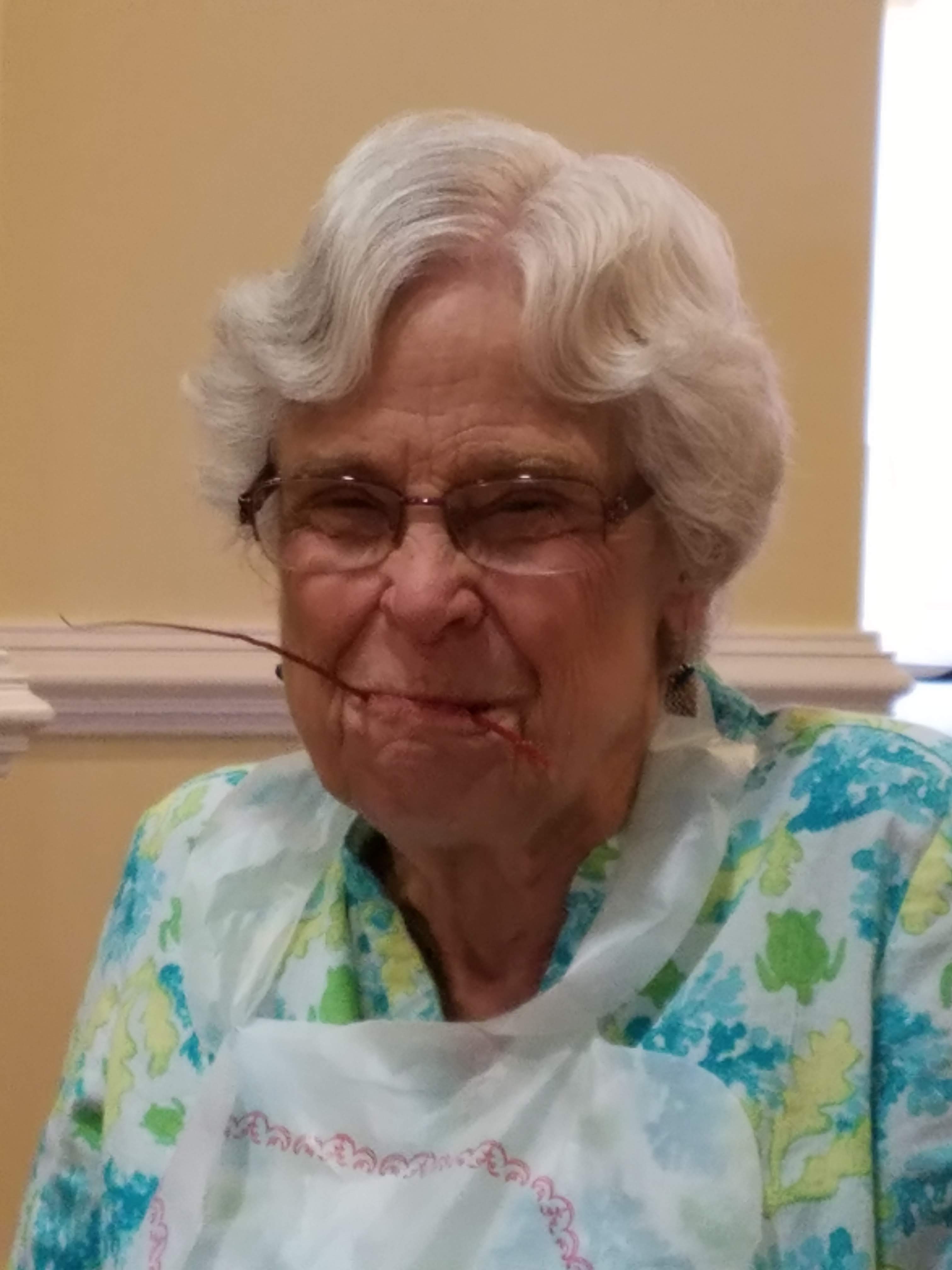
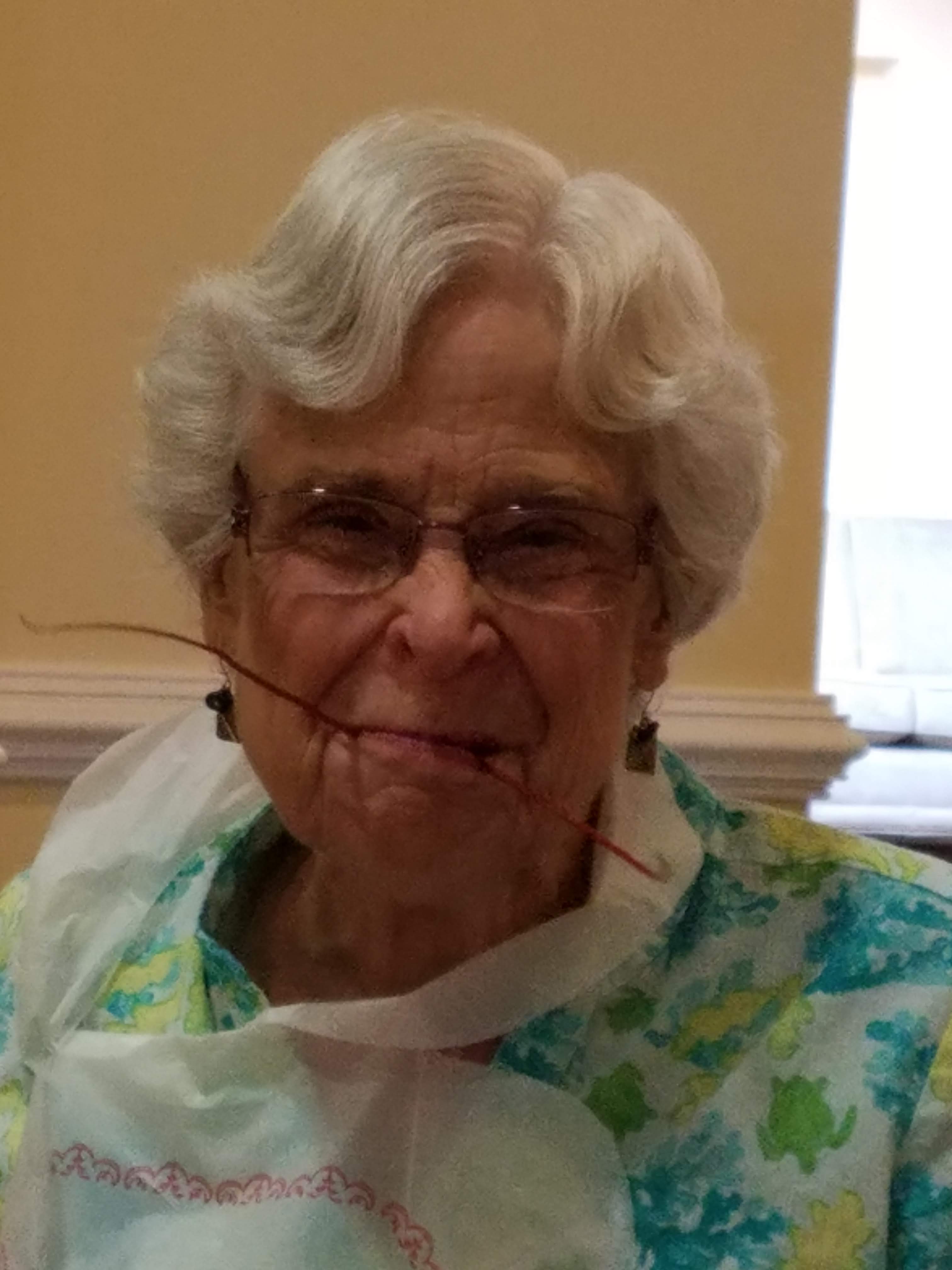
But laughter, silliness, childishness – these thongs (oops, things!) came along later for me, and I am so glad they did! They came along for my mom too, who could hardly do anything more out of character than pretending to be a lobster while wearing a plastic bib in (this is the kicker) a dining room filled with lots of people!

mom whiskers1.jpg

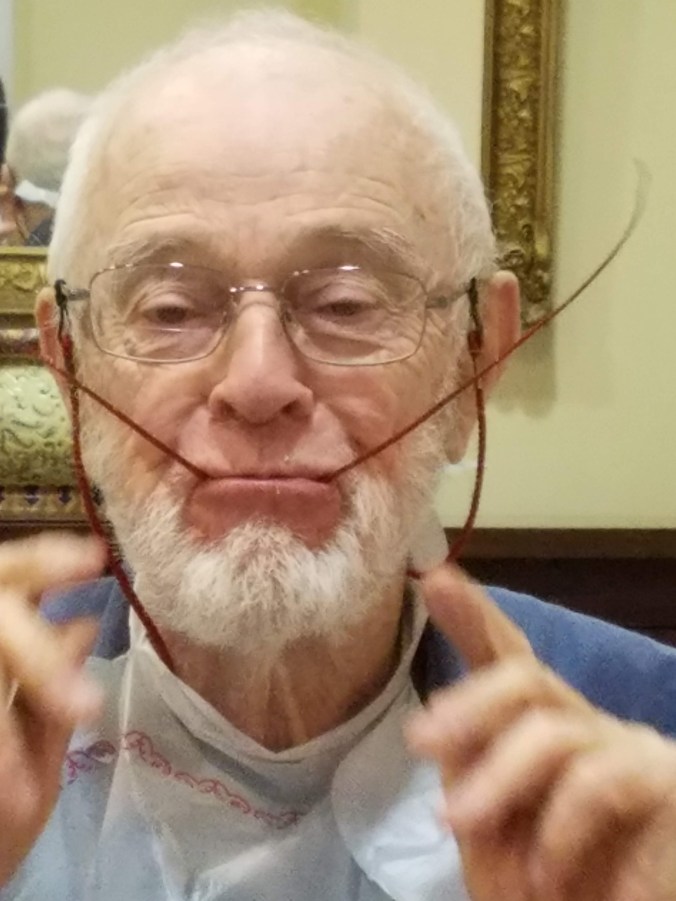
Can’t you just hear some old marm saying Barbara, that’s unnecessary! Stop being so silly! I’m sure she heard those words in her head, but silliness won the day! Granted, she had a good model. Jerry did not need any encouragement, in fact he started the whole thing.

Jerry whiskers4 (2).jpg

On the heels of this, my tennis buddy Scott did a most unnecessary thing on his paddleboard on Labor Day – a headstand!

Scott Newman headstand (2).jpeg

None of us needs to do a headstand on a paddleboard (!) or insert lobster antennae in our mouths like whiskers,

or be tomato-heads

tomato-heads.jpg

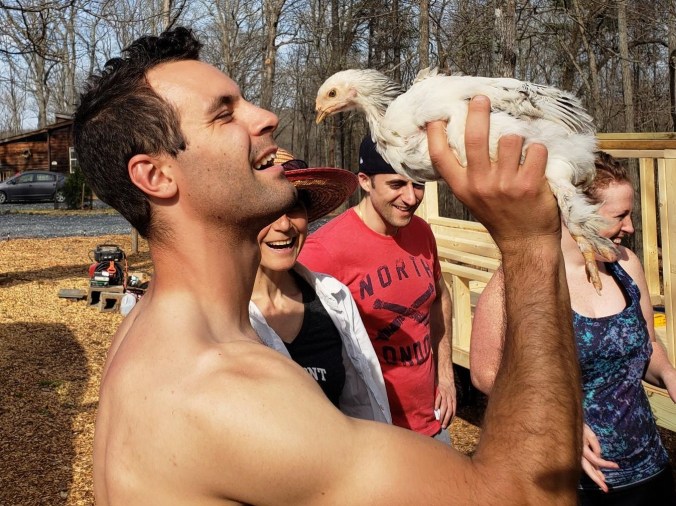
or go face-to-face with ridiculous chickens!

Samuel with chicken (2).jpeg

But we should! We should do all kinds of silly stuff!

My mom with lobster whiskers! My mom laughing so hard she can hardly stand it! Not in my wildest dreams did I envision this moment. I am still giggling just to think of it.  But little makes me happier than seeing that smile on her face 😊

mom whiskers3.jpg

Great Neighbors and The Power of a Tractor

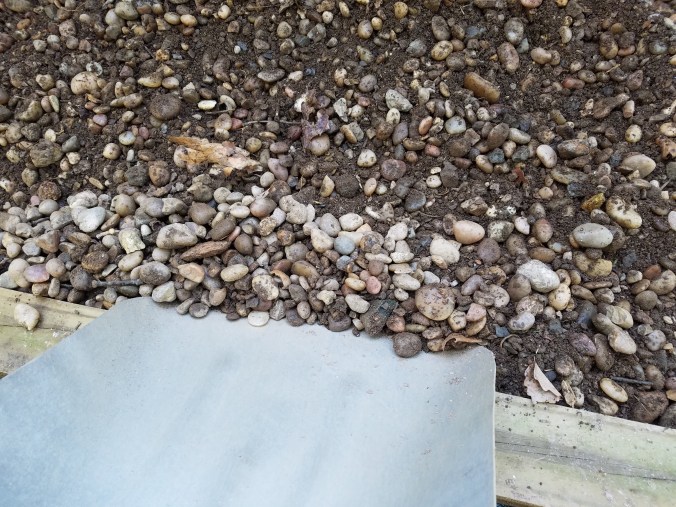
“Have you got a square shovel?” Joe asked.

“I have a snow shovel,” I said.

“As long as it’s not plastic,” he said.

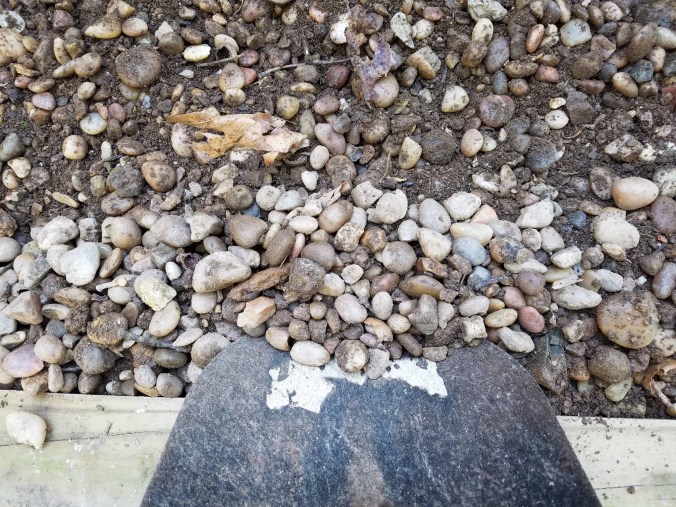
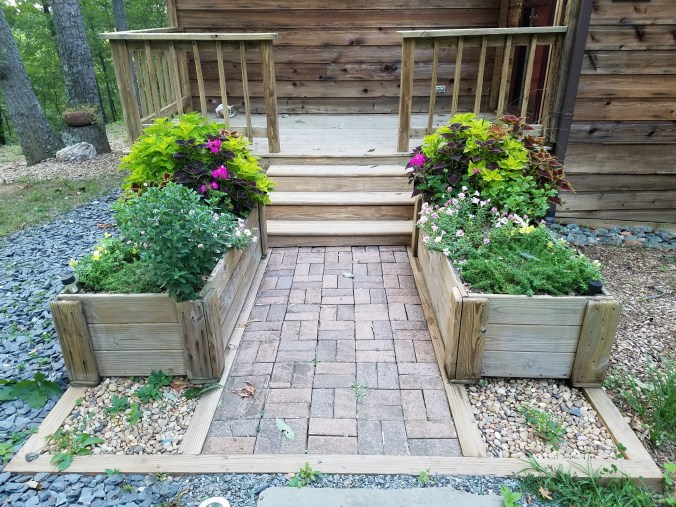
I went to the shed and got the metal snow shovel and brought it to where we were moving the smooth river rock into the bucket of the tractor. The river rock was sitting within an open wooden framework flanking the brick pathway leading to the front porch steps. A square shovel makes it easier to shovel from the inner edge of the frame…

flat shovel.jpg

…while a pointed tip is not so wide and would leave a lot behind.

pointed shovel.jpg

We wanted to move the river rock in order to save it for use some other time. The excavation work soon to happen in this area will erase all traces of river rock, so if you want the rock, move it while you can.

As I walked back to the work site I thought about Laura Ingalls Wilder. Her own “Little House in the Big Woods” was vastly different from mine. Her setting, Wisconsin in the 1870s, was largely unpopulated. Families needed enormous measures of gumption, skill, courage and strength, a portion of luck and at least a few good tools.

I wondered: Did they have a square shovel? I am sure, between building a house in the woods, making their own butter and cheese, harvesting crops, raising, hunting and butchering animals, and fending off a variety of threats to their admirable homestead, they did not have need to move decorative river rock out of preexisting wooden frameworks. But I’ll bet a square shovel would have been handy for some aspect of their operation. More than that, think how different their experience would have been with a good tractor.

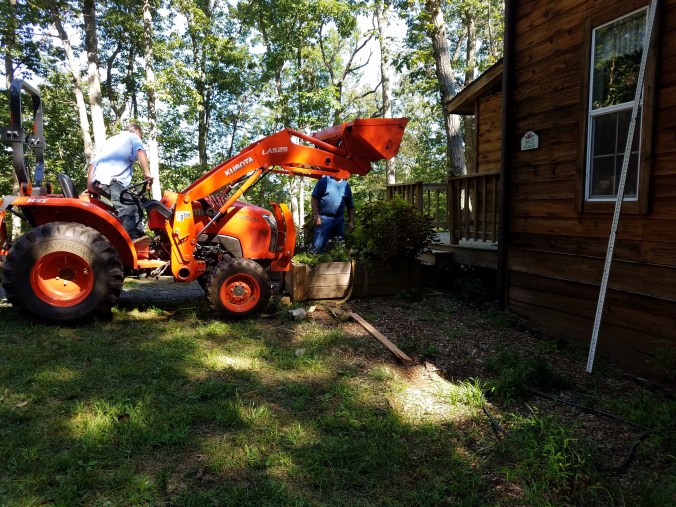
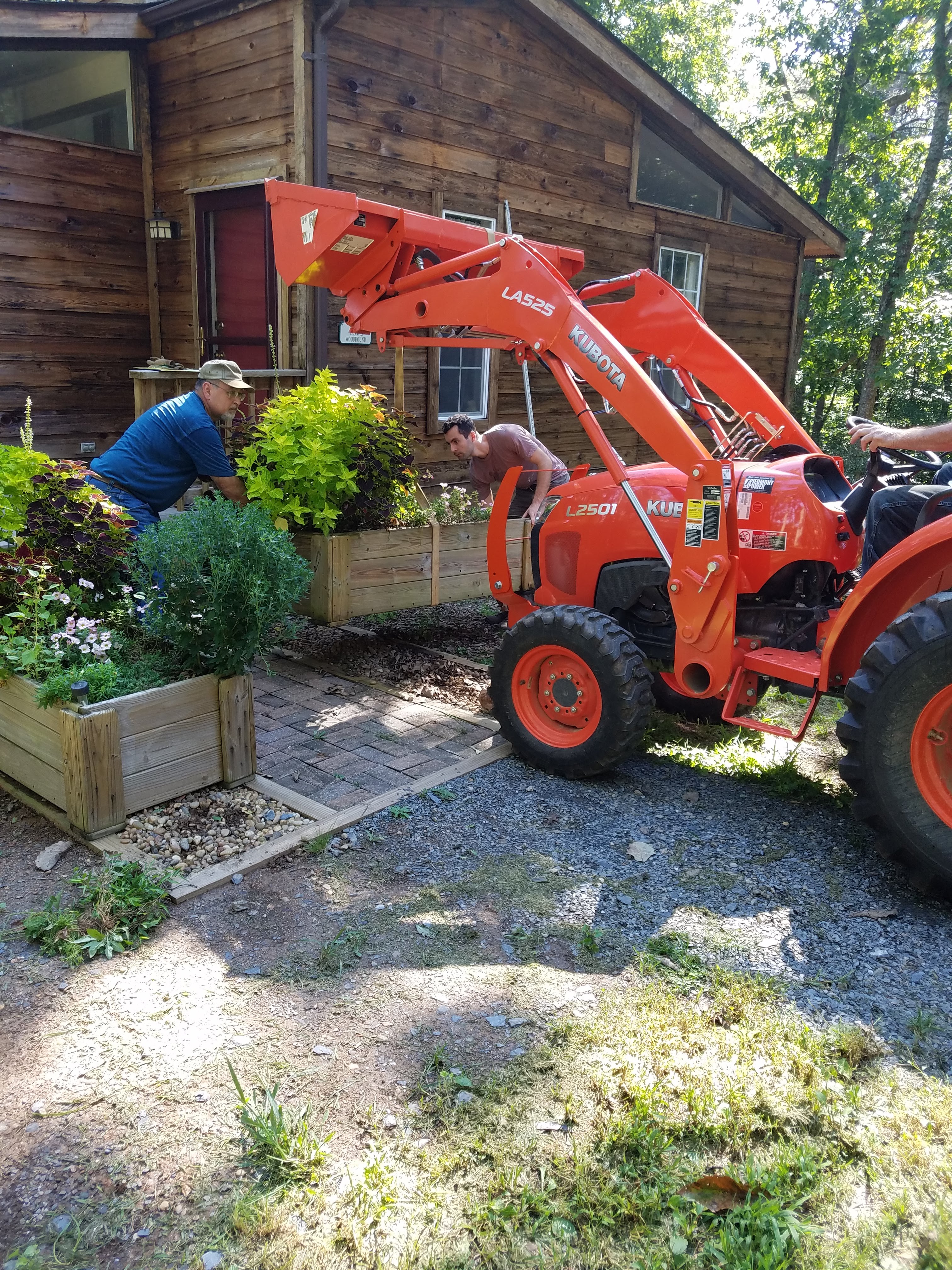
Having the right tools helps so much. It sure helped yesterday. And I don’t mean the snow shovel for the river rock. I mean this Kuboda LA525.

kubodaLA525.jpg

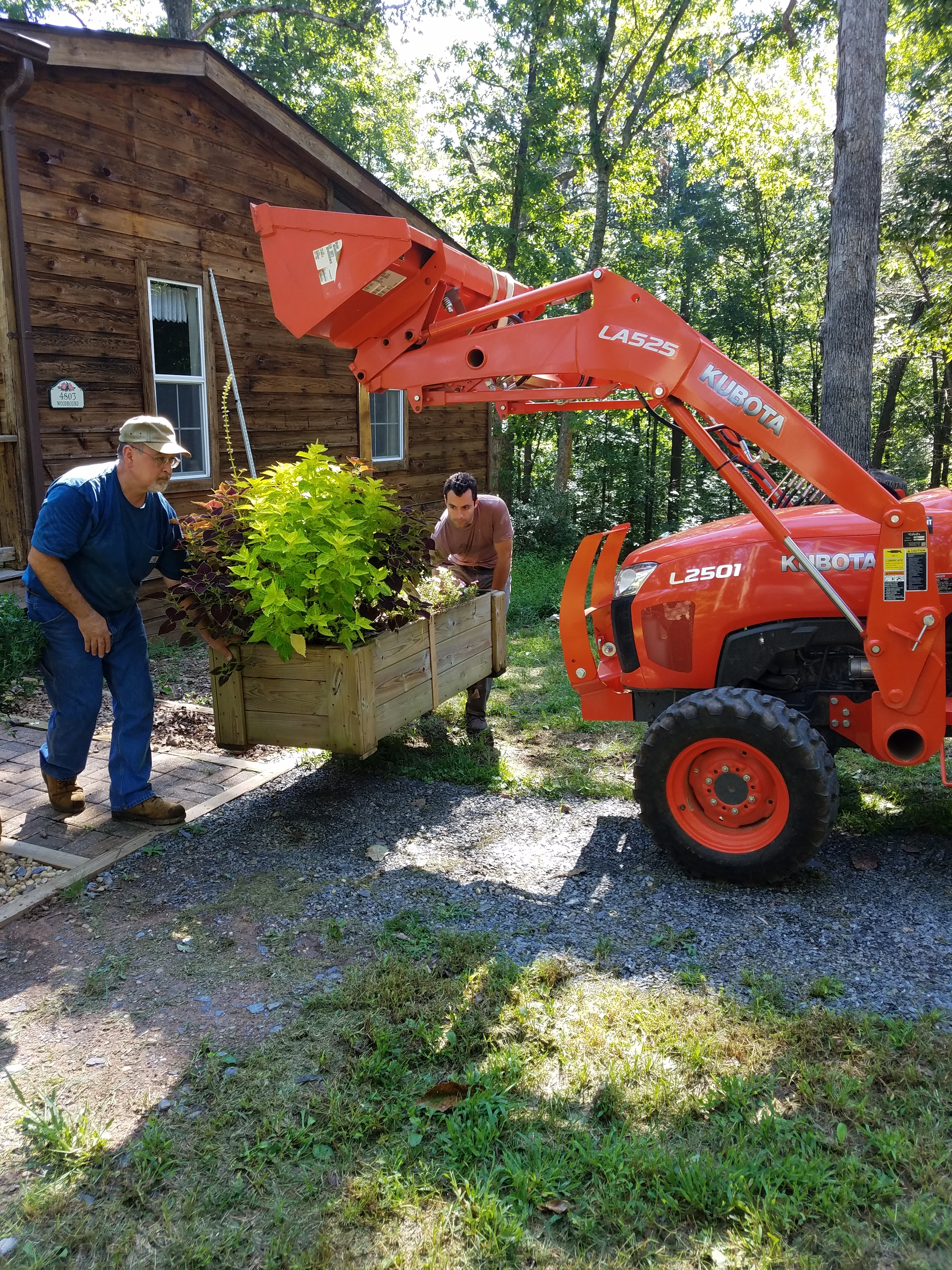
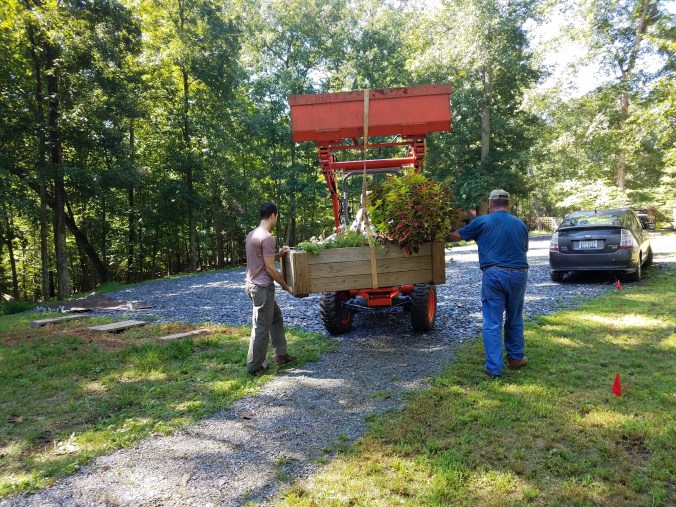
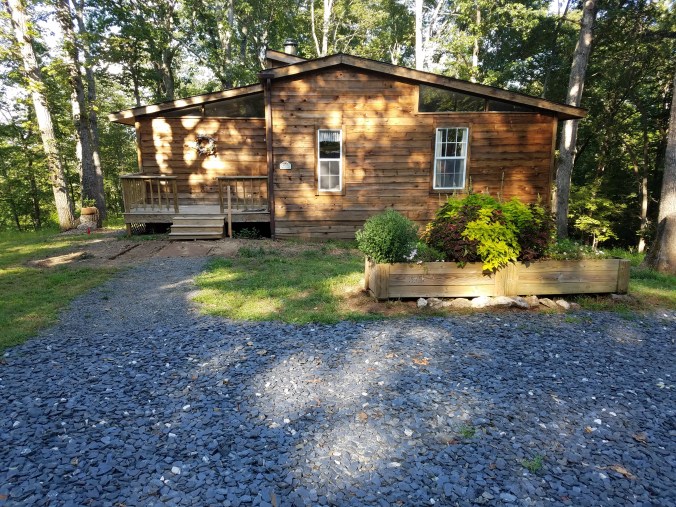
Tracy, my very generous neighbor, gave me two hours of her time along with the use of this beast of hers. Joe, her very capable dad, masterfully orchestrated the relocation of my two planter boxes, each of which has to weigh at least 500 pounds.

coleus.jpg

Together with the help of the beast, these great neighbors did in two hours what would have taken us the whole weekend.

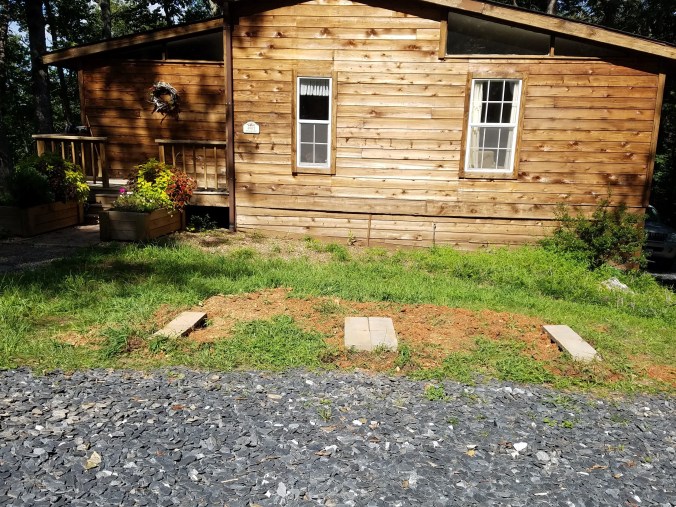
I did the prelim work last week, putting the cinder blocks in place. That’s when it looked like this.

cinderblocks1 (2).jpg

But after that my hands were tied. Earth weighs approximately 100 pounds per cubic foot. These planter boxes are five feet long by about two feet wide and about 18″ high. Granted, the lower half is filled with some empty cans and Styrofoam peanuts just to take up space (coleus, even gigantic ones like mine, don’t need that much dirt). Still, the 100 pounds per cubic foot is just the dirt. The total weight of the boxes also includes the rainwater that soaked that dirt two days ago, the wood itself that the planter box is made of and even the relatively minor weight of the plants themselves.

I don’t own a tractor and had spent a good bit of time considering how we were going to solve the problem of moving these huge and heavy boxes. We might dig the plants and most of the dirt out of them, then drag each box or walk it one angled step at a time, a few inches at a time, to the concrete blocks. Or use a furniture dolly. Sooner or later we would have moved them. But oh, the joy of a machine with this kind of power!

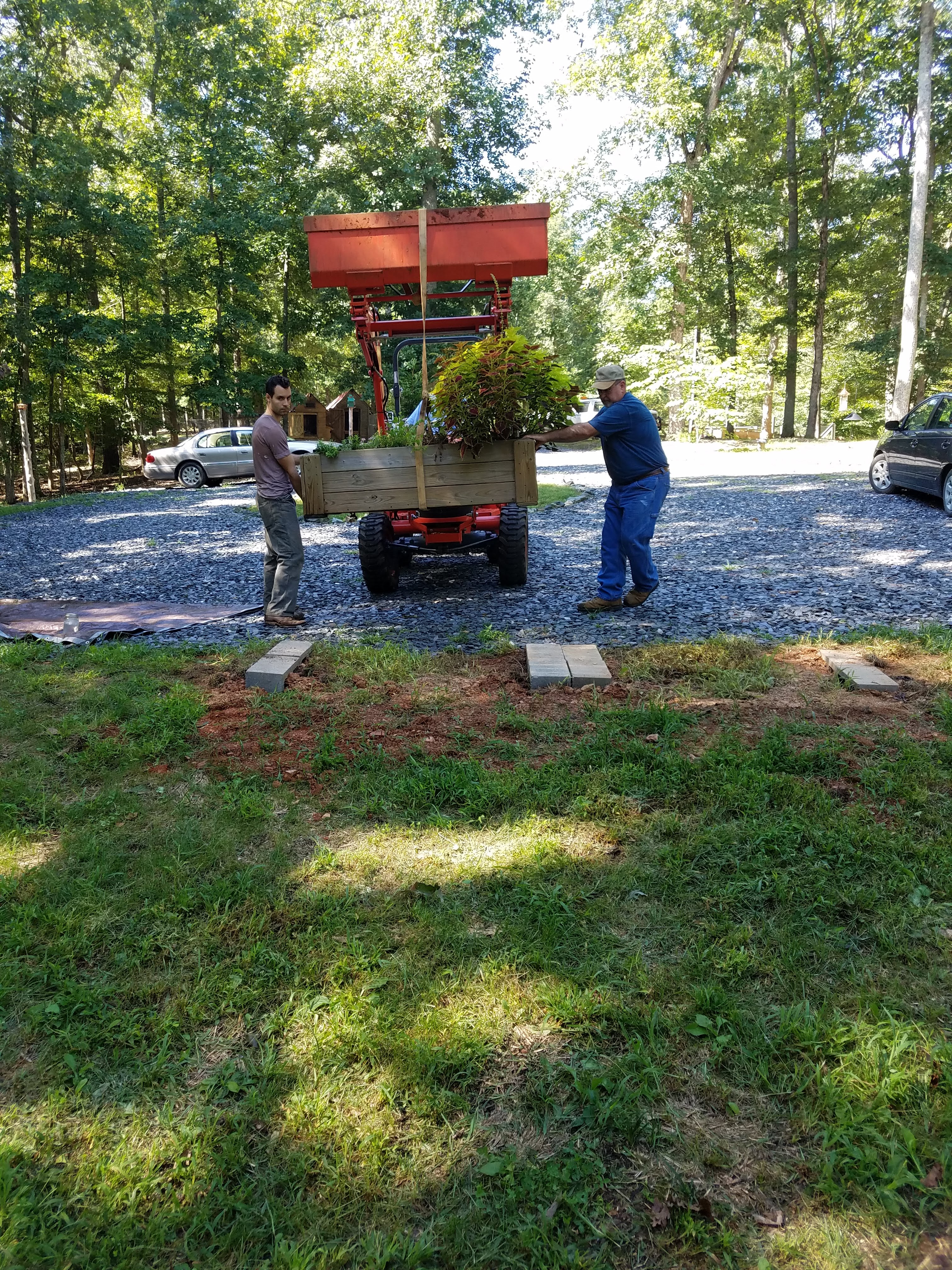
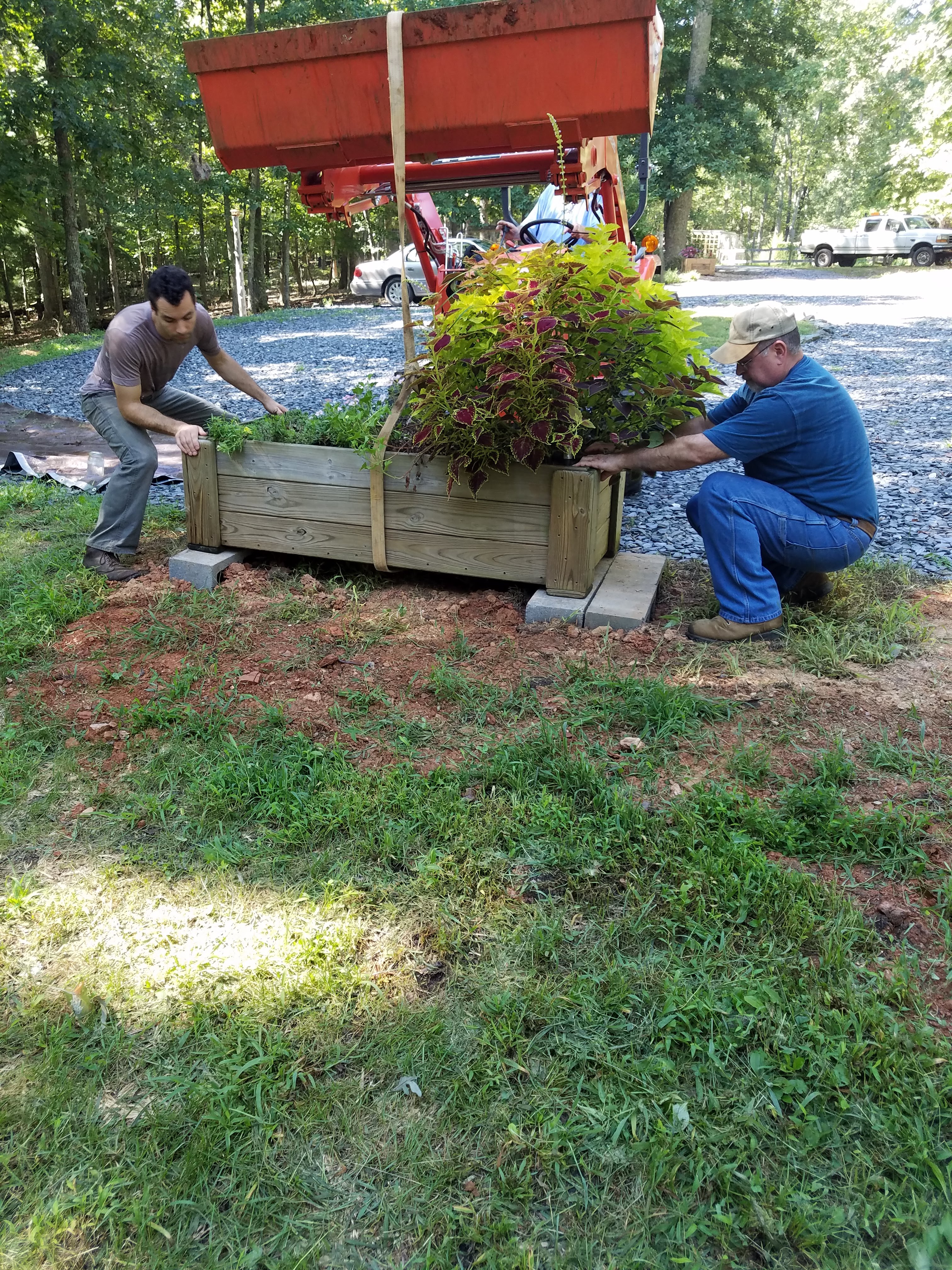
Watch what it can do. With just that strap around the middle, Joe at the wheel, and Samuel and Sandy to keep it from tipping one way or the other, the box went off the ground. They pivoted it,

pivoted.jpg

Joe backed up,

keeping her steady.jpg

they kept her steady,

keeping steady2.jpg

they moved toward the landing pad,

keeping 3.jpg

and he lowered her into position.

down.jpg

The second box was just as simple except for my landing pad not being as level as I thought it was. (Least said about that, the better!)

boxes moved3.jpg

It’s an amazing machine, but more important to me, it was a great team effort, the kind of thing you wonder about sometimes: Is it real? Do neighbors help each other like that?

They did yesterday! They do!

This is community, people coming together to make a hard thing easier. This is the way it’s supposed to be – not to say it always is, but it should be. In the 1870s in the big woods of Wisconsin, pioneers pooled their strengths and resources as well. Wilder’s book includes heartwarming examples of her father trading labor with their neighbors. Yesterday my own heart was warmed as I witnessed amazing labor on Labor Day.

Everyone can do their bit – any day of the year – to perpetuate good, to lend a hand, to make their own corner of the world a better place than it might otherwise be. The best vitamin for making friends is B1, right? Same applies to having good neighbors, I’m sure.

Mario’s Yam Soup

Yams were $0.79/pound yesterday in my grocery store, which must mean that they are coming into season. And now it’s September (how can this be!?). As soon as the air is a little cooler at night and you start to see the leaves turning color or falling – here and there they are doing that already in Virginia! – it’s time to think about the fall recipes.

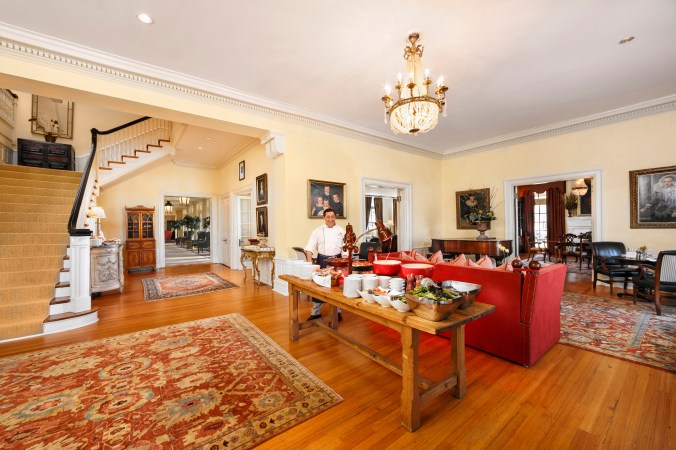
Yam soup is one of my favorites. I first had it a few years ago when Mario, the “Villa Lunch” chef at the hotel where I worked, included it in his buffet. This is Mario in his glory. It was a nice hotel.

villa_crawford_mario.jpg

Unlike most cooks, Mario was out on the floor daily. He made all the food for Villa Lunch starting at 7am, then came upstairs with it at noon and personally sliced the meat and spooned the sides onto the plates of very happy guests. He is talented, personable, kind and funny – absolutely perfect for this job. He often made up a plate for me as he was breaking down the buffet table around 2pm. It would include whatever I wanted from that day’s items, quite a nice perk! He knows how much the guests loved him from the stack of comment cards collected over the years that sing his praises. I hope he takes those out of his desk and reads them now and then.

Mario’s yam soup was a guest favorite – out-of-this-world flavor, but so simple. If you were preparing lunch for 40-50 people every day including a soup, a salad, a main dish (and associated sauce or accompaniment) and two hot sides, various cold salads and a cheese and charcuterie board, and you had a total of five hours to get everything ready, you would keep it simple too.

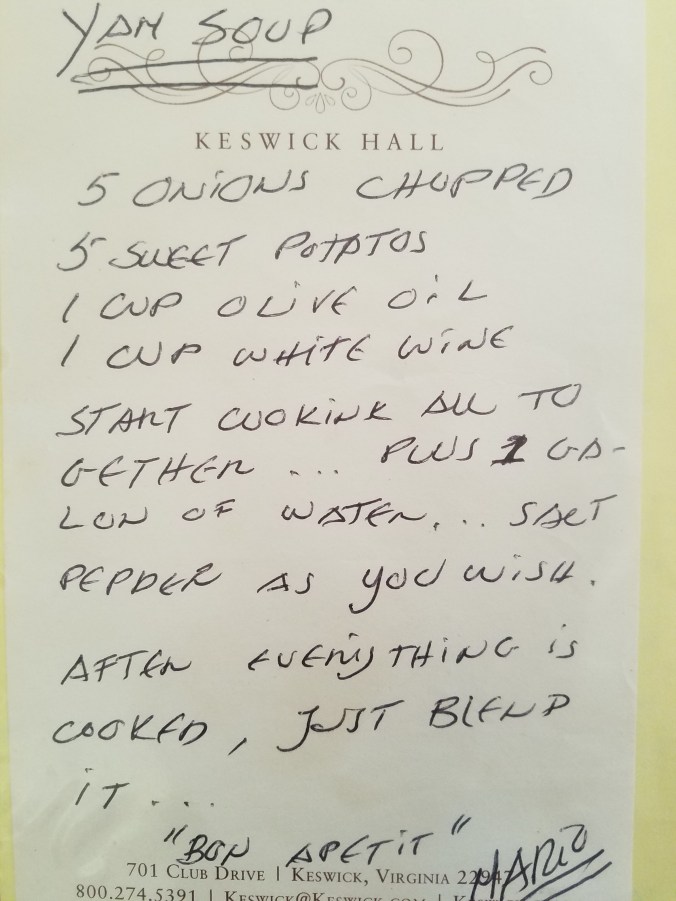
I posted this recipe on July 19 (in The Cookbook Comes Out). Here it is again. Now’s the time to make it.

Mario's yam soup

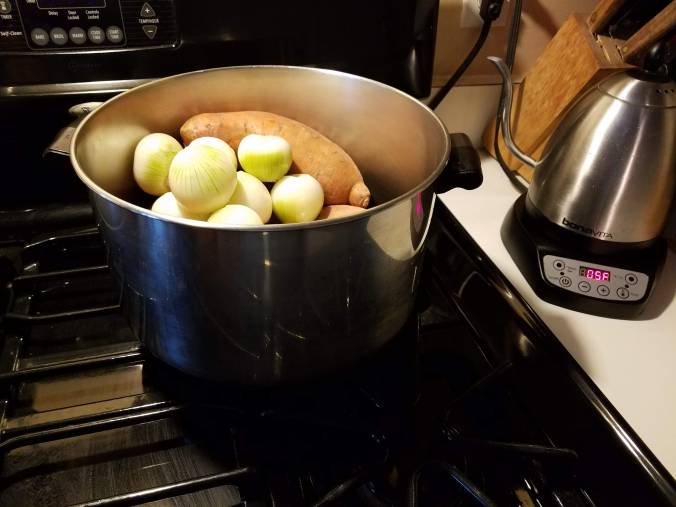
You might want to divide all the ingredients in half (and if you want to use three yams instead of two and a half, it won’t hurt anything). This recipe as it is makes a lot of soup. It freezes very well and I have always made it in this quantity, but you need a big pot. A really big pot. To get an idea if my regular Dutch oven would be big enough, I put the yams and onions in it, whole, and then tried to imagine having to add the oil, wine and a gallon of water. I don’t think so.

onions and yams in pot2.jpg

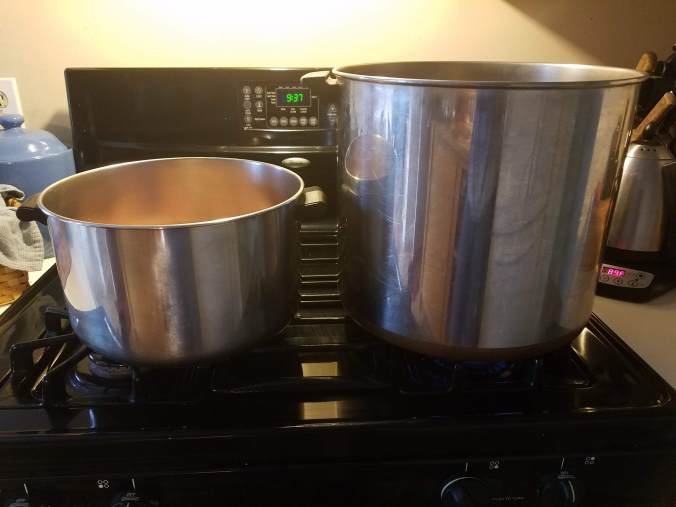
I had to bring out my big pot. It’s considerably bigger than my Dutch oven, bigger than I really need, but better to have more room in the pot than a quantity that is unwieldy at best and possibly might even spill over. My big pot is this big compared to my Dutch oven. It worked.

pots.jpg

A pot midway in size between these two would have been perfect.

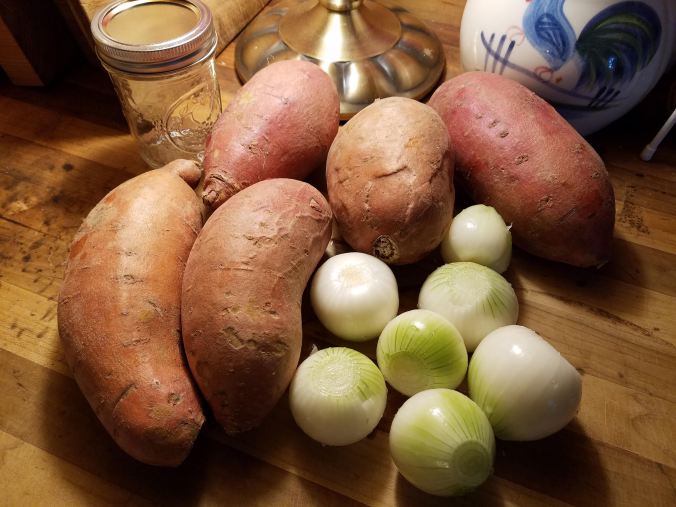
Having settled on the right pot, I started chopping. Those of you who are very sharp might have noticed that there are more than 5 onions in my pot in the photo above. Isn’t that the thing about recipes? They tell you 5 onions but not necessarily how big the onions are supposed to be.

I have Mario’s onions in my mind, the huge ones I saw him cutting up when he was making this soup. My onions are not huge. They are from my garden so I love them, but they are on the small side, so I used seven instead of five. Mario might have used ten of this size, but I’m going with seven. That’s the thing about onions. It doesn’t matter that much how many – more gives a stronger onion flavor, fewer gives not as strong an onion flavor. Your call.

(The yams look redder in this photo than they are.)

onions and yams on counter.jpg

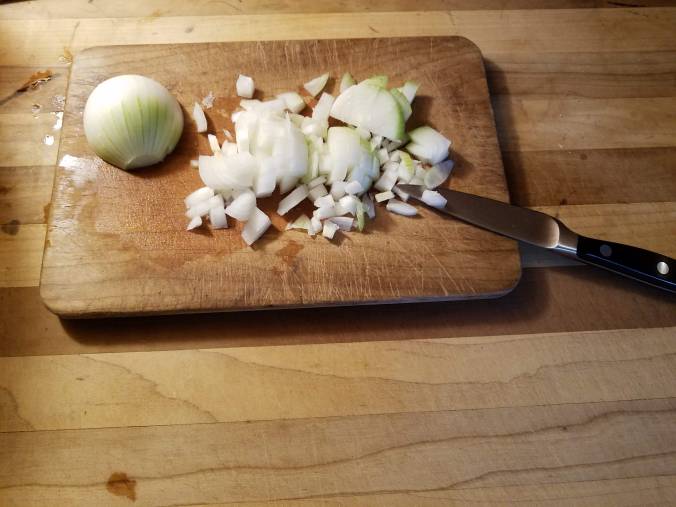
I put the cup of olive oil in the pot, turned the flame on low, and proceeded to chop up and add the onions to the oil. My onions were chopped like this. I chop them on a separate board – always have, this particular board for decades actually – because as much as I love onions, I don’t want their flavor/odor getting into the wood of my countertop and I don’t want the thing I cut up later (let’s say, watermelon) to pick up any of that flavor. It’s a small price to pay for the joy of chopping on a wooden surface.

chopped onion.jpg

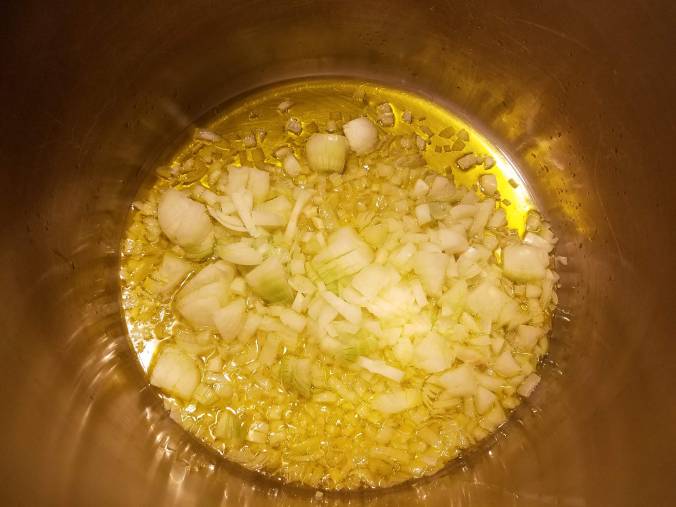
The onions in the oil are a thing of beauty.

onions inpot.jpg

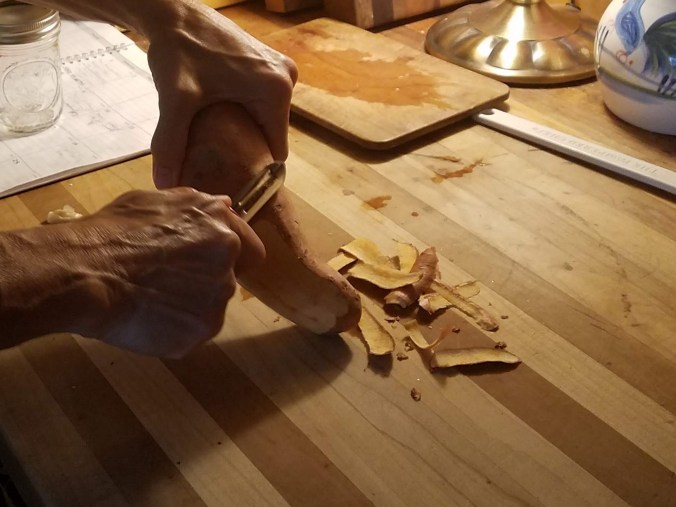
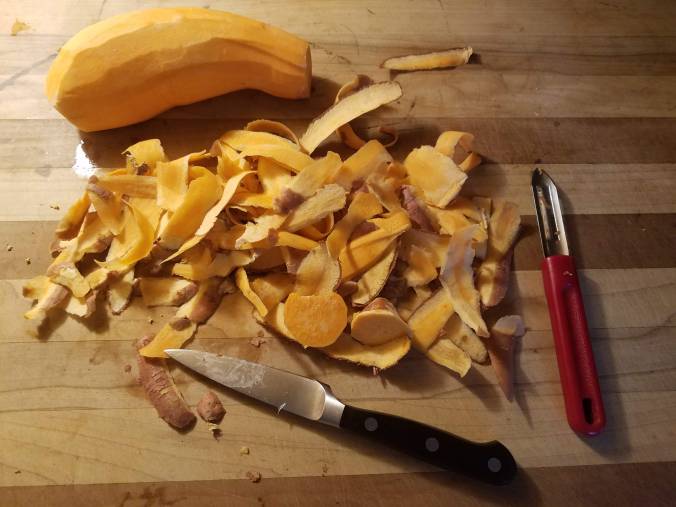
There are two ways to peel a yam. One way is with a peeler and the other is with a knife. The peeler works only if you have a good peeler. Even then, it is simply a matter of preference.

peeling yam2 (2).jpg

When it is peeled and the end is cut off, it looks like this.

peeled yam.jpg

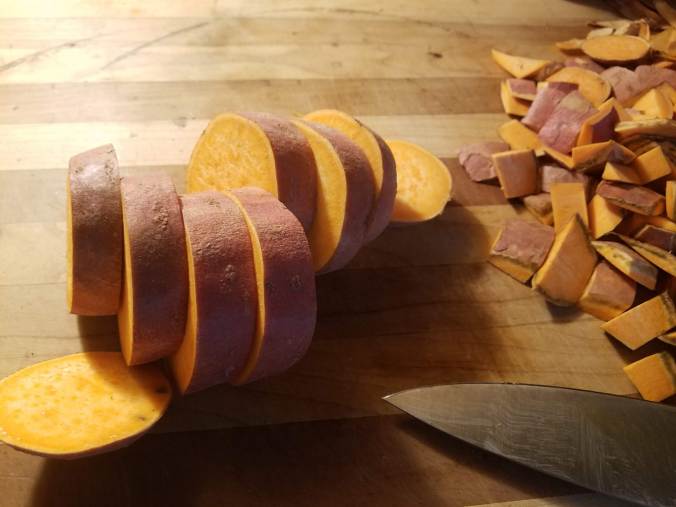
I find it easier to slice it into thick wheels first, and then cut off the edges. For this I use my 10” chef’s knife. First make slices about ¾” thick.

slices.jpg

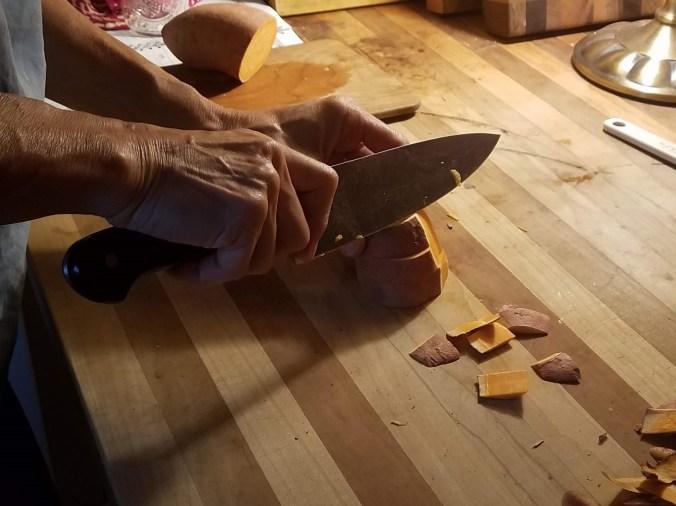
Then, either in a small stack…

cutting sides off a stack (2).jpg

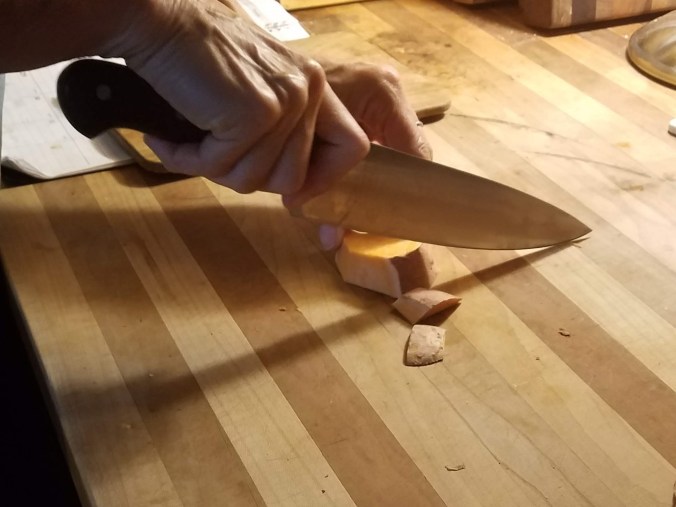
…or one by one, cut the edges off.

cutting sides off (2).jpg

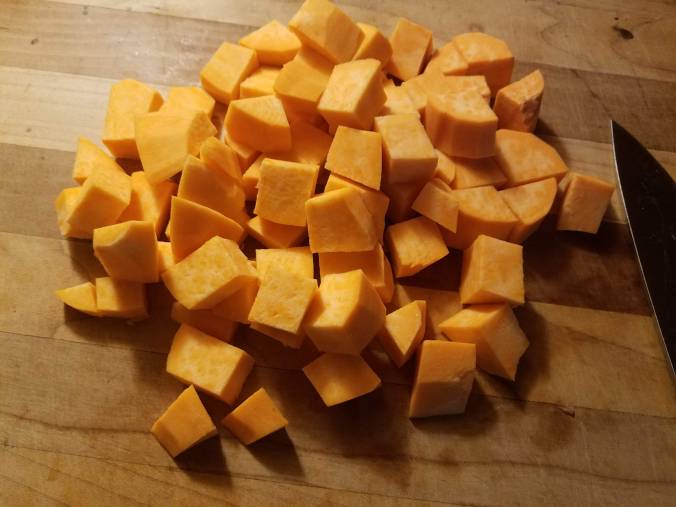
Then cut them into cubes…

cubed yams2.jpg

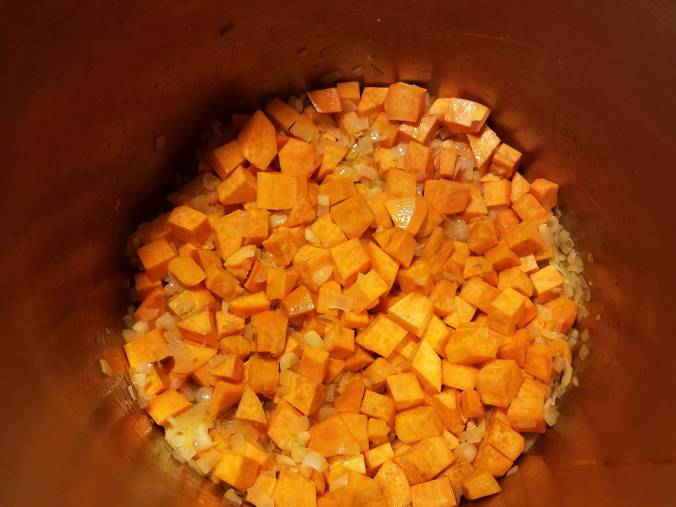
… and put them in with the onions.

onions and yams in pot.jpg

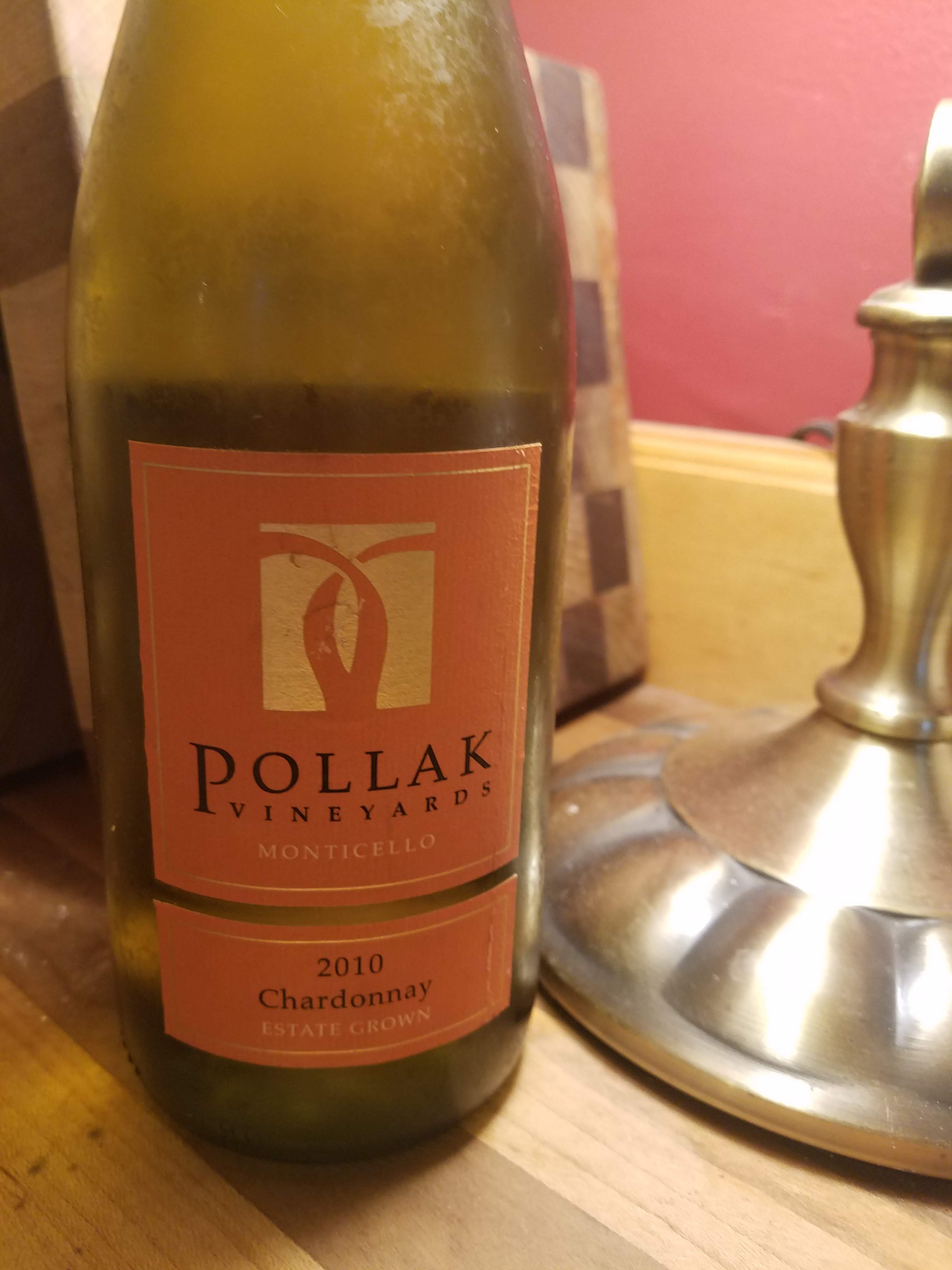
I turned it down to low and put a cover on to let this all soften. About 20 minutes went by before I remembered the wine. White wine, the recipe says. Talk about UN-EXACT! I guessed at a chardonnay. It also happened to be the first thing I pulled from my fridge. Chardonnay will work, I decided. Pollak is a local Virginia wine and a very nice vineyard to visit if you are in the area.

wine.jpg

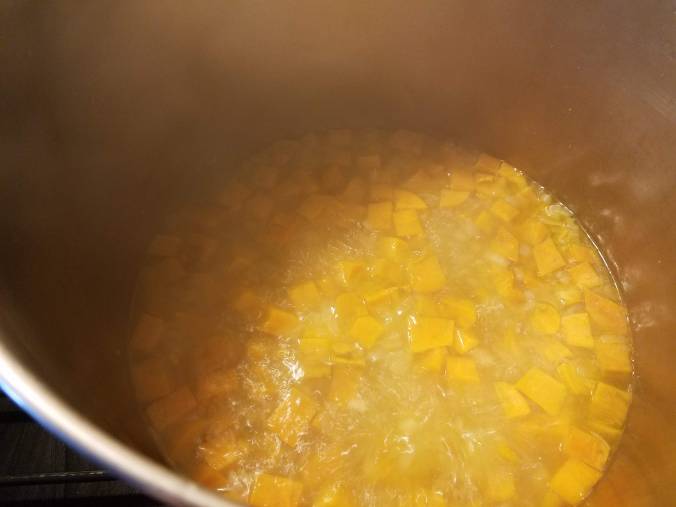
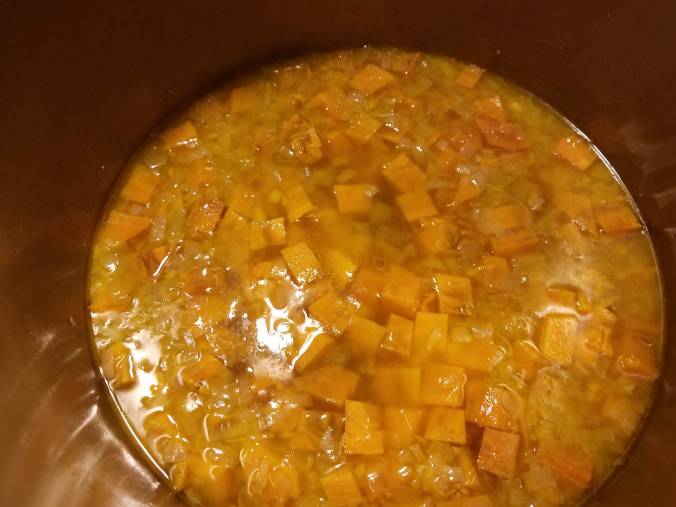
In went the wine and again I covered the pot, this time forgetting the water! Not the end of the world, she says ten minutes later. The veggies had already cooked down a bit, were not quite mushy but getting there. In went the gallon of water. It seems less formidable if you just fill and dump your quart-size measure four times. Then it looks like this.

cooking with water.jpg

And in half an hour it looked like this.

cooked.jpg

That’s when I turned it off and let it cool. You don’t have to let it cool before the next step, but I was going out to read to Evelyn (we are almost to the end of the Queen Victoria book!) so I left it.

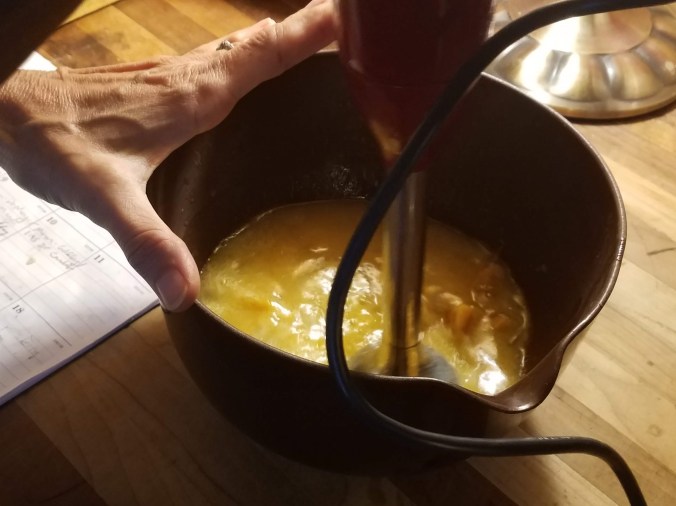
There would be two ways to “just blend it,” as the recipe says. God bless him, Mario means blend as in blender, electric blender, and there are two of those: the traditional stand-up blender and the immersible kind. Let’s try both, and see.

I put some in a bowl, thinking I had a big/tall enough bowl for the immersion blender. Wrong. It made a splashy mess and did not puree the veggies as I wanted. Reject this method.

immersion2 (2).jpg

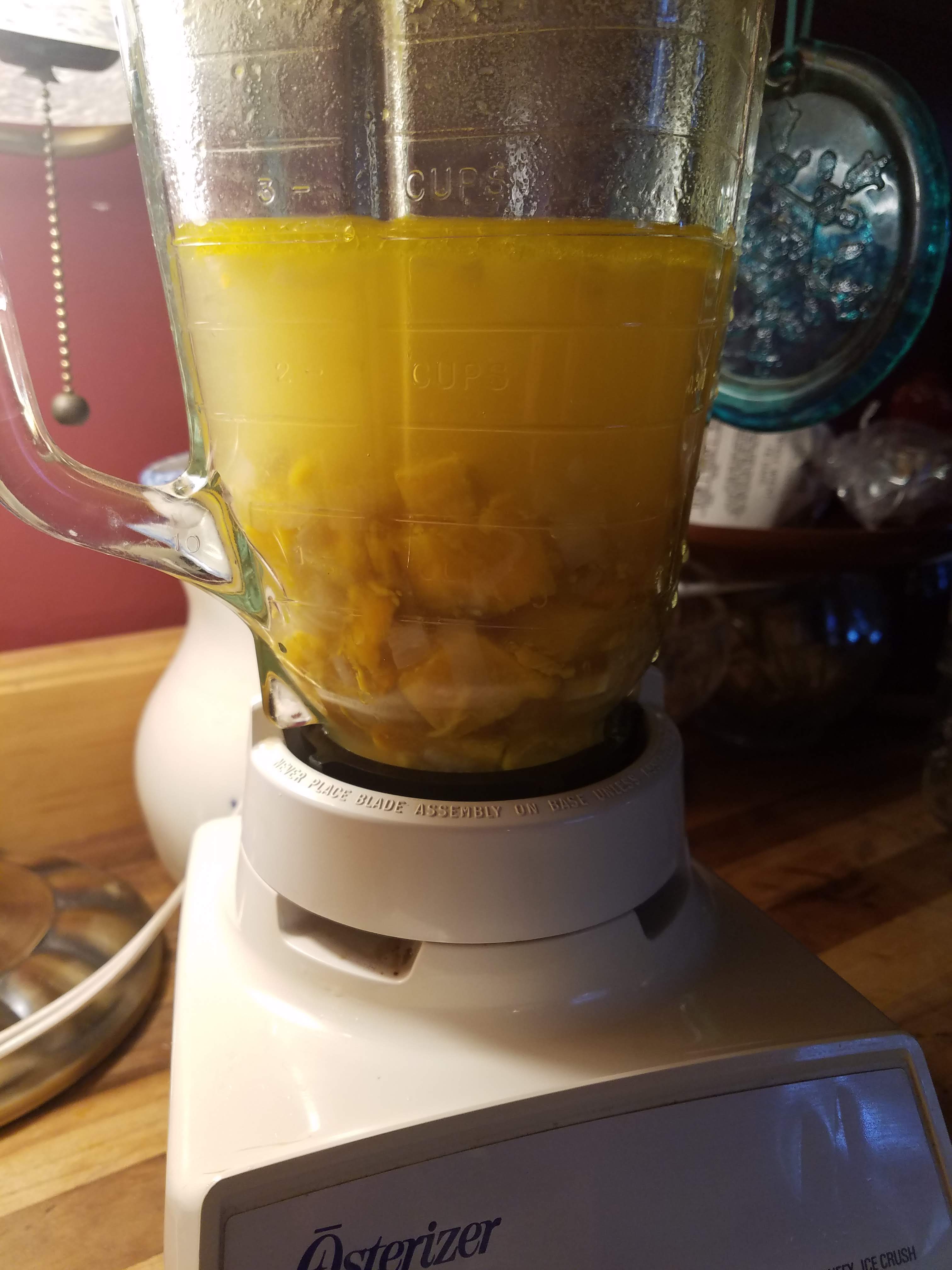
I got out the tried-and-true blender that has to be 25 years old, filled it about halfway,

blender1.jpg

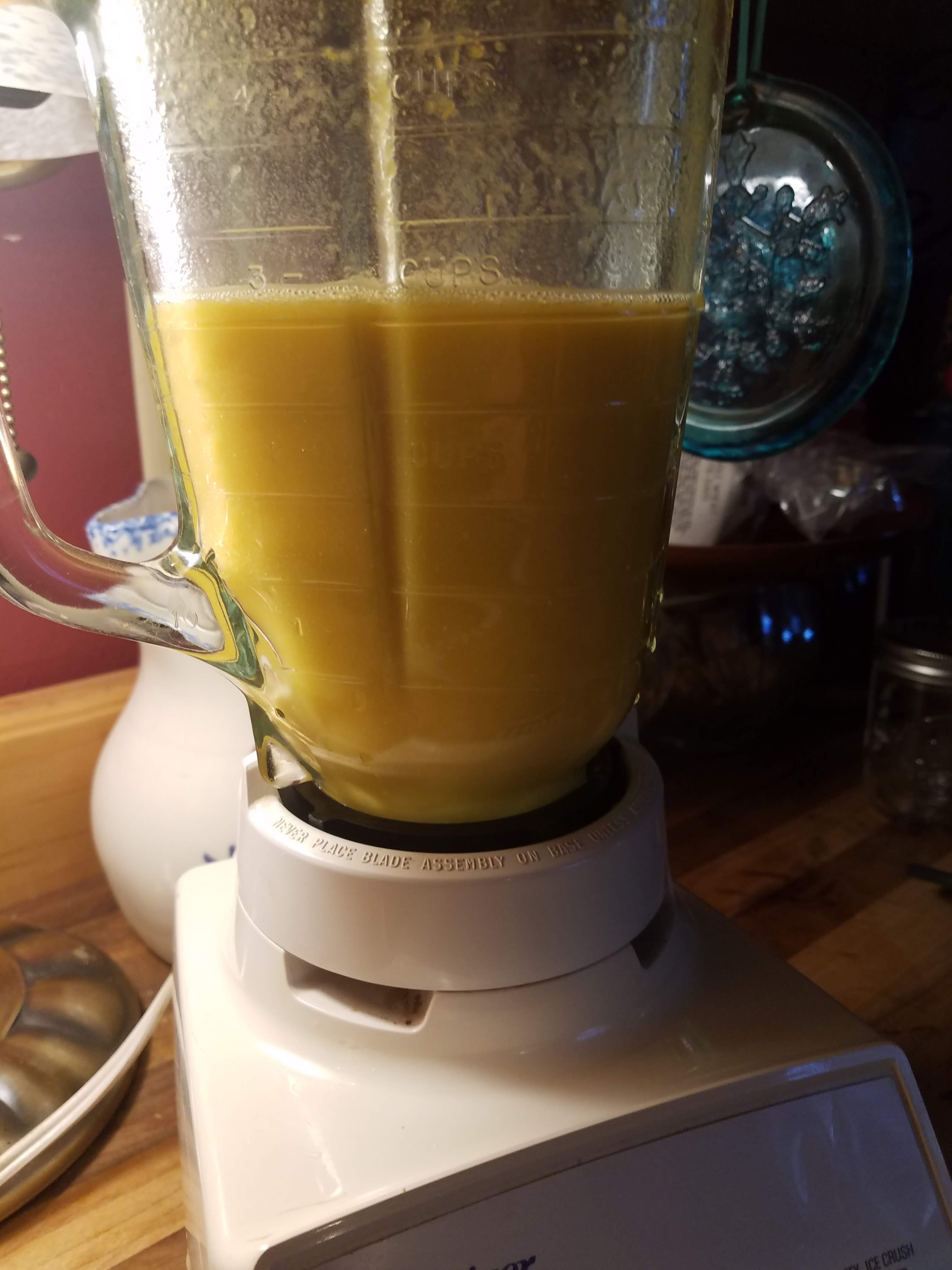
put the lid on tight and hit Puree. I let it do its thing, whirring, chopping, pureeing at high speed for ten seconds. Ten seconds means me counting to ten as in one, one thousand, two, one thousand, three, one thousand….

Voila!

Don’t you love that word: Voila!

blender2.jpg

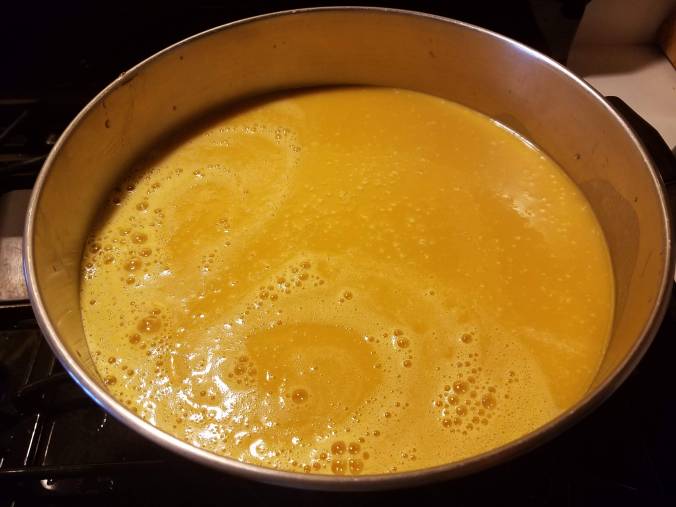
It was enough. I transferred each blender-full of the now-pureed, almost-soup to the regular size Dutch oven. Fill, puree, repeat until all is done. I got this much, which turns out to be just shy of 5 quarts.

finished in pot.jpg

Add salt a teaspoon at a time, remembering that salt enhances the flavor, brings it out. Stir and taste each time. Too little is no good. Too much is no good. I needed about a teaspoon per quart to make it taste right (to me). Add pepper to taste.

When you heat it up to eat it, put some of the Backerbsen or some other little crouton on top of the soup in your bowl as I suggested with Mom’s Tomato Soup. They would be terrific on this.

Please let me know if my efforts to be EXACT in my instructions are not exact enough. I was timing something earlier, another recipe I might share, and Samuel, my son who’s 24, chided me. “Since when do you time things?” he said to me.

“Since the people who read my blog requested that I be EXACT,” I replied.

“Is this an effort to rebrand yourself as someone who gives specific instructions instead of your normal ‘you’ll know when it’s done’?”

Very funny.

My Racoon Skin

(For my followers, this is today’s post. The one you received half an hour ago had a problem — half of one of the paragraphs was missing.)

Recently while scrounging around in the basement for felt, stuffing and anything that might be useful for making fake fruit, I came across the racoon skin from our homeschooling days. The ringed tail came off long ago, but for years I used it on the flat surface of my hutch and put pretty things on it, like a glass bowl or a decorative candle. Unadorned, it looks like this. You have to imagine the tail.

racoon skin.jpg

I realize that not many people would have and/or use a racoon skin. I just like it.  I found it as soft and luxurious as it was thirty years ago, though it was not originally intended to be part of the décor. Originally it was part of a lesson about Daniel Boone, pioneer days and self-sufficiency.

We didn’t kill the racoon. The kids were young then, early elementary, and we don’t kill things anyway. But we were reading about and talking about what people had to do back in the day when you were immersed in the natural world around you and relied on it to provide for a good portion of your needs, back when you cut down the trees to make a path through the woods, when you built a house with those logs, when you killed the predators that were killing your livestock, when you milked your own cow and churned your own butter. If Daniel Boone needed a hat, he couldn’t just go buy one because he was out there in the wilderness somewhere and there were no stores with hats.

I was never one for only reading and talking about a thing – I want to do it. (I know this is a surprise to some of you, but really it’s true!) Coincidentally, we left home one day to go who knows where and what did we see along the side of the road? Roadkill, that’s what. A road-killed racoon. And what does any self-respecting homeschool mom who is trying to make a point about Daniel Boone’s self-sufficiency do with that? She stops, checks to see if it’s: a. freshly killed – no smelly or decomposing carcasses for me, thank you, b. undamaged, other than being dead of course, and c. (seemingly at least) unclaimed – I would not want to take someone else’s roadkill.

I grant that for some people the idea of skinning a racoon is off-putting to say the least. We are all a product of our experience to a point though, and my experience included three years of being the anatomy lab assistant at Douglass College (Rutgers U.). In anatomy lab you study anatomy, hands-on. I mean hands on the real thing, not looking at pictures or plastic models of the muscles, tendons and bones. Sure, you can talk about how the transversus  abdominus of a cat inserts into the linea alba, and you can read about how the masseter is covered by a tough, shining fascia lying ventral to the zygomatic arch, but there is nothing like taking a sharp blade in your hand and carefully dissecting the animal.

There is no room for squeamishness in this process. I became familiar with it, comfortable. So the road kill racoon didn’t faze me. We brought it home and pretended to be Daniel Boone. I’m not saying it was a pleasant experience, but the real world is messy sometimes. It is complex and hard and utterly fascinating. I think I can safely say that the inside of a racoon is unlike anything you have ever seen.

In the end we didn’t make a hat though. Once the fur is off the rest of the racoon (and the inner part discarded somehow, I forget how), the job is not done. You don’t go from dead animal to useful, clean skin that easily. The fur is soft (and would surely be warm) but other side of it (the hide) is wet, one might even say gooky. The next step is tanning, which involves trimming and scraping the hide, placing it in the shade on a flat, cool surface such as a large rock and covering it with salt.

Where Daniel Boone got salt out in the wilderness is beyond me, and we take our self-sufficiency lessons only so far. A friend of mine, who was far more self-sufficient than I, had at about the same time gotten mad at the racoons that were getting into her garden and had taken a shotgun and killed them. She was having those skins professionally tanned. I jumped on that option. A few weeks later I went to her house to pick up our beautiful racoon skin.

I think we didn’t make a hat because by the time it was ready, we had moved onto other exciting lessons – though it is hard to top skinning a roadkill racoon. Besides, and more importantly, the fur was just too beautiful to cut into. On whatever surface I put it, it served as a reminder that we had once, in a very small way, walked in Daniel Boone’s shoes. We had done a messy thing and ended up with a beautiful thing. We had done a thing ourselves that most people would have had someone else do.

I got to thinking about all this because of Oscar Wilde. In the book I just read, The Guernsey Literary and Potato Peel Pie Society, there is a story about a little girl whose cat died. She was inconsolable until a stranger came along and told her that cats have nine lives and that her cat was enjoying his next life in France. The stranger then left, but what followed were letters to the little girl from France describing the new life of this cat, how happy he was, etc. The letters turned out to have been written by Oscar Wilde himself who had visited the island briefly and then gone on to France.

Whether all this truly happened or not, I don’t know, but it made me look him up. In doing so, I discovered his involvement in the 19th century aestheticism movement, about which I had known absolutely nothing specifically. I did, however, have the vague idea that surely someone before me must have also determined that things don’t have to have a purpose other than being beautiful. “Art for art’s sake” was their bottom line, and maybe my racoon skin fits that category.

The process of skinning the racoon hopefully taught my children a thing or two about anatomy, about the realities of pioneer life, about using what nature gives you to keep yourself warm. It was time well spent in their early education. But the skin itself, once it came back from the tanner, didn’t have a purpose for me other than being nice to look at and nice to touch. That was enough. Sometimes I would just stroke the fur. I enjoyed it for many years and will probably never throw it away.

I think we all have some things like that – things that we just plain like. They are not necessary things, not useful in a functionally useful way. But we get a good feeling inside when we are near them, and that makes them very useful indeed. They make our hearts happy and help to balance out the ugly, messy, uncomfortable parts of life.

Yesterday’s fake felt fruit is not necessary either, though it will be useful for Ellie in her picnic play.

fake felt fruit.jpg

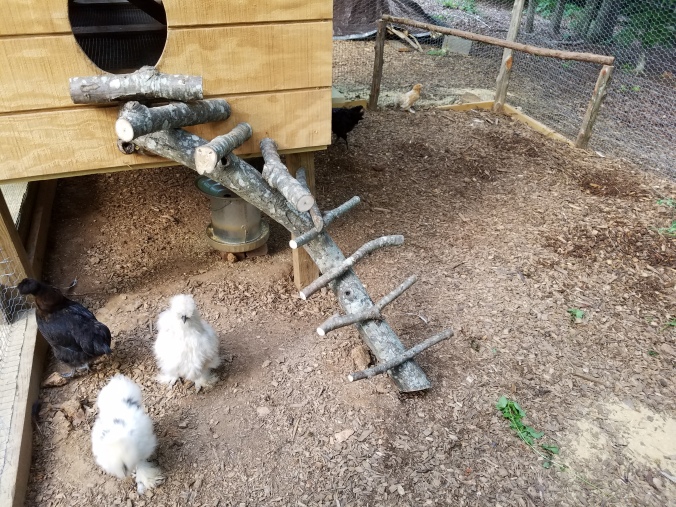
Making funky ladders for chickens is not necessary either.

cool ladder.jpg

Nor is a peony bush in the bed with the lettuce and carrots.

carrots in May.jpg

Or letting Coco lay on the sheets I’ve just pulled off a bed. I could just put them right away in a basket and take them away. But I don’t. I put them on the floor because this very predictable animal will come along and plop down and look at me like What? Something wrong?

Coco on sheets.jpg

All of these things, and many more of course, make me smile. A long time ago someone told me there’s enough craziness and heartache in this world. You should do what you can to tip the scales to the other side, even in small ways, even if it’s only to make your own heart smile. You should make or do something beautiful, something fun, something that brings cheer as much as you can. Chances are good that you are not the only one who ends up smiling and feeling better.