Making 974 Pierogies

Granted, not everyone wants to make 974 pierogies. But if you do, I suggest a party. It works great for Lynn and Billy, who have been doing it for years. The deal is: you come, you work a few hours getting your hands sticky and/or your shirt spattered with flour, and you go home with zip-lock bags full of deliciousness. It’s worth every minute!

Getting a bunch of people together to make good food is, all by itself, a fun idea. Getting together to make a family favorite, something that is best made with lots of help, something everyone is happy to take home – that’s even better. The party invite should say Bring an apron.

Pierogies,* a filled dumpling, are part of my brother-in-law Billy’s Polish background. They make two kinds, potato-cheese and cabbage.  The potato-cheese kind is creamy and comforting in the same way as mac and cheese is creamy and comforting, and the cabbage ones are filled with slowly sautéed (in lots of butter) sauerkraut, i.e. fermented cabbage cooked down to tender sweetness. Both kinds are amazingly good.

Traditionally, you boil them as you would any filled dumpling (or pasta, if you think along Italian lines), douse with melted butter and serve. I like to sauté some onions in a pan over a low flame, lay the frozen pierogies on top, add a little water, cover, and let them steam into tender puffs …

in pan side 1.jpg

…then flip to get the other side just a little crispy.

in pan side 2.jpg

It is not a piece of cake to make pierogies, but here are several good reasons to venture into the Pierogi Party Production arena: 1. Many hands make light work. 2. Food is a powerful motivator, meaning you can get people to do work when food is the reward. And 3. Assuming you have someone like my sister Lynn in charge, you know it’s going to be good. She is a master organizer and keeps things going with admirable efficiency and poise. Anyone who can get 12 people to show up at 10:00 on a Saturday morning to do four hours of work with zero monetary compensation deserves applause.

Lynn gets all her ingredients ahead of time. This last time, just before Christmas, they weren’t aiming for 974 pierogies, but they were aiming high! She got six pounds of potatoes, five pounds of butter, 16 (!) large cans of sauerkraut, six large onions, three dozen eggs, a gallon of milk and 35 pounds of flour. The day before, she gets out her recipe (it’s fairly straightforward, you’ll see) and prepared the potato-cheese mixture and the cabbage footballs. Then when her “guests” – all of whom want in on this action because they’ve had these before and they want them again – start coming, she gives everyone a task according to age, ability and stamina, and organizes the steps in such a way as to crank out large quantities in a very short time. It’s a model of productivity.

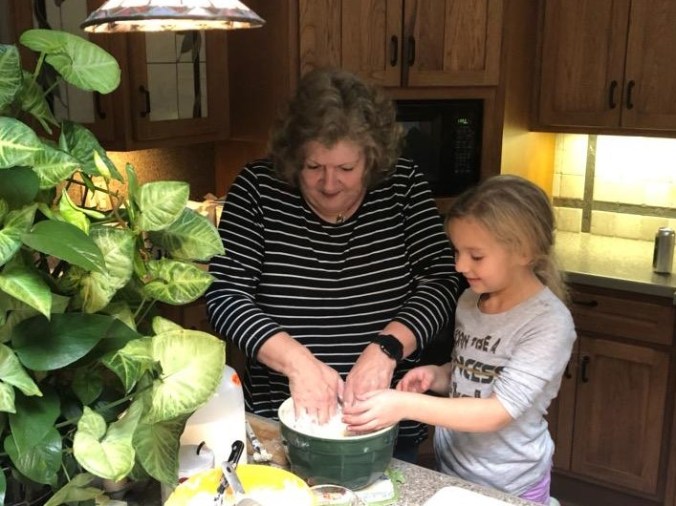
Four-year-old Brea isn’t going to roll dough, but she can help crack eggs into each batch of dough.
6 (2).jpeg

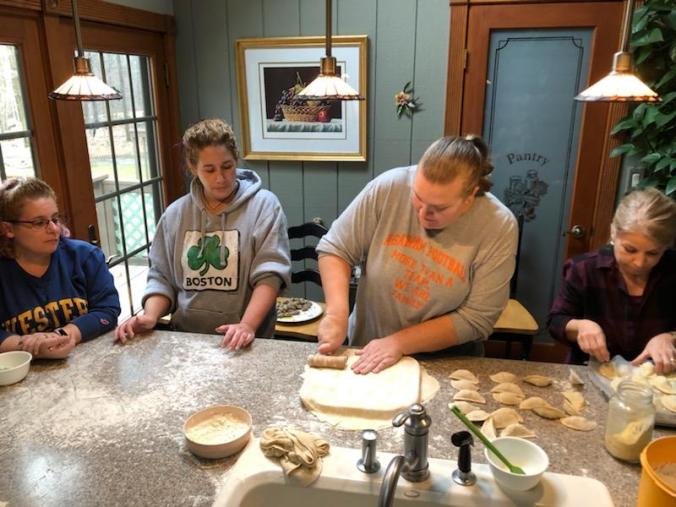
The rolling out of the dough Lynn assigned to the strong and energetic. If my calculations are correct, Evan and Matt needed to roll out 108 pieces of dough about the same size you’d need for a deep-dish pie.

4.jpeg

The pierogi form, this thing…

flipping and tray waiting (2).jpg

…makes 18. That’s 54 times you need to flip pierogies out of it to make 974 total, but 108 times you roll the dough because there’s a top and a bottom. That’s a workout!

Some people press the mini-roller on the pierogi maker to seal the edges together (go, Erika!), some separate the finished ones and some wait their turn.
3.jpeg

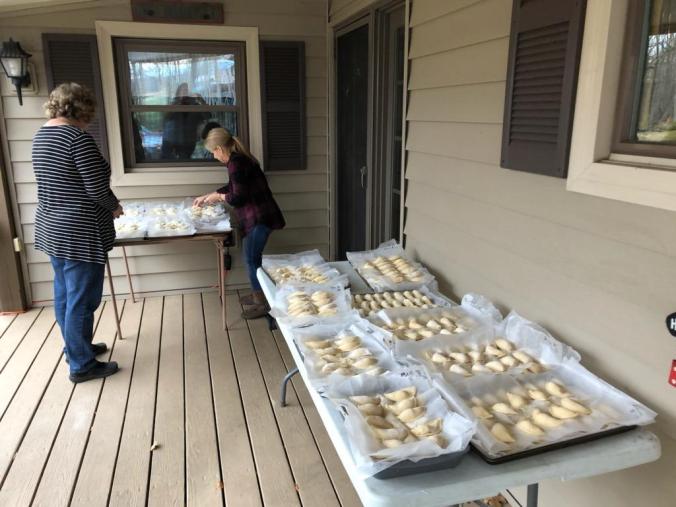
In the end, they ran out of room inside the house and set up tables out on the porch until these made it to the freezer. 974 is a lot of pierogies! If you don’t believe me, I am sure one of them will confirm the truth of this statement.
1.jpeg

The mere 233 we made last February when Lynn and Billy came to my house to visit pales in comparison, but we had our own Pierogi Production Party. We had so much fun (and the pierogies were sooooo good!), we did it again when they came in early December. Tomorrow I’ll give the specifics…


*In case you were wondering, pierogi = pierogies. Both are plural. Both are correct (or at least in our modern English usage correct). I use the -es ending for the plural because that’s how I learned it.

Puzzling Puzzles

On Christmas Eve I spent hours bending over the coffee table trying to see the difference between pieces as alike as these. I know, I know – you can see plainly that the one on the left has a little bit of dark on its top outie.

3.jpg

If you’ve ever done a jigsaw puzzle, you know that the difference is not so easy to see when the table looks like this.

partway (2).jpg

The pieces below give you a little more to go on because clearly the very pale green (which makes you want to have a stern conversation with the artist who painted this picture or the marketing person who decided that it would make a good puzzle) – if you can see the very pale green under artificial light when people are walking around making intermittent shadows – is going in two different directions. Do they fit together?

2 (2).jpg

It could be hours before you discover that they do. In the meantime there are several hundred other puzzle pieces competing for your attention – Pick me! Pick me! – and you can look through all the as-yet-unplaced pieces a thousand times and not see the obvious. Of course they go together.

1.jpg

Sometimes I think I have a disorder, you know, the kind that has to do with not being able to sit still. I keep pretty active in general and have been known to forget what I’m doing because I get distracted doing something else. Is this a human characteristic or a disorder? I don’t know, but I have also been told that I should relax more.

For the record, doing a puzzle like this is totally relaxing for me and I did not jump up and down away from it every time I thought of something else I should /might be doing. In fact it was so relaxing I forgot about the scalloped potatoes I should have made, which in the end Samuel made and which were fabulous. And now he knows that this is a recipe.

scalloped potatoes.jpg

He made this dish on Christmas morning (with some supplemental verbal instruction), and naturally we were doing a bunch of other things, and I forgot how we did the onions last time – on top or mixed in – so we thought it best to put them on top, which trust me was a very good decision. This is how it looked on the table — that white dish between the wine bottles with the golden brown, soft, sweet onions on top. You will have to imagine how good it tasted.

at the table (2).jpg

My point is that I was so absorbed in the puzzle on Christmas Eve that we were scrambling to do the scalloped potatoes (which were none the worse for the scramble) on Christmas Day. Does this sound like a person with a disorder? Okay, maybe a disorder of forgetfulness rather than a disorder of distractibility. Never mind about the disorder discussion!

Puzzles are challenging! Why do we do them? For me and my family they are a holiday activity, and I do not remember ever keeping a puzzle in its finished form beyond a few weeks. Sooner or later we break it all up and put the pieces back in a box. All that work! All those hours! Why do we take time to do something that in the end goes away? It reminds me of what my mother used to say about Thanksgiving – you do all that food prep, days of food prep, and in ten minutes they’ve eaten it all up! My Airbnb cottage guest, Rob, was saying last night that the different sweeteners you use in mixed drinks react differently (and make a different drink) depending on the temperature of the liquid. There is a whole chemistry behind mixed drinks that he is clearly an expert on, but why does he take the time to study this?

Why does Trish make amazing little appetizers like this to bring to a holiday gathering? Why does anyone take time to make food look like adorable little mice? We don’t eat mice! But when they look like this and we know they are sweet, we eat them!

Trish mice.jpeg

We do these things because they bring a certain kind of satisfaction. We use our brains and our hands and put them to work alongside creativity, competence, curiosity and confidence. We love knowing we can do a thing that not everyone can do — even if we couldn’t do it ten years ago and had to learn. Rob had a succulent turkey going inside a foil pan inside my gas grill. He showed me. I smelled it and knew that he and Kelsey would be having a fabulous Christmas dinner. He said he loves to cook but can’t bake anything. Kelsey, on the other hand, can bake! Why? Who knows?

Does it matter? We share our strengths and in the end there is both entree and dessert. There is both passion and reason, strength and flexibility, activity and rest. We need all the components that make us human, but we don’t each need everything all the time. The unboring joy of life includes a little of A, a little of B, some of R sometimes, some of Q another time, learning M this year and N the next, one person doing X, another person doing Y (and it all gets done somehow!). It’s like one big puzzle in which no two pieces are exactly alike yet they all fit together to make a satisfying, wonderful whole.

done.jpg

Christmas Trees Among Friends and Family

Sometimes I forget things. My first waking thought today, Christmas morning, was not (I am sorry to say) about the real meaning of Christmas, but instead Oh, right, I told Mom I would make scalloped potatoes to go with the dinner today – better get to that! Yesterday was pure relaxation after Samuel helped me finish up the chocolate lime pie, our traditional Christmas dessert. I got out a new (very hard!) jigsaw puzzle and got completely absorbed with that until we turned on It’s A Wonderful Life while enjoying Samuel’s excellent pizza.

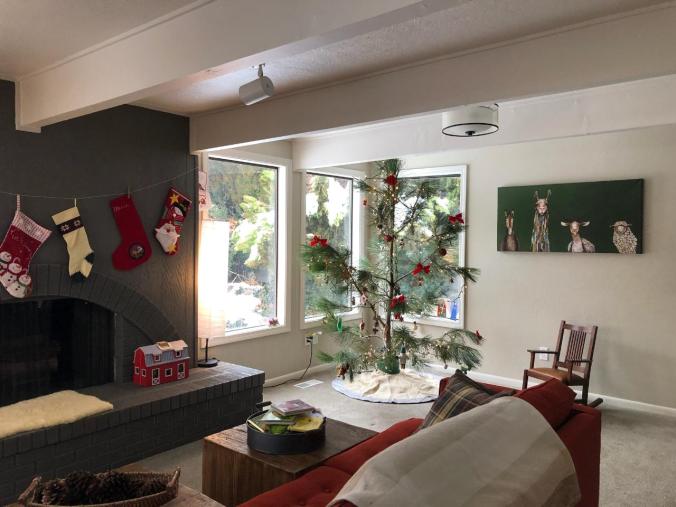
Now I realize I also forgot all about the popcorn garland I was going to add to the Christmas tree. Could have done that yesterday too. Do you think it needs it?

mine.jpg

Speaking of trees, I almost didn’t put one up. I was so enchanted with the way my outdoor tree looked this year, especially when we got snow, I said to myself, It’s enough. I wished it had snowed before I made up my Christmas cards this year!

outdoor (2).jpg

But snow (in Virginia) melts and various people I know sent me photos of their Christmas trees. How could this not nudge me??

Louisa in North Carolina was the first. How amazing that her tree is not only so incredibly beautiful but that she got her precious pups to pose in front!

Louisa's.jpeg

My sister Lynn in Massachusetts was next. I love the way her star on top shines on the ceiling, so soft, and I bet it looks different from different angles and at different times of day.

Lynn's.jpeg

Fred in Kentucky, I venture to say, could tell you where every ornament came from. How precious a walk through memories…

Fred;s.jpeg

Marie’s (in Idaho) made me smile big. They went out with neighbors and cut one from the woods. I love it!

Marie's.jpeg

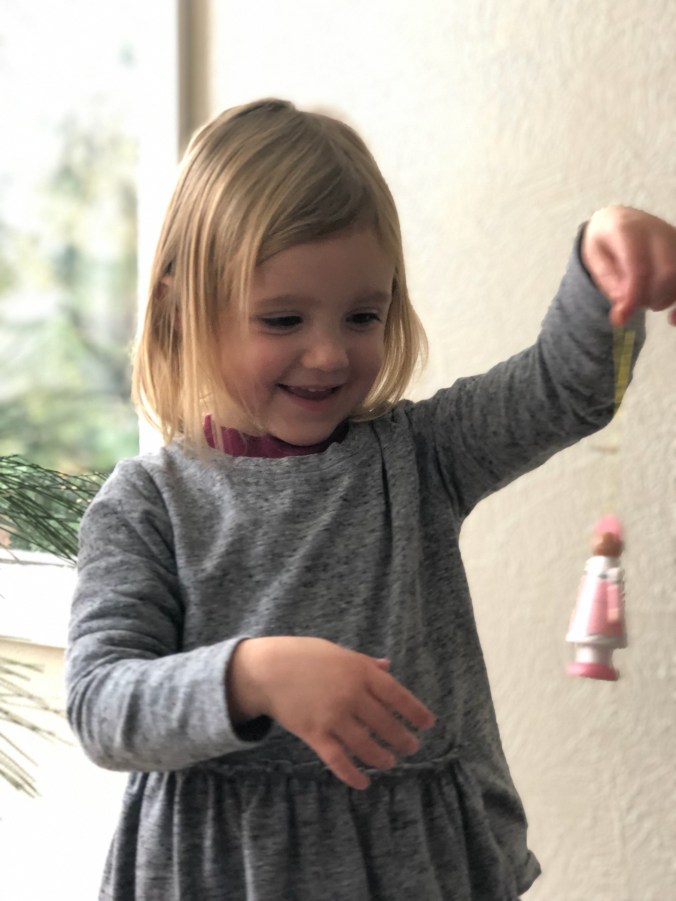
Even more precious was the photo of Ellie, who is three, holding an ornament. Marie said, “Grandma gave me this one when I was three.” I hope Ellie’s child (someday) is smiling as she holds the ornament I sent Ellie this year…

Ellie.jpeg

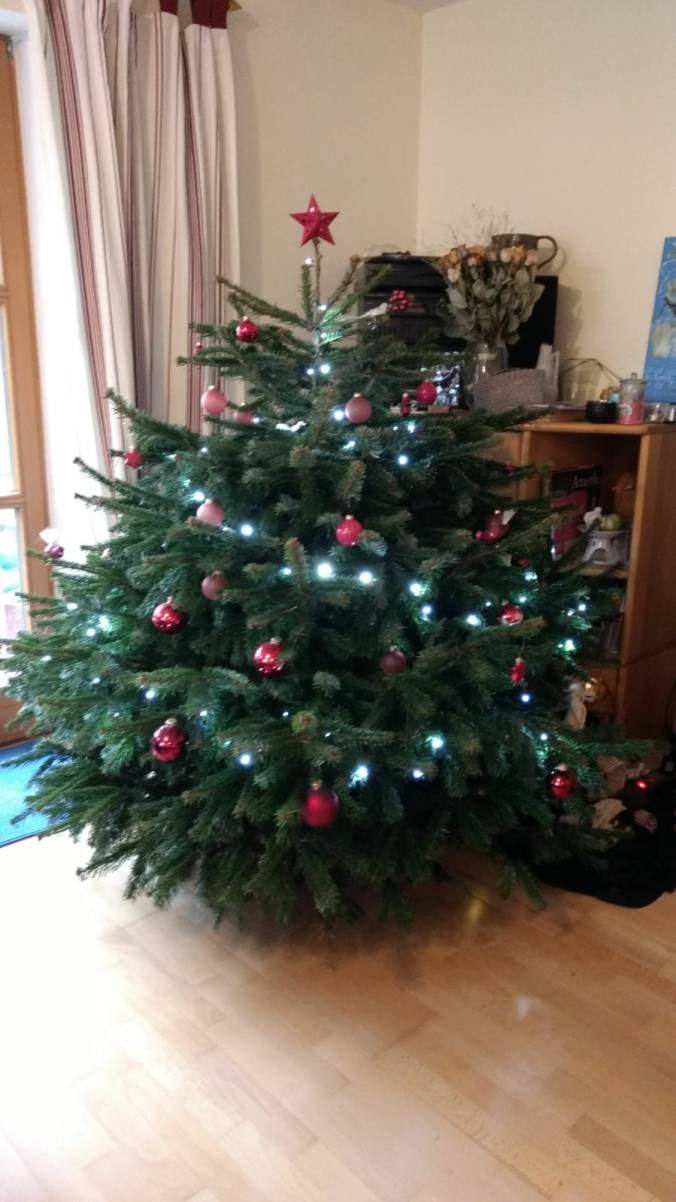
Claudia’s tree in Germany is full and jolly!

Claudia's.jpg

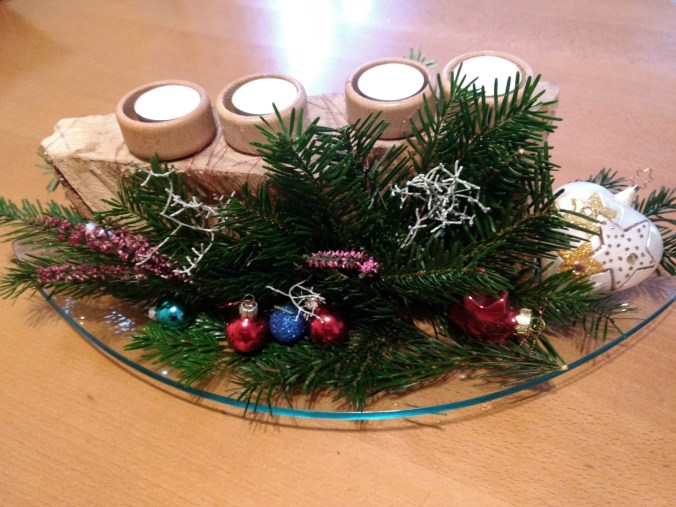
I also loved her table decoration prepared in time for the first Sunday of Advent. How we take such simple elements and put them together to make something so pretty and meaningful!

Claudia's table.jpg

Kim’s in Vermont is not exactly a tree, but it is made from branches of trees! At their family camp where they traditionally get their trees there just … weren’t any. She said it’s growing on her and is much more manageable than a real tree! I love it!

Kim's.jpeg

We make do and we make it wonderful! Lincoln and Julia in Vermont, in their straw bale house, decided to be even more unconventional. I love theirs too!

Lincoln's.jpeg

Lincoln’s, Kim’s and Marie’s made me think – here I am with the unboring path and yet I have a rather conventional tree. They get the prize for Unconventional! How fun and wonderful to see such a lovely variety, to bear witness to the creativity of those I know, to see and hear about the joy and fun that surrounds this custom.  They all made me smile! What a funny custom it is – we buy a tree or go to the woods to cut one down (or cut some branches, if you are Kim and Dave), then install (assemble?) it indoors in a prominent place and decorate it with our favorite ornaments. Or if you are Lincoln and Julia, you put up some lights and hang ornaments and use your imagination! What a special way once a year to slow down, do something unnecessary but just fun,  share a tradition with countless others and revisit our Christmas memories as we make new ones.

Merry Christmas! God bless us every one!

Lincoln’s Pentagonal, Straw Bale Insulated House in Vermont

My son Lincoln is building a house, but not a normal house. Twenty de-barked trees taken from his six-acre riverside property in northern Vermont constitute the vertical supports, and the first-floor walls are stacked straw bales that serve as insulation. Oh, and the pentagonal design means the corners aren’t square.

Presently it looks like this. The smoke coming out of that stovepipe might lead you to think it’s warm in there. Indeed, it’s warmer than outside!

28smoke in chimney.JPG

Last week Samuel and I traveled to Vermont to work alongside Lincoln and better understand his project. I found myself awestruck not only by the hard work, craftsmanship and ingenuity evident everywhere, but also by the fortitude, patience and ease with which every member of the family is walking through this process.

First of all, it’s not warm in Vermont in December. It wasn’t warm in November either. This year, Thanksgiving was the coldest on record (11 degrees Fahrenheit, -11C), and snowfall broke the previous record set in 1900 with 32” (81cm) of snow in November. As Lincoln has been building this unusual, amazing house, he and his wife Julia and their two delightful daughters (Rise and Eppie, 6 and 4) have been living in a 16’ (4.8 meter)-diameter yurt on the same property. It has a wood stove that keeps it toasty, but the privy is detached and the adjacent “greenhouse” that Lincoln and Julia slept in is unheated.

Some nights it got down to –4 degrees Fahrenheit (-20C). Think about that. How many blankets would you need? They would turn their electric blanket on about 40 minutes before going to bed. A couple weeks ago when he was about to get the wood stove in the house set up, Lincoln said, “It’s very exciting for those of us sleeping in unheated greenhouses waking up to -4 degrees on our faces.” When I said I could not even imagine how that feels, he said, “Eh. Our electric blanket is awesome. It’s basically just like getting out of bed into a walk in the freezer.”

You can see the yurt and the greenhouse down the hill from where Samuel is standing with Coco tucked into his jacket. (She was a constantly shivering camper during this week, but that is another story!)

samuel and coco and yurt and grrenhouse.jpg

This is glorified camping. In the winter. In Vermont. As the fire dies down, you can sometimes see your breath inside, but no one seems to notice. None of them complain. They just carry on. Here we are cooking dinner together in the yurt one night early last week. I have an ear warmer on under that hat, and I am wearing four layers on top (including a wool sweater and an alpaca sweater), and two on the bottom (cold weather leggings under snow pants) and the girls are in regular clothes, oblivious.

cooking in yurt with girls.jpg

There is no running water right now. The pipe that brought water into the yurt froze during the very cold November. No matter. They bring in water in large containers such as the one behind me in the photo above, filling and refilling at their friends’ house (Zach and Nicole live a very short drive away). But there’s electricity and internet. They have a fridge, a stove, a microwave and a toaster oven. You heat up water to do the dishes. You put on another sweater if you feel cold.

Lincoln works on the house day after day, one task at a time. Julia works outside the home, coming and going with gentle, saintly tolerance. Rise goes to kindergarten and Eppie to preschool, and I suspect few of their classmates are as unspoiled or resilient, or as well equipped to handle the various forms of adversity that their own lives will bring. The snow, the cold, the construction zone, the tight quarters, the inconveniences – they all take it in stride. They may not have running water yet, but they will. In the meantime, as they love, support and serve one another with smiles and strength and kindness, they are happy, healthy and secure in a peaceful, incredibly beautiful place. They ask for nothing and have everything they truly need.

I stand in awe.

Lincoln could have built a normal house, and it would have been done by now, or nearly done. A normal house would have square corners, a shingled roof and indoor plumbing as it applies to both kitchen and bathroom. There would not be sawdust and bits of straw everywhere or 6ml plastic for windows.

But he didn’t. He created a unique home design that is enormously ambitious and unconventional. He is living his dream, and Julia, God bless her, is his perfect partner.

Lincoln’s dream is a lot of work (a lot of work!), but it lets girls be prairie dogs,

10prairie dogs.JPG

includes dizzying heights,

13verticals from the top.JPG

demands outstanding joinery,

14detailing of center supports.JPG

and creates surreal images.

21a evening skeleton.JPG

I hope these few photos have whet your appetite. I plan to do a more thorough step-by-step of his building journey in future posts. If you have any questions or want me to explore any particular aspect of the project more, let me know.

Guy on Window

Bizarre as it was – the sounds, the images, the mind associations – no one flinched. No one asked for an explanation, no one cared. We all just carried on as if there weren’t a guy on the window, as if a guy on the window happens every day. Let’s take GUY ON WINDOW one word at a time.

GUY: Guy refers to a male generally, unless it’s used in the “What do you guys want to drink?” colloquialism, but that is a different conversation. I am from New Jersey. When we say “I know a guy” it means “I know a man who does X [and I can talk to him about doing X for you].” I have often been amazed at how, for the most part, even from afar (though this is not foolproof of course), we can instantly tell if someone is male or female just from how they stand or walk or gesture. We don’t need to see their face. We don’t need hairstyle or other typical gender signifiers. They can be bundled in bulky clothes. Something about the image tells us “male” or “female.” I’d put money on it: this was a guy on the window.

ON: On is a preposition that implies adherence to or connection to another object. According to Oxford Learner’s Dictionaries, “on” means “in or into a position covering, touching or forming part of a surface” as in

“a picture on a wall

There’s a mark on your skirt.

the diagram on page 5

Put it down on the table.

He had been hit on the head.

She climbed on to the bed.

What you don’t see here in this list of possible uses for “on” is “guy on window” or even “there’s a guy on the window.” Because it’s unusual. When I say on, in this case, I mean in-a-position-touching-the-surface-of-[the-vertical-third-floor-window].

WINDOW: Windows are generally glass and generally flat planes. This one was. Sometimes they open to let in air, and sometimes they are sealed shut. The kind in office buildings, especially on upper levels, are usually sealed. This one was on the third floor, and it was sealed. Windows need to be cleaned now and then. This one apparently did.

Of course we weren’t sure what was going on at first. At first all you saw was a foot.

guy on window1.jpg

I was waiting for my mom to get through her appointment with the eye doctor.  There are many aspects to the appointment – various tests and various waiting periods. When you go there as the driver, you know it will be a while. Last time it took almost two hours. This time was better, only an hour and 35 minutes. Still, that’s a lot of time to observe what is going on.

Those of us sitting in the waiting room had heard water being sprayed. We had seen water streaming down the window. Someone new walked in and said, “Is it raining?”

No, not raining, but oh, look, there’s a guy on the window. Yeah, so, a guy on the window. Big deal. He has the right equipment. The water he uses to clean the windows with comes out of the nozzle because it is hooked up to a system that supplies it. He is agile enough to manage this job. He is strong enough to hold everything. He is not afraid to be up that high, though he is strapped in somehow I’m sure. He is paid enough for him to want to do this work. The businesses in this building are doing well enough to pay someone to wash the windows. The building is well made so that no water seeps through. Etc!

So much has to be in place just for this one guy to clean the windows!

guy4.jpg

I thought about this today while Samuel and I were driving to Vermont. It took 12 hours, the first five of which were in horrible rain. Despite the rain and the accompanying driving conditions, we realized that it’s remarkable to be able to drive 650 miles in one day. Like the guy on the window, so many factors have to be in place for this to happen: We have to have a car that runs, money to put gas into it, good health to be able to make a trip. The roads have to be in good repair, we need to be able to find the gas to put in the car, so there must be gas stations along the way. The state borders through which we travel (Virginia, West Virginia, Maryland, Pennsylvania, New York and Vermont) – indeed all of the states in the US – allow free travel – no border stops, no restrictions, just keep going. We have jobs and schedules that give us the time to travel. Etc!

And because of all of this, now I get to spend several days with my sweet granddaughters and help my son and his wife with their new house – his straw-bale-insulated, pentagonal house on six rural acres in Vermont, which I will tell you more about soon.

In the meantime, remember that the things to be grateful for never end.

The Value of Failure

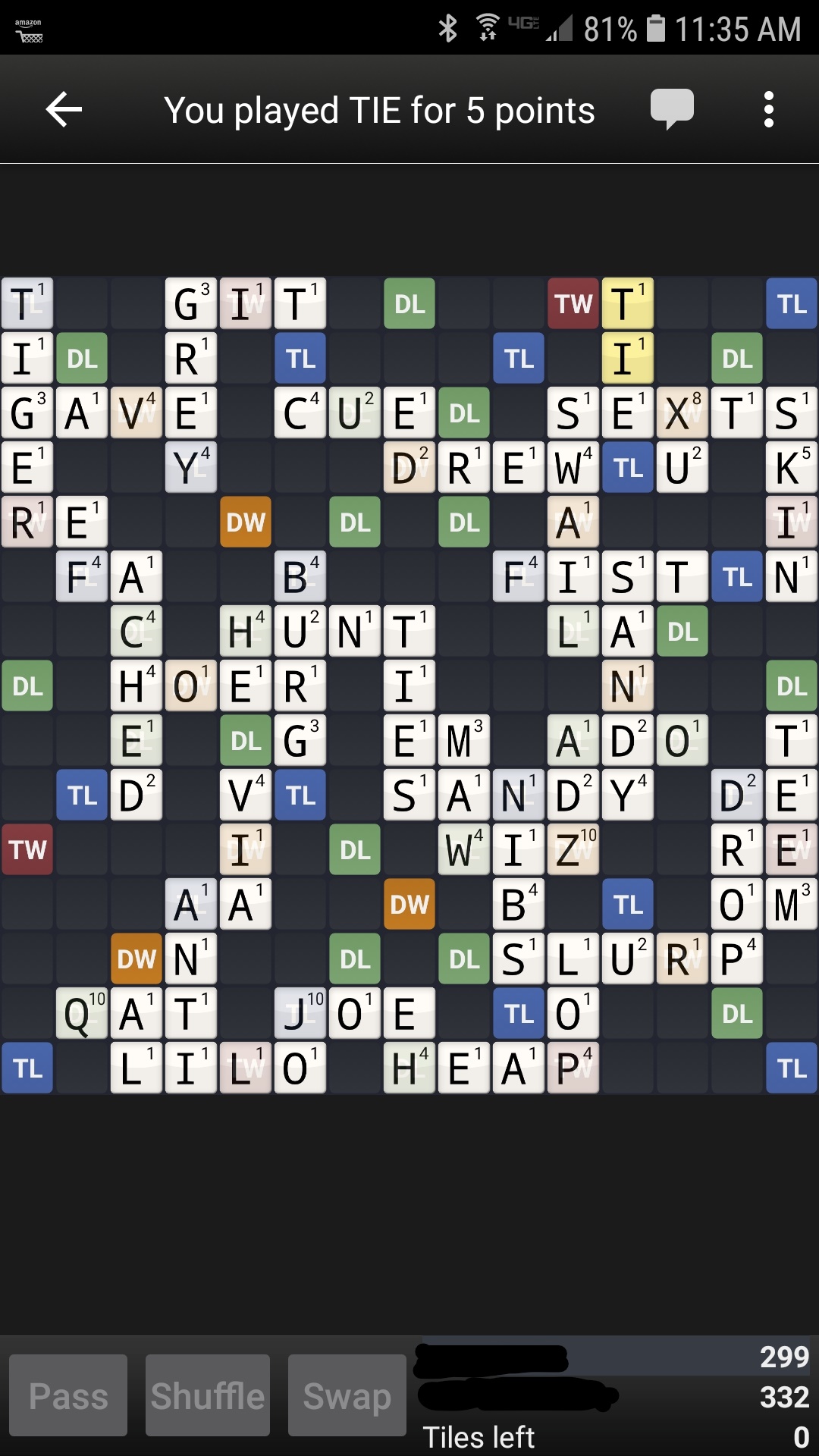
I play a Scrabble-like word game online. One person I play with kills me, I mean decimates me, I mean against him I have a batting average of .166, and probably I won the games I won only because he was not paying attention. Overall my success with this game (like my life, one could argue) is all over the map. The beauty (or curse) of online play is that it keeps track of wins and losses, from which my simple calculations reveal my current averages of .853, .714, .636 (i.e. usually I win these games, but not always), .262 and .315 (besides the .166, usually I lose these, but not always) and .533 and .555 (neck in neck).

A recent game looked like this. I lost. (Bravo, Nancy!)

Screenshot_20181211-113554_Wordfeud_LI.jpg

The statistics do not reflect whether you lose by 33 points or by 3 or by 147. If you lose, you lose. That’s the way games work. That’s life. (Deal with it.)

I am not a super competitive person and do not stress about the score or the win-loss stats. In fact I seldom look at them. Today was the first time (for the sake of this post) that I calculated my batting average. I do not take great joy in beating someone. Nor do I lose sleep over how poorly I stand up next to opponents who make short work of me. I just play. It’s a game.

But in the years I’ve been playing it, I’ve learned a few tricks such as not flippantly using valuable letters like S, J, Q, Z and H, not setting up your opponent for an easy triple, and playing parallel rather than perpendicular words whenever possible. I’ve learned that OK is not an acceptable word but OKAY is. I’ve learned (and try to remember) words like KA, XU, EME and QAT. Unlike the board game on your coffee table, the online version allows you to keep trying combinations until you get one that works. Sometimes you simply don’t have the right letters. Sometimes you say “I didn’t know HOER was a word!”

Against one person I am batting 1.000. 14 wins, 0 losses. Good for me, bad for him, right? Poor fellow. A wonder he still wants to play, wouldn’t you say? It all started when, not long ago, I told him about the game and he said he wanted to play. You’re the writer but I know how to play, he said. Being a writer has nothing to do with it, I tried to tell him. The three people who clobber me the worst in Scrabble or Wordfeud (you know who you are!) are not writers. Instead, they recognize and remember patterns (including spellings) and they play strategically, blocking my moves and setting up their own. Sometimes you get lucky and all the letters you need for a great word are just there. Yay! Sometimes you have them but you have no place to put them! Sometimes you have awful letters, and you have to make the best of it.

Back to: “in the years I’ve been playing.” Some people play solitaire in their idle moments, some check the weather, some text their friends. I play Wordfeud. With time and practice, my game has improved. I tried to tell this to my batting-1.000 opponent. I tried to say You are new at this. I have been playing for years. Give it time. And I tried to give him hints, such as never getting one point for an S. Be careful with S’s. They are very valuable.
The first time he said “I give up” during a game, I said “You don’t have to play.” No one was holding a gun to his head about it. He kept playing so I assumed he was willing to try to learn the tricks and the strategy and the obscure words. There is no other way to learn, right? Experts don’t fall from the sky, as they say in German. In my early days of playing tennis, I played as much as possible with people who were better than I was (if I could get them to want to play with me) because you get better by playing with someone who is better than you are. You write better by reading the prose or poetry of someone who writes better than you do (and paying attention and trying to learn from their mastery). You cook better by following the guidance of someone who cooks better than you do. You build a better bench by working with someone who has made a bench before.

You don’t necessarily win the Wordfeud game (or make it to the USOpen, or write a Pulitzer Prize winner, or land your own cooking show, or remember how to use the biscuit joiner next time), but you get better, and in the big picture, this is what you want.

Near the end of our most recent game, he said “I give up” (again) in the game’s chat function.

“Why?”

“I don’t know all the secret words like Qi and have no chance because of that.”

I don’t know how anyone could think that after only 14 games, they should know what they need to know and have learned what they need to learn. I should perhaps have had more compassion, or at least more empathy in regard to his bruised ego, but I felt disappointed. I am a slow learner myself and have played hundreds of games to get to my own particular skill level, and I have absolutely no doubt that Mark, Lincoln and Samuel would still kill me if we played a game tonight. But they wouldn’t kill me as bad as they have in the past!

What I know for sure is that you don’t improve if you give up. You don’t succeed if you give up. Just ask Michael Jordan.  “Twenty-six times,” he will tell you, twenty-six times he was “trusted to take the game-winning shot and missed.” He failed sometimes, he failed miserably sometimes, but he kept on playing. Ask J.K. Rowling or Warren Buffet* or any of the highly successful people in the world who got to their pinnacle only after many failures, devastating failures, failures that would cause other people to give up.

Granted, there are times when giving up is the right or expedient or sensible thing to do. I’m not saying you should do your own wiring if you are not comfortable with the fuse box. Or that you should enter a marathon if you can’t run a 5K. But if you set out to learn something new or do something new or improve something you do only marginally well, there will be failures, stumbling blocks, challenges, points of frustration – whatever you want to call them. They are par for the course, a term borrowed from golf meaning the normal or expected. It is normal to fail sometimes. Unless you fail sometimes, you won’t improve. Failure is a good teacher if you don’t let it debilitate you.

You want to learn a game? Play the game. My friend Fred played golf yesterday when it was 38F – rather nippy! – but he is determined to improve his skills, to learn to play better than he does now. When I told him I played tennis in the cold many times, he asked, “Did people call you crazy too?” Maybe, but I didn’t care.

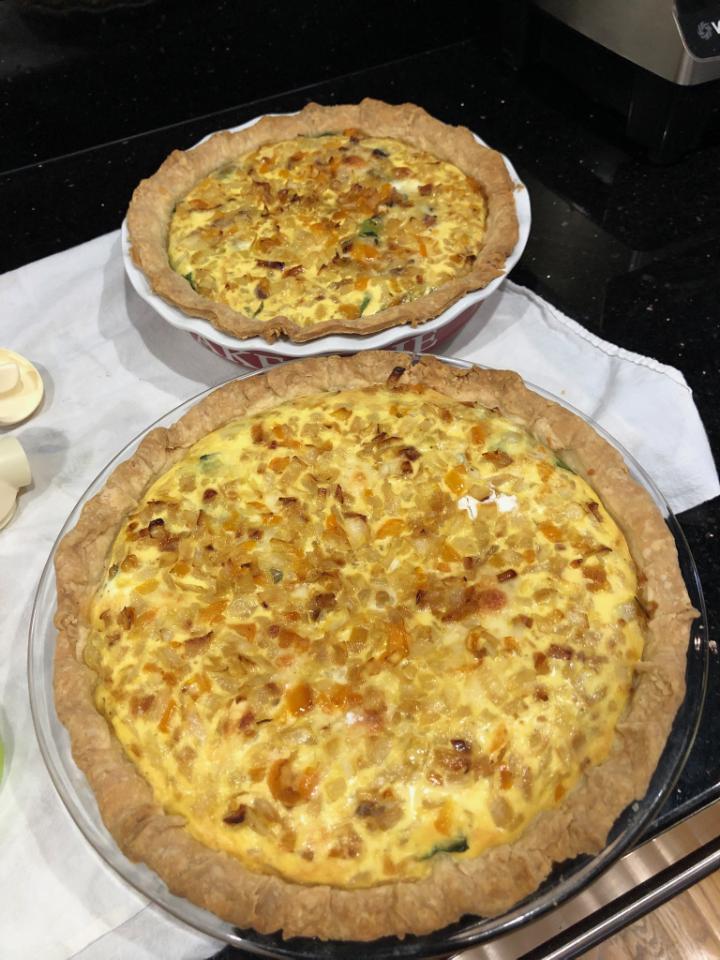
You want to learn how to cook? Cook something. My friend Millicent made a quiche the other day with ham, bacon, cheese, spinach and onion. She was super excited not only that it turned out super well but also because “I feel like I accomplished something today.”

Millicent's quiche.jpeg

Fred and Millicent are not sitting around wishing they were good at golfing and cooking. They are golfing and cooking – tentatively perhaps, with full knowledge that they have a ways to go perhaps – but they are golfing and cooking.

Golf, cook, play, tinker, build, write, DO whatever you enjoy and want to get better at. Just keep doing it.


*Many thanks to Jeff Stibel for his wonderful Profiles in Failure articles.

Pug Meets Pig

You have to wonder about dogs sometimes: what matters to them, why they get excited about this but not that, how they process our interactions with them. For the moment, this is the dog I’m talking about. Coco, what’s going on inside that funny-looking head of yours?

up close.jpg

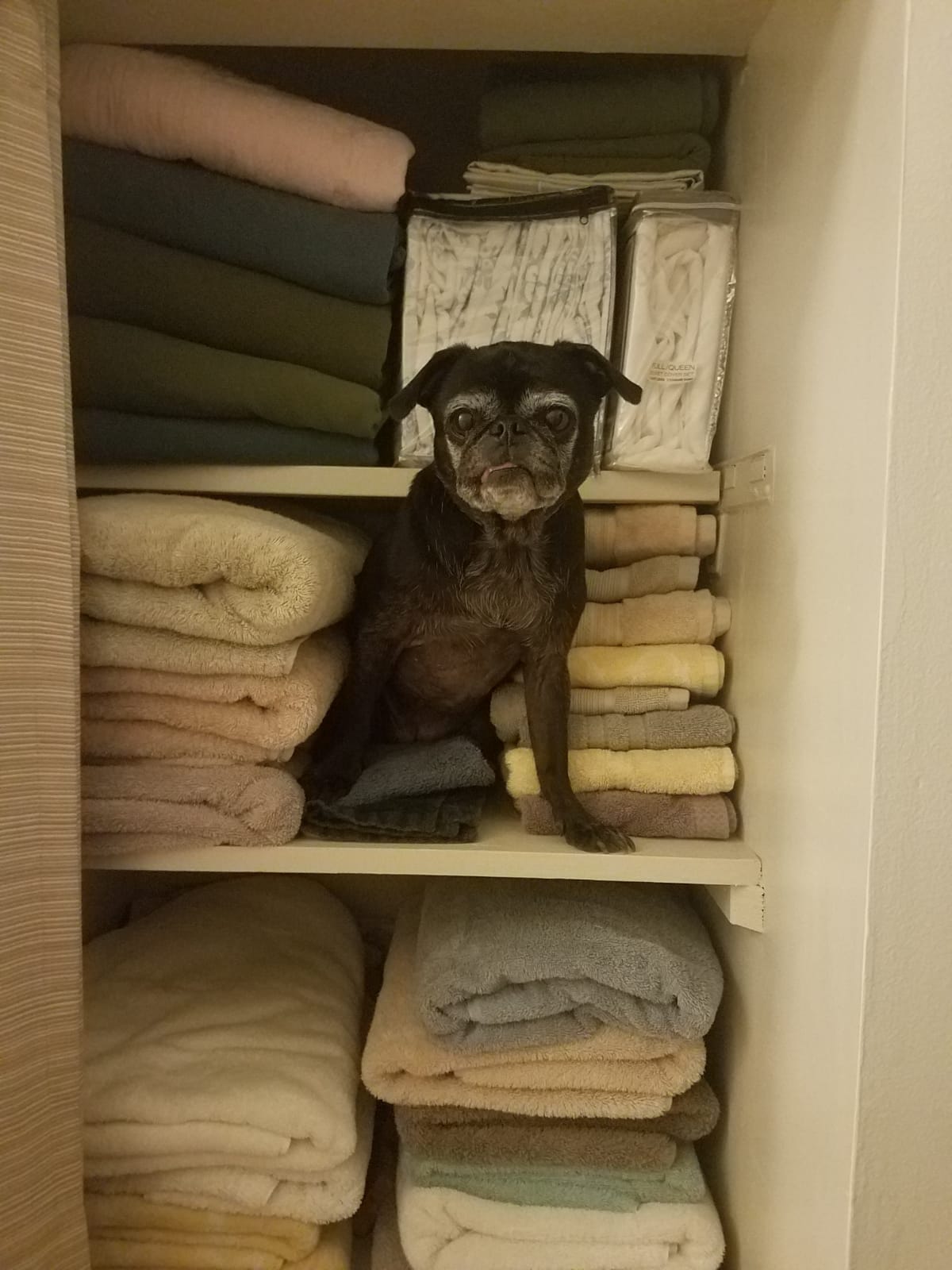
Samuel presents her with various challenges such as putting her in a closet…

in closet.jpg

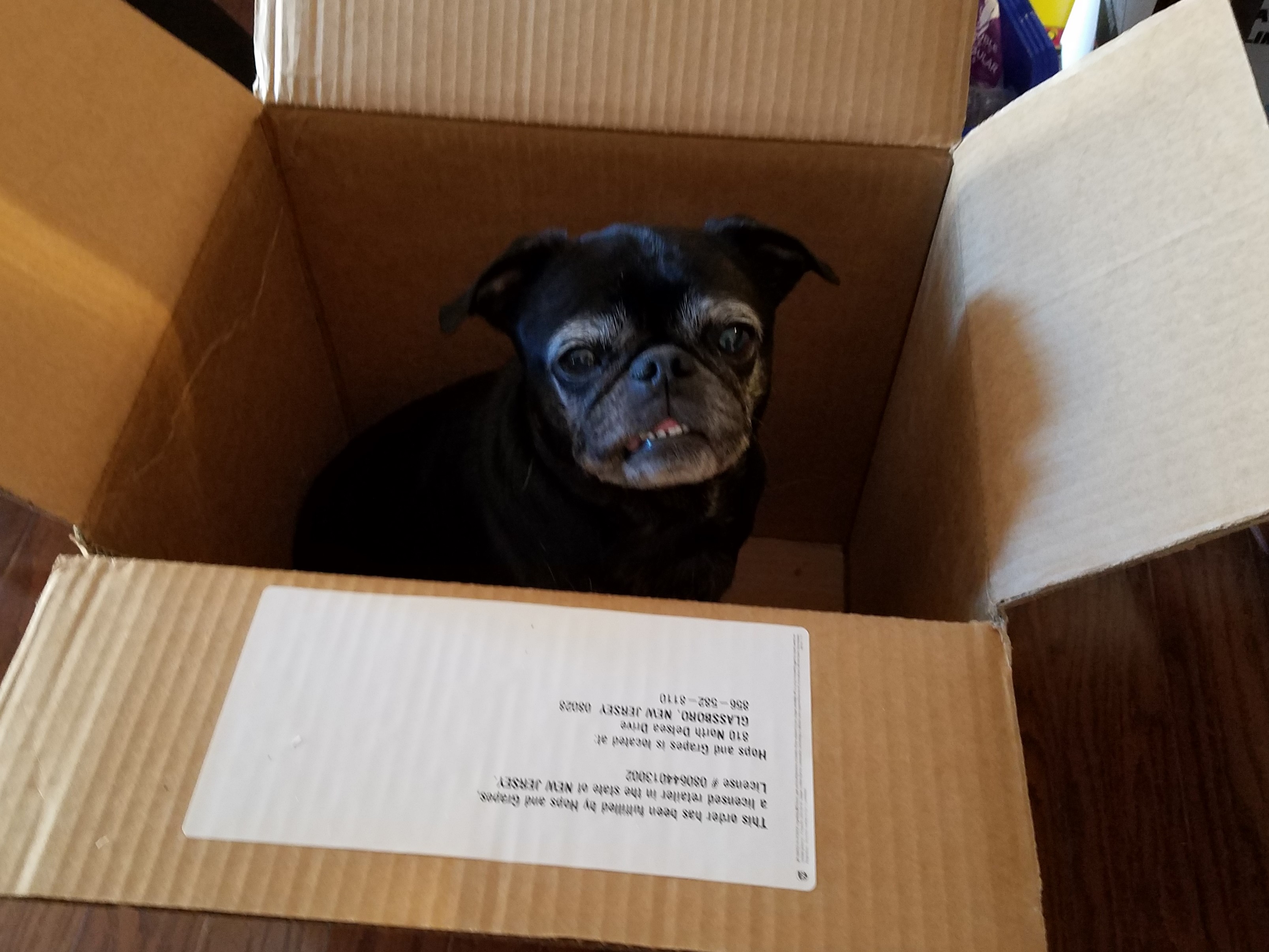
… putting her in a box…

Coco in box (2).jpg

…and standing her on a bookshelf.

Coco on bookshelf.jpg

Does she care? Is she saying to herself (in whatever way pugs and other dogs say to themselves) What’s up with these humans? I was just trying to have a nice nap. Is there any good reason to be bothering me right now?

The questioning goes two ways. Much as I expect she is clueless about our behavior sometimes, about why or how she ends up in a closet or in a box or on a shelf, we are equally clueless about her behavior. Let’s go for a walk with her.

At this time of year my gravel road has lots and lots of fallen leaves along the sides. The cars going by, few as they are, must provide enough air movement in the right direction for the leaves to land everywhere except in the road itself. For whatever reason, these leaves are really interesting to Coco. There’s a treasure of a smell every few steps it seems.

But okay, let’s keep going because down the road a piece there are, right now, two very large and amusing pigs to visit.

pigs9.jpg

My neighbor Tracy’s very well cared for and fortunate pigs wander around their exceptionally spacious (for pigs) fenced-in area all day looking for acorns they missed or taking a snooze in a patch of sunshine. They seem to love visitors. You approach and they come. You are something to do, an attraction, a point of interest.

Hello! (I love this picture!)

pigs3

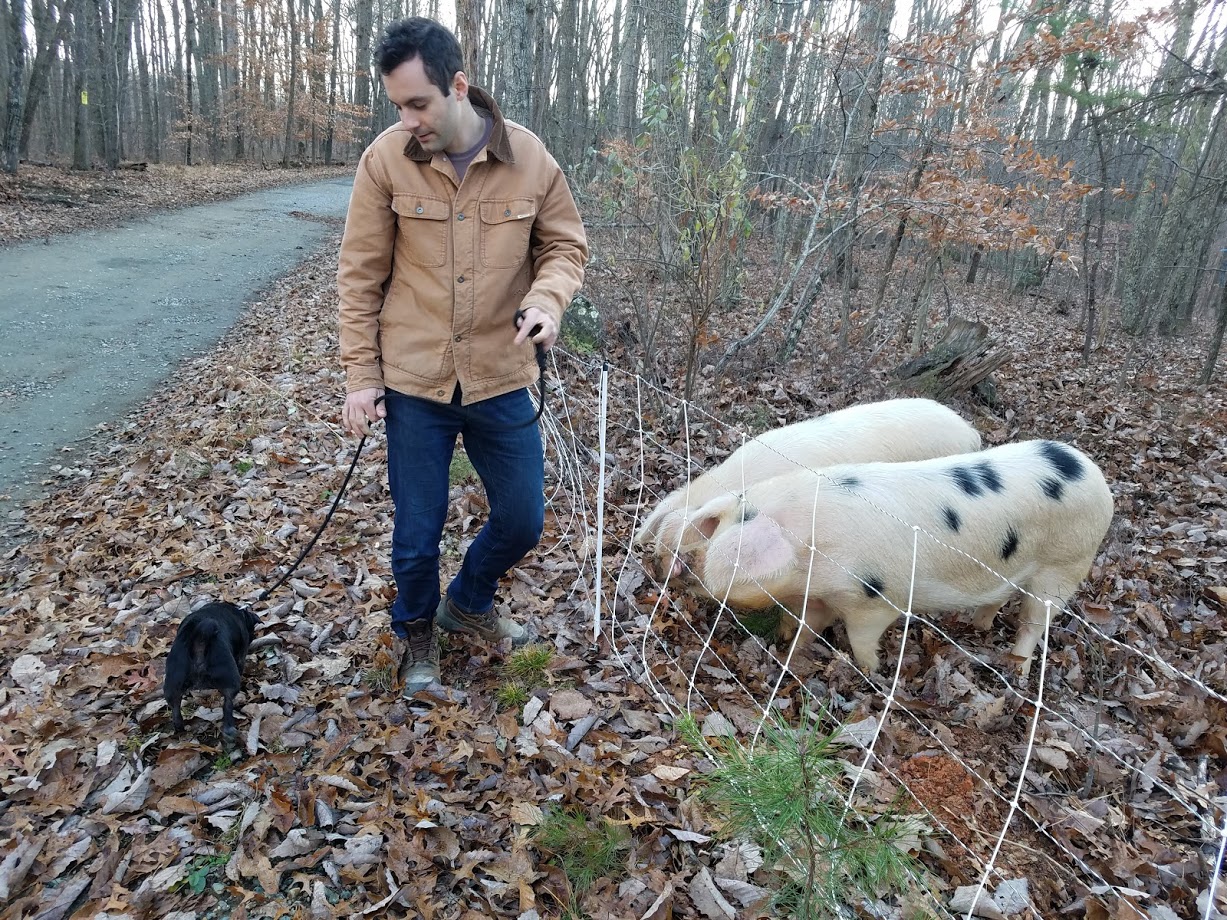
A few days ago Samuel and I took Coco with us on a walk. We were curious what would happen when the pug would meet the pig(s). Initially, what happened was exactly what you would expect to happen.

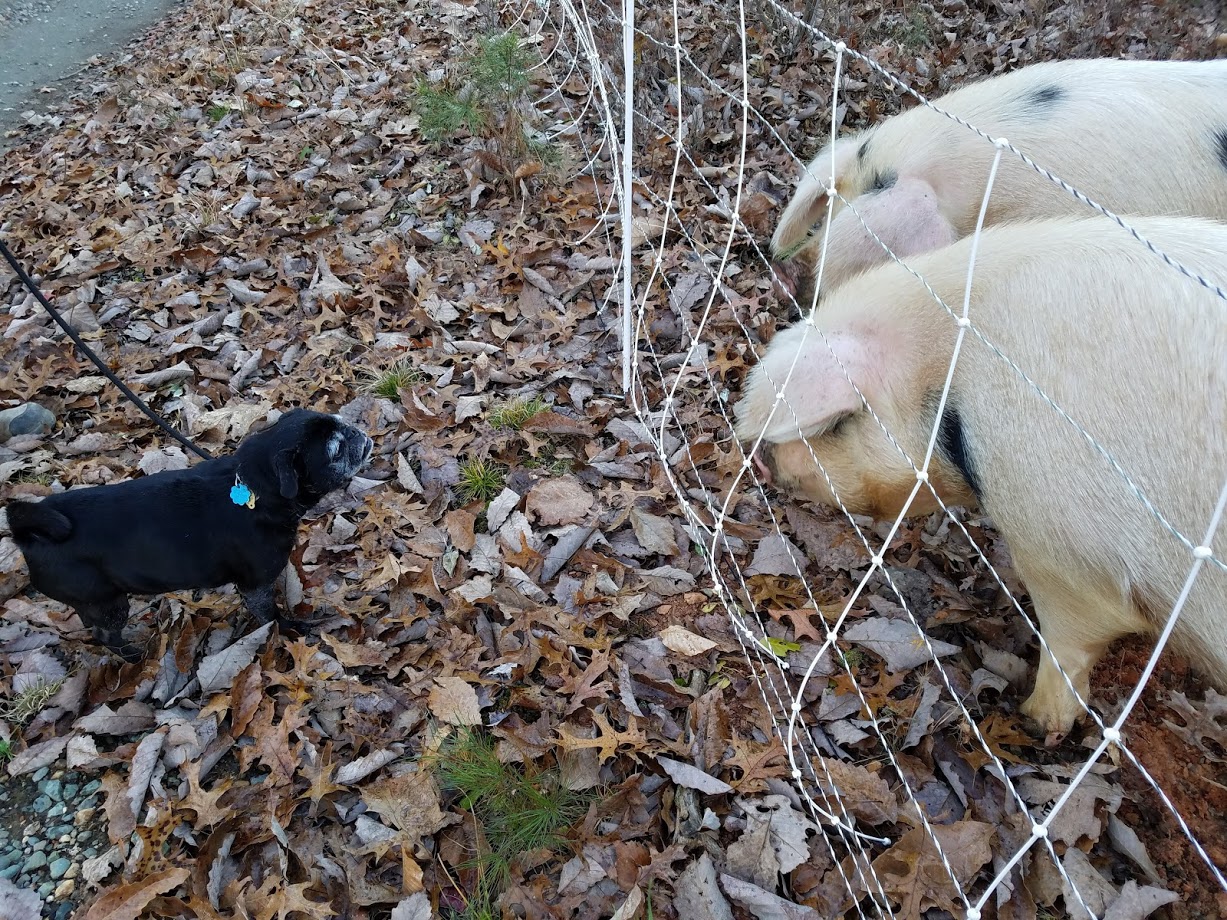
Uh, hello, what on earth are you?

2.jpg

The pig approached, and they sized one another up. You have to assume more olfactory activity than we could ever imagine (especially with a nose like that!), and who knows what, besides the intense and new smells of each other, they notice. Curiosity lingered a moment, then they both decided to get a little closer and the other pig joined the party.  Hmmm, similar nose, different color, different size, different ears!

Pig 1: Hey, sister, what’s happening?…. What IS that??

7.jpg

Pig 2: I don’t know. Looks like an alien. Vaguely familiar nose though.

Coco: I beg your pardon!

Pig 1: Why is it here? What does it want?

Pig 2: Doesn’t look edible.

Pig 1: What good is it if it’s not edible?

Coco: Hey, watch what you say about edible!

Pig 2: Gotta admire that nose though, smooshed flat the way a nose should be.

Pig 1: It has the nose going for it, I agree. Maybe it wants to play?

Coco: Oh, look, these leaves smell so marvelous!!

And off she went! No longer interested in pigs! Practically perfect pig pals, no less!

Pig 2: Was it something we said?

uninterested in pigs.jpg

Really, Coco?

Coco: If you knew how amazing these leaves smell, you would be on your hands and knees with me! I know that’s a pain for you, bending those ridiculous long legs so you can get to a reasonable height off the earth. The human design is so unhelpful when it comes to smelling leaves and other super important things. By the way, this is super important and I don’t mean to be rude but… busy here!

The preoccupied, party-pooping (possibly pampered) pug pursued personal priorities while these pleasingly plump, perfectly peaceful, pleasantly personable pigs at the pinnacle of their porcine pudginess pondered a plan to play! Positively perplexing!

Isn’t it the same among family and friends though? We get why the people we know or encounter do some things, many things even, but sometimes their behavior is incredible, bizarre, mysterious, absurd. Why, for example, do some people choose vanilla when chocolate is available? I will never understand!

I recently came across a marvelous, short Alain de Botton video about marriage and partnership that makes a similar point about confusing-behavior reciprocity, a.k.a. tolerating each other’s quirks. Why does my husband/ wife/ partner/ girlfriend/ boyfriend/ friend/ colleague/ neighbor/ dog (!) do [….X….]? Weird! Maddening! Crazy! Or maybe just Confusing. Inexplicable. Bizarre. Absurd…

The fact is: You see the other person’s issues much more plainly than you see your own. You have things to tolerate which do indeed get under your skin, and you forget that you (most likely) get under their skin sometimes too.

Why does Coco care more about the leaves than about the pretty pigs? Whoever knows! But she does, and from that moment forth, the pigs didn’t exist for her. Eh. Pigs. Smelled one, you’ve smelled ‘em all. So what. But these leaves!!


A Smart Phone at 88

Last week Jerry decided to get a smartphone. I give him a lot of credit. His jitterbug served him well. It made and received calls the way a landline can’t – he could take it with him when he left his house and it would work. But he wanted a smartphone, so we went to Verizon and got him a smartphone. Jerry will be 89 in January.

Jerry phone.jpg

Going through this process with him, helping him choose one and then, most importantly, figure out how to make a call, has opened my eyes (yet again) to the things we take for granted, the things we have learned but don’t remember we actually had to learn, the things that are not as self-evident as they might appear. For example:

Your smartphone can be “on” but not “on” and “off” but not “off.” The power being on and the home screen being visible are two different things. Another way to look at this is that the phone can be on but the screen can be off. Problem is, when the screen is off, it looks like the phone is not “on” (though it might be and probably is, but it depends on whether the power is on). The little button on the side (or the back, or the bottom, depending on where it is on yours) turns the power entirely on or off only if you hold it down/in long enough, but once the power is on, you have to press that same button – but not for as long! – to get a visible screen and for your phone, which was “on” before, to appear “on.”

The amount of touch, the very weight of the tip of your finger on an icon so that you can get from one screen to another, is not intuitive. Those of us who graduated from one cell phone to the next don’t realize how we have adapted to the incremental changes in technology. Somewhere around here I have my first cell phone, a gold-tone Nokia that I could not find to take a picture of (but I did find some scarves I was missing!!). I got that Nokia in 2001, and all the buttons were physical – you pressed them and heard a click and that made something happen. My next phone was a flip phone – how cool was that!? – physical buttons still, and with three letters of the alphabet on each of the number pads, you could even text. (You may remember that you had to hit the 1 once to get A, twice (fast) to get B and three times (fast) to get C, but hey, we could text!!) From there I went to a flat screen where there are no physical buttons. That was a bit of a learning curve, but I needed it for work and everyone around me seemed to manage it, so sooner or later I got comfortable with that too.

But you have to get-to-know and practice-til-perfect how much pressure to place on a given icon. On my phone, if I hit the green phone icon in the bottom left corner lightly (see the green phone icon with the little 1 showing one missed call?),

Screenshot2.jpg

I get to my phone list. Touching that icon with just the right amount of pressure takes me to the screen that can toggle between RECENTS (a reverse-chronological list of calls made and received) and CONTACTS (my full phone directory including all numbers I have saved in alphabetical order).

If I hold the tip of my finger on that same icon too long, I don’t get to my phone list. It gives me other options:

Screenshot1.jpg

These other options have their place , and I might even use them someday, but if all I want to do is make a call, and I get these other options instead because I didn’t judge the amount of finger-pressure right, I might (rightly) get frustrated. And it’s not just the phone icon that gives you other options when you hold it down longer.

Randomly hitting buttons will affect your phone’s operation. When Jerry first got his phone, I spent an hour or so with him going over HOW TO MAKE A CALL. I wrote it down step by step, which thing to press and what you will find when you get there. Repetition, repetition, repetition is the name of this game. I came back the next day and found numerous screenshots in his gallery. He does not know what a screenshot is, let alone how to make one. But clearly he hit the home button and the power button at the same time – numerous times – and inadvertently made numerous screenshots.

This morning Mom called me to say that the two of them were “practicing” making calls, but his phone wasn’t ringing. It was just buzzing. Sounds to me like he turned the volume off, Mom. And I walked her through finding the Volume Up button and pressing it until she saw the horizontal blue volume bar that appears at the top get increasingly longer. Oh, that works. Clearly he hit the Volume Down button enough times to inadvertently turn off the volume.

When to swipe and when to touch is not intuitive. When your phone rings, swiping (starting at the larger green phone icon that appears on the lower part of the screen) is the way to answer it when it is not currently in use – i.e. when your phone is either not “on” in the visible screen sense or is not currently occupied with a different app(lication). Touching (the smaller green phone icon that appears on the upper part of the screen) is the way to answer it when the phone IS currently in use – i.e. when your phone is “on” (in the visible screen sense) and is currently occupied with a different app(lication) such as you are in the middle of texting someone or you are reading a restaurant review.

But who thinks this through and realizes the difference? Again, those of us who have been incrementally learning this stuff have learned to swipe when the green phone icon is big and there are arrows moving in the direction of the needed swipe and to touch when the green phone icon is small and the tiny word ANSWER is underneath it. If you are new at this, if you have never used a touch screen before, you don’t necessarily, intuitively, know when to swipe and when to touch. As Jerry puts it, you just want to answer the damn phone.

The challenging nuances of making a call seem unnecessarily cumbersome until you are familiar with the process and have begun to appreciate the value of the many options you have regarding each and every call. But think about it, a four-year-old can learn a foreign language much more easily than an adult of almost any age. Likewise, making the switch in one leap from a mechanical device that serves simply to make and receive calls to an electronic device that can also turn your lights on when you are not at home, track your children’s precise whereabouts and translate a piece of foreign text in a flash is a very big leap.

My Aunt Judy put it well in an email to me this morning:

It’s tough “teaching” us “oldies but goodies” stuff that’s technical, but what goes around comes around. I remember trying to tell my aunt how to operate the “stereo” (young ones probably don’t even know what that word is ??????). Anyway I kept thinking, “But it’s so simple!”  Oh well, now it’s me – you tell me, and it sounds good, but will I remember it tomorrow????   Hey, we oldies are happy to have our feet hit the floor every morning.  

Amen to that. Let us ALL be happy to have our feet hit the floor every morning!

A Saint Barbara Day Cake!

Last week Mom told me she was invited to a “tiny tea party” on December 4, St. Barbara’s Day, a party that included all the Barbaras who live in her community. The host is a Barbara who has been hosting Barbara tea parties since starting the tradition in Park City, Utah, in 1999. What a lovely idea!

I asked the host if I could come and take a few pictures. Here they are posing with a cutout of Marilyn Monroe, whose real name was Norma Jeane, not Barbara. Whatever. You don’t get to pose with Marilyn every day.

ladies.jpg

And again the Barbaras at the table with Norma Jeane looking on – see her in the mirror? (Another Barbara came later and another had the date mixed up.) During the party, Host Barbara (in red) showed them various St. Barbara items she has collected over the years and even gave them a crossword puzzle entitled “Barbaras We Have Known.”

ladies at table.jpg

“St. Barbara was quite a lady,” Mom’s invitation had said. Indeed she was. Virtuous, beautiful, locked in a tower by her self-serving father, Barbara of the legend lived in the third century, converted to Christianity (when that was not the thing to do) and was publicly humiliated and finally beheaded, thus the head she holds in her hand.

st barbara.jpeg

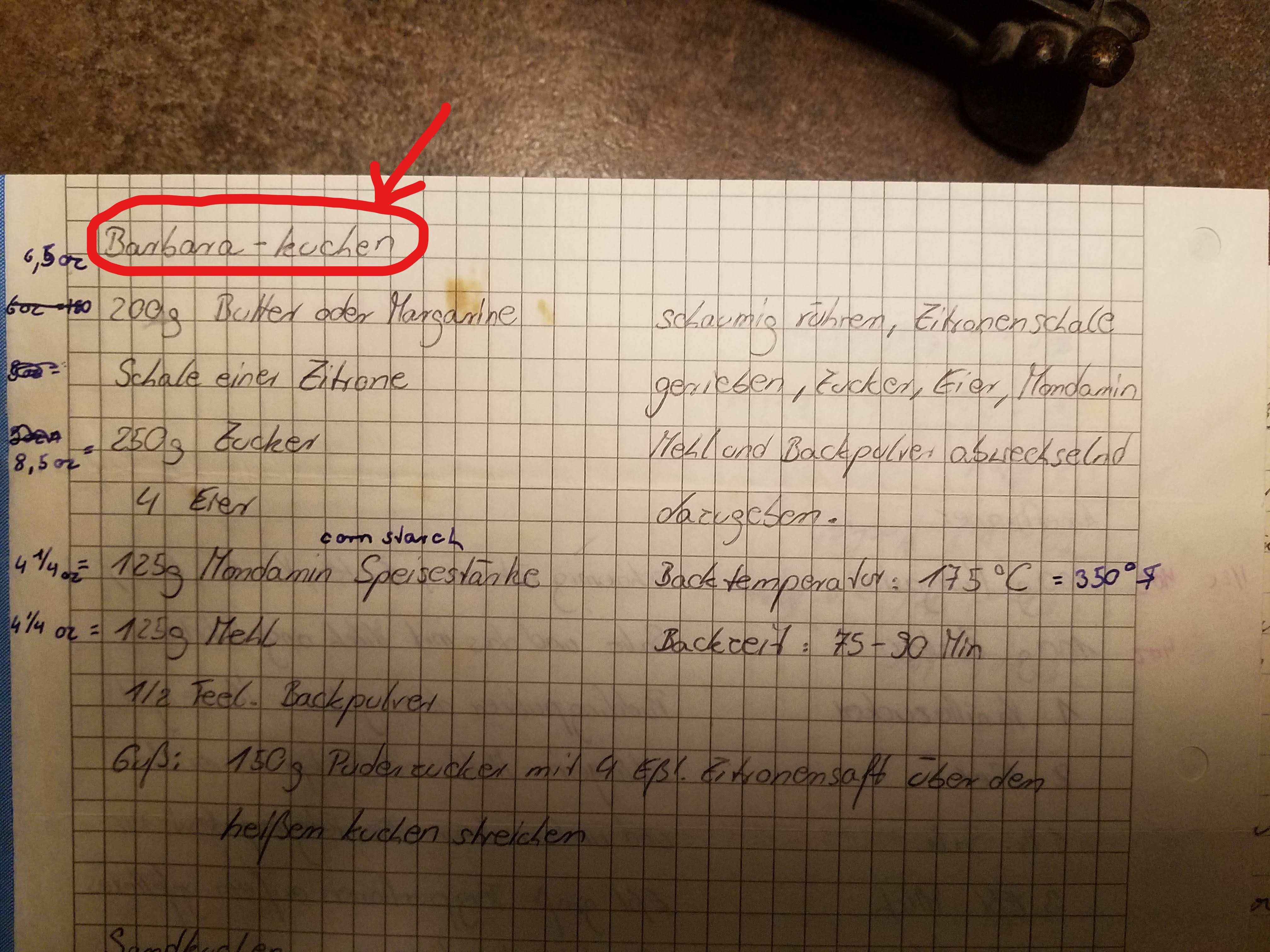
For many years I have had a recipe in my cookbook for Barbara-kuchen, or Barbara cake. The handwriting is my friend Anett’s, who lives in Germany, where St. Barbara is more widely celebrated. It’s really quite a simple cake, even if it looks unintelligible. The main thing is to see that it says Barbara-kuchen at the top.

recipe_LI.jpg

As a way to thank the host for allowing me to come take pictures at her tiny tea party (and a wonderful excuse to bake), I decided to make the cake. Ingredients are:

14 Tablespoons butter, softened
the grated rind of one lemon
1 cup sugar
4 eggs
1/3 cup corn starch
1 cup flour
½ teaspoon baking powder

You soften the butter (in my microwave this took 1 minute 20 seconds on defrost), add the sugar and eggs, and whisk it till creamy. A hand mixer would have been handy at this time – for such a small amount of batter I didn’t want to get out my big, wonderful stand mixer, but I had to beat the ingredients with a good bit of wrist action to get the fluffiness I wanted. If you have an electric hand mixer, or your stand mixer on the counter, it’s better to use it.

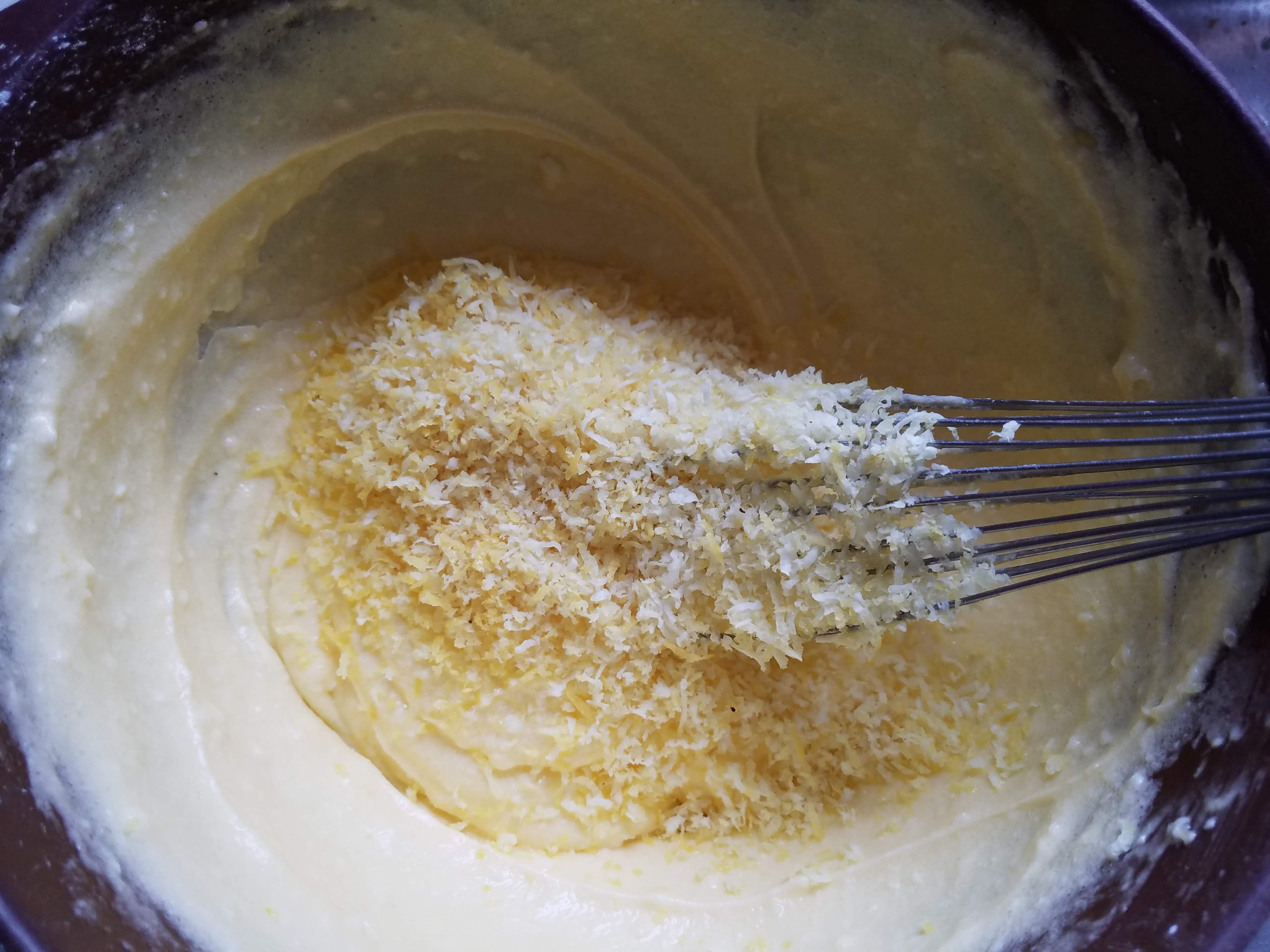
I added the lemon rind after that. You can see the teeny bits of butter still in the batter (my wrist is only so strong). I decided it didn’t matter and kept going.

adding lemon peel.jpg

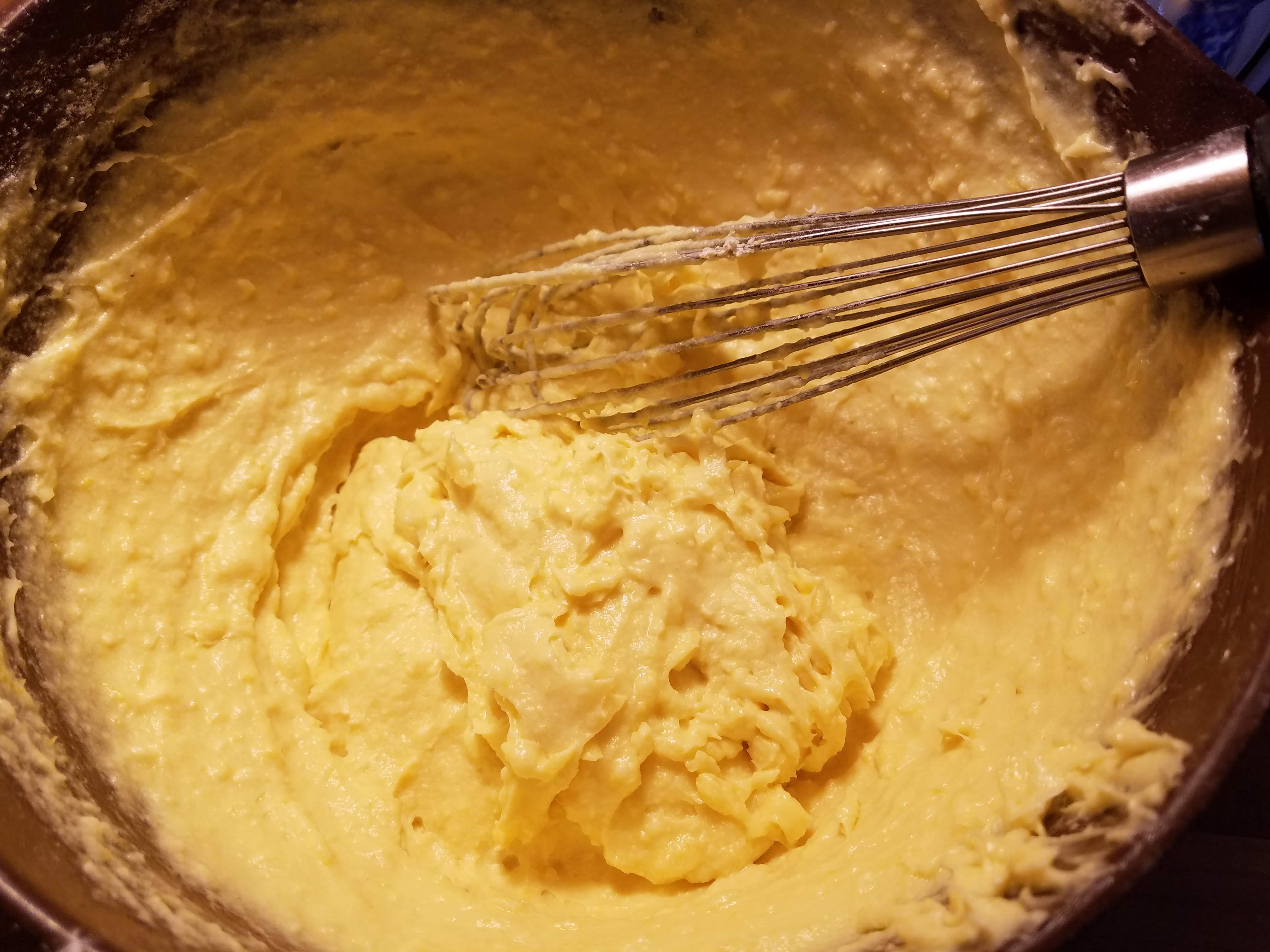
By the time I added and stirred in the rest of the ingredients, it looked like this.

batter.jpg

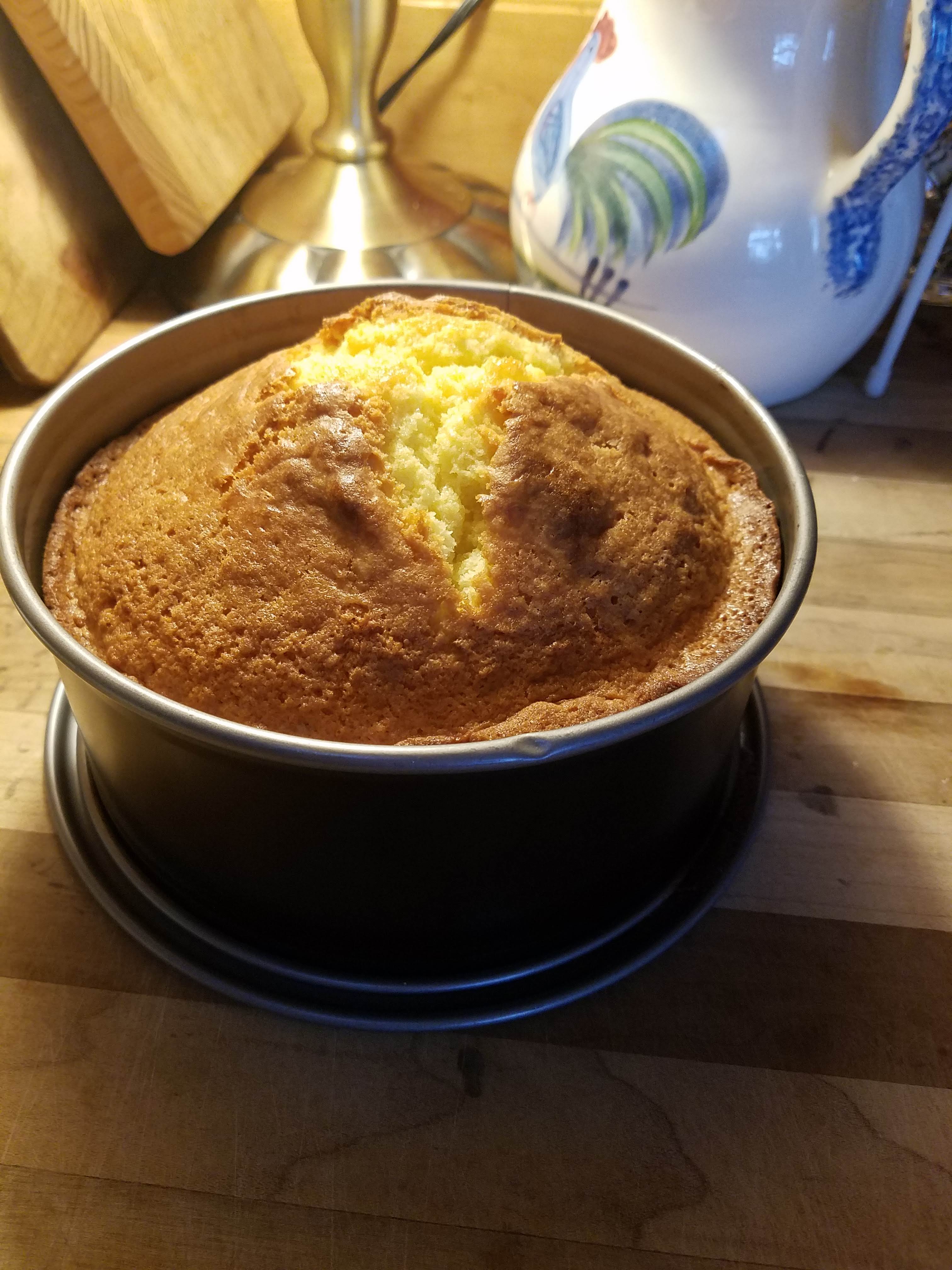
Those amazing eggs of mine made the batter so golden! I chose a small springform pan to bake this cake in because, Claudia tells me, traditionally in Germany the cake is baked in a “Kastenform” resembling the tower in which St. Barbara was imprisoned. I reasoned that a larger pan would make a flatter cake and a smaller pan would make a taller cake, so I went with small. My pan is 7 inches (18cm) across and 3 inches (8cm) high. I baked mine for 35 minutes at 375F (a toothpick inserted came out clean). I see now that the recipe says 350F. I missed that earlier.

But it came out okay. See? Bit of a tower, no? (Use your imagination now…)

cake in pan.jpg

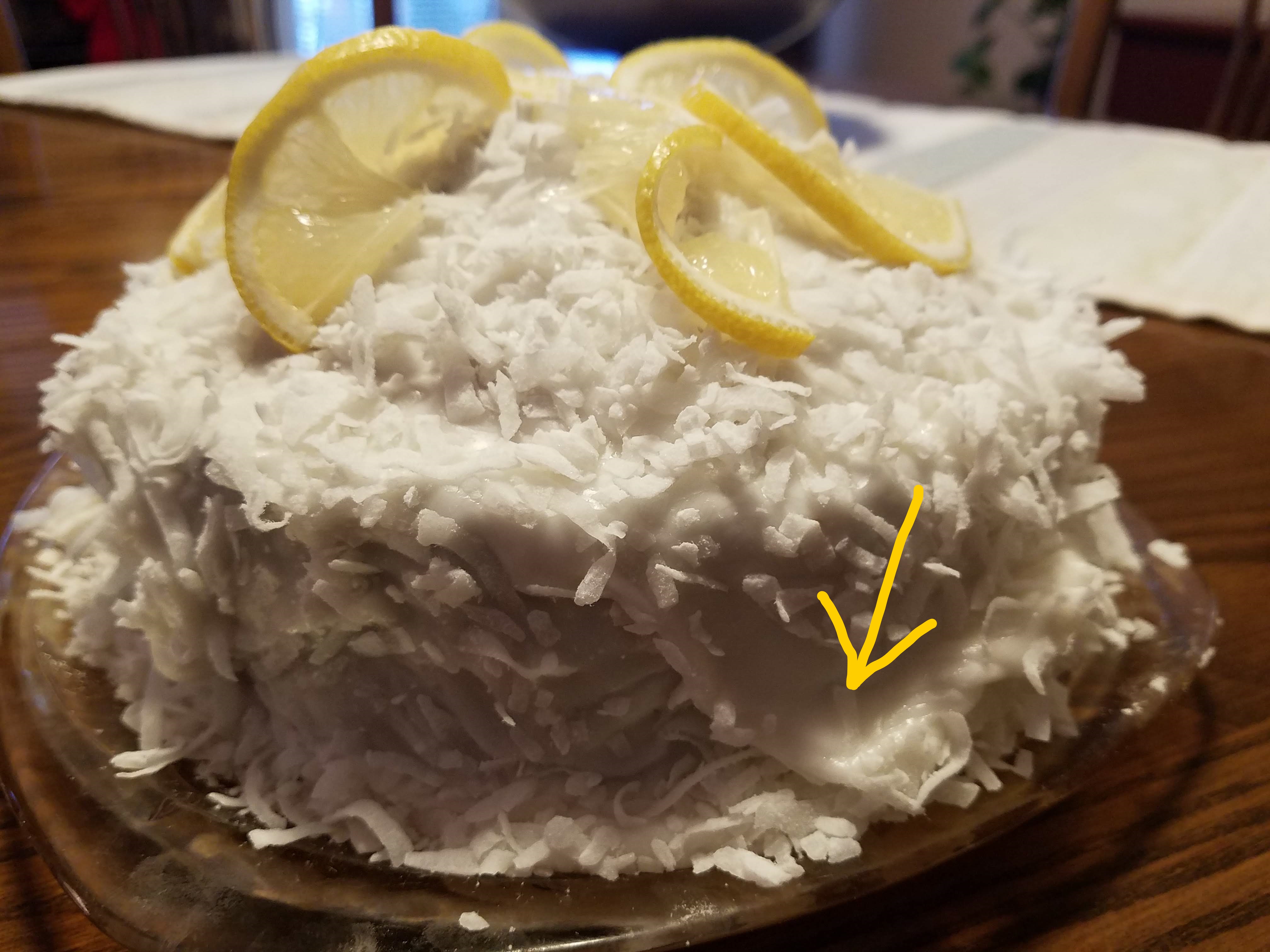
I made the frosting with the juice of the same lemon I grated plus enough confectioner’s sugar added little by little until it seemed stiff enough. I can’t tell you how much sugar. I was in a hurry trying to get to this party in time!

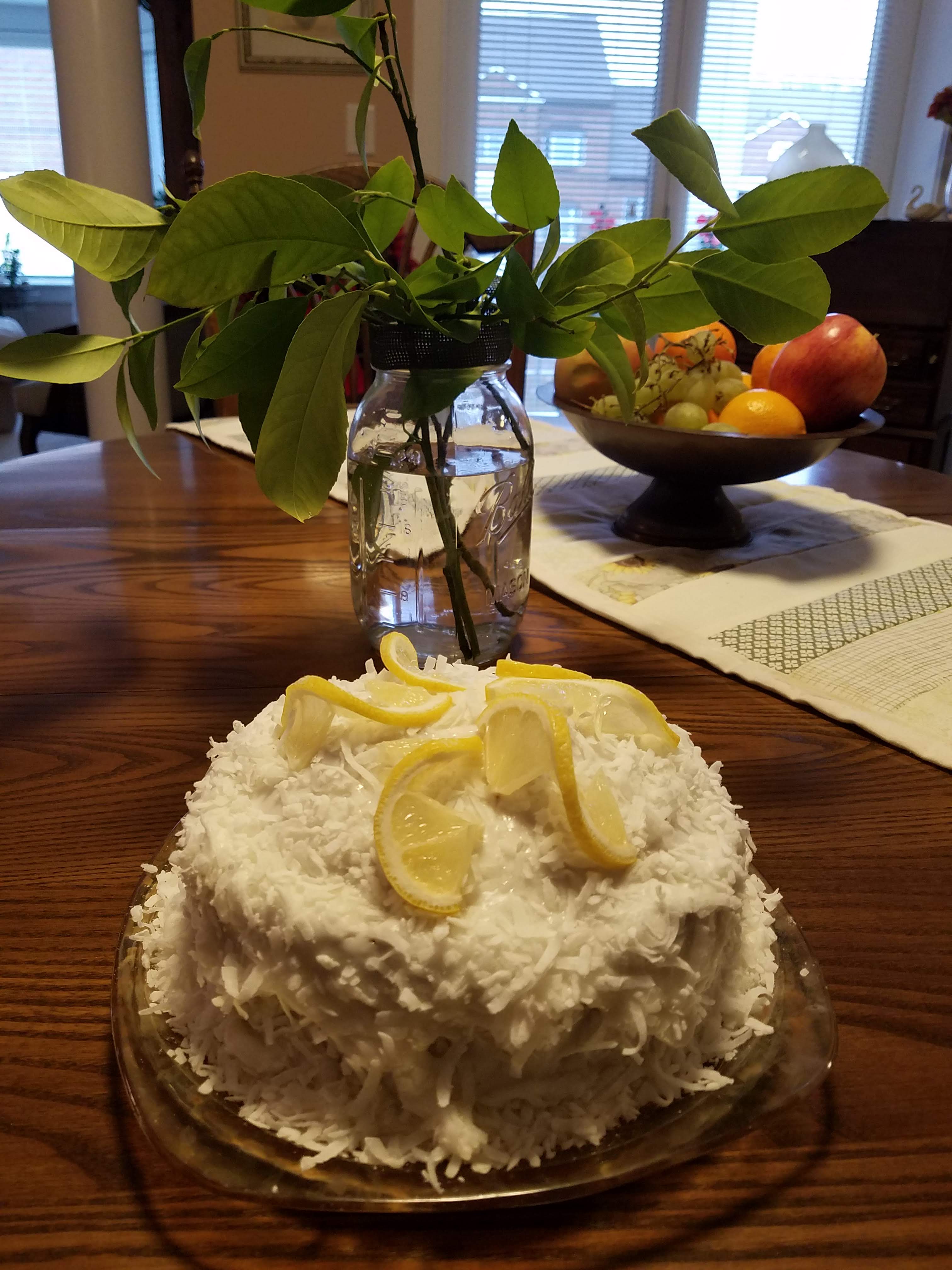
After I put the frosting on, I realized it was not stiff enough, in fact was beginning to sag a bit down the sides, so I decided to remedy this by adding a lot of coconut all over it. Anyway you can’t go wrong putting a whole lot of coconut on top of lemon frosting that is covering a lemony cake. You just can’t. Then I thinly sliced another lemon and twisted them to make the cake pretty on top (as if loads of coconut is not inviting enough). Here’s the cake on Mom’s table before we went over to the party.

cake1.jpg

See those leaves in the jar behind the cake? I brought them too because of another part of the legend. It is said that on her way to prison, St. Barbara got her robe caught on a small cherry branch and it broke. Somehow the branch was put in water and then a new blossom opened on that branch on the day of her execution – the stuff of legends to be sure! I cannot imagine she was allowed to bring her broken cherry branch into the 3rd century prison with her and that someone gave her a jar with water in it, which she then used for her branch until they took her away. But what do I know — maybe this happened!

There is a lot I don’t know about 3rd century prisons. It is not useful to be sticklers about unknowable information like this. Just know that if you cut a branch (cherry or apple traditionally) on December 4, it is supposed to bloom by Christmas. I don’t have a cherry or apple tree, and neither does the community where Mom lives, so I brought branches from my lemon tree (thinking there’s lemon in the cake, so why not lemon?).

I want you to see how droopy my frosting was.

cake drippy_LI.jpg

Time was not on my side, as I said, so I let it go. Anyway, I decided, it would taste the same (delicious I hoped!) and I am not trying to win any pretty-cake contests. Things that are made with love don’t have to be perfect.

To all the Barbaras, but especially to my mom (the best Barbara ever!), I wish a Happy Saint Barbara Day!

What We Do With Obstinate Ketchup

Some people think it’s an abomination to put ketchup on meatloaf. We don’t. We draw the line at putting it on quiche, or mac and cheese, mind you, but meatloaf is fair game. Last night Mom made meatloaf and had invited me and Samuel to come. I have discussed Mom’s amazing meatloaf in another post and there was nothing disappointing about last night’s. In fact, as Mom’s meatloaf goes, this one was exceptional. But it was the ketchup that caught my attention.

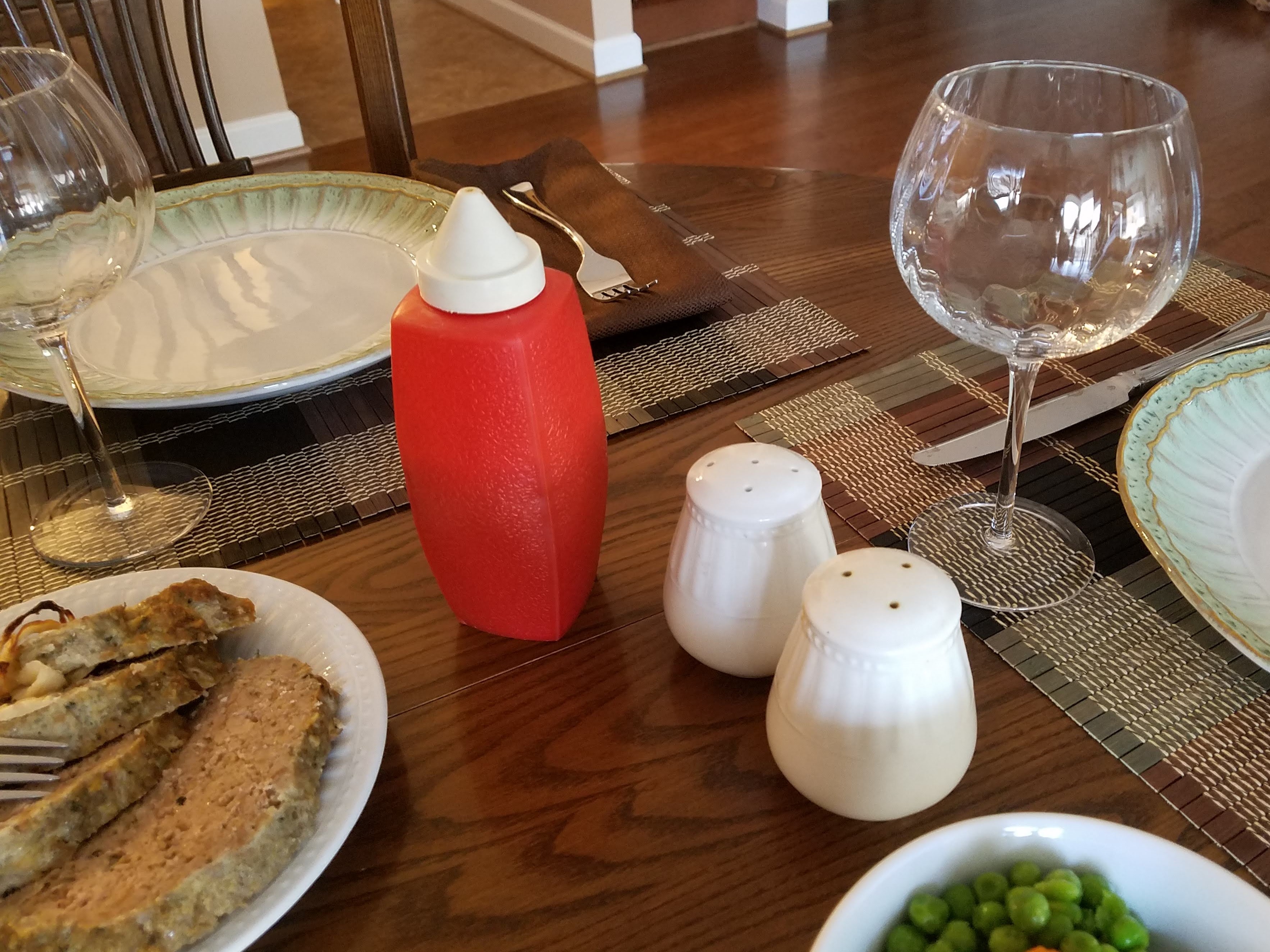
Mom has this squeezable container that she keeps it in.

ketchup (2).jpg


It’s one of those that people got and used when ketchup still came in a glass bottle (and that was the only way you could buy it). If you had one of these red plastic squeezie things and made a habit of filling it and keeping it filled, you put it out on the table instead of the glass bottle because ketchup is obstinate about coming out of glass bottles. It was too often a maddening experience. You might remember: Either you banged madly on the bottom of the bottle with the flat of your hand and nothing came out, or you banged on the bottom madly and a gigantic blob came out. Only occasionally would the banging result in the right amount of ketchup. We must have the right amount of ketchup, c’mon.

In my family we have been putting ketchup on meatloaf for as long as I can remember. Last night, no surprise, there was that container on the table along with the wine glasses and cloth napkins. Samuel picked it up to decorate his slice(s) of meatloaf and remarked, “This is the best ketchup container.”

“Yes, I’ve had that one a long time,” Mom said.

“Oh, I remember,” Samuel said. “It’s the one I remember from when we came to your house when I was a kid.”

A quick glance at ketchup container images on google revealed a few interesting designs, but most are boring – straight-sided, cylindrical, vaguely transparent bottles with red screw-on lids that have a point. Probably there are not many super cool ones because it is assumed that hardly anyone needs them – ketchup now comes in squeezable containers, not glass bottles. I have one of the boring ones. I use it because I buy ketchup in large containers that yes, are squeezable, but I can barely get my hand around them, let alone get my hand around, turn it upside down and squeeze.

This is a mug shot of mine. I have no idea why I have one with a yellow top, which seems like it goes with mustard. I never thought about it. Mom’s is way cooler.

ketchup container.jpg


It is also possible that some people prefer transferring from the manufacturer’s squeeze bottle to a squeeze bottle of their own, that they are willing to go through the trouble, that they prefer putting an unadorned squeeze bottle at their table rather than one with the word Ketchup in a bold font across the front right under the company name along with supplemental text, a bar code, a list of ingredients and other information manufacturers deem necessary to print on the label because they agree with Miss Manners that packaging at the table is unthinkable.

In her Guide to Excruciatingly Correct Behavior, in a section headed “Reading at Table,” we see the following:

DEAR MISS MANNERS:
Would you please comment on the proper etiquette for reading at the dinner table? In particular, is it considered proper to prop a letter against the salt shaker or to lean the newspaper against a carton of cottage cheese, in order to free the hands for eating?
GENTLE READER:
Miss Manners was about to duck this question, on the grounds that it is never proper to eat at the dinner table if anyone else is present and that what you do when you eat alone is between you and your God, and not a matter of etiquette. Then she came to the cottage cheese container. No decent person would put a food package – including ketchup bottles, milk cartons or cereal boxes – on the table, even at home alone with the shades drawn.

Laughable, right? I did laugh out loud, though not so much at the concept but at the language. Miss Manners’ very words have their nose in the air 😊.

But think about it, maybe she is not so far off. Most nicer restaurants stick with only dishes, utensils, glasses and actual food on the table. One of our dinner standards when I worked at the hotel was: All condiments are presented in small ramekins or dishes with appropriate service piece; no portion packets are used except sweeteners. In other words, nothing in a package (including mini ketchup bottles) except the white sugar packets and pink, blue and yellow artificial sweetener packets was acceptable. This standard gets tricky when it comes to jam, honey and Tabasco sauce, trust me.

I think it is entirely up to you what you have/allow/tolerate on your table at home and I suspect you will not be judged for this. Fear not. However I do think Mom’s ketchup container would pass Miss Manners’ muster. Better still, Samuel remembered it from his childhood, and I remember it from mine. The same container all these years – there’s something to be said for that. It makes me wonder which of the things in my kitchen, on my table, in my house will be remembered. What do you hope will be remembered from yours?