Egg with Tail, Paper Piles and Real Towels

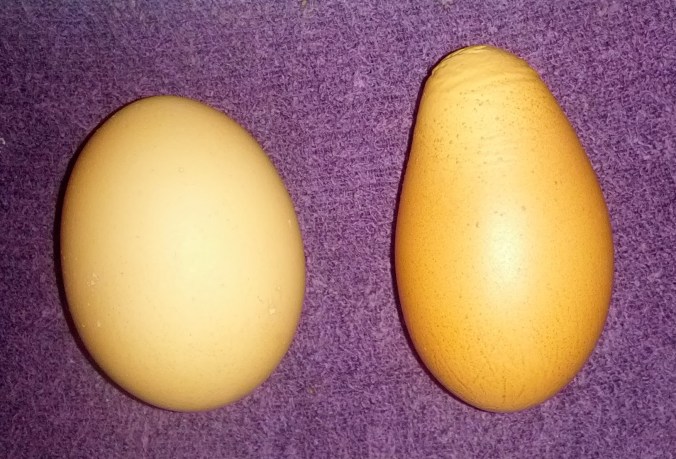
She just didn’t finish. That’s what it looks like to me. The hen that laid the egg with the tail (yes, you read that right) either got bored and distracted and forgot when to pinch off, or it started to hurt and she just eeked through the pain, or she is protesting her egg-laying job but had to get it out anyway. Let it be said that none of us knows exactly what it feels like to plop out an egg, but it doesn’t take a whole lot of imagination to get the general idea.

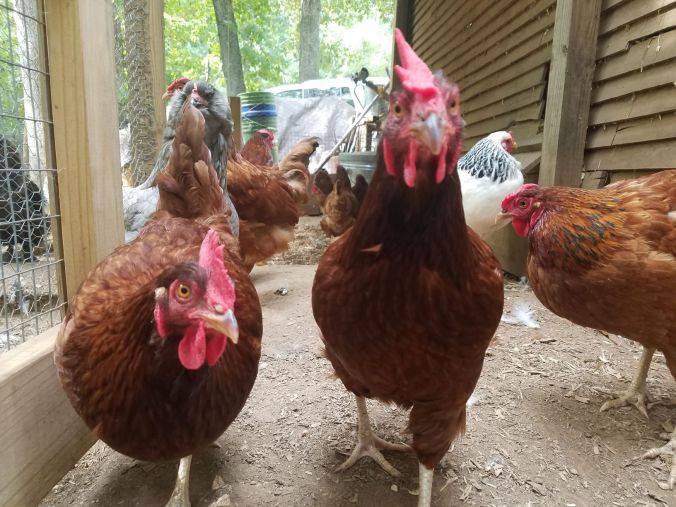
This egg was like the other weakly shelled egg from earlier this summer, squishy just the same, a bit like jello with the thinnest of a crust, just enough crust to keep the yolk and white from making a gooey mess all over the place. Only this one had a tail. What’s up with the chicken that lays such an egg? I wonder which chicken? Miss Old Gray? Don’t-Mess-With-Me White Brahma? Sister Cinnamon Queen?

chickens2 (2)2mp.jpg

I wonder if the same chicken laid both. I wonder why.

I’m thinking it’s one of the Queens. I see an attitude, don’t you?
chickens2mp.jpg

Why give an egg a tail? Is it because what else, given her limited physiology, can she do for fun? You know, to let her artistic side run wild? See what they think of this design! Did the chicken misfire or did the misfired shell surprise the chicken? At the Chicken Council will she defend herself with Hey, sisters, really, that shell material had a mind of its own – I didn’t try to make it do that! As if (overall weak shell aside) the hen tried to get the tail to break off and it just wouldn’t? A little like, well, you know. Perhaps the shell proper, taking an autonomous stand, was unwilling or too embarrassed to break off? Or maybe the blame goes back to insufficient shell material in the production line – Hey, Jack, you shorted me! How am I supposed to make a good shell if you short me on the hard stuff?

No getting around it (no pun intended), this egg is unfinished, improper, abnormal.

egg with tail1.2mp.jpg

There was nothing wrong with the egg inside. I had it for lunch, scrambled with a bit of leftover rice. The shell reduced to a teeny, wet, plastic-bag-like mess once the innards were removed, and that was gross and instantly trash, but the white and yolk were perfectly normal. This egg-with-a-tail anomaly caused me to wonder about other kinds of unfinished business, other things that I never quite wrap up in a neat little package and call DONE, like mail and laundry, and that led to fond memories of systems-that-work-but-are-somehow-unimplemented and environmental consciousness. Bear with me.

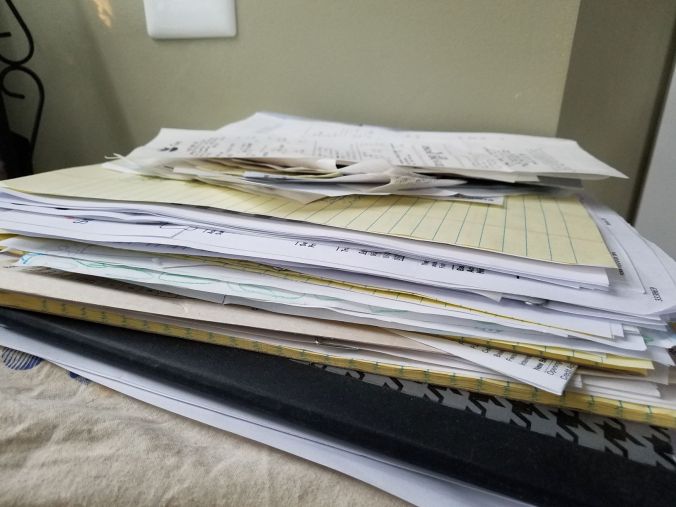
Mail: It’s true they don’t send as many catalogs as they used to, increased postage having changed that game. My paper piles don’t get as high and toppling as they used to. A lot of bills come electronically now, and they send you ads online instead. Last week I was looking at websites for outdoor furniture because sooner or later I will have a finished porch (speaking of unfinished business!) and later, while reading a New York Times article, up popped an ad for the very chair I had been looking at. That’s just plain creepy. I assume it’s legal for some program to be tracking my views, and I know it happens all the time and waaaaaay more than I know, but I don’t like it a bit. I think I’d rather deal with the pile!
paper pile2mp.jpg

Still, I can’t blame my pile(s) on the creepy internet. In the mix you’d find checks I don’t know what to do with after I have mobile-deposited them (can I really throw them away?), receipts for the next time I do taxes, that great garlic-planting guide Tracy gave me (I’m going to need that in October), the really nice visitor’s guide from when I was at the Ringling Museum in April, bank statements (I still get some in paper form), to-do lists (I still write them to keep myself on track and I sometimes like looking back on them to see Oh, look how much was accomplished! – though be assured I do throw the shopping lists away after the shopping trip), random business cards, occasional invitations that are too pretty to throw away (and isn’t it somehow disrespectful to throw them away?)…

What kills me is that I have had, have used and have benefited from a perfectly good system for dealing with such random papers – a filing system! You get plain pocket folders (a variety of colors is more fun) and label them Bank, Garden, Travel, Projects, etc., and then you put the lists, receipts, etc., in the corresponding folder, which then goes in a file box somewhere handy. How hard is that?? No paper piles need exist at all!

I could say it’s hard right now because of living in a construction/ undone/ upside-down zone. Three rooms of my house need sheetrock work. Here’s one.

living room2mp.jpg

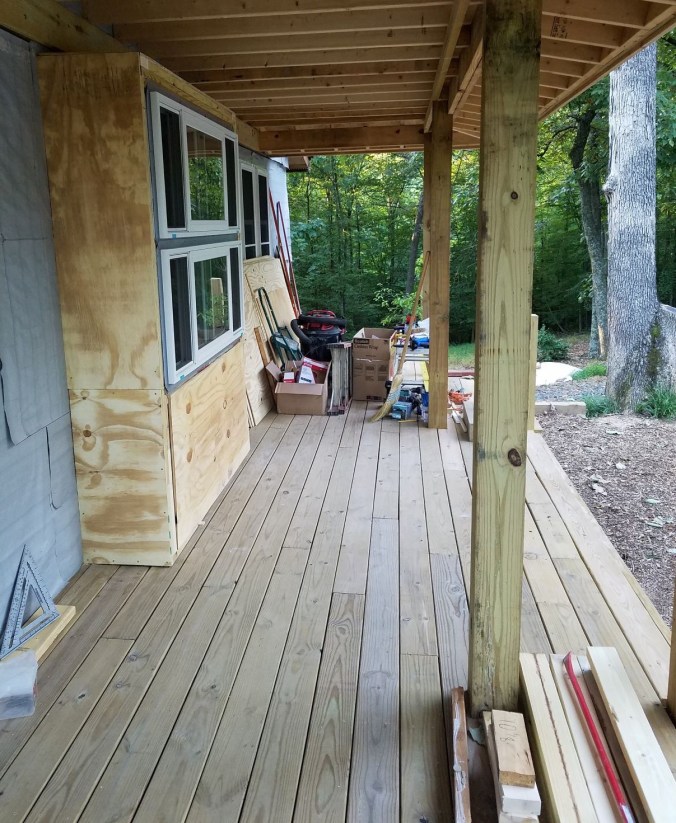
The foyer houses a lot of tools and construction materials because you can’t run downstairs every time you need a different level or drill bit. And if you can call the new porch a room, that makes four undone zones – two of the three new sets of windows are in but not trimmed…
porch2mp (2).jpg

…roof is on but not siding, some new ceiling lights now (as of yesterday!) turn on and some ceiling plywood is up but not all, and not all lights are in, and I still have not picked out the fans, and some of the old cedar siding is planed (to become ceiling material over the plywood) but not all, etc.

It’s a mess. A work-in-progress, I-begin-to-see-the-light-at-the-end-of-the-tunnel mess. A beautiful-vision-in-my-mind mess. Can a person be expected to maintain neat file folders under such circumstances?

Excuses, excuses! I hear you! Try living in my house, you say.

So-and-so (no names) adds to the mess / takes all my time / distracts me unspeakably!

My job is so demanding right now!

If only the people who said they would do the work would actually do the work!

Truth be told, I myself can never remember to buy the pocket folders! All right, all right, I’ll put them on the list. Now where was that list?

Laundry: When do we come to the end of laundry?! I operate a little b&b, so there are always sheets and towels, to say nothing of my other life and the sawdusty clothes from porch-building and oh-yeah-my-other-life the inside-out workout pants that I love.

But I don’t really mind. I even hang my laundry on a wonderful outdoor clothesline most of the time. There is nothing under the sun like sleeping on sheets that have dried in a sunshiny breeze. (I do not hang bath towels – they do need to fluff up in the dryer.)

There is in fact one portion of my laundry that I am even proud of in a way only some of you will understand.

I am not one for paper towels any more than necessary, nor throwaway wipes and that sort of thing. There is something about using a real piece of cloth that is fully intended to get dirty and be the thing between my hand and a mess I have to clean up, something about the softness of the cloth coupled with its toughness/ reuseableness/ tried-and-trueness. There is a difference between a real towel vs. something that tries to be a real towel.

Imagine my delight when I read in A Boat, A Whale and A Walrus (lovely birthday present cookbook from my daughter) by Seattle restaurant owner and entrepreneur Renee Erickson:
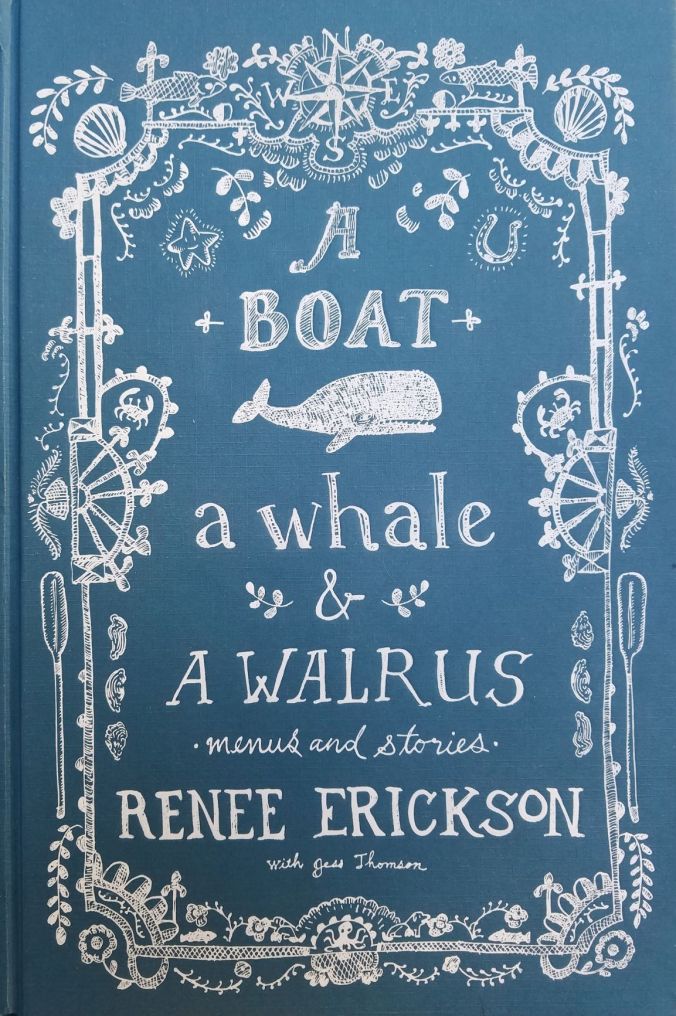
book boat whale walrus (2)2mp.jpg

REAL TOWELS

I’m a fan of towels – not the paper kind, but real cloth towels, the kind you hang from your oven door. At home I keep a huge wicker bin of them next to my oven, and I use them in lieu of paper towels, to mop up messes, blot food and soak up excess liquid wherever it appears. I accumulate them when I travel, mostly, but especially in Parisian antique markets. They’re pretty, and they’re washable. And because living in the restaurant world inevitably means making a lot of waste, it makes me feel good to use a little less paper at home.

I did not acquire my own cloths at Parisian antique markets, nor are they all the same. Some are terry, some soft knit, some woven cotton, some gauzy. They are my go-to for cleaning, for spills, for drying things, for polishing things. If they are rendered trash – such as when you use them to mink-oil your shoes – so be it. There are always more. Most of the time they go in the wash (thereby adding to the laundry, yes, but I am going to do laundry anyway, and so are you) and go back in my rag drawer. I can only imagine having space in my kitchen for a huge wicker bin of them.

rag drawer2mp.jpg

I wish I had a way to know how many paper towels I have not used over the years. I wish I knew the amount of money I have saved by not buying massive packs of them or could see the still-empty corner of a landfill that’s not filled with just my lifetime’s worth of them. I know someone else’s use of paper towels will fill that corner. I know that what I don’t use in a lifetime is probably what a football stadium, say, accumulates during one event. I certainly use paper towels sometimes.

Still, every time a paper towel is just the thing (such as on the plate I am about to transfer crispy bacon to from the hot pan), I pause and see mountains of trash in my mind, with bulldozers pushing it around to try to make room for more and more coming day after day, and I say to myself it’s okay this time. The “leave as little a footprint as possible” directive was intended for campers at first if I remember right: Take away anything you bring to the campsite, allowing the next camper to enjoy the natural environment as much as possible (instead of having to deal with your leftover stuff). To me this applies to everyday life too and to the big picture of my footprint on the environment. I am responsible for mine, after all, not someone else’s. I do what I can to be a good steward of my resources, earth’s resources. And a part of me is very satisfied about that.

As the chicken was probably satisfied. Hey, doing the best I can here!
What We Keep and What We Throw Away

A couple weeks ago I realized that the shoes I have been using for bricklaying and porchbuilding and gardening had serious cracks in the soles. The kind of cracks Nora Jones sings about in Creepin’ In.

There’s a big ol’ hole
That’s gone right through the sole
Of this old shoe
And the water on the ground
Ain’t got no place else it found
So it’s only got one thing left to do

Creep on in
Creep on in
And once it has begun
Won’t stop until it’s done
Sneaking in

Go ahead and click on the link – her music, her voice (and Dolly Parton’s in this collaboration) are way better than the words alone.

What do you do when your shoes have holes in them? I’m a make-do person, and I would fix them / deal with them if I could, but the fact is that these slip-ons really weren’t that supportive anyway – kind of loose around the ankles they were – and had considerable wear on the inside too so maybe it was time to retire them.

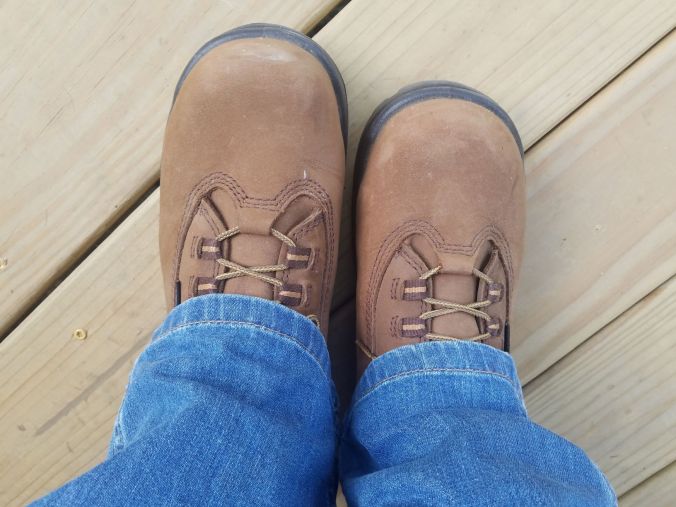
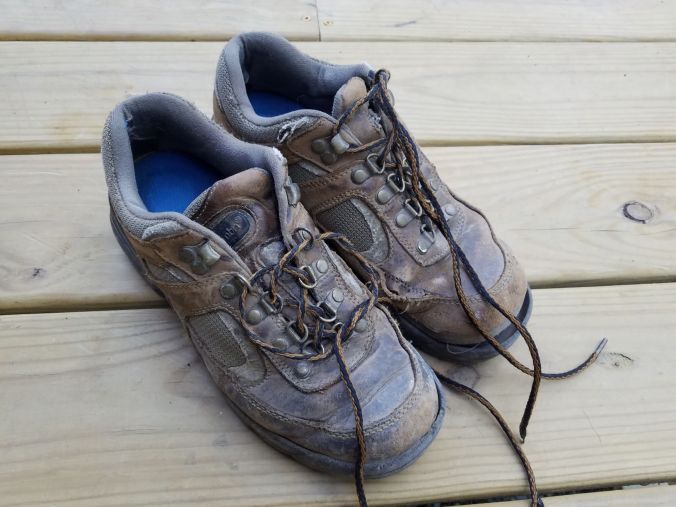
And I had this other old pair in the closet that I probably got for hiking (long before the days of who-would-have-thought-it bricklaying), a pair with decent (read uncracked) soles, strong laces, metal lace-holders (that surely have a name in shoe-talk) and only a little bit of the stitching coming apart. See?

2.2mp.jpg

Faithful, sturdy shoes, these, reminding me so much of the goblin’s shoes in the Little Bear books.

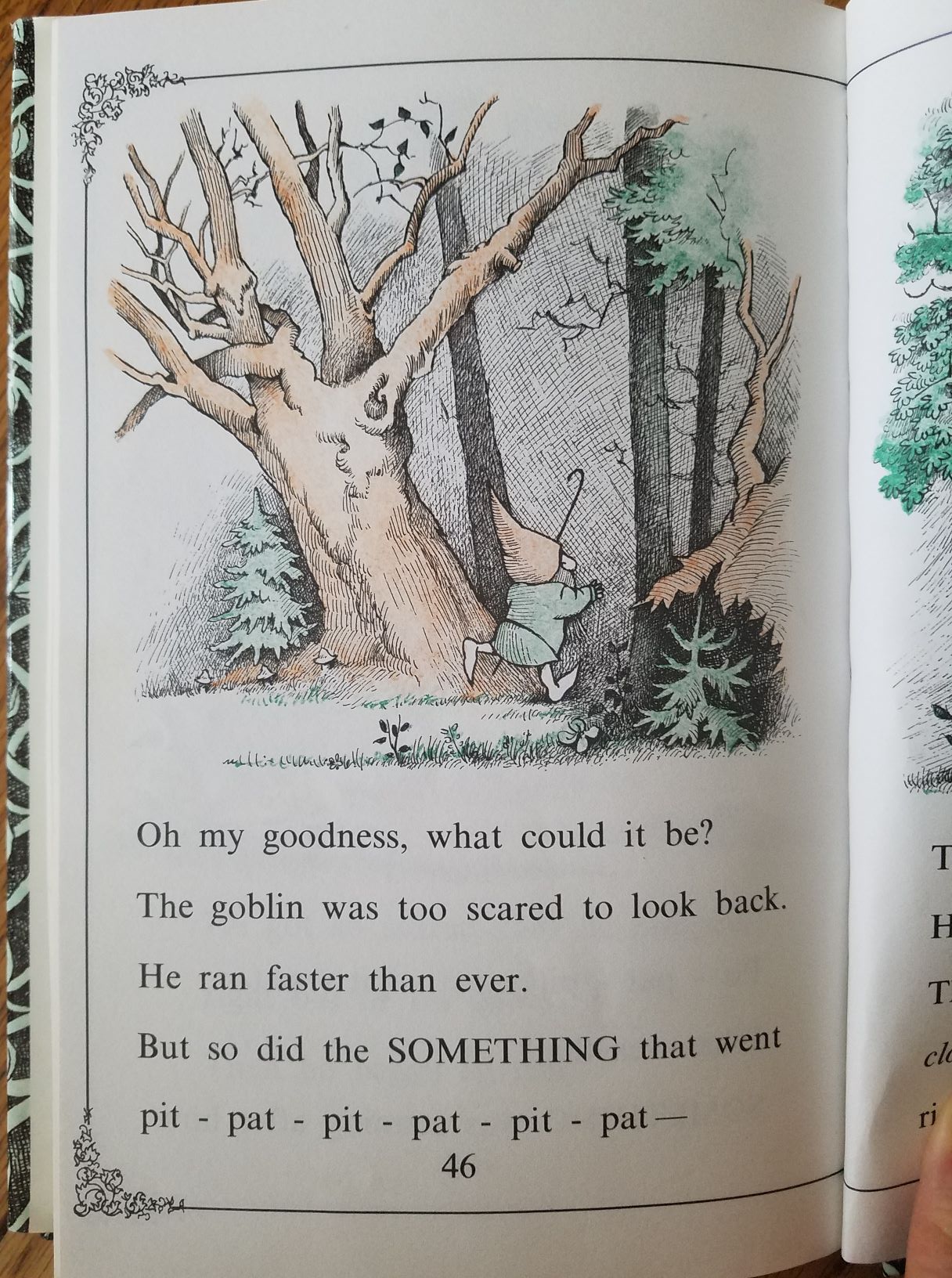
One day a little goblin went by an old cave. It was old, it was cold, it was dark. And something inside it went bump. What was that? BUMP! “Hoo-ooh—” cried the goblin. He got so scared he jumped right out of his shoes. Then he began to run…. (The goblin ran and ran, very scared – first about the bump, then about the pit – pat – pit – pat chasing after him.)

LB42mp.jpg

the pit – pat – pit – pat came closer, closer – CLOSER – till it stopped right by the hole in the tree!

(Then he saw a hole in a tree, jumped in and …)

Then all was quiet. Nothing happened. Nothing. The little goblin wanted to peek out. It was so quiet. Should he peek out? Yes, he would. He WOULD peek out. And he did. “Eeeeeh—!” cried the goblin. Do you know what he saw?

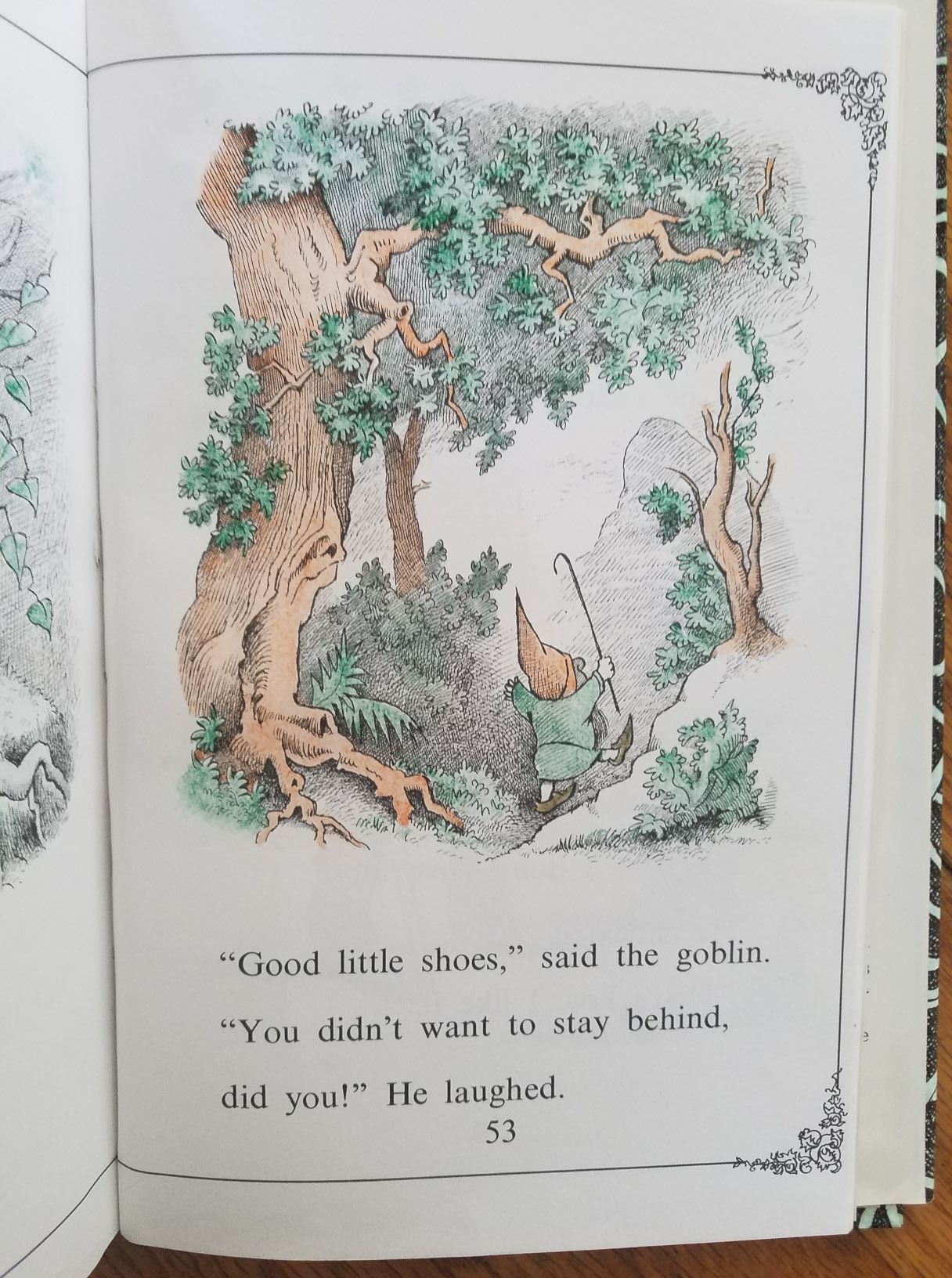
He saw – HIS SHOES! His own little shoes – and nothing more. “Goodness,” said the goblin, hopping out of the tree. “That old bump in the cave made me jump right out of my shoes. But they came running after me, didn’t they! And here they are!”

LB1.2mp.jpg

Good little shoes! As were mine.

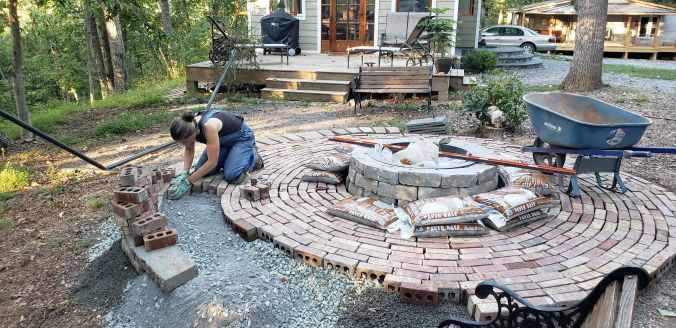
Or so I thought. Proudly (I was smart enough to hang onto these perfectly good shoes for such a day as this when they would come in handy!) I began wearing the good old shoes. Their value suddenly came into question while I was shoveling gravel to fill in empty spaces to make this firepit platform level (things you will walk on should be reasonably level) with the 709 free bricks that came my way (thank you, Joe!). See all that gravel filling in where the ground slopes downward? One shovelful at a time, baby! We call this I-get-to-have-ice-cream-later!

midway2mp.jpg

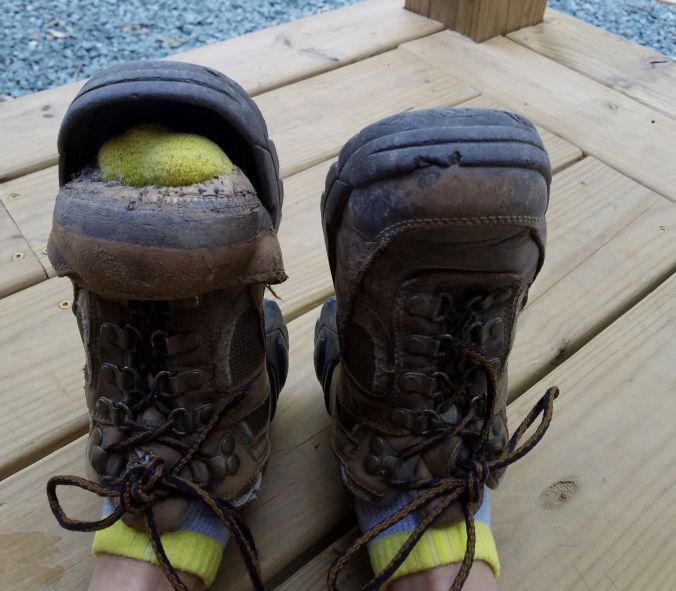
So, yeah, gravel does not feel good when it gets IN your shoes. Understand, the gravel was not, as in the case Nora Jones’ Old Shoe, creepin’ in the way water got through her sole. Oh no. It was not, as in my First Retired Pair, dropping in around the loose ankle part (the sole cracks being big enough for water but not for gravel). It was having a high-old-easy-time-of-it coming in where the sole separated from the rest in a way it is not supposed to. See, your toes are not intended to be ever visible once your foot is in the shoe. In case you were wondering.

3.2mp.jpg

You think maybe I could fix this with glue?

Okay, I do know better than that. Last year Samuel got Red Wings and is convinced they are the best, especially their once-a-month-we’ll-take-care-of-your-shoes plan, and he’d been asking me what I wanted for my birthday, so off we went. New, wonderful, shoes – voila!

new2mp.jpg

But it got me to thinking about what we keep and what we throw away. I’m not a person who easily throws stuff away, not do I hoard, nor do I misunderstand that things have a given span-of-presence in our lives.

Why do we keep some things and throw other things away? By things I mean not only things in the inanimate sense – shoes, old windows, Christmas trees in early January, mugs, cars, underwear, mail, cookbooks, screwdrivers, couches – the list is long!! I also mean people. Not in the sense that we throw people away of course, but that the circle of people who touch our lives changes over time. Some come closer, some fade, some appear occasionally, some reappear after long periods of time.

It’s hard to know who and what to hold onto! I wish I had Kenny Rogers’ confidence. Do you think he was talking only about the cards in your hand during a poker game?

You got to know when to hold ‘em
Know when to fold ‘em
Know when to walk away
Know when to run
You never count your money
When you’re sittin’ at the table
There’ll be time enough for countin’
When the dealin’s done.

The advice of The Gambler gave Kenny an ace he could keep. But how do you know when to hold ‘em, when to fold ‘em, when to walk away, when to run?

Seems to me, some things are useful and some are relational. And that applies to both things and people. We only sometimes feel a pang about leaving people behind when we change jobs, but anyone who is remotely a friend (or very much a friend) is in another category and we ought not be so flippant. That teapot with the hairline crack might be on its last legs, but I got it while shopping with Claudia in Germany; its usefulness is only part of the reason I use it every day. Old shoes that eat gravel should go in the trash – their function is past – but small cracks in the soles of the other pair, well, maybe I can use those for painting?

Some things are easier to get rid of than others. There are no hard and fast rules or guidelines about what or who to keep around and what or who to part ways with. I think the key word in the song is you, as in you got to know…you never count…

If I may elaborate:

You look for clues, you seek confirmation, you follow your heart, you make your best judgment (you got a great new pair of shoes!). Sometimes you are wrong, you misjudge, misinterpret clues, have to re-assess, start again. Sometimes you are 100% correct and your timing is perfect.

Sometimes I wish the answers were clearer! But then we’d be like robots, right? See A, do B, expect C, repeat with other As, Bs and Cs.

Now that wouldn’t be any fun! Part of the journey is not knowing what’s around the next bend, like an ongoing movie that we don’t see the ending to until we get there. Do you ever feel like you’re in the middle of a movie? I do! And I love it because I get to play my part, small as that is, connected to these particular people as it is, focused on this goal or struggling with that challenge as it is. I never want to forget how wonderful it is to have what I have, even if it’s different from what other people have, even if there are things I don’t have and wish I did.

A Very Happy Labor Day to Everyone!

It Smells Like Earth

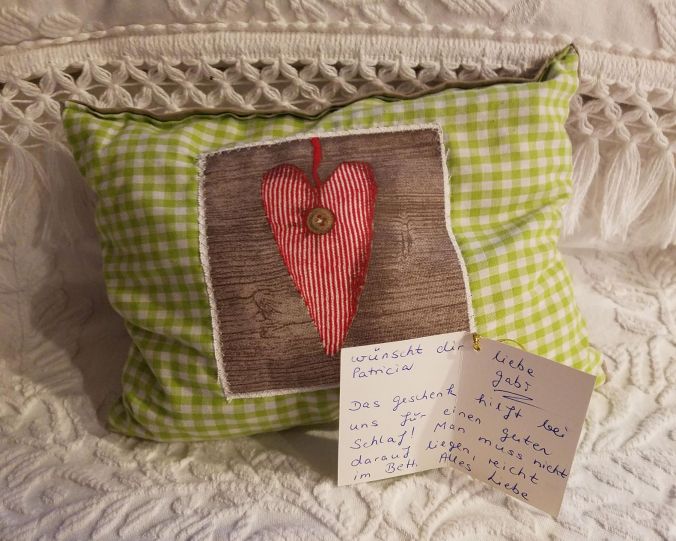
This morning as I made my bed, I again smiled at a gift I received last year, a small pillow filled with I don’t know – pieces of pinecone? I picked it up, held it to my face and breathed deeply in. The earthy scent of the filling filled me. My eyes closed, my body relaxed, my smile broadened.

earth pillow2mp.jpg

Gabi wrote a note to explain the un-ordinary pillow. It helps us get a good sleep, she said. Just have it near you in bed. Why would someone want a pillow filled with forest material? Why would I want one?

Trees stand tall all around me, some towering over 100 feet. Giants they are. This time of year my windows are wide open. Cool freshness wafts in. I hear birds chirping, squirrels chittering, insects singing, an occasional train in the distance rumbling, not much else except my confused hen (the one that thinks she’s a rooster) sometimes crowing.

Yet I love this pillow. And if I love it, I who live in the country, I can only imagine how other people in other settings might love the scent of earth at the ready, packaged neatly and freely evoking thoughts of earth’s predictable-yet-always-slightly-different cycles, of forest filled with boundless unseen dramas, of blessed, beautiful trees with fluttery leaf dances so high up.

I wonder how a pillow like this strikes a person who lives near the sea, where saltiness would pervade the air, water would predominate the landscape and the rushing, ebbing, flowing tides, rustling dune grasses and hungry shore birds would replace the forest sounds. The waterfront scene is as lovely as the forest, some would say as lovely as the sea of waving grass in the plains or the jagged, white peaks of high mountains. All these places can be our connection to earth, to the intelligent design it presents, to things we often hardly give thought to – how magical and majestic are these natural wonders, how awesome and complex is the schematic that includes all the moving parts of this picture, how utterly spectacular is a sky that is different every single sunset and sunrise.

What do people do who do not have the natural world in their everyday life? I don’t mean you have to have a forest around you or a vast body of water in your sightline. I mean just a piece of nature, like Rachel’s pawpaw trees.

Once I had guests at the cottage, parents and two middle-school-age daughters. As we were exploring the garden, the mother said, “Girls, this is nature.” To me, quietly, she said, “The closest we get to nature is the fruit bowl on the counter.”  Oh, dear, can this be true?

Maybe nature – the wondrous creation of things not-man-made – doesn’t speak to other people the same way it speaks to me. Maybe I just want to think it has a lot to say if only we hear and listen, look and see, touch and feel. The older I get, the more I think there’s more to everything than we can ever know, and that makes it not only endlessly unboring, but also ever able to teach us something new, something we need to know, something that helps or serves something else. Maybe I just hope it.

The Side Effects of Old-Fashioned Cookery

Yesterday after I put the ingredients together in a bowl for meatloaf, I asked Samuel if he would mix it up for me since my shoulder was acting up pretty bad. He washed his hands, stuck them in the bowl and began mixing up the couple handfuls of oats, two eggs, milk (to moisten the oats), a small hunk of finely grated asiago (for the cheese this time because I didn’t have any romano – I figured it was close enough), a small bunch of chopped fresh parsley, a pound of ground beef (it came in a weighed package!) and salt and pepper.

He squished and turned and squished some more and then said, “Seems wet to me. Is it always this wet?” He was right. This is a risk when you pour the milk directly from the gallon.

I reached for the breadcrumbs in the pantry, said, “This’ll fix that,” and sprinkled some in. He mixed some more, it still looked a tad wet, so I sprinkled some more breadcrumbs in. Good now. He formed the loaf in my cast iron skillet, and I turned on the oven a while later so that everything would be ready when he returned home. I misjudged and the meatloaf baked a while longer than was perhaps ideal, but that meant a very delicious crispy bottom crust – and the inside was certainly not dry!

At one point during meatloaf-making, Samuel had said (half under his breath), “Do you measure anything?”

Of course I do! But it got me to thinking about measuring, about “cookery,” about ease in the kitchen – the trial and error of learning to make food, the imprecision, substitutions and playing around that often work, the times I make do or figure out what’s for supper by looking in the fridge and seeing what speaks to me, the side effects of being as old-fashioned about it as I am.

I also thought about Malcolm Gladwell’s 10,000-hour rule, how he says in Outliers that those who have achieved a high level of competency in any area – whether a concert pianist, a hockey player, a computer programmer – have simply, over the years, put in the time. “Highly competent” is a subjective assessment in the kitchen (and I myself have miles to go before I’m close to that), but I wondered if my ease, my sense of when it looks right or feels right or smells done, my willingness to flex with ingredients sometimes (such as using a different cheese in the meatloaf this time) has to do simply with having spent a lot of time over many years preparing food in a kitchen. It’s probably why my mom and my sister are such great cooks.

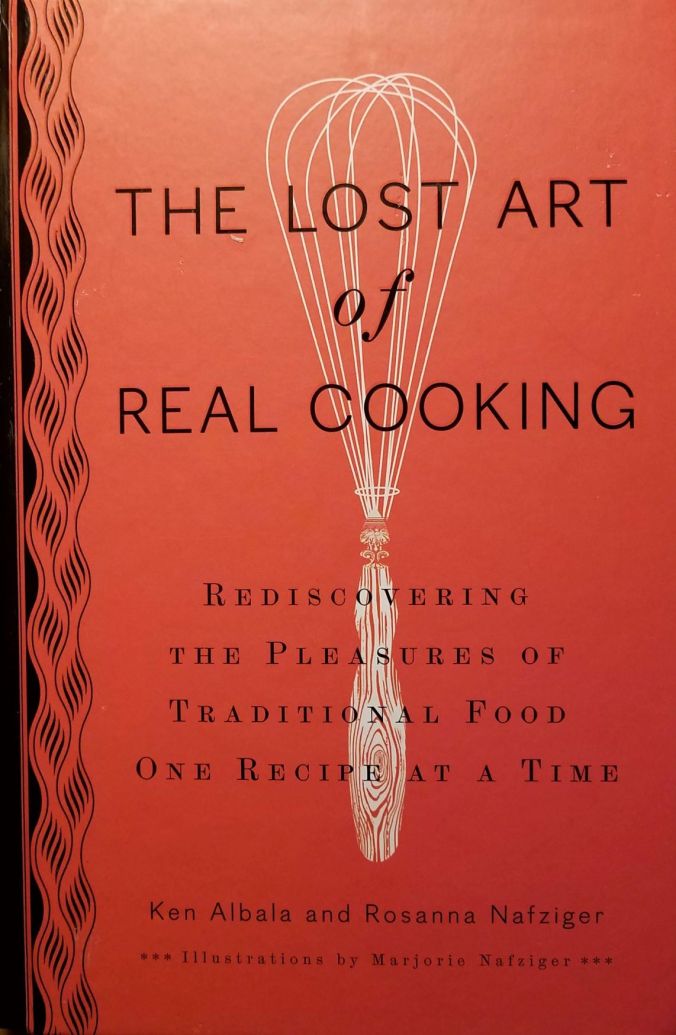
This past week my dear friend John gifted me a book called The Lost Art of Real Cooking.

the lost art of real cooking book2 (2)2mp.jpg

He mentioned it was coming by saying, “I’m sending you a hard copy of a book that reminded me of you…. When I read part of it I could hear you talking 😊”  Now that I have it, I wonder which part. Maybe, knowing my meatloaf methodology, he liked: “This book is an effort to loosen up.”

Maybe, knowing how much joy I get from feeding people: “There is, it cannot be denied, unspeakable pleasure in providing sustenance for others with the labor of one’s own hands.”

Maybe it was this part (because I have said as much!): “Yes, this will be hard work. But can you see the irony of people who save time and energy with electric gadgets and then traipse off to burn calories in the gym? Why not boldly brandish a whisk instead? Your egg whites will be all the more happy for it, as well as your biceps.” (Myself, I would like to add an exclamation point after biceps!)

Maybe this part (because I have also said as much!): “We are not averse to measurements per se, they are often necessary, particularly with baking. But to insist that a quarter teaspoon of some particular seasoning is correct while anything more or less, or, heaven forfend, a substitution, altogether amounts to culinary heresy, this is just too much to bear.”

Maybe he’s thinking of how much time I spend making homemade manicotti (including the crepes that wrap up the cheese) or waiting for bread to rise or watching the tomato soup slowly cook down to the point of straining out the seeds and skins, or how delighted I am that the basil I planted in May gives flavor to our pizza in August, or how satisfied I feel when the granola comes out crunchy because it sits in the oven overnight. “So before you continue, Gentle Reader, if you cannot abide long hours in the kitchen, this is no book for you….Cooking slowly with patience is inherently entertaining and the food it yields tastes better, costs less, and connects you with the people you feed in a way that a prefabricated meal can never hope to do.”

Beyond that, I’d say that “cooking slowly with patience” connects you to the earth, to the seasons, to your own senses, hands, arms, legs, back and brain, to the real plants and animals that keep you alive and to the many who came before you, patiently working with what they had, feeding the people they loved, honing the skills they learned valuable, far-reaching lessons from. In a broader sense, isn’t that what life is all about: making the best of what you have, taking care of the people you care about and increasingly gaining knowledge and understanding that better equips you to carry on (let us hope) with grace and compassion?

Imagine my joy when, just a few days ago, while still digesting the comforting and (truth be told) vindicating message of this book (thank you, John), I read the following poem by Sarah Silvey (yes, the same Sarah who drew the teeth-brushing/berry-eating bear peeking/peeping in on Mom). Out of the blue she produced a perspective on working in the kitchen that took my breath away, so closely did it mirror my own experience, so well did it express the unspeakable pleasure and unexpected benefits that come from a simple task in the kitchen. Thank you, Sarah.

Sometimes I enjoy doing things the hard way
The long, difficult way
By hand
Without electricity
Without advanced tools.
It connects me to the past
To ancient humans
Struggling to make ends meet
To those who worked hard perfecting a craft.
I tried to saw dovetails with hand tools
When I made my desk.
It was hard work.
It took days.
I was sore, my carpal tunnel flared
And when I finally tried to hammer the pieces together
It didn’t fit.
But I learned
how much work
Every piece of furniture should be.
I can appreciate
The ease of modern living
Machine made items shipped to your home.
I can appreciate too
What we’ve lost.
You forge a connection
With things you built
With food you grew, harvested, and processed.
Even doing something as simple as washing your car by hand
You learn more about the state that car is in
Notice its scratches and weak points
Restore the sparkles in its paint.

I processed five gallons of grapes by hand.
When I sat in my kitchen
Peeling grapes
I mimicked the motions of my ancestors.
Women have peeled grapes
Into bowls in their laps
For thousands of years.
They spent hours upon hours
Processing the bounty of summer
To stave off winter’s bite.
They told stories while working
Sang songs
And some just worked
Alone, in quiet thought.
Every grape I handled
Taught me more about this food.
I learned to tell a wormy one by feel
Its rough scar tissue
Sent a shudder through my marrow.
I learned what every color tastes like.
I learned to love the Concord smell
Rich and strong and sweet and tangy.
If I’d used tools
I wouldn’t have had to stand at the sink for so long.
I wouldn’t have had the quiet thinking time
I wouldn’t have been able to practice my working posture
Relaxed enough to fight fatigue, yet always moving.
I noticed I was taking much longer than necessary
Due to my need to get every grape, save every grape, not waste
Anything
And I knew someone watching me would have felt frustrated
Just as I felt
When I watched my mother process peaches for the freezer
Always graceful, always painfully slow, yet inevitable.
After two days of work
The peaches would be all blanched, peeled, sliced, sugared, and frozen.
I felt her echo in my slow fingers
Of her, and a million women before her
All of us preparing the harvest
So we might have something sweet
For winter.


Is the Bear Peeking or Peeping?

Earlier this week I mentioned that my mom, in her house in the woods, always pulled her blinds at night because she worried that a bear might be looking in on her. No matter what, she closed off the view. Mom, really? I teased her. A bear cares to look in on you? But I wonder: Those of you who live in the woods – do you worry about that too? If you live next to another house, do you close the blinds every night? Does it matter which room you’re in? Does it matter if you know your neighbors are home?

I also wonder: While looking into someone’s window is a thing, yes, and maybe a thing the someone should be worried about, is it peeping into someone’s window or peeking into someone’s window?

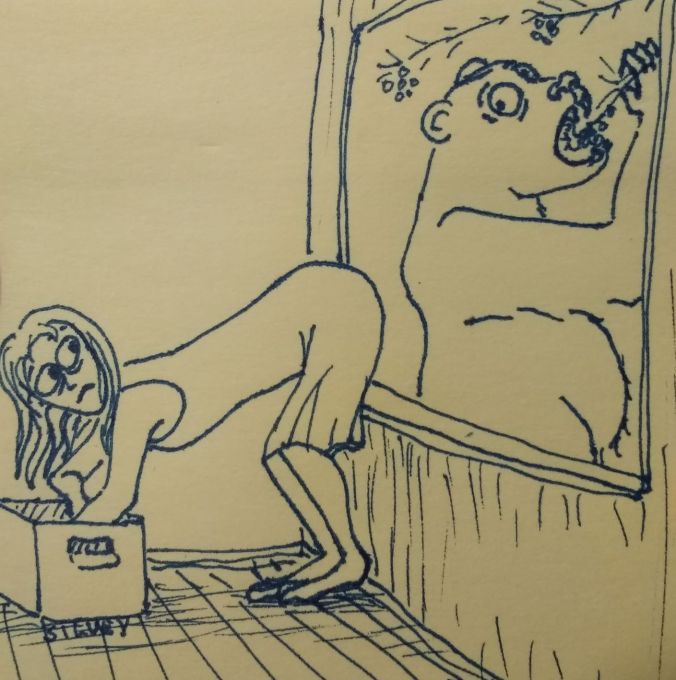
When I mentioned Mom’s blind-pulling, bear-avoiding habit, I suggested that Sarah – poet, artist, writer, friend – would no doubt be able to draw the scene, probably easily. It would flow like water down a hill for her, the pen setting down lines where lines should go, and in practically the blink of an eye she could relocate the image from her brain to a piece of paper and produce a very recognizable image. I was sure of it, even a mite envious of that skill, wistfully, wishingly thinking Oh, to be able to draw like Sarah!

Sure enough, she did it! And priceless it is! In no time at all she sent me a mom-and-bear post-it-note drawing with window between, each occupied but suddenly aware of the other (or so it seems to me). Uh-oh! they each seem to say. Notice how Sarah went beyond a bear peeking/peeping in – we get his personal hygiene routine, the box of goodies Mom’s rummaging through (always goodies in Mom’s case, never junk), the mutual surprise – only creative people like Sarah think of (and successfully execute) these extras! Don’t you love his paunch?!

You tell me. Is the bear peeping in or peeking in? Is Mom doing either?

Sarah's bear drawing.2mp.jpg

Does peep mean to look in furtively or briefly and does peek mean to look in cautiously or slyly, or the other way around?* Both have the idea of quickness, of trying not to be seen, of some measure of invasion of privacy. Does it matter if you intend to look in, or if something simply catches your eye and you glance toward it? Did Peeping Tom set the connotation in stone forever? Is peep up to no good and is peek benign?

Remember Scout and Jem and Dill trying to look in on reclusive Boo Radley in To Kill a Mockingbird? In Chapter 6, see Harper Lee’s choice and also get a little reminder how amazing this book is (in case you have not read it recently). What are the children doing?

“What are you gonna do?”

Dill and Jem were simply going to peep in the window with the loose shutter to see if they could get a look at Boo Radley, and if I didn’t want to go with them I could go straight home and keep my fat flopping mouth shut, that was all.

“But why in the sam holy hill did you wait till tonight?”

Because nobody could see them at night, because Atticus would be so deep in a book he wouldn’t hear the Kingdom coming, because if Boo Radley killed them they’d miss school instead of vacation, and because it was easier to see inside a dark house in the dark than in the daytime, did I understand?

“Jem, please—”

“Scout, I’m tellin’ you for the last time, shut your trap or go home – I declare to the Lord you’re gettin’ more like a girl every day!”

With that, I had no option but to join them.

There are so many elements of this book I would like to talk about – the norms of the time, the things we don’t know, the ways people surprise us, the consequences of actions, the role of fate – another time! For now I wonder if Harper Lee chose peep on purpose. I don’t want to split hairs about meanings, but words can get us in trouble sometimes, and our own understanding is not always someone else’s understanding. I want to know what y’all think about peep vs. peek.

________________________________________

FYI:

*Merriam Webster says it’s the other way around. They assign “slyly” to peep and “furtively” to peek. Are sly and furtive that different?

The Soothing Power of a Dog on a Tractor

I have mistake-on-the-brain because I made a big one this weekend. The maddening part was Shouldn’t I have seen this coming? The worst part was knowing the work I caused for other people, who themselves are doing me a favor and should not have to backtrack because I goofed and then changed my mind. The good part was that in the end it was a fairly-easily-rectifiable, not-the-end-of-the-world mistake. The best part was the dog on the tractor.

Coco on tractor.2mp.jpg

Sandy called her “Farm Girl.” He took a break from hammering, measuring, sawing and fitting to make some amusement and roped Joe into the plan. Coco has a small brain and I expect this adventure was nothing more for her than Sure, whatever you say. I’ll sit here like a doofus, why not? I did not participate in setting this stage, but was called over when she was propped and perky and please-can-I-get-down-now? I was still, at that moment, in the throes of self-flagellation, beating myself up for not seeing the situation clearly enough in my mind to head off the mistake at the pass.

Nothing like a little silly dog to change the subject and bring a smile! Thank you, Sandy!

Come to think of it, a day or so later, the mistake itself doesn’t matter so much. It’s only a window, right? It’s only the window I’d been waiting more than eight years for (and then five weeks after ordering), the window I thought would be perfect, the window marked on my inside wall with painter’s tape and marked on my outside wall with a full-size template – both of which I had been staring at for weeks. We worked all day to get that window in. It was hot! I wanted to LOVE it!

But I didn’t. It just looked wrong. Too small. How can it look so small? But it was too small. I was up half the night trying to figure out how to make it right, but I knew – though I hated to say it – that the new window had to come out.

Out it came first thing next day. Not a super big deal in the end and thank God for the reverse function on the screw gun, but I internally fussed: Whatever made me think a small window there would be the right window there?

A fishbowl. Now I see. It all comes down to a fishbowl. Here is my five-seconds-or-less Pictionary drawing of one.

fishbowl.2mp.jpg

The house I live in is out in the country at the far end of a gravel road. The only other house you can see from it is my own cottage. But my living room did not come with a front window at eye level. The funky 70s triangular window way up high, now removed, did let in light and did sometimes blind anyone sitting in the middle of the room, depending on the sun’s angle, but no one is that tall. I have never been able to look out and see from this room. Likewise, no one has ever been able to look in and see.

Hence, I have never had to worry about being the fish in the fishbowl! Eeks! Adding a window to that wall is a gigantic leap. Nothing partial. No middle ground. No gradually-getting-used-to-this-new-situation. I will go from being unseen and unable-to-be-seen to potentially being seen in one fell swoop! (Whether there is anything interesting to see is another conversation.). Dare I? Do people do this?

My mother is to blame on this one and she knows it – at their house in the woods on four acres she always pulled the blinds at night because “a bear might see me.” No kidding. (I wish I had Sarah’s drawing skills and could draw a bear looking into a window! Her Happy Friday and Purple chinchilla drawings are among my favorites.)

But here I was with a new (small) window with real glass at eye level. How did I think the size would make a difference? Maybe I thought that if it were small it wouldn’t matter? That people would say to themselves Here is a woman who clearly does not want to be looked in upon (otherwise she would put in a big honkin’ window!) – cease and desist! How did I not realize that window glass is window glass and see-through-able regardless? To this point Joe said casually at dinner, “You get something to cover the window for when you need that, a curtain or a shutter or something.”

I do know about curtains and shutters, what they do, how they work, why people use them. Why did it take this simple statement to make me realize that if you can cover a small window, you can cover a big one!

Ah, well, funny creatures, we humans. Fickle sometimes. Not overly able to visualize upcoming realities sometimes. Dense, you say? Thick? Fuzzy? Obtuse perhaps? Lackwitted? Slackminded? Featherheaded? Airheaded? Bubbleheaded? Blockheaded? Myopic? Cabbageheaded? Chowderbrained? Hebetudinous? Out to lunch? Three bricks shy of a load? (Gotta love a good thesaurus!)

Guilty as charged! But a new window is coming – a honkin’ big window! – picked it out and framed up the rough opening already. It will be better!

One Determined Marigold

Various people in my world are struggling. Some have chronic pain. Some have jobs that make them crazy. Some feel creaky, obsolete, scared, unwanted, frustrated or alone. All of them are like my one little marigold.

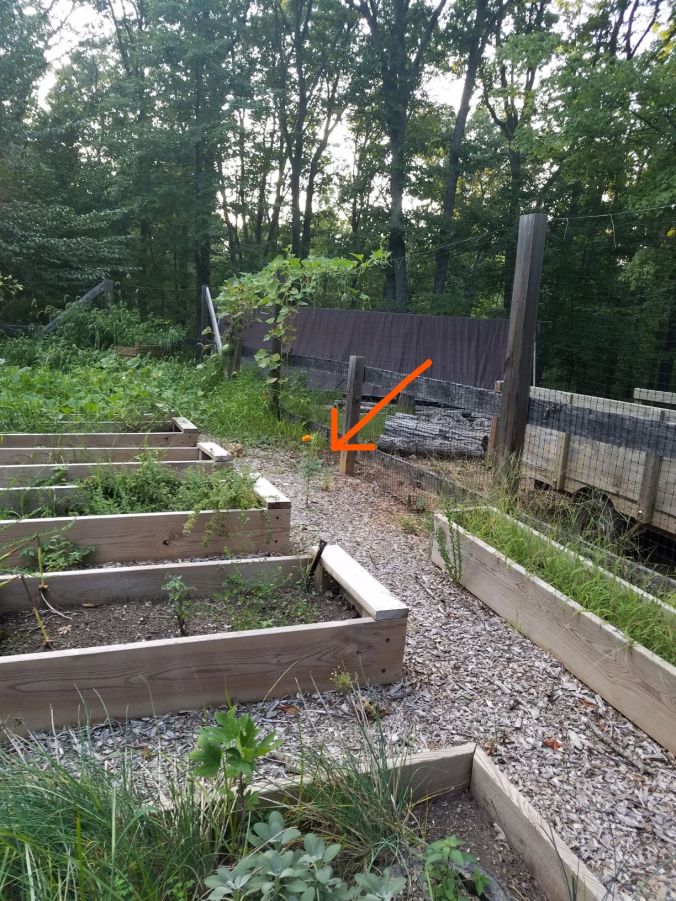
Apart from certain, strangely-not-completely-out-of-control areas, my garden is a mess this year. I’ve had some perfect veggies, enough for the marginal labor to have been worthwhile, but roughly half of the space qualifies as a jungle. With the front porch project I simply haven’t had the time. Plus this aggravating shoulder of mine, unimproved after three weeks of physical therapy (maybe worse), holds me back.

Still, I like fresh green pepper on my pizza and Samuel said he’d make some the other day. My contribution amounted to walking to the garden for a pepper. The jungle mess did not encourage lollygagging – it wants to get about its wild business without critical observers – so I got my pepper and was about to leave when a spot of gold caught my eye.

one marigold_LI.2mp.jpg


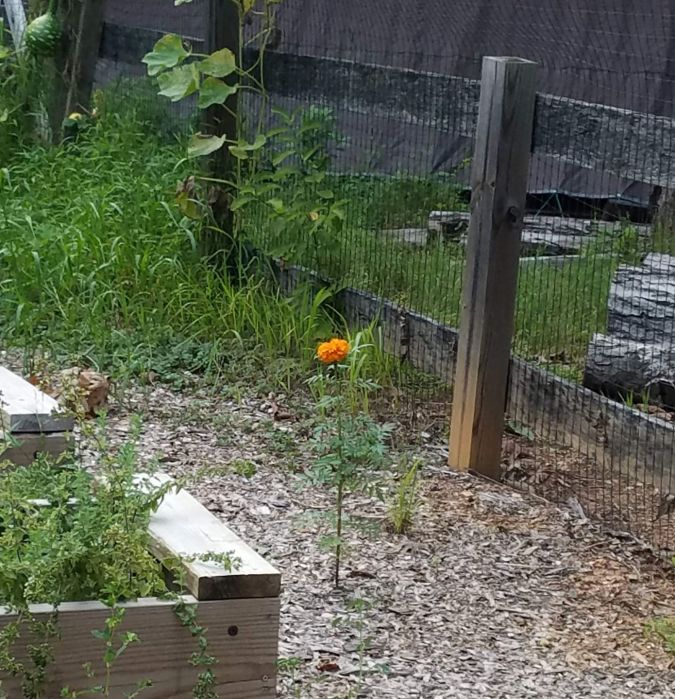
There it was, one single marigold, standing tall and beautiful despite the choking weeds not far away. I had not planted it. I am unconventional in a list of ways, but it would not even occur to me to plant a flower in the middle of a path. One of the seeds from last year’s lovely crop must have found its way to this spot.

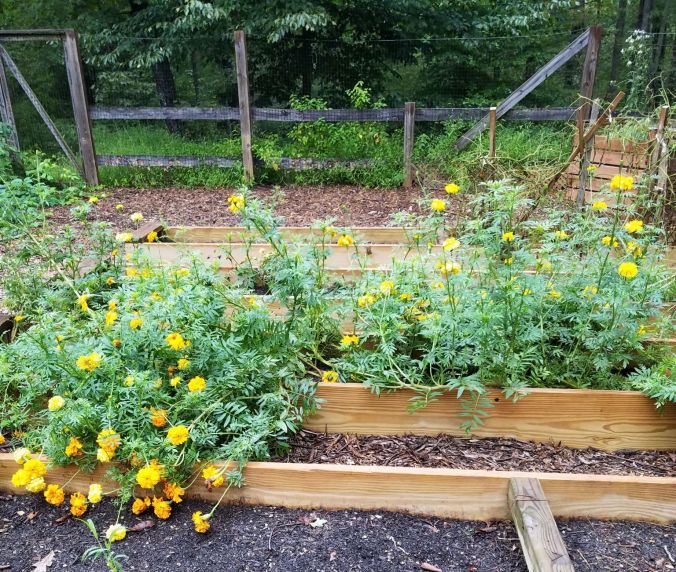
In August of last year the marigolds I did plant were huge and just beginning to blossom. My granddaughter Rise, five years old at the time, sweetly gives you the idea how tall they were.

rise marigold 2018.2mp (2).jpg


By September they were so full and heavy they fell over with gorgeous weight.

marigolds (2) 2018.2mp.jpg


This year I planted gourds instead, and some of them are remarkable (see the one hanging in the upper left? it keeps getting bigger!), but no zinnias, marigolds, asters or any other purely-for-color-and-show plants. Yet here is this one flower – standing strong, beautiful in its own way, determined – despite the mess – to have its moment.

one marigold1 (2).2mp.jpg

What a lovely parallel. Just like each person I know who is not in ideal circumstances presently, each person struggling with this or that, my one marigold is determined to

Stand strong: It’s hard to endure pain! It’s hard to have no time for yourself, or be far from those you love, or go to a job that feels dead-endish or keep up your end of a deal when those around you slough off. It’s hard to see the proverbial light at the end of the tunnel, to remain positive when you feel like crap, to hold your tongue when someone is out of line, to go to the gym when you feel weak, to push through when you want to stay in your comfy little cave. Yet all around me I see people standing strong just like this marigold. It doesn’t care that it’s the only one. It proudly manages feeling like the first grader in the college class, being the newbie on the block, saying the words that are hard to say. Bravo, little marigold!

Be beautiful: See all the green around the marigold? The scene of mostly weeds (other than that one funky gourd) sets the stage for this one determined flower to shine. In our own mess of life, in the chaos or worry or disharmony we endure more often than we would like to, it’s easy to simply become part of the mess, to add to it, to blend in and become invisible. Instead we can choose to be the marigold – at least sometimes – and be other, be radiant, be beautiful.

Have its moment: The older you get, the more fleeting time proves itself to be. Time is so limited. Resources are so limited. So what. None of us will be here forever, or do everything we want to do or reach all of our goals. We are bound by our bodies, our relationships, our location, our circumstances, our education, our wisdom (or lack thereof). Bound. Having a bum shoulder has made me think a lot about the elusive thing we call equality. I can’t do what I want to do! I have a disadvantage compared to people with good shoulders! (Funny how you see things like good shoulders that you didn’t see before!) But this shoulder is mine, for better or worse. I own it. It is unique to me and limits me in ways I wish I could change right now. Alas, we do what we can while we can with what we have. This little marigold will be seen and admired by precious few people before it succumbs to the frost in a few months. No matter. In this season, this year, in this place, it will be like a gem in the dirt, determined to have its moment and do what it can despite its limitations.

I wonder if it grew in this spot just to bring these ideas to me.

Geocache on a Pinecone

Why do people traipse through forests? Hiking maybe? Hunting? Birdwatching? I expected my next foray into the woods to be a search for small dead cedar trees to use as poles. We need some small poles around here. Never before has it been my goal to find a mysterious object, investigate it, write in it, put it back and walk away. But that’s what geocaching is all about.

If you have never heard of geocaching, join the crowd. From the few people we talked to about it last week, it seems you’re either really into it (or know someone who is) or you’ve never heard of it.

My sister Lynn was here for a visit with her daughter Erika and granddaughters Kaileena (11) and Brea (5). We decided to explore some of the pristine lakes in this part of Virginia, having been motivated in part by a free-entry-pass that came in the mail (these promos do work sometimes!). On the way to Sherando Lake in the Blue Ridge Mountains, Erika mentioned that they had what you could call a mission while in Virginia – finding a geocache in which to put a little “travel bug.” You’re doing what? Mom said.

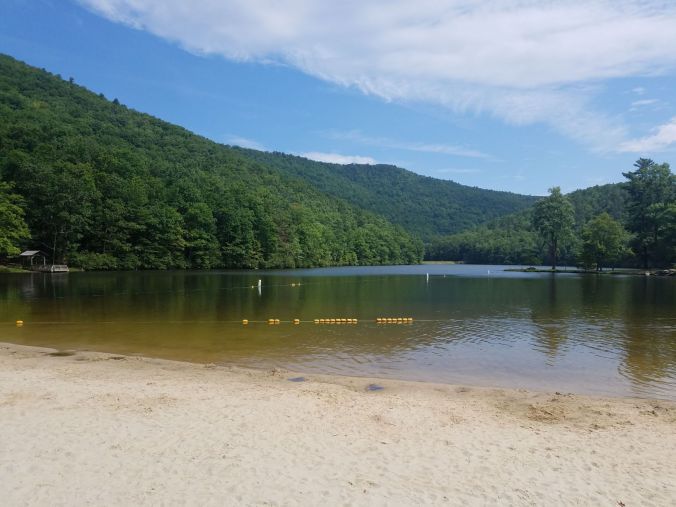
This is Sherando Lake. Ooh, so perfect.

Sherando Lake.2mp.jpg

Kaileena’s “travel bug” is plastic, the size of a large coin or a key ring and has a cartoony dragon image on it. It was found at a geocache in Southwick, Massachusetts, by Kaileena’s Girl Scout troop leader, Lisa, who handed it off to Kaileena when she found out about the trip to Virginia. The idea is to give this little bug/trinket a ride from there to here to some other place eventually, and in doing so, connect with fellow-geocachers in a worldwide hide-and-seek adventure. Every cache is some version of a little treasure chest and contains a list of who has been there. Some of the caches also contain a constantly changing array of trinkets like Kaileena’s dragon, placed there for the next person to find.

For geocaching though, peaceful and picturesque Sherando Lake was a bust. We had fun there, don’t get me wrong. The weather was splendid, as you can see. Mom clearly demonstrated You are never too old to be silly with a fishing net!

mom with fishing net (2).2mp.jpg

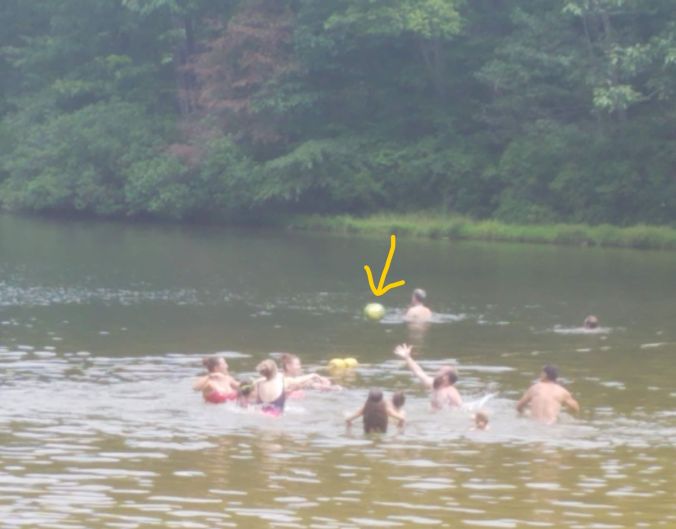
Kaileena and Brea spent hours in the water — til they were “prunes,” as Mom says. And we watched some people throwing a watermelon around in a water game – one presumes there were rules, but I cannot be sure. See the watermelon? The guy with the open hand had just thrown it. Or maybe he’s trying to catch it?

watermelon game2 (2)_LI.2mp.jpg

Alas, geocaching – along with so many other activities nowadays – requires internet. Zeroing in on a specific cache online gets you exact (longitudinal and latitudinal) coordinates that take you to within 16 feet of the cache. Erika had checked the online global geocaching map and knew there were some caches near Sherando Lake, but of course they are not out in the open – what would be the fun of that!? By the time we got to the lake, we had no signal. She even drove to a parking lot next to the fishing end of the lake, but mountains will be mountains and will sometimes very effectively block signals.

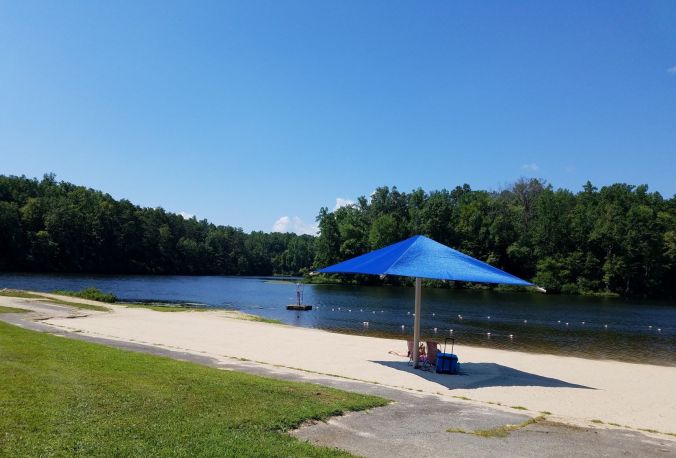
We had better luck at Walnut Creek the next day. A county park closer to home, Walnut Creek is almost as pretty as Sherando Lake.

walnut creek1.2mp.jpg

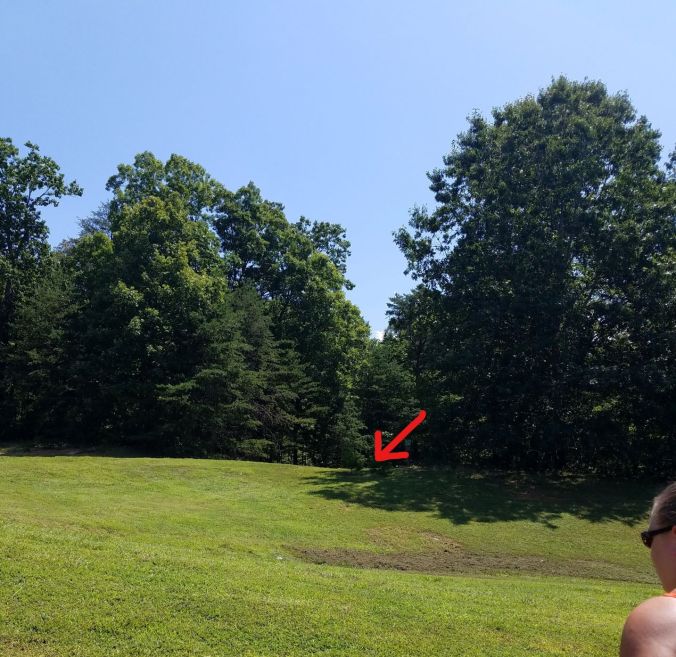
The lifeguards told us internet was sketchy here too, but “See those two little pine trees up on the hill? Try there.”

cell service trees1_LI (2).2mp.jpg

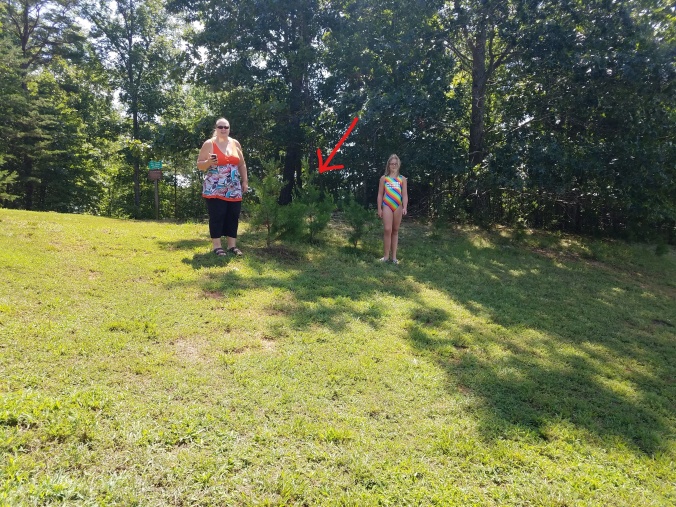
They are hard to see in the shadow, but Erika, Kaileena and I trekked up toward them anyway …

cell service trees_LI.2mp.jpg

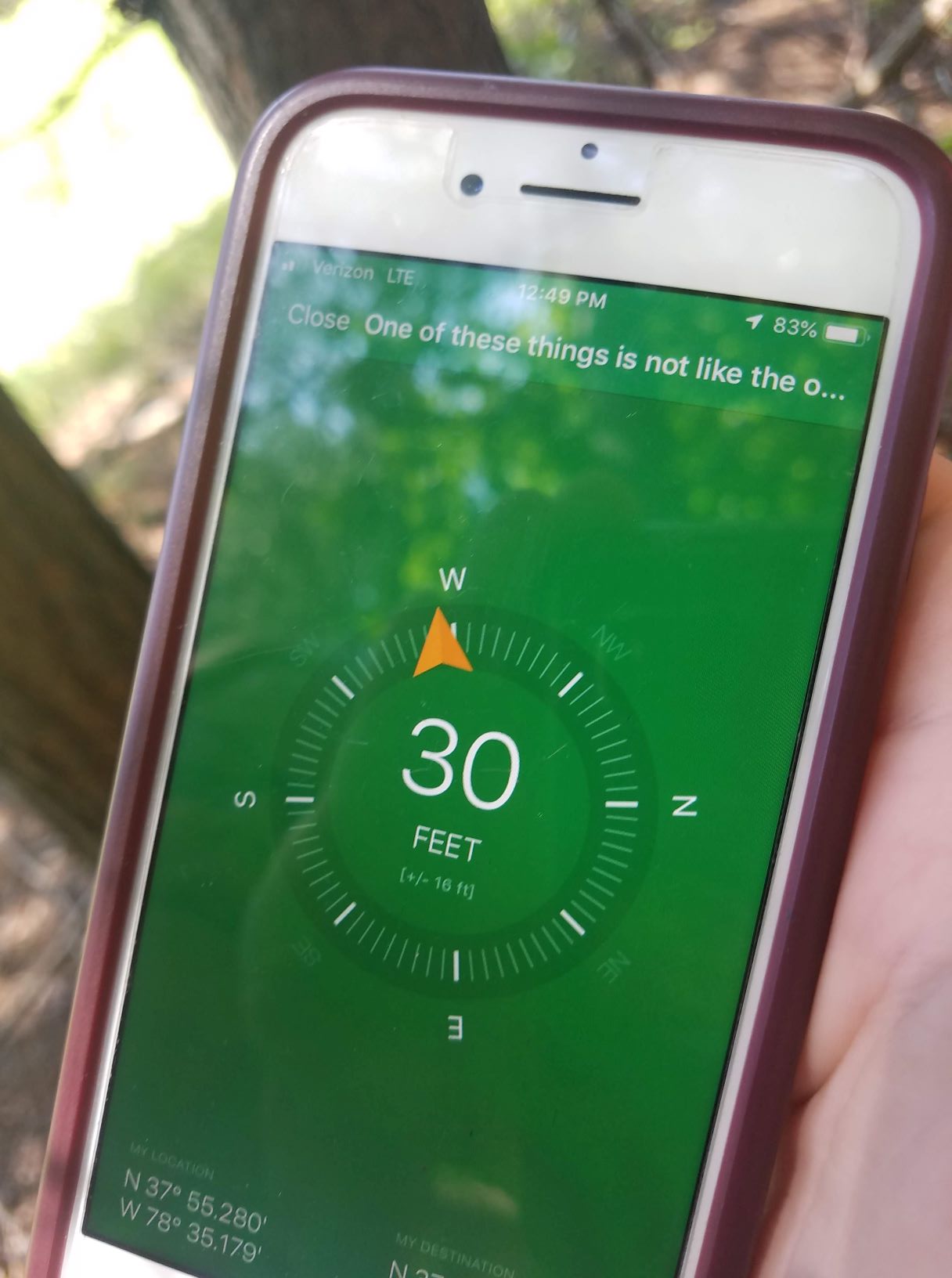
… and sure enough, service! Terrible service, make no doubt, but as we all know, one bar is better than no bars. Within a quarter mile, the coordinates told us, up the hill more, to the right and through the woods, we would find the cache. Erika switched to compass mode on her phone and off we went, following the arrow. It tells you almost step by step how close you now are.

following.2mp.jpg

No two caches will look the same. When on the search, as you make your way toward the hidden or not-quite-hidden cache, the thing to look for is something odd, something out of place, something not as it should be. Hmmm, here we were, branches snapping underfoot, clueless about any specifics to look for other than “it will look wrong.” See how on top of the phone it says “One of these things is not like the o…” We knew ahead of time that this cache was a micro-cache, meaning it would be too small to put the bug into, but we were determined to find it anyway (challenging as that might be!).

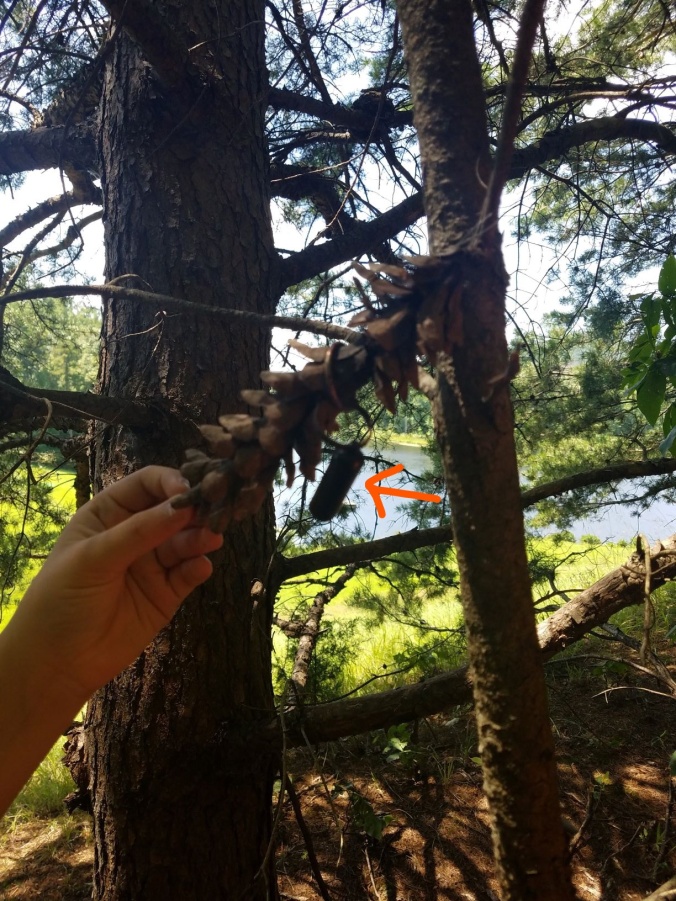
We got to where Erika’s arrow stopped. “We are within 16 feet. It’s got to be here somewhere.” Miraculously, she suddenly found it – a pinecone hanging at eye level from a branch with fishing line (which is not as pinecones should be hanging from trees). “One of these things is not like the o…” has to mean “One of these branches [from which a pinecone hangs] is not like the others.”  Hanging right underneath the pinecone, a little cache. Ta-da!!

showing cache,2mp.jpg

Closer up, the pinecone looked like this. See the little cache hanging off it? See the fishing line above?

pine cone.2mp_LI.jpg


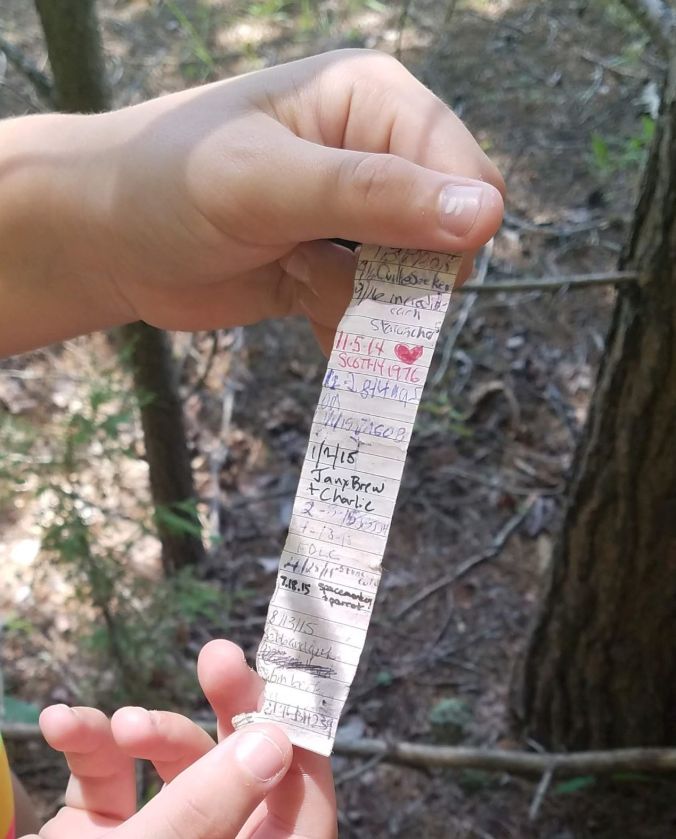
This little waterproof case holds a paper list of those who have stopped by.

showing the insides2,2mp.jpg

Both Kaileena and Erika added their info. Erika then re-rolled-up the list, tucked it back in, screwed the lid on and put it back on the pinecone. That’s it, folks! Quite the lovely view we had from the top of that hill…

view from top.2mp.jpg

… but back to the lakeside beach we went.

What about the dragon-bug, you ask? (I knew you didn’t forget.) The next day, Erika and Kaileena got new coordinates, found a box in a stone wall near the hospital in Charlottesville, deposited the bug and signed their code names. The box was a bit worn and shabby, could stand to be replaced, so Erika added a note to the online info about this particular cache. Someone else will come along sooner or later and replace the box hopefully, and maybe even decide to give that bug a ride and take it elsewhere.

Who knows where it will land next!


The Guys in the Shell Department

Today we’re going to talk about shell production – the industrial-level, incessantly-cranking-‘em-out-level production of … (no, not artillery shells! been listening to a little too much Dan Carlin, have you?) … egg shells!

A little quiz today, or think of it as Some Questions for Fun:

  1. When is the last time you saw an egg without a shell? Last time you cracked one (or two or three) to make an omelet or some popovers, right? Duh.

Check out these beauties – that orange is what happens when you give your chickens the scraps from a lobster fest.

lobster yolk2.2mp

Okay, clearly you need a harder question, even at this hour.

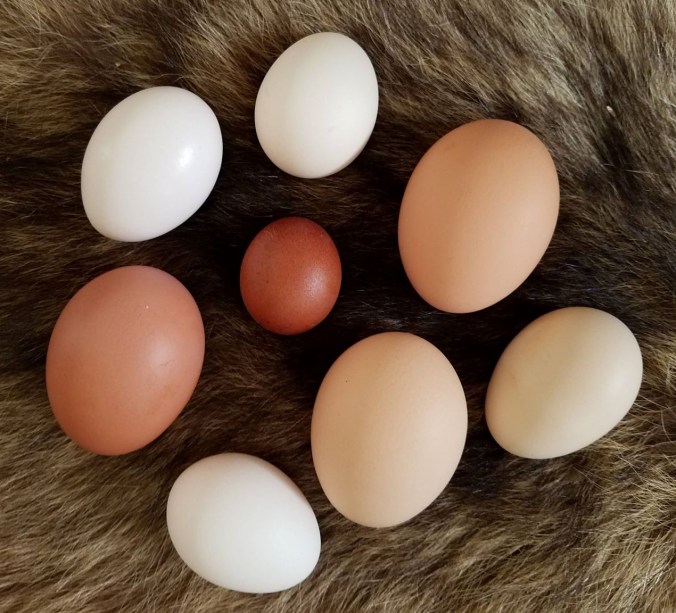
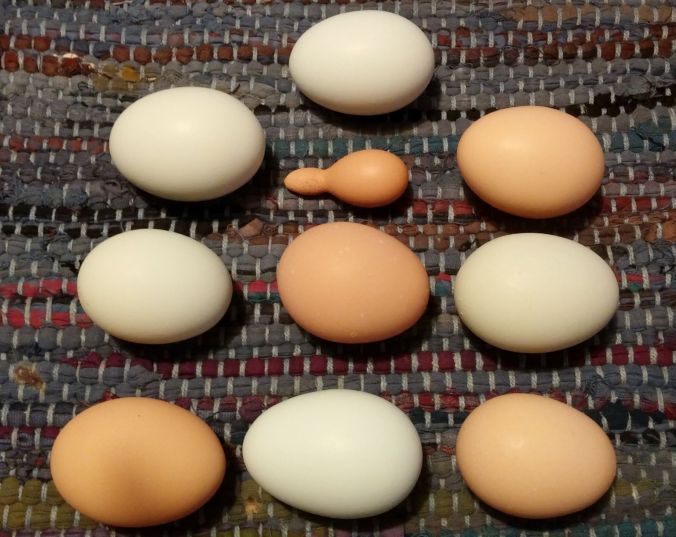
  1. Eggs are so beautiful. I sometimes just stare at them. What perfectly beautiful shapes – though you have to think that middle, fattest, section is the hardest moment for the chicken, just sayin’. What lovely variation in color and size my chickens give me:

2.2mp.jpg

(Yes, that’s my raccoon skin underneath them, in case you were wondering.)

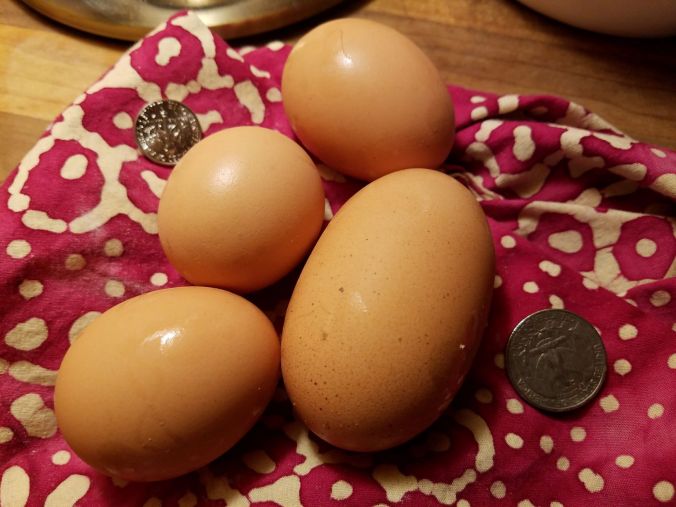
Speaking of size, they do vary tremendously. Here are some measured next to coins.

sizes with coins.2mp.jpg

And others next to a ruler.

sizes.2mp.jpg

Oh, right, there were questions happening here! Let’s try again.
  1. What is eggshell made of?

(You science nerds will get this in a second. The rest of us are deeply grateful that there are science nerds in the world to tell us such things.)

The code (is it called a code?), uh, formula? chemical name? is CaCO3, which in English is calcium carbonate. Well, the shell is mostly, as in 95%, calcium carbonate. You always wondered how the shell can be tough enough to protect the growing chick inside it but breakable enough for its 21-day-old beak to poke through. According to Labmate, “The remaining 5% features hundreds of different proteins that affect how calcium carbonate crystallises. It’s this perfectly balanced cocktail that allows mineral crystals and proteins to form an eggshell that’s crack-resistant, then use nanoscale adjustments to change the pliability and let a chick break free when it’s ready to hatch.” Cool.

Fun facts (these from the Exploratorium) also include: a. the eggshell is covered with as many as 17,000 tiny pores that air and moisture can pass through (so the chick can breathe while it’s developing) and b. the shell has a thin outermost coating called the bloom or cuticle that helps keep out bacteria and dust (which is why you don’t need to wash eggs and should use them quickly if you forget this rule).

Question #3!

  1. What else in nature is like an eggshell (in being made up of calcium carbonate)?

Give it a little thought before you read on…

The examples are striking. Who isn’t impressed with the stalactites and stalagmites you see in caves, like the gigantic ones at Luray Caverns?

stalactites at Luray.JPG

Also there’s

  • seashells that are the exoskeleton of snails, lobsters, clams (though NOT turtle shells, in case you were wondering – I knew you were wondering)
  • coral that you scuba divers find in reefs and the rest of us watch on Blue Planet
  • pearls that oysters and clams make, in which the individual CaCOcrystals “are laid down in such a perfect order that the result is smooth, hard, shiny, and sometimes even iridescent, as in the rainbow colors of abalone shells.” Who knew? (Thank you, again, Labmate.)
  • whole mountain chains in the form of chalk, limestone, marble and dolomite. IMA Europe says more than 4% of the earth’s crust is CaCO3, and jrank says 7%, so somewhere between 4-7% is probably right.  And you know how much we need chalk (to raise pH in soils with high acidity, clean pewter, keep screws secure and dry your hands for weightlifting, bouldering or gymnastics), limestone (to make steel, cement, fertilizer and even white paper), marble (from columns to countertops, a most gorgeous building material as is) and dolomite (to make glass, bricks and ceramics).Now back to the chicken eggshells.
    1. What happens when someone in the shell department screws up?

    Screws up? What do you mean screws up? Eggs are eggs, right? Smooth on the outside, kinda slimy (when uncooked) on the inside, invaluable in making delicious food and fabulously nutritious.

    Nope. Eggs are not just eggs. All eggs are not created equal.

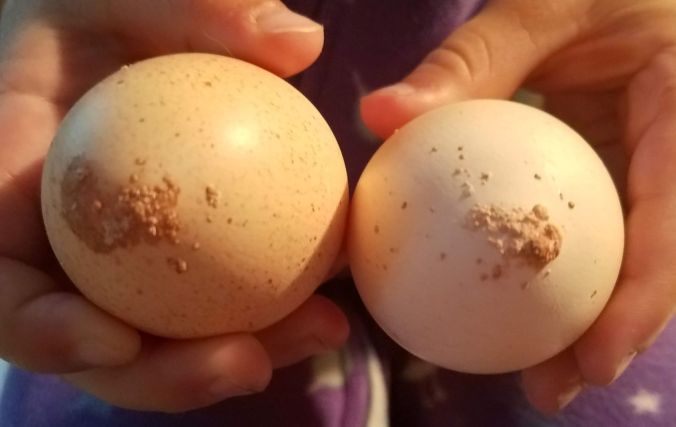
    A daydreaming shell maker got a little carried away on these ends – made little warts instead the standard smooth finish because of thinking about his girl maybe (hmmm), or that new car, or those ribs for dinner? Bit too much CaCO3 in those places I’d say. Best have a little chat with this worker about focusing when in production mode. Focus, Jack. We have a job to do here.

    funny ends.2mp.jpg

    The one assigned to this day’s lot was confused. Gourds on his mind perhaps?

    gourd shape.2mp.jpg

    This worker forgot (toward the end apparently) what shape we are aiming for in egg production.

    odd shape.2mp.jpg

    Now, back to Question #1. When is the last time you saw an egg without a shell?

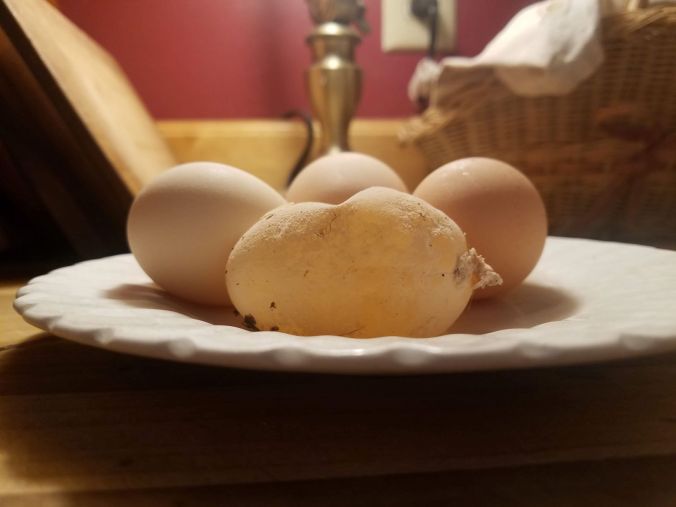
    Forget the omelet. How’s this? A wildly woobly egg! An intact egg with NO shell to speak of, though maybe a few granules of the calcium carbonate here and there, a spattering you could call it. The bottom flattened out and the top collapsed a bit, but this egg mostly held its shape, its membrane apparently keeping it from gooing all over the place. When we touched it, it squished in like jello. Oh yes, and whoever the shell maker was in this case tried to cover his tracks and squirted a few squirts of the CaCO at the end (see that unshapely blob sticking out toward the right?) – undoubtedly a last-ditch effort to demonstrate that it’s not a complete bomb and maybe he should not get fired. Really, HR needs to have a conversation with this employee!

without a shell.2mp.jpg

Last question: What’s really going on in the chicken coop???


Enough is As Good As a [ _____ ]

When Claudia visited in 2016, her first trip to the states in a few decades, we were acutely aware of how rare and precious our time together was. You know how it is – time flies with dear friends. You want to do everything you’ve been talking about for so long: Let’s make that no-knead bread and the homemade mozzarella cheese and a salad so you can dress it the way I love, oh and let me show you how we make our pizza now. Let’s watch Downton Abbey and Witness and The Lives of Others – and have you seen The IT Crowd? (Both stupid and hilarious, for when we just want to laugh!) Monticello is nearby, and Yoder’s, and the downtown pedestrian mall that’s so much like Burlington’s, and don’t forget Barboursville Vineyards with its cool stone ruins of Governor Barbour’s mansion. Let’s take walks in the morning when it’s brisk and in the daytime when the sun is warm and in the evening when the sun glows in the western sky – oh, yes, and Humpback Rocks is a great hike, best in the evening (not like Tirol, okay, but for Virginia, a great hike!).

Claudia and me Humpback Rocks Oct 2016.jpg

We had only nine days. And when I had asked her ahead of time what she wanted to do when she came, she replied with one word: “Rest.”

So let’s, instead, be real. Life comes down to choices, right? As I lamented, she comforted: Zu viel nimmt weg von genug, which I wrote down on a post-it, duly translated and left stuck on the side of my fridge.

Too much takes away from enough.

You could play with the translation and say Too much is worse than enough or Too much negates enough. The idea made sense – if we try to do too much, the time will not be restful, we’ll make ourselves crazy, we’ll miss the balance. And the German had a nice cadence to it. But the verbatim translation didn’t quite work for me. It stuck in my mouth somehow. And it never occurred to me to flip it around and put “enough” at the beginning.

This past week I got help from Mary Poppins. As I watched my five-year-old great niece giggling her way through this classic, I stumbled on a translation of Zu viel nimmt weg von genug that I’d missed the last, oh, say, five times I watched this movie. After the bit of nursery magic when all the toys and clothes dance and bounce and jump around, finding their way into drawers and cabinets and closets, converting the room from messy to tidy in a few delightful minutes, Jane and Michael wanted to do it again. More magic! More fun! How can that be bad? Mary Poppins drew the line in her practically-perfect, matter-of-fact way: “Enough is as good as a feast.” Click on the link to watch her say it.

Well, look at that! In 1910, the setting for this film, they too were struggling with When is enough? Where is the line? Clearly this is not a new problem. Well before that, people in biblical times were likewise advised about moderation. Have you found honey? Eat only what you need…. (Proverbs 25:16)

The idea of potential excess, should-I-or-shouldn’t-I-cross-that-line, comes up all the time.

What fills a day (or nine days)? Activity, yes, but how much is enough to be fun and satisfying yet avoid utter exhaustion?

What fills a house? Stuff, but how much is enough to fend off clutter and inundation?

What fills our bellies? Food and drink, but how much is enough for good health? How much crosses the line?

Decisions. Every day I have to make hard decisions – not every day as in on a daily basis, no, I mean continually    throughout    every    day – what to say yes to, what to spend money on, what to put in my mouth. Abundance has a downside, some would say a curse.

Funny, we don’t have trouble deciding how long to stand there rubbing our hands together with the soap before we decide they are clean enough. We know when’s enough. We’re pretty good about knowing how fast to drive (we value our lives), how much physical space should exist between us and the person standing next to us (how close would be too close), how many toppings we want to put on our pizza (how many would be too many), when we’ve been sitting too long (need to move!), when enough time has passed since we last heard from an old friend (time to send a message). How come that same mostly-good judgment can’t apply so nonchalantly and easily to (pick a temptation, any temptation) shall we say ice cream?!

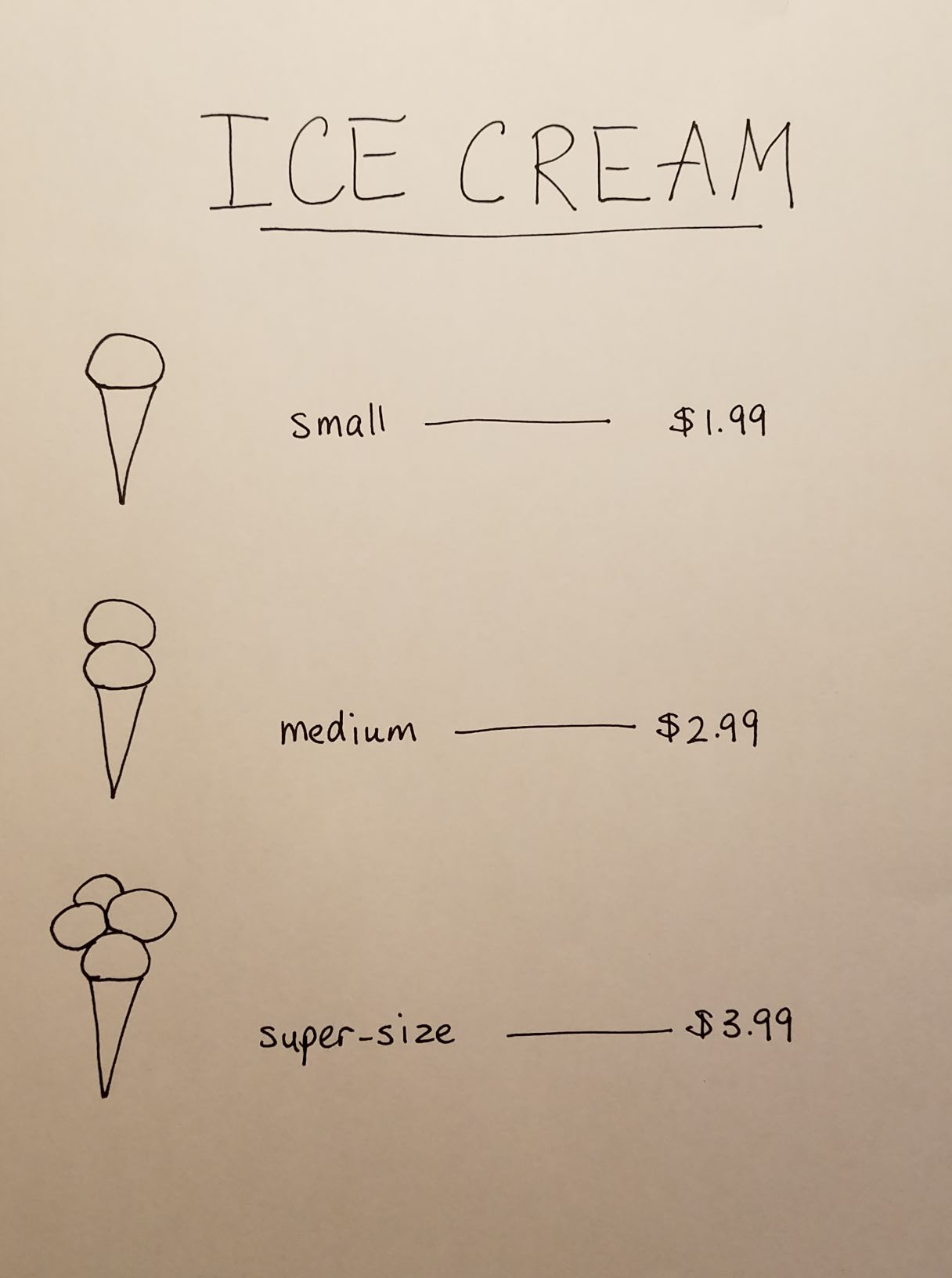
While standing in line to get ice cream recently, the person next to me ordered a small but said out loud while staring at the price list that looked something like this,

ice cream price list.2mp.jpg

“I want the super-size.”

Aren’t people the same no matter what year it is!?

A friend who was watching her weight once told me that a small scoop of ice cream didn’t taste better than a large bowlful, and that when she had less, she savored it more – or at least she was trying to train herself to think this way!

Maybe training is the answer. We can train ourselves (or be trained) to do new tasks at work. We adapt to new surroundings or circumstances with a bit of self-talk. It’s an idea.

Hmmm, but I like a feast as well as anyone. (We have only nine days! … That bread is fresh now! … I really like that bowl/table/shirt/game/book/gadget!)

How about mental gymnastics? Maybe I could reconfigure the feast, spread it out over time a bit or have one a little less often?

I hear once again my wise professor’s words. The topic at the time was bacon: Should I eat it? Shouldn’t I? How much? He calmly said three words: Balance. Variety, Moderation. Is it really that simple? Maybe.