Unbeatable Biscotti

“You could sell these.”

“You should sell these!”

“If you’ll make me more of these, I’ll pay you.”

“These are better than any you can buy.”

plated.jpg

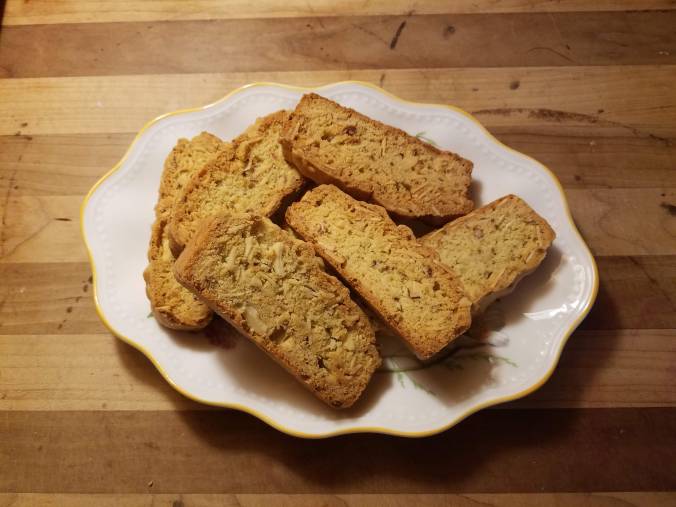
If just one person had said such things about my lemon-anise-almond biscotti, I would have thanked her (or him) and carried on. But these make a great gift – they mail well and keep well – so I have made a gift of them many times. And I have heard similar versions of “these are great!” over and over again throughout the years since I discovered and tried this recipe in the Williams-Sonoma “Cookies & Biscotti” baking book.  I don’t even eat them myself (can’t abide the almonds) so I can’t chime in. Sometimes you have to just take people at their word.

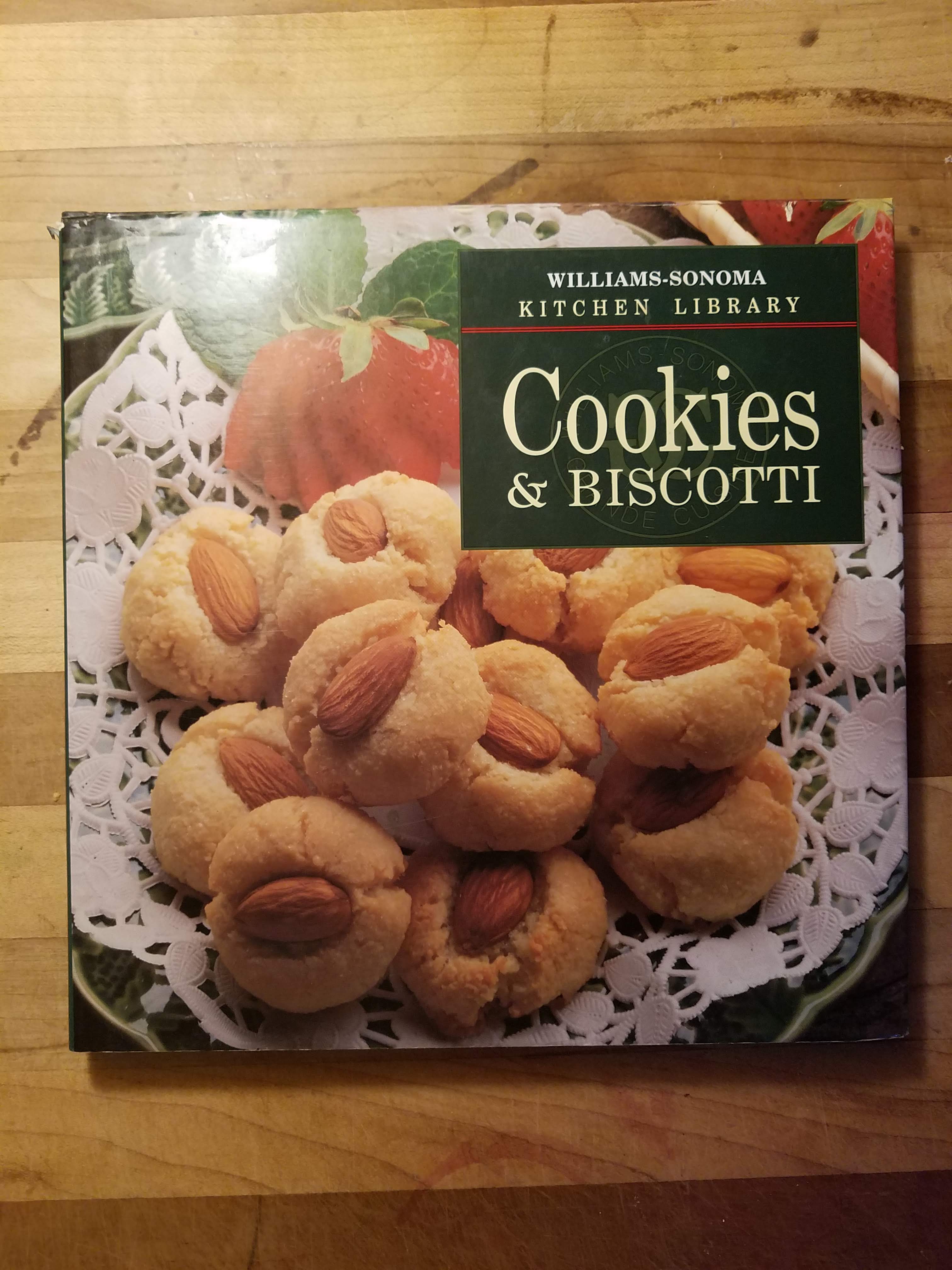
This is the book.

book.jpg

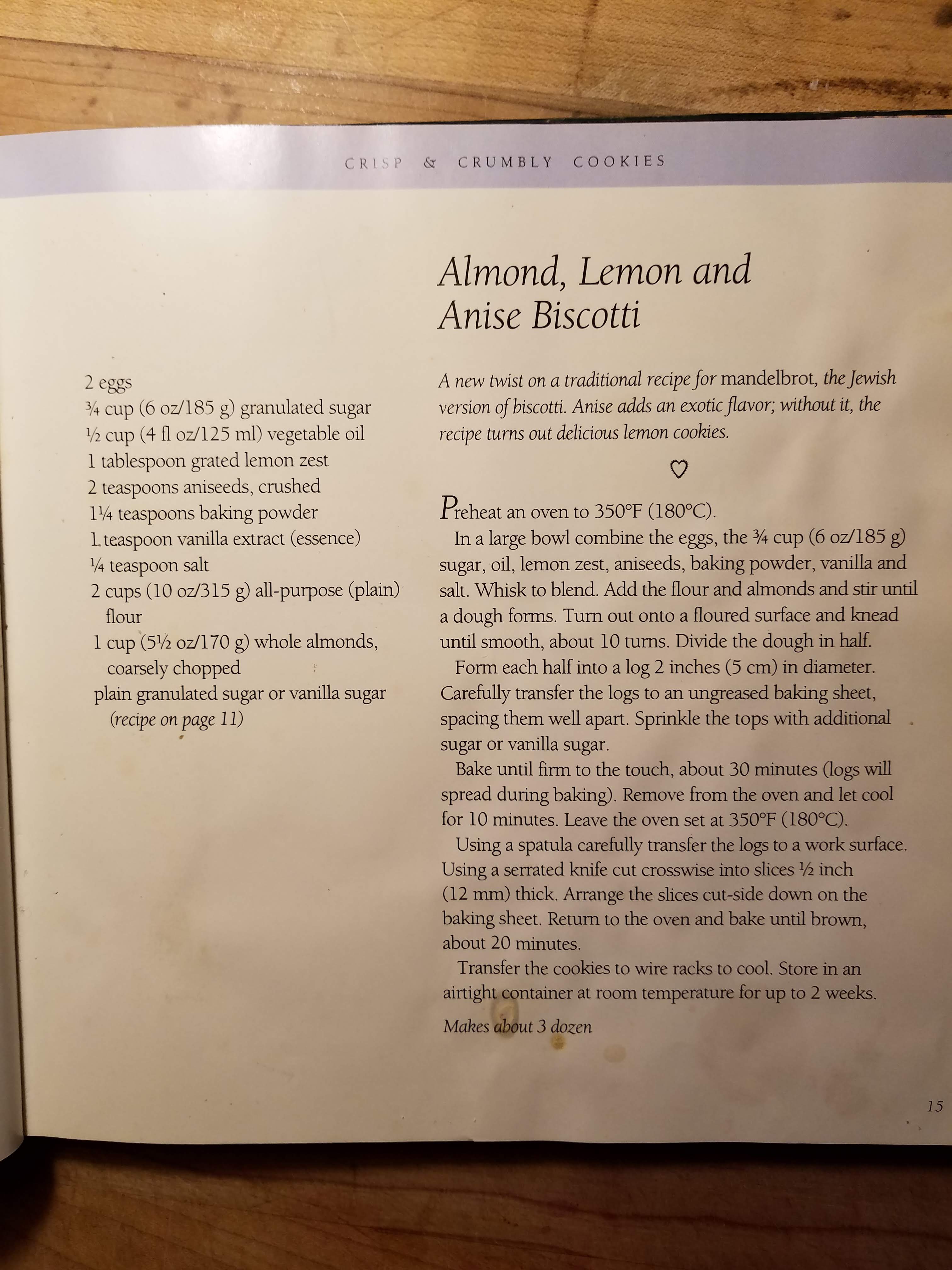
This is the recipe from the book.

recipe.jpg

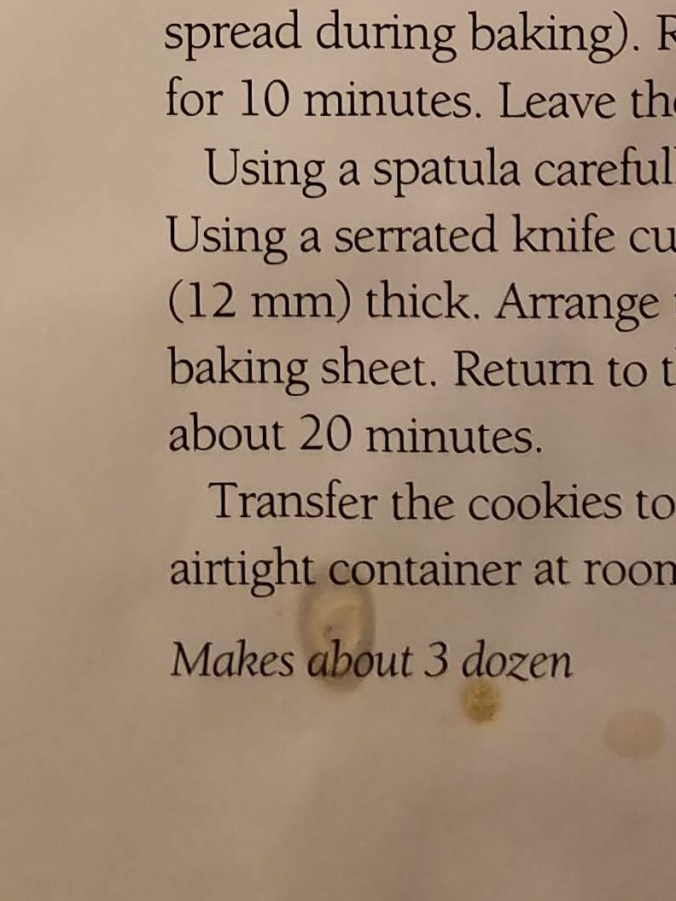
You can see that the page is wrinkled and has spots of something that spattered on it where it says “Makes about 3 dozen.”

recipe (2).jpg

This is what happens when a book is open near your work area. The marks of use are like a letter of reference or a proof that the book has been opened to this page near splashing ingredients numerous times. You don’t use a recipe over and over that you don’t have success with. The marks on this page are the same as a tattered quilt to me — used, loved, used again.

Not only are these a wonderful gift, but they are a joy to make – even for someone who can’t abide nuts! Start with the mixing of the eggs and sugar. I know I’m partial to my own chickens’ eggs. Yesterday, when I needed one and simply walked out to the coop to get one (and the door was stuck on account of being swollen from the rain and I couldn’t get it open and had to ask Samuel for help!), I thought How many people can just walk out to their coop and get a fresh egg when they need one?

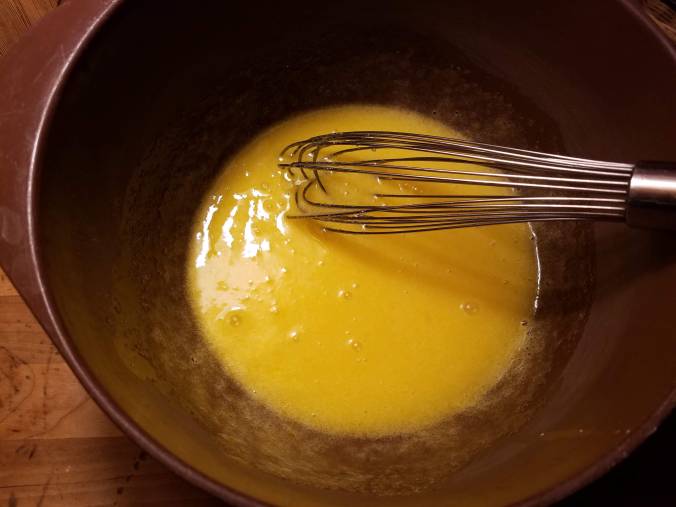
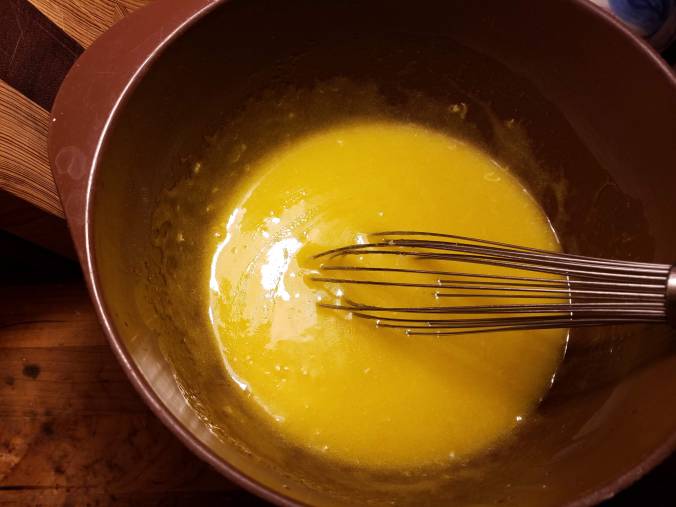
I know my eggs are super fresh, but I think yours would look just as beautiful as this whisked up in a bowl with the sugar.

eggs and sugar.jpg

When you add the oil (olive oil for mine, I always use olive oil) and it sits on the top looking so separate,

oil in.jpg

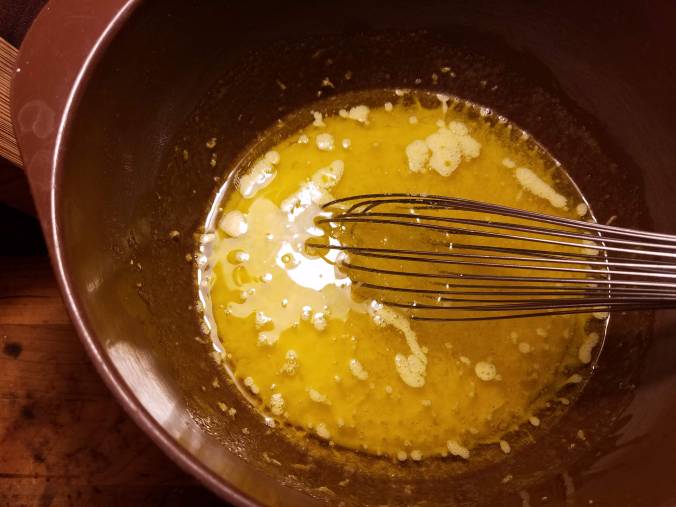
you might be tempted to wonder how it will incorporate. But a little wrist action brings those pure ingredients together into a smooth, glistening mixture that has its own beauty. I love the gleam.

oil mixed in.jpg

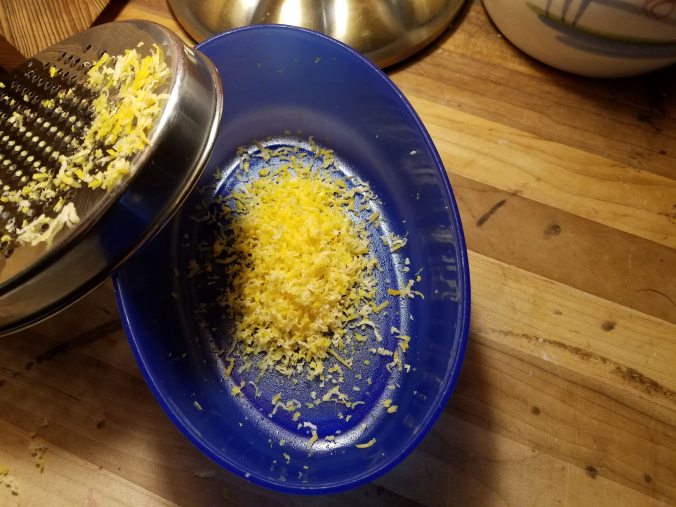
I don’t measure the lemon zest. The peel of one lemon, grated fine, has always been perfect not only in amount but also in how it adds to the pleasure of making these biscotti. On and in my grater, the little pieces of peel not only look beautiful, but the lemon oil that gets released fills the air with a freshness like no other. And however much it makes, it makes. I put it all in.

lemon rind4.jpg

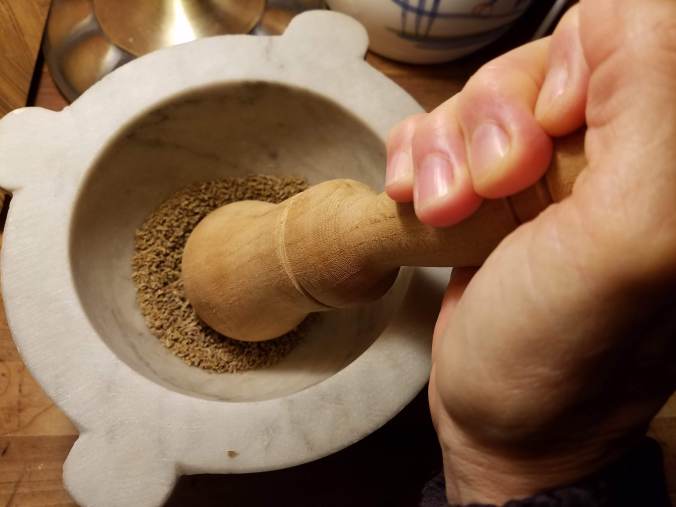
Next comes the anise, another sensual wonder. You can buy ground or crushed anise, but to crush it yourself in an old-fashioned mortar and pestle, to smell the rich aroma of the anise oils breaking forth from the seeds – well, I’m in heaven.

anise4.jpg

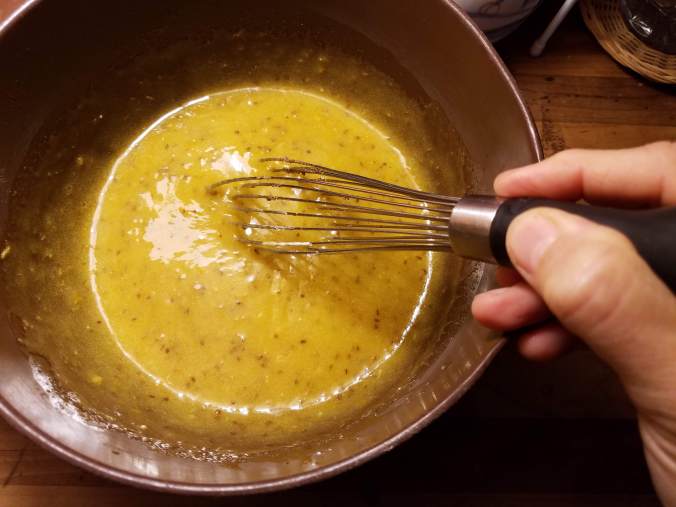
Once the grated lemon peel and crushed anise seed have been mixed in, it looks like this. Your nose will tell you you’re on the right track.

anise mixed.jpg

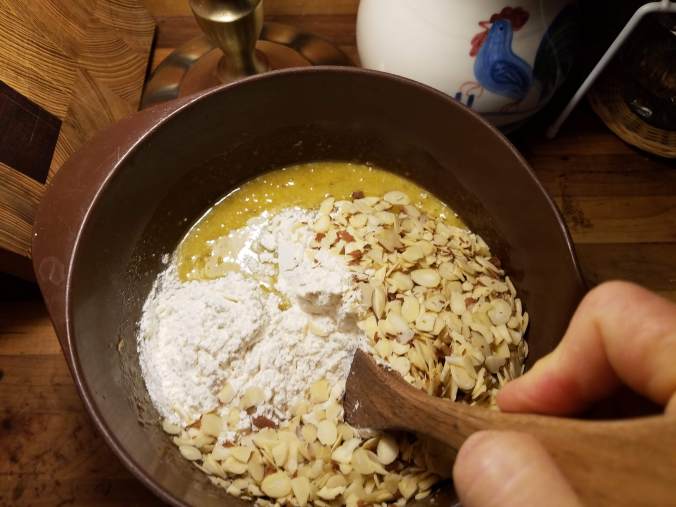
It’s time for the rest: baking powder, vanilla, salt, flour, almonds. The recipe says to use whole almonds and chop them coarsely. If I liked almonds and wanted the joy of that experience (no doubt for almond-lovers it’s right up there with mixing the olive oil in, grating a fresh lemon and crushing anise seed), I would do that. But I simply tolerate the almonds for the sake of those who like/love them, so I cheat here and add the very thinly sliced almonds you can buy. In this case it was raining the other day when I might have gone to the store and Mom had some in her freezer – thanks, Mom!

Notice I moved to a strong wooden spoon instead of the whisk for this part.

almonds flour etc.jpg

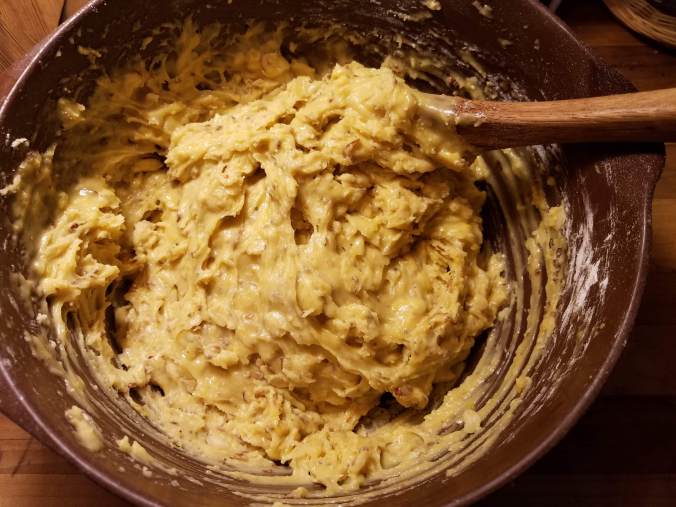
The dough is quite stiff by the time you mix everything in. The strong spoon is better.

stiff dough.jpg

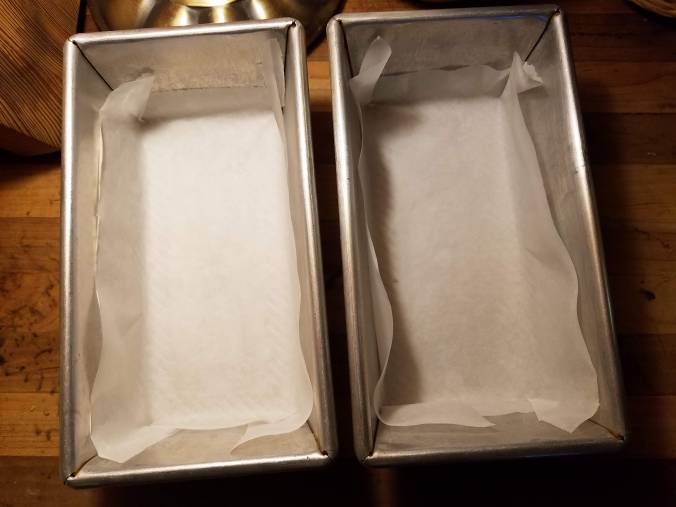
The recipe says to turn this out on a floured board and knead until smooth, about 10 times. I don’t know if I was distracted (that never happens around here!) or if I thought the dough looked smooth enough. Anyway I forgot this part and jumped to the pans. Again not sure what moved me to use parchment paper this time (for the first time ever) but I did, and it was great. I lined the pans. Notice I am not overly generous with the paper. Cheap runs deep!

pans ready.jpg

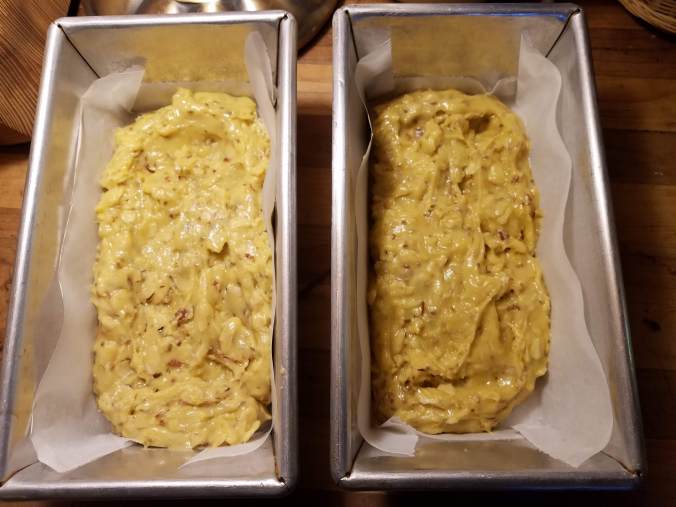
And put the stiff dough in.

pre oven.jpg

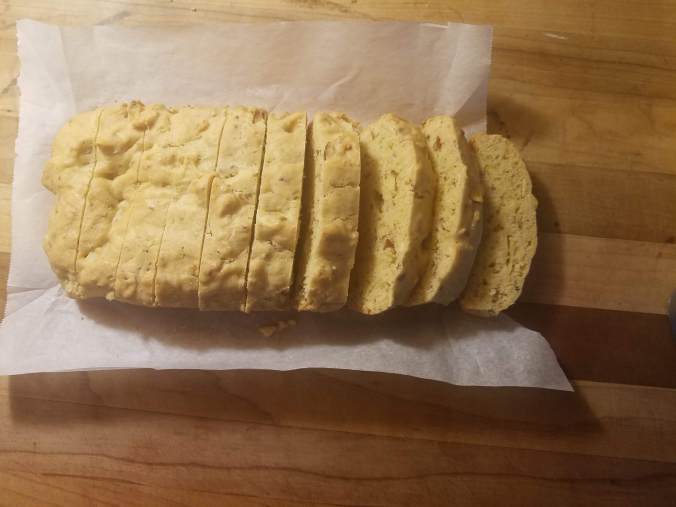
Turns out that not kneading the dough did not change the outcome. My loaves baked for the 30 minutes the recipe calls for, and they didn’t look very brown, but I took them out, waited a few and sliced them. It was just right.

Use a good serrated bread knife. You have to get through the almonds, and whether they are finely chopped or thinly sliced, they are an obstacle. Slice carefully.

post oven sliced.jpg

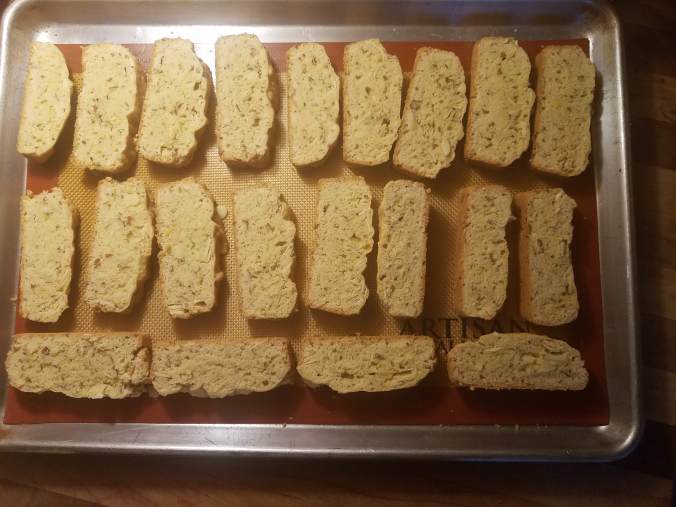
Now put those slices, cut-side down, on a baking sheet and right back in the oven.

post oven on pan.jpg

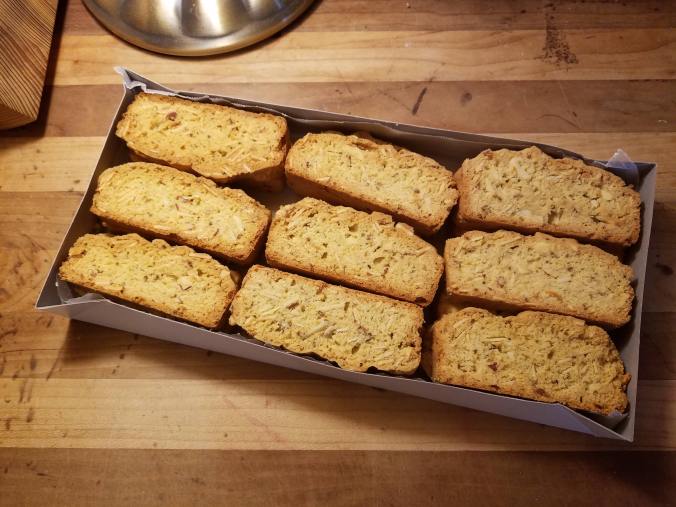
After 20 minutes in the oven for this part of the process, I didn’t think these looked quite browned enough, so I left them in another 8 minutes, and I liked that color, so I took them out, let them cool and boxed them up for my sister Joanne and her husband Fred, who were in town for a visit.

boxed.jpg

I found just the right box in my handy-dandy empty box collection. Look at that, two layers fit perfectly. My children always laughed at me for saving empty boxes of various sizes, but as any empty box collector knows, all boxes are not the same and there’s something to be said for having a good selection for times such as these, which I did (on account of careful saving), and which came in handy (again). I say, if a thing – say for example my empty box collection – doesn’t harm anyone, shall we perhaps kindly overlook the quirk and allow the collector to indulge? But I digress.

Enjoy your biscotti and prepare yourself for rave reviews!

Randos and Meatloaf

If you typed the sentence below into a blank page in Word document on your laptop, one word would come up with a red line under it, telling you to check your spelling because it’s unknown to the internal Word dictionary. If you tried to play that same word in Wordfeud or any of the online scrabble-type games, it would reject that word as “not a word.” Here’s the sentence:

Last night my son Samuel came home from a tech meetup and told me there had been some randos there.

Did you guess which word I mean?

“Some randos?” I said to him. From the context I guessed: “You mean random people?” He smiled. “Randos?” I repeated.

“Yeah,” he said, still smiling. Clearly I am so out of it that my ignorance is amusing. “Random people who show up who don’t necessarily belong.” To prove his point, he said, “I’ll show you in the slang dictionary.” He put rando in a google search. “Oh!” he said, “not the slang dictionary. Merriam-Webster!”

Indeed, rando is a word, randos being the plural. From the Merriam-Webster page https://www.merriam-webster.com/dictionary/rando:

Screenshot (39) rando.png

Who knew? Obviously I didn’t. According to M-W, “The first known use of rando was in 2003.” Ah, a millennial word. To further his amusement and my education, he then pulled up a song on youtube that humorously includes much of the millennial lingo. To further yours, I humbly suggest checking out Millennial Love https://www.youtube.com/watch?v=MUendT_dGks&start_radio=1&list=RDMUendT_dGks

New words enter the lexicon all the time. Notice “meetup” in the original sentence about randos. Why can’t young people say they are going to a meeting? Because when young people want to gather in a group, they don’t meet. They don’t meet together. They meet up. The verb in “Let’s meet up” turned into the noun in “I’ll see you at the meetup.” I myself would be tempted to add a hyphen for the noun, as in “I’ll see you at the meet-up.” But no. Why would a millennial bother with hyphens?

Now that I am clear and settled on this new word (which somehow I missed for the last 15 years) I can reflect on the endless supply of almost everything in this world. Recipes, for instance. Just last night I was making meatloaf. I put the ingredients in a bowl. In this case, ground beef, bread softened in milk, eggs, minced red onion, parmesan cheese, fresh chopped parsley, salt and pepper.

in bowl.jpg

I mixed it all together and found that it was a little too wet. I added a handful of (dry) old-fashioned oats. It was still too wet so I added another handful. This made it just right. A long time ago I had a recipe book that used oats to “stretch” the meat the way my mom had always used leftover bread. I always thought oats were a good idea, as in more “pure” (one ingredient instead of everything that’s in the bread), more natural, more fiber. But while going through my pantry yesterday I had found some dried old bread and thought to use it up with the ground meat I had thawed the day before. But when I had added milk to soften it, I’d added too much, thus the need for more stretch ingredients, i.e. the oats.

I shaped two thin loaves (so it would bake faster, I was hungry) and baked it in a very hot oven (450, I was hungry) which also gave it some crispiness. The meatloaf came out great, even if meatloaf never really looks that great.

cooked.jpg

I thought about sharing my meatloaf recipe and was constructing the ingredient list and preparation steps in my mind when I realized that, well, normally I don’t put minced red onion in. I just happened to have one already peeled in my fridge and it stared at me when I went in for the eggs.

Also I would normally use oats, not bread, for reasons above. But I used the bread yesterday because there it was. A lot of people, including my mom whose meatloaf is fabulous every time, use bread and that’s okay. She squeezes hers to get the excess moisture out, and I think uses water instead of milk to soak it in.

If you don’t have fresh parsley, dried will serve.

How many eggs? Two or three per pound of meat? That depends on 1. how moist you like your meatloaf and 2. how big your eggs are. Mine from the silkies and d’uccle are very small, so I would have used three if I had not poured too much milk on the bread.

I like to use the “meatloaf mix” you can get in the meat case at the store, where they grind up beef, veal and pork together and package it specifically for meatloaf, but that’s not what I had taken out of my freezer, so yesterday’s was just beef.

My sister Lynn makes a stiffer mixture, flattens it out, puts stuff inside (I can’t remember: salami? cheese? cut up veggies?) and rolls it up before baking the loaf. This is always delicious.

Some people bake their meatloaf in a loaf pan. I prefer a freeform elongated football. A very skinny football if I’m very hungry.

My point is: There are endless ways to make meatloaf just as there are endless new words and new expressions in our lexicon.

Go to the greeting card section of any store that sells them. There are endless ways to say Happy Birthday or I’m so sorry for your loss.

Decide to build a porch on your house. There are endless ways to design it (not all of them sensible, feasible or economical, I grant).

Watch the political campaigns happening around you. There are endless ways to say Here’s why you want to vote for me.

Check out Blue Planet II on amazon. There are endless kinds of sea creatures with endlessly different shapes, colors, habits, habitats, diets, methods of survival, ways of caring for their young, levels of ugliness or cuteness. There’s fire spouting from mountains under the sea. Sperm whales rest vertically!

It would be easy to be overwhelmed by the endless newness and the endless variety, and maybe sometimes we are. But mostly I hope we marvel at the richness of the world and count our blessings that there is always something new to learn. We are never done learning. We never should be.

Who knows? The next meatloaf might be even better than this one was!

A is for Applesauce

For as long as I can remember, I have made applesauce come fall. It’s a signal of the season change, when my best descriptor of the air is “crisp” and my thoughts turn – without intention – to hunkering down and getting ready for the colder, shorter days of winter. It’s fundamental to our primal instincts to get ready for scarcity of food, even if we don’t have to worry about that at all. Applesauce is one of those pure foods that’s good warm, cold or icy, all by itself or next to a slice of pork roast or a potato pancake.

It’s simple. You wash the apples, cut them up, put them in a pot with a little water, let it cook down, press it through a strainer, add some cinnamon if you want, and enjoy! I’ll take you through it step by step.

Amazing apples make amazing applesauce, so start with apples as fresh and crisp as possible and as local as your location allows. I am fortunate to live 20 minutes from a well-established and super impressive family farm that specializes in heirloom apples. https://www.albemarleciderworks.com/

sign.jpg

One day last week I happened to be going right by there, so I stopped in for 40 pounds, my usual portion when applesauce is the goal. (Forty pounds fills three canvas shopping bags a bit more than half full each, in case you wondered.) Normally Albemarle CiderWorks has five or six long folding tables set up along the outside wall of the barn with a box of each kind of apple, one after the next, in a long row on the tables. (There’s a good photo on their web site showing this.) They have small paring knives and paper plates and descriptions of each apple set out in front of the boxes, so that you can sample them and decide what you like best.

But last Thursday it was raining and all the apples were in cold storage. I was escorted into that living-room-sized refrigerator and chose fast! Cold storage is cold!

Different apples are picked at different times, and different apples are best for different purposes. Applesauce naturally comes out best when you use apples that are best for cooking. For me that means they are very firm and a bit tart, which is as technically descriptive as I can get. Last year I got one called Black Twig that was extraordinary, but it comes late in the season and was not available yet. Virginia Gold and Liberty looked good to me in the ten, very cold seconds inside the fridge that I allowed myself to contemplate this decision, and the woman helping me confirmed that they would make great applesauce. Pack ‘em up! Done! Homeward I drove.

Yesterday, following too much rain this past week, the ground was too wet for the final grading in front of the house, so we thought maybe it would be a good time to get the oak clapboards on the coop. That job has been sitting all summer on the back burner while we waited for the wood to be milled and got involved with other things. We had barely started measuring and cutting boards when raindrops came again, so we turned our attention to the basement, more specifically to making order in the basement. A lot of stuff got moved to clear the space in front of the interior wall of the foundation that needs repair, and that stuff had been put here, there and everywhere. It took a couple hours, but all is decently in place now. A bunch of stuff is in the trash.

Then it wasn’t raining anymore, and the coop siding beckoned still. But before heading out, I decided to get the applesauce going. Look how beautiful they are in my sink.

apples in sink.jpg

I rinsed them off and stared at them a bit, admiring their gloss, their unique colorings – every Liberty with slightly different transitions from reddish to greenish, every Virginia Gold with different splotches and spots of brown. I have to admire them before I cut them up. It seems the respectful thing to do.

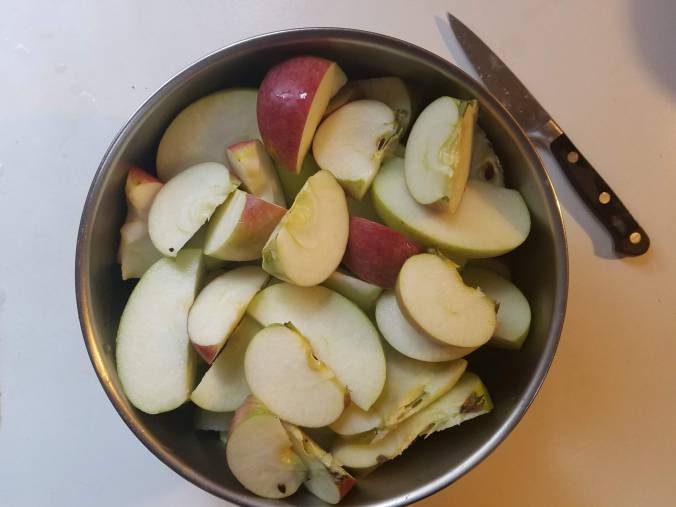
But once you start cutting, you just cut. The little ones you can quarter, the big ones in sixths or whatever is quickest. Seeds and skins stay; stems go in the compost or trash.

cut up.jpg

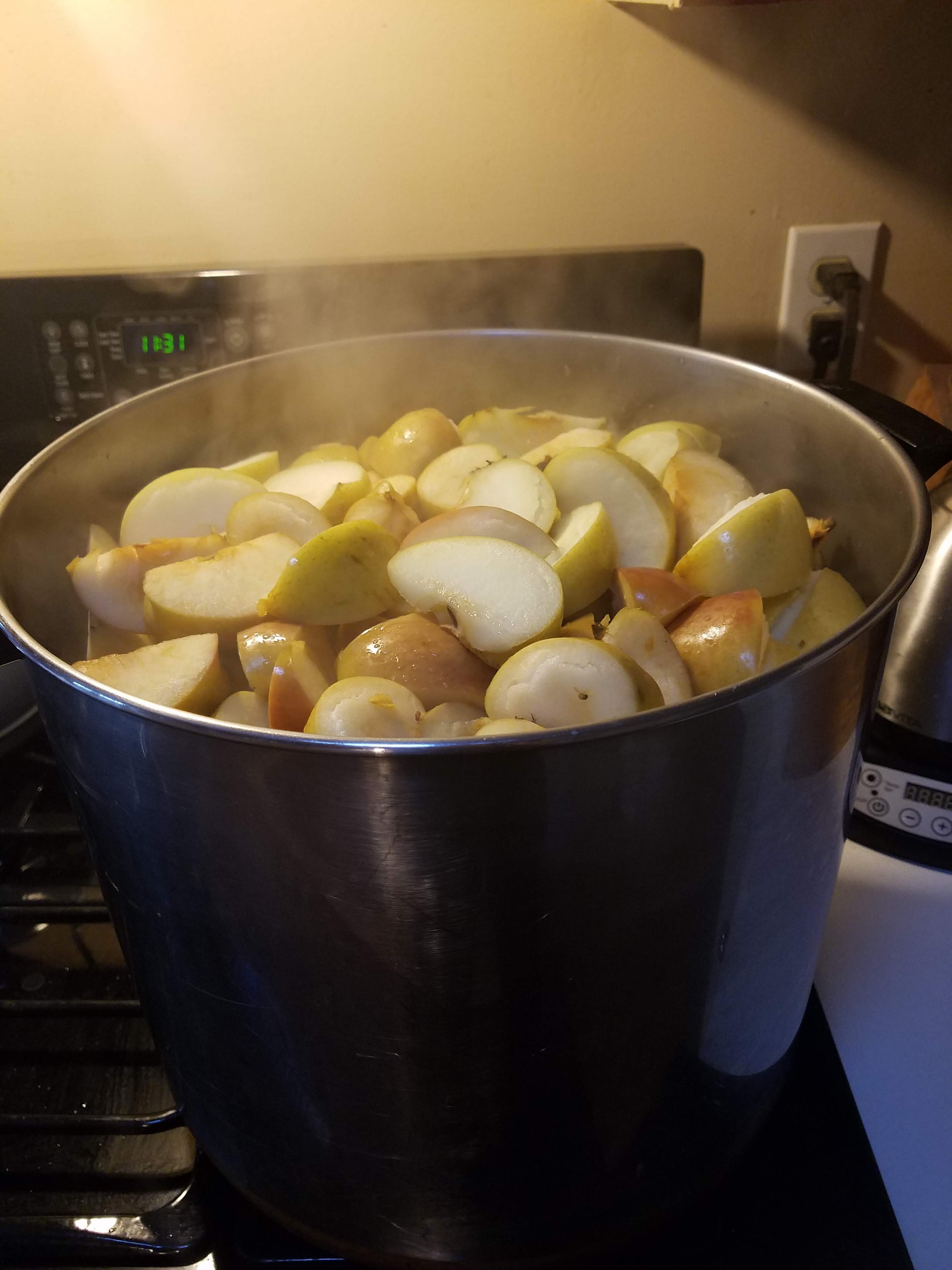
I can’t be overly specific regarding quantities here because it’s entirely up to you how much applesauce you want to make. Take out a big pot (I used my five-gallon pot) and put about half an inch of water in the bottom of it. Put your cut-up apples in the pot until you can’t fit any more. Mine looked like this.

start.jpg

Cover the pot, turn on medium and walk away. Go read a book or put siding on the coop. With the lid on top and the water in the bottom, those apples will just steam and get soft. After about an hour I took a break from the siding and checked on them; mine were doing what they are supposed to do: reducing in volume, steaming away, looking like this.

after one hour.jpg

Yours might take a little less time if it’s a lesser quantity. (What makes me think that not everyone is going to fill a five-gallon pot? You can make a smaller amount, but after you taste it, you’ll wish you made more!) The apples need to cook down slowly, and all they need is time and heat. Give it a stir at this point if you want, but it’s not the end of the world if you don’t.

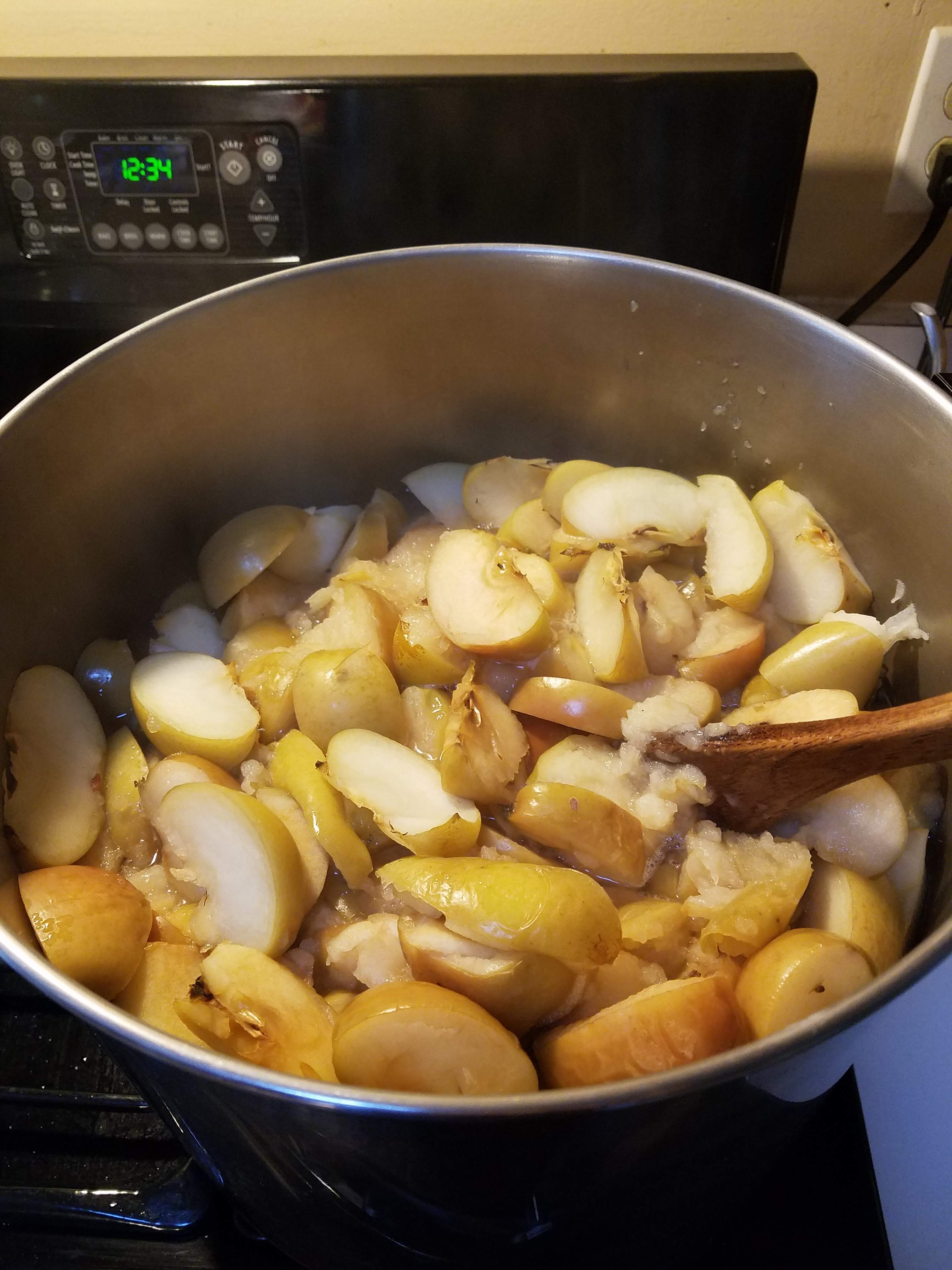
After about two hours it reaches the point of mushiness where you can easily stir it with a wooden spoon and make mash by doing so. By this time the aroma of apples fills your home and you wonder why more people don’t cook.

after two hours.jpg

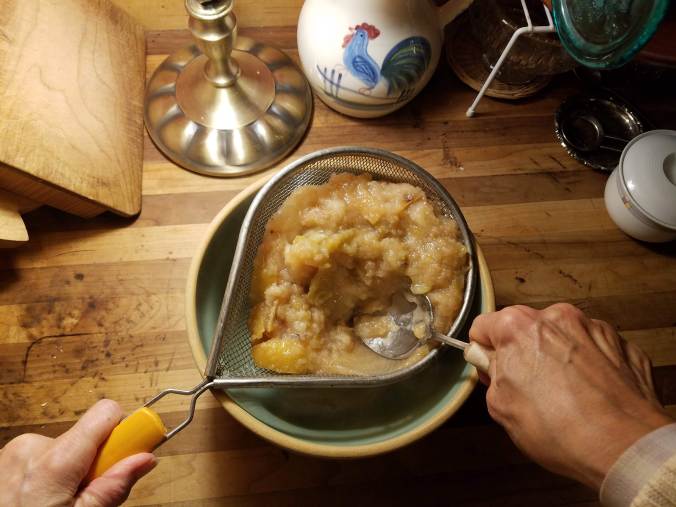
See the mash around my spoon? With a few more stirs, it all looks like that and you can spoon it into the strainer that you have set up in a bowl.

mash in strainer.jpg

Except for the skins and seeds, it’s applesauce now. Why not just peel and core them before cooking them? You can, but that process is tedious and time-consuming, and you lose more of the flesh of the apple that way. I do not have that kind of patience, much as my chickens would love the extra apple they’d get. And these apples are precious to me – I want as much of them as possible going into my applesauce.

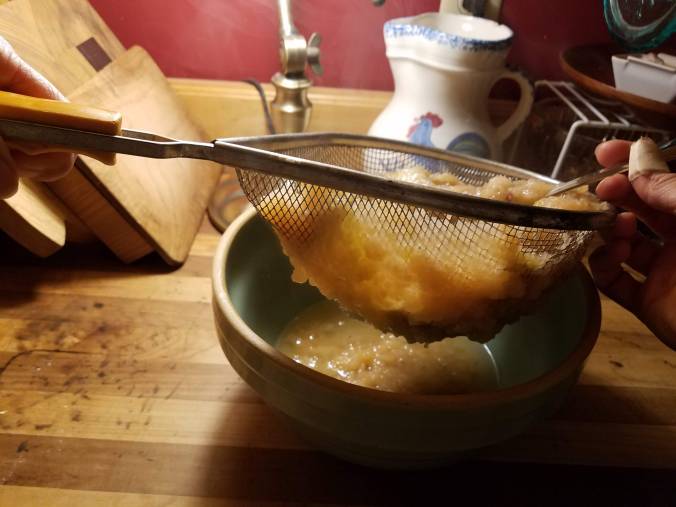
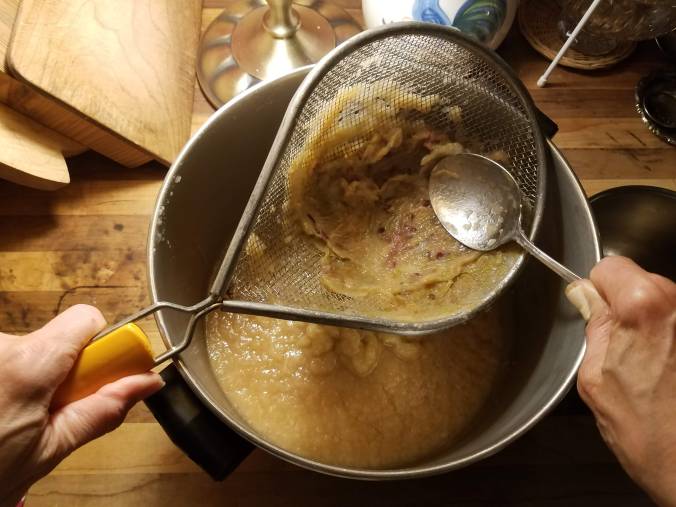
Now all you have to do is press the applemash through the holes of the strainer with the back of a spoon. A Foley food mill works well for this too, if you have one of the older models. I found the newer ones problematic and more trouble than they are worth. My sister Lynn loves her Foley food mill; if I still had my old one, I’d probably love it too. But we get used to things one way or another. See what works for you.

pressing against side.jpg

Note that the holes of my strainer are not super tiny. They are big enough for the sauce to go through pretty easily, but not so big as to allow the seeds through. Every now and then scrape the underside of the strainer.

underside of strainer.jpg

I discovered quickly that my bowl was going to fill up too fast, so I switched to using my Dutch oven as the bowl underneath. Then when the level of the applesauce reached the bottom of the strainer, I transferred the applesauce to the bowl.

Keep pressing applemash against the sides of the strainer until all you have left is skins and seeds. It will look like this.

seeds and skins.jpg

Scrape out the seeds and skins from the strainer into a separate bowl (this is great for your compost or your chickens!) and start again.

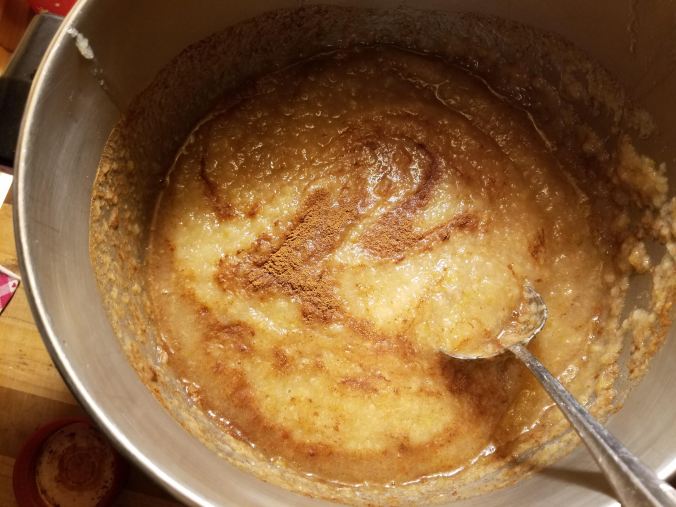
With the quantity I made, I added cinnamon each time the bowl became full (instead of waiting till it was all strained through and then adding cinnamon). Now that I think of it, I suppose you could put cinnamon sticks in the pot with the cooking apples, but oh well, maybe next time! I can’t tell you exactly how much cinnamon to use. It’s like salt and pepper: Add what seems right to you. I used about two teaspoons per three quarts of strained applesauce.

I love the swirl of the cinnamon getting stirred in.

stirring in cinnamon.jpg

You can put your applesauce in a container and put it in the fridge to eat soon, or you can put it in mason jars and can it in a hot water bath, or you can freeze it. I think freezing is best. It’s easy and allows for icy applesauce at some point down the road.

Quart-size ziplock bags work great. If one person holds the bag open and another person spoons it in, that’s ideal. If you are by yourself, try putting the applesauce in a large measuring cup with a pour-spout or a small bowl with the same, and holding the bag with one hand and pouring with the other. A wide-mouth funnel can be good too. You can also freeze in jars as long as you allow a good inch or so of air space for expansion, otherwise the glass will break. (And you don’t want that!)

I had filled my five-gallon pot to overflowing with cut-up apples and ended up with about ten quarts of applesauce and three cups of seeds and skins which my chickens enjoyed tremendously. Always keep a little out for enjoying fresh.

finished.jpg

Oh, and if you think your applesauce is too watery, just cook it down a little more after you’ve removed the seeds and skins. That’s how you get apple butter – it’s just way-cooked-down applesauce. It might take another hour or so to cook down. Turn off the heat when it’s as thick as you like. In the meantime your house is blessed with apple aroma again! Some people add sugar too, at the end. That’s your call.

For those who are wondering how you get icy applesauce, just thaw one of your frozen bags or jars to the point where you can break the applesauce apart with a fork. Stir until desired smoothness. Oh yum!

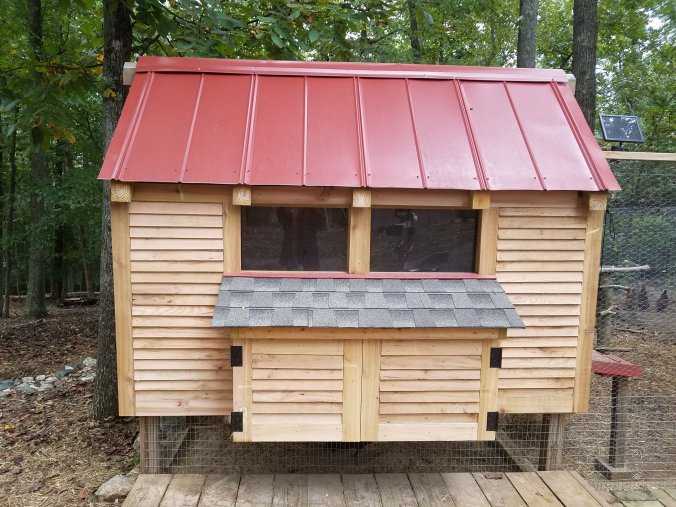
And the coop — I love the siding! Claudia calls it a chicken castle! More on that soon 🙂

5.jpg

Ela’s Apple Star Bread

I love learning something unexpectedly. Today I helped Ela make a beautiful, sweet, cinnamony, apple bread that is formed in such a cool way!

Ela was my granddaughter Piper’s German au pair from the time Piper was a few months old until this past January. It says a lot about their relationship that she would choose to spend her vacation here in Seattle with the family. I was delighted to finally meet her. This is Ela with Piper yesterday when we went to Bob’s Corn and Pumpkin Farm in Snohomish.

DSC_9941 (2).JPG

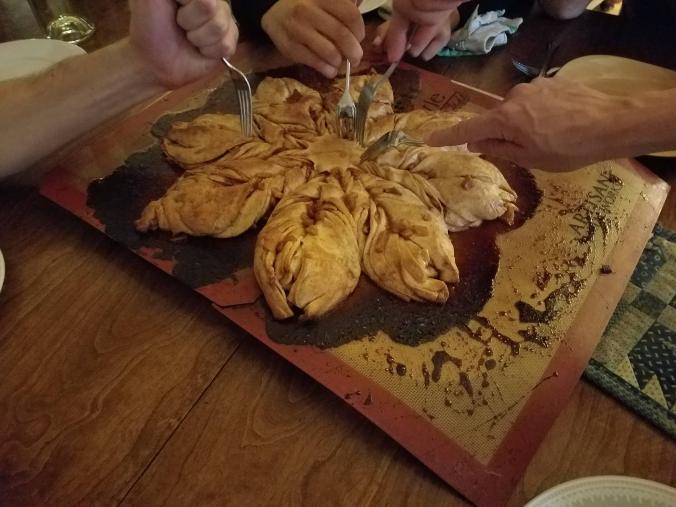
Ela is not only Piper’s fun friend, she is a great baker! Her apple star bread was devoured after dinner tonight. We all were anxious to dig in. (It’s a pull-apart bread, thus the forks.)

forks in, ready to go.jpg

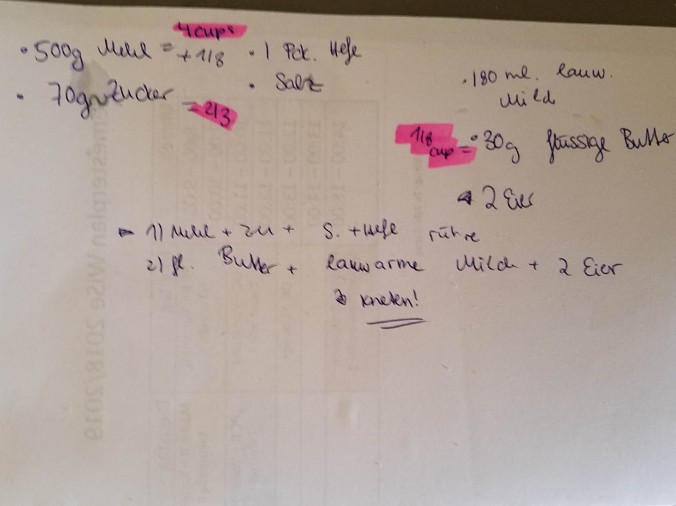
That shape was so fun to make. I have to show you how it was done. Her recipe might be a little hard to read.

recipe (2).jpg

It says to combine 4 cups flour, 2/3 cup sugar, a package of dry yeast and a bit of salt (say half a teaspoon). In a small pan combine ¾ cup milk with 2 tablespoons butter until just warm. Add the milk, butter and 2 eggs to the dry ingredients. Mix and knead. Ela let the beast of a mixing machine that Brad and Beth have on their counter do the kneading.

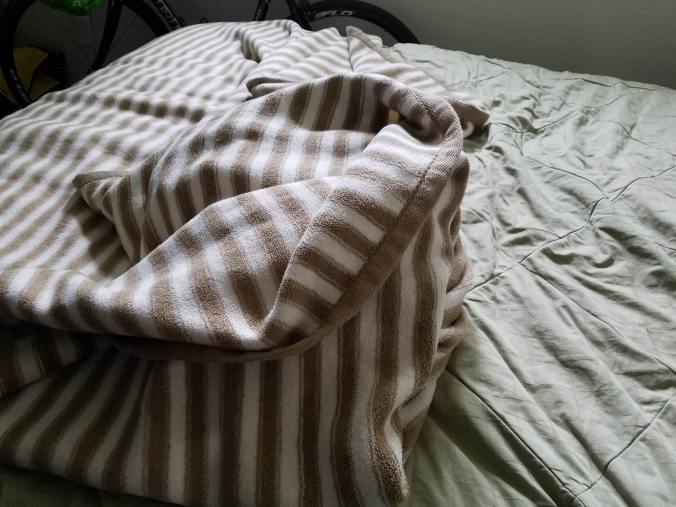
Then, and this is the part she says her grandmother always did, put the dough to rest in bed! You read that right. This lump in the bed is hiding the bowl.

dough in bed.jpg

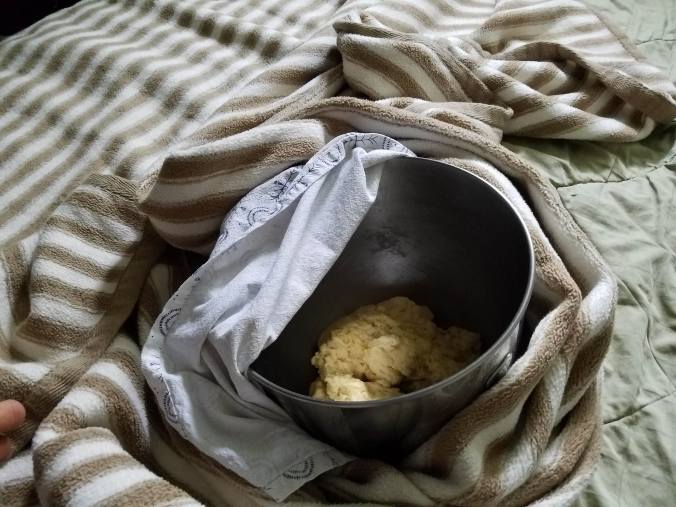
Yes, underneath that lump, deep within the warmth of the bed, is the dough. Ela left it there for a few hours, all covered up.

dough in bed1.jpg

While the dough is resting, cut two apples up in small pieces and put them in a saucepan with two cups of sugar and 1 tablespoon cinnamon. Turn on a medium heat and cook until it’s bubbly, like this.

apples cooking in pot.jpg

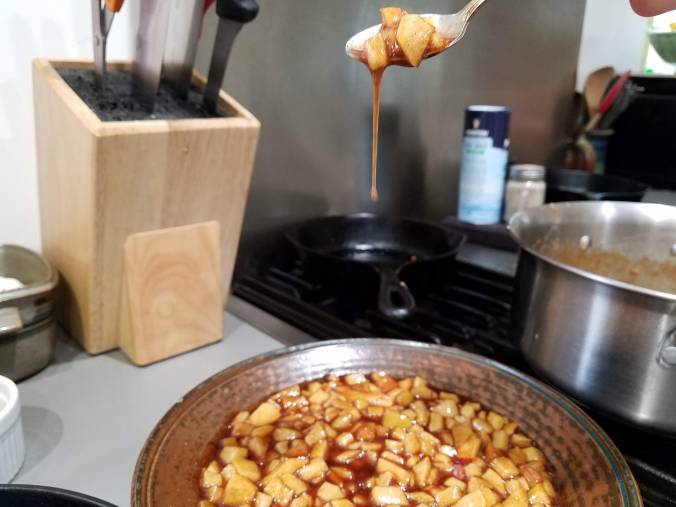
Cook down until you have a sugar syrup that drips off the spoon like this.

sugar syrup.jpg

Do you see how it holds its shape in mid-air? It should do this a few seconds before falling. That’s what you want.

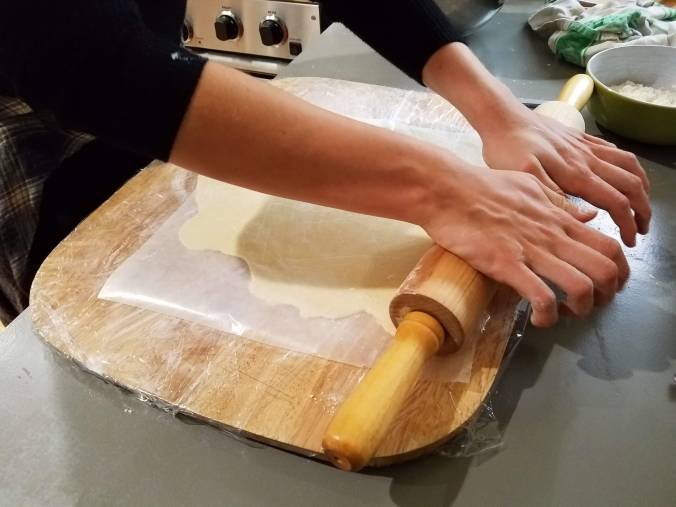
Divide the dough in four parts. One at a time, roll out each quarter of the dough into a circle. Ela put plastic wrap around the board she was rolling on to keep the dough from sticking, then put a piece of waxed paper over it, like this. You want each layer of dough as thin as possible.

roll with waxed paper.jpg

Transfer the dough to a large piece of parchment paper, which we didn’t have. Parchment would have been better because you can more easily cut on it, and there is cutting required later. You shouldn’t cut on silicone mats. Ela put two mats together and placed them directly on the oven rack. She cut very carefully when the time came for cutting.

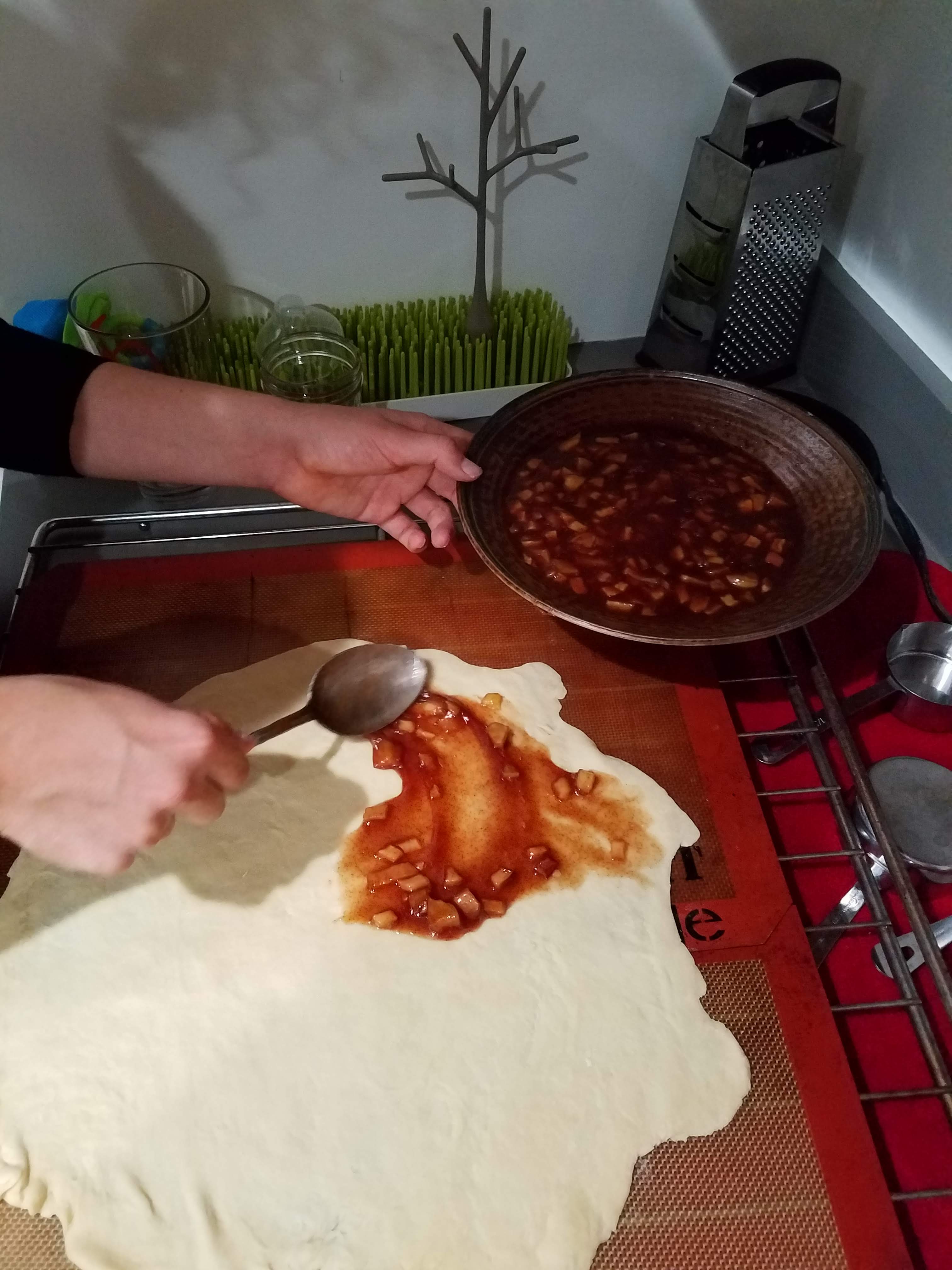
So, first layer, then spread apples.

first layer spreading.jpg

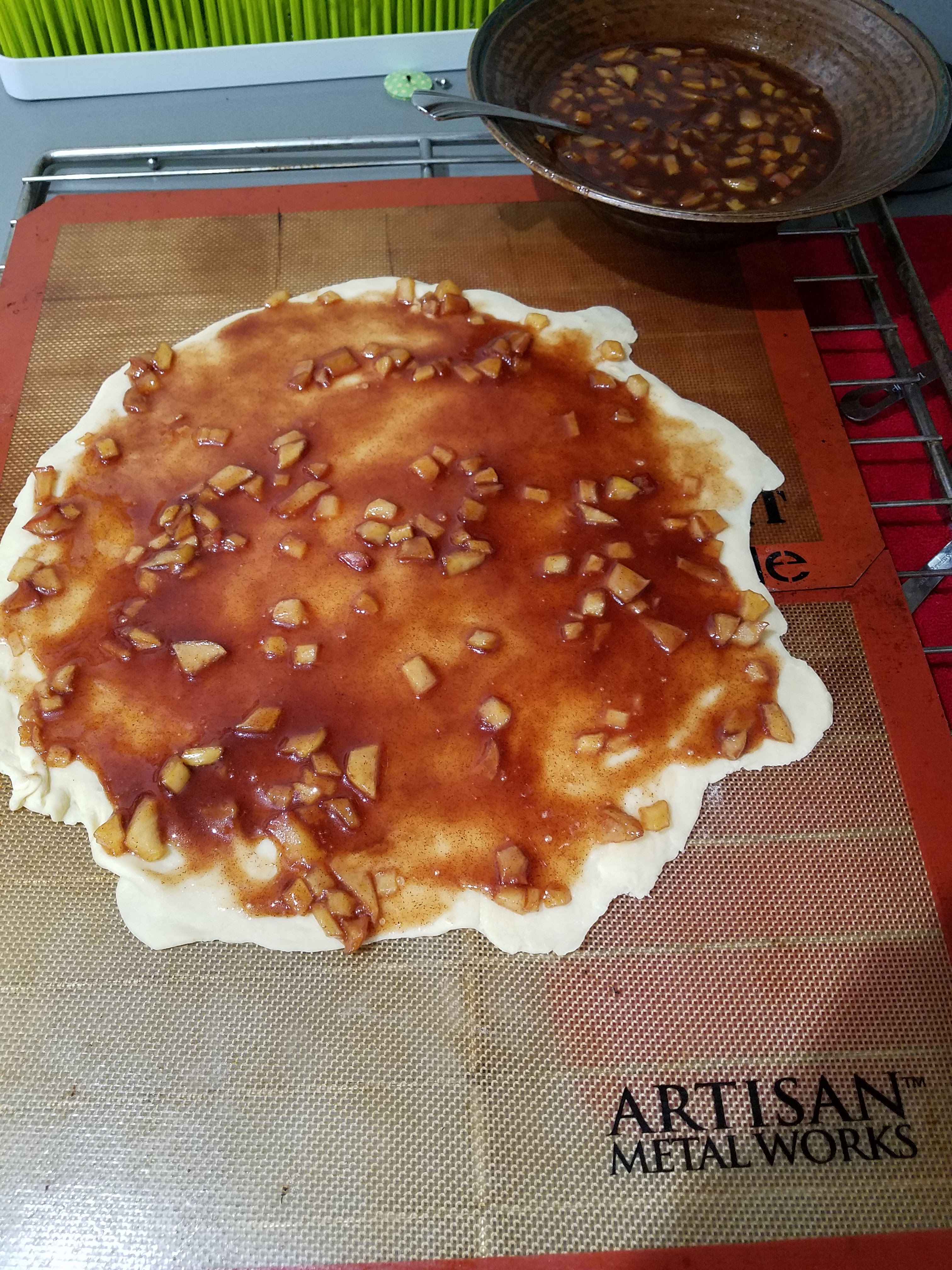
Keep adding spoonfuls of the gooey, sticky apple mixture until the layer is covered.

first layer.jpg

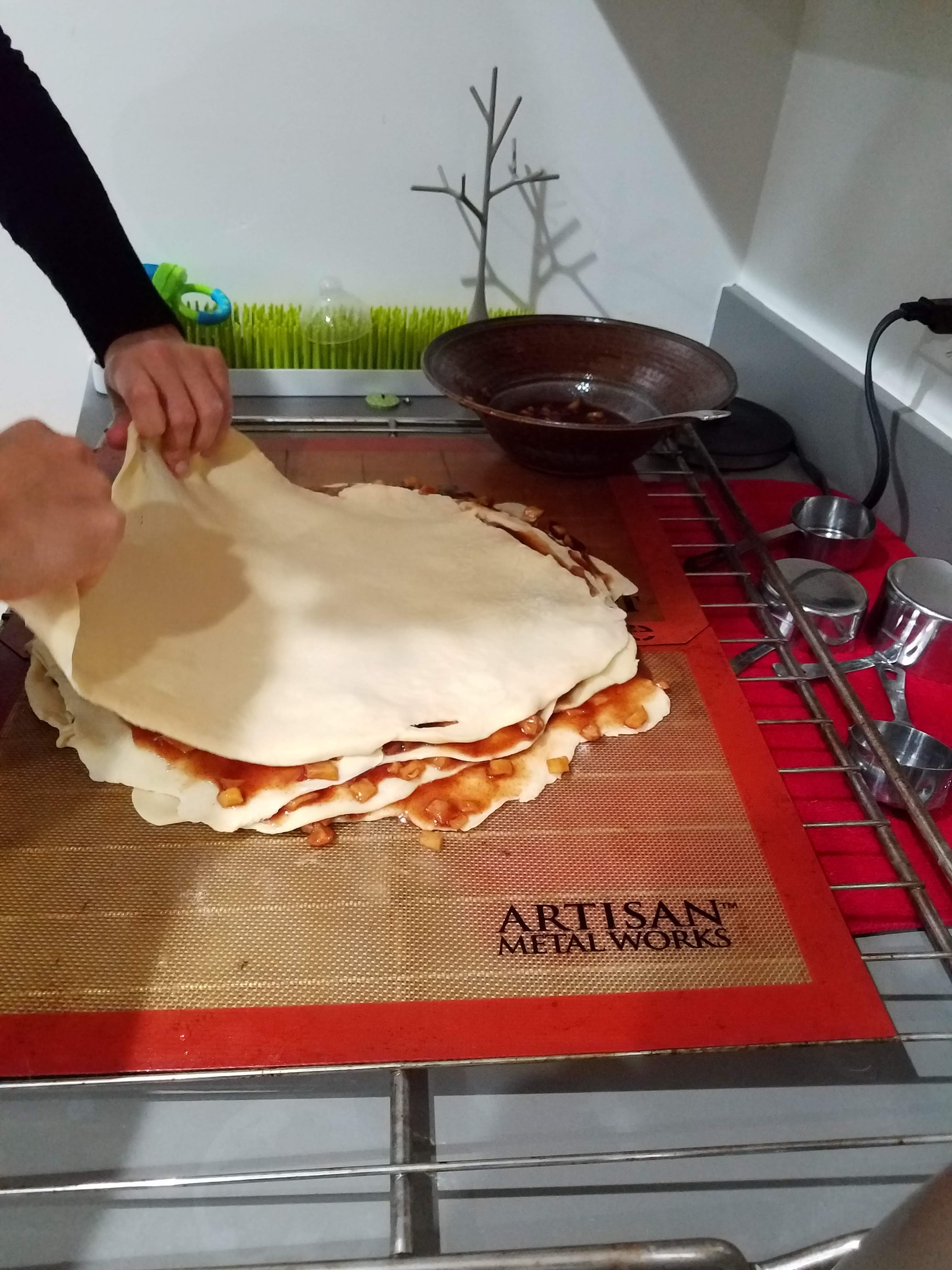
Do layer after layer until you have dough-apples-dough-apples-dough-apples-dough.

dough4.jpg

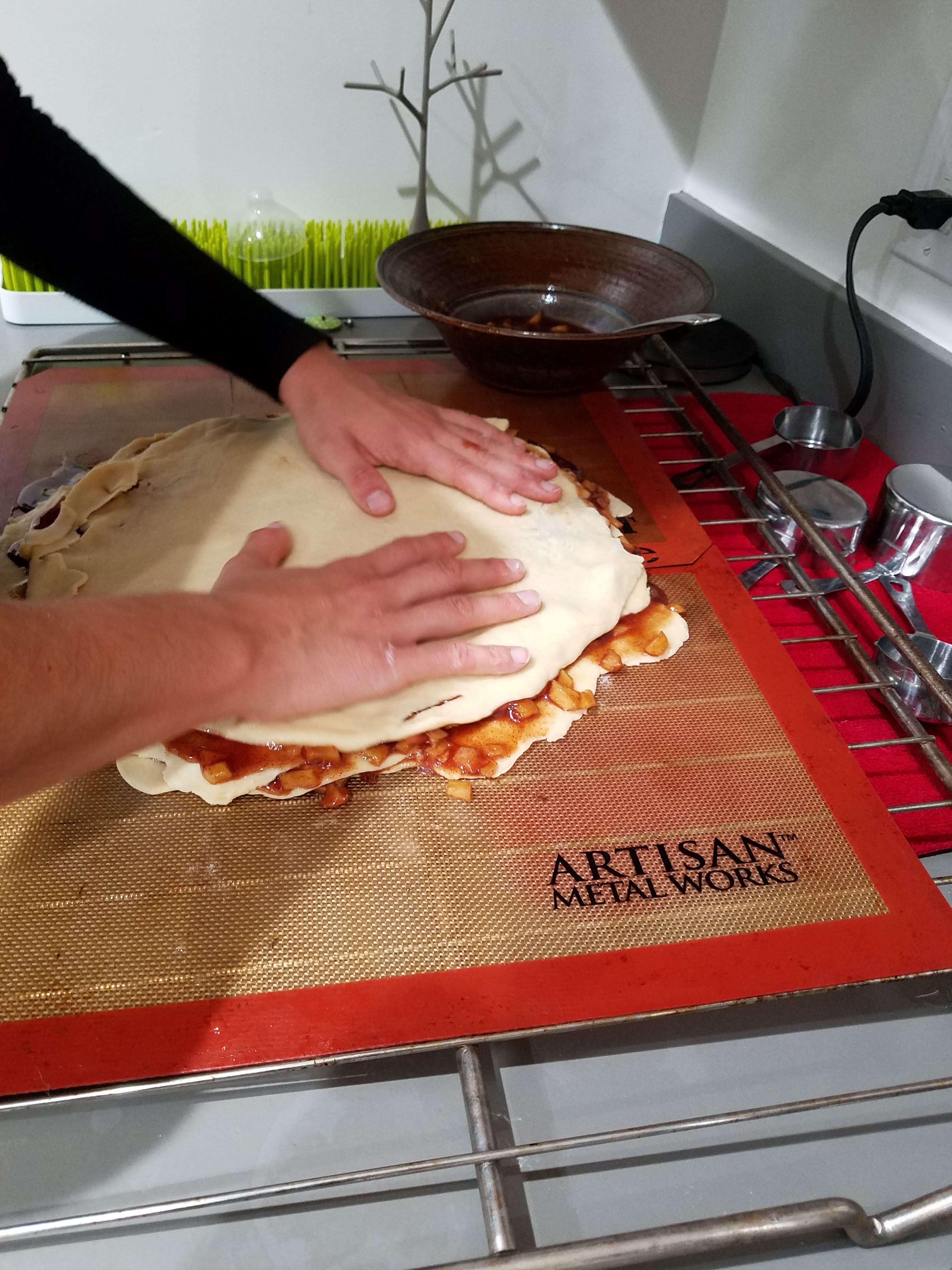
You’ll have to press a bit to get the layers to stretch to the edge.

pressing4.jpg

To make it easier for cutting, we carefully slid the ensemble back to the wooden board she rolled the dough on. Ideally, put this in the refrigerator for an hour or so. It would make the cutting part much easier.

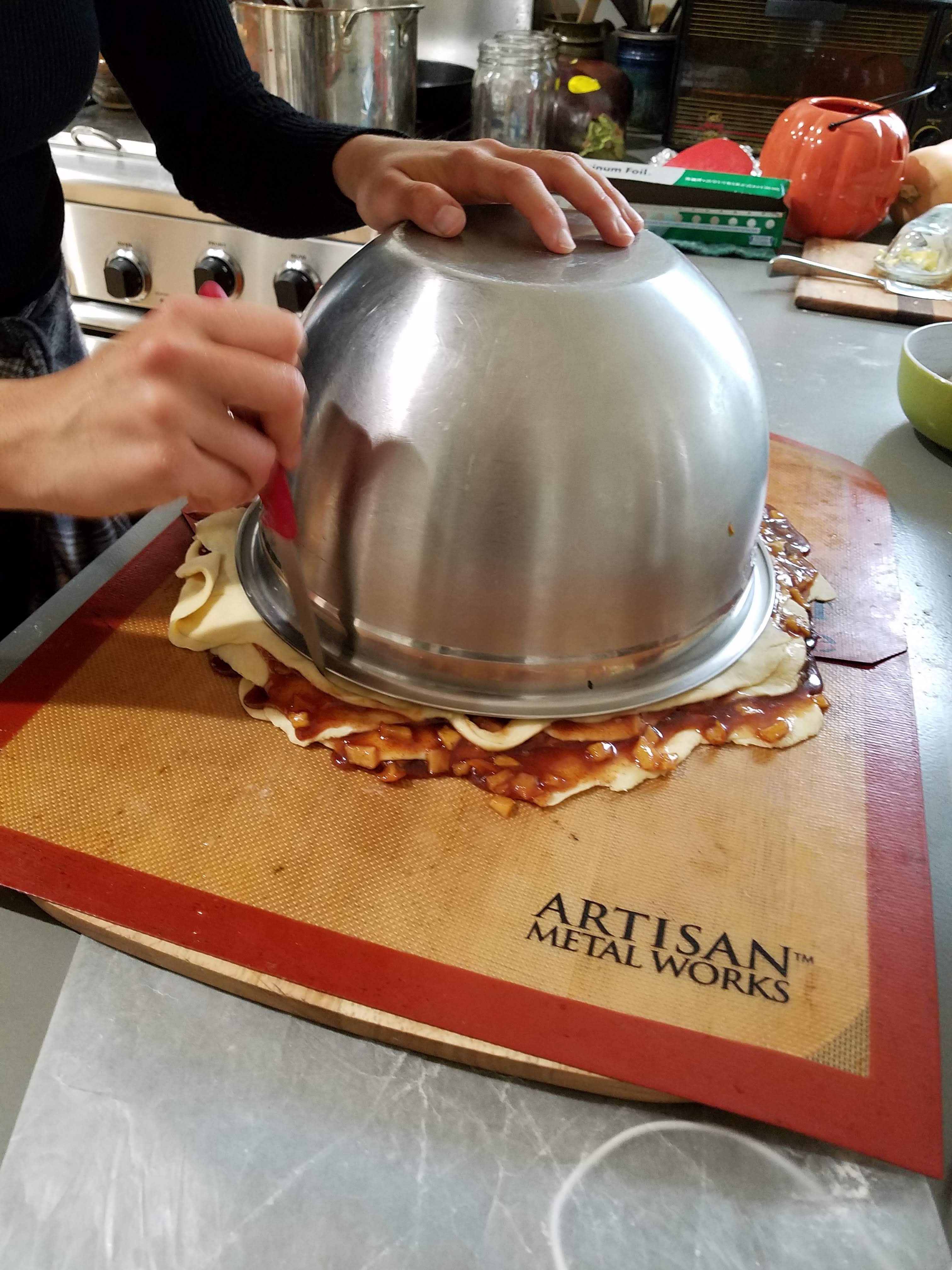
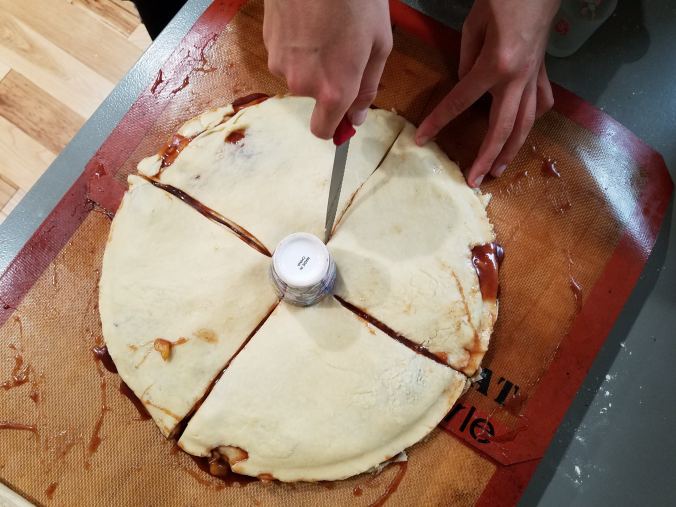
Ela then found a bowl that was as big as the ensemble to give herself a template for cutting a circle. You want as little waste as possible.

circle.jpg

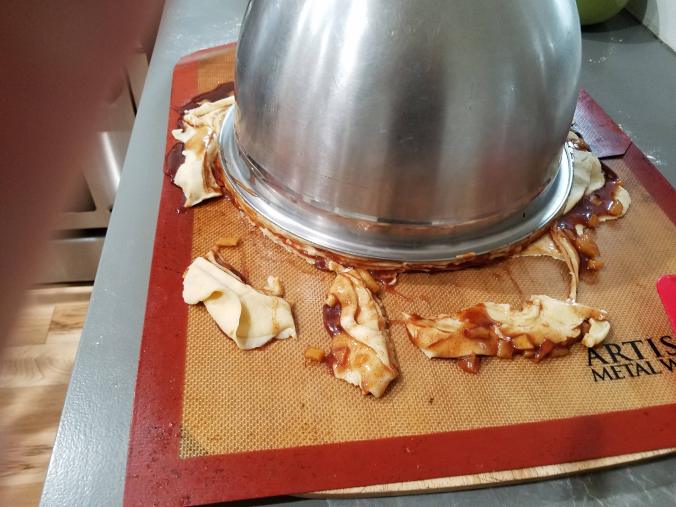
She then (carefully!) cut through the layers of dough until she had a circle. You are going to have leftover. These sugary dough bits look a mess, but just put them in muffin tins and let them rise just the same as the bread and they will taste very fine (not altogether different than the monkey bread we made last week!).

trim excess.jpg

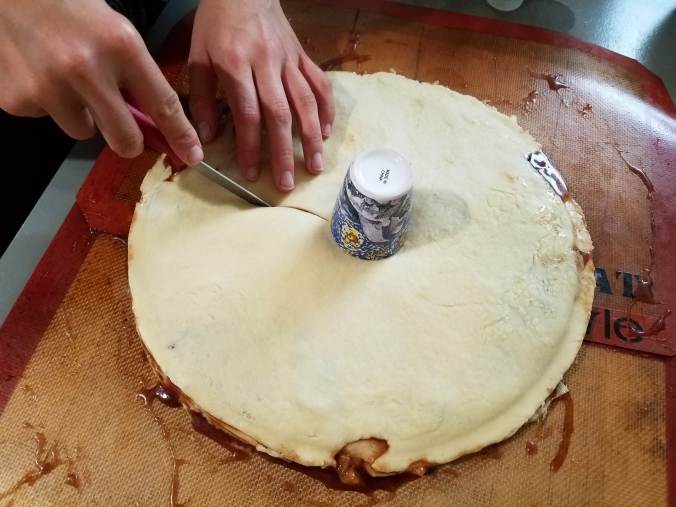
Ela then found a small cup (a shot glass is about the right size) for the center.

cutting.jpg

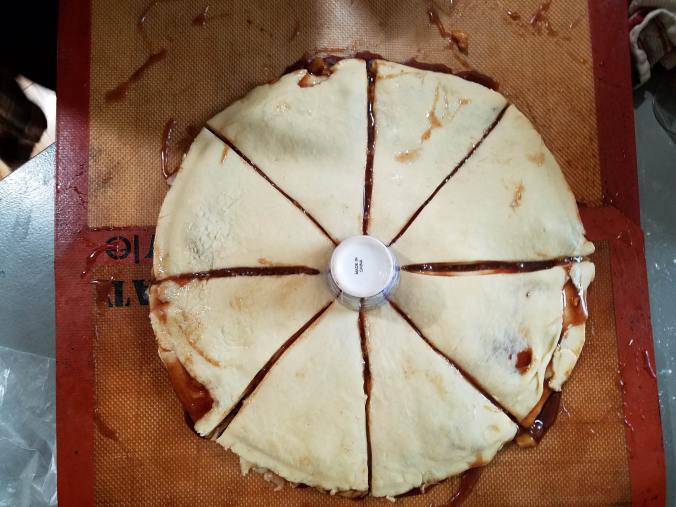
She then started cutting again (carefully!), first four lines, starting at the cup and working outward.

cutting four.jpg

Then eight, rotating the board to make it easier.

cutting 8

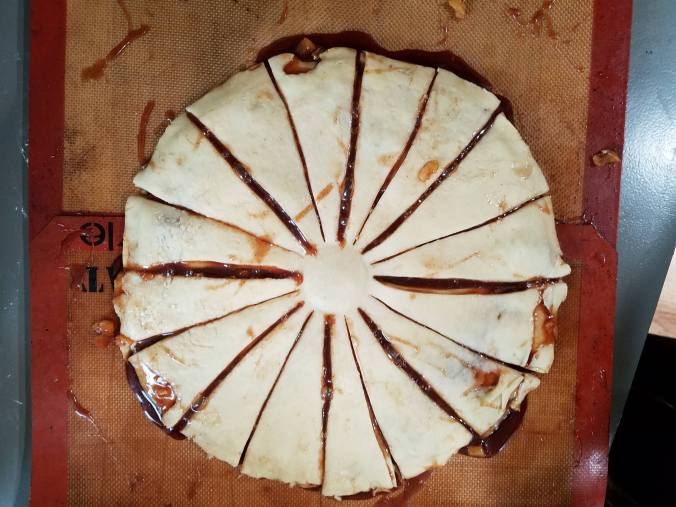
Then sixteen. That’s when she took the cup away.

cutting 16 with cup removed.jpg

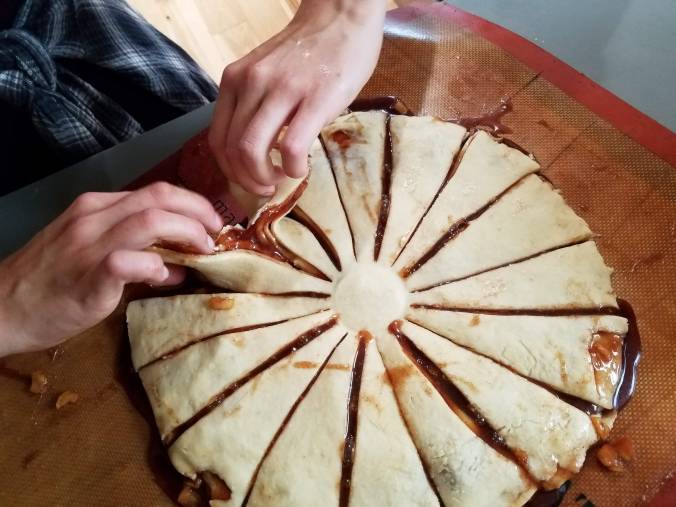
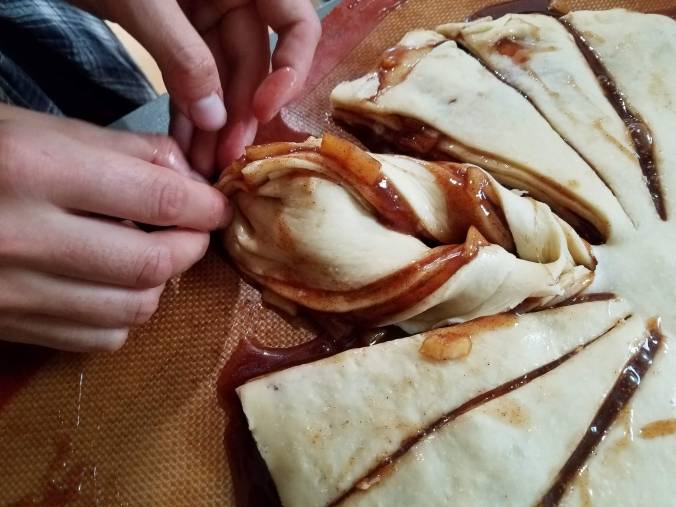
Now for the funnest part! Take two pieces that are side by side, lift them, twist once,

pick up two.jpg

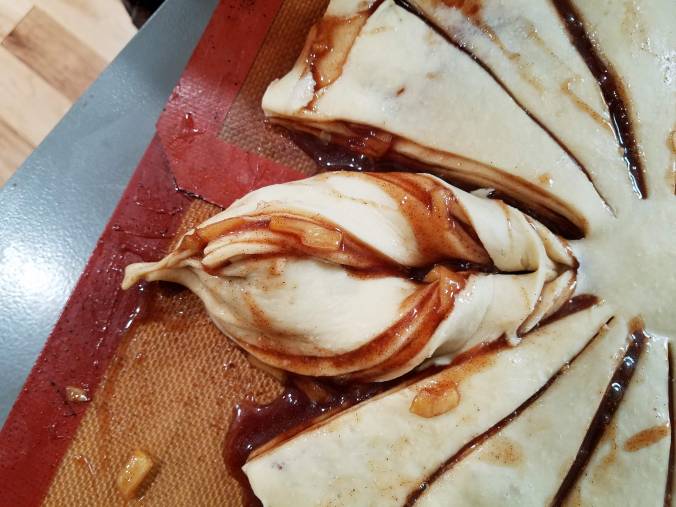
And again. You make two full twists.

twist twice2.jpg

And then pinch the ends together.

point of star 2.jpg

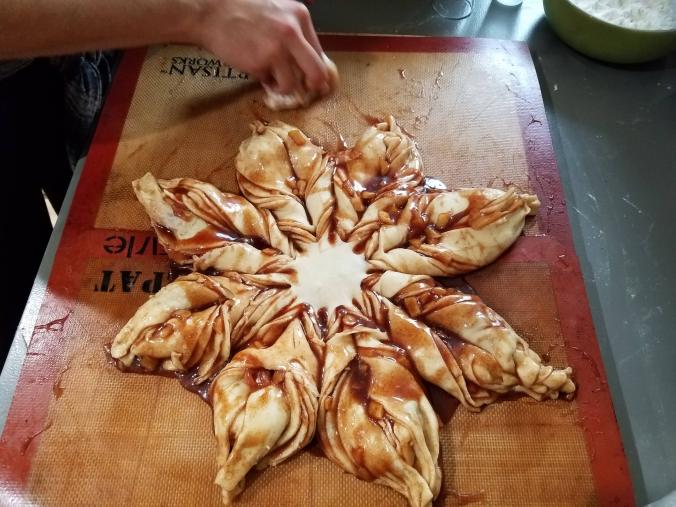
Do this all around until it looks kind of like this.

all stars.jpg

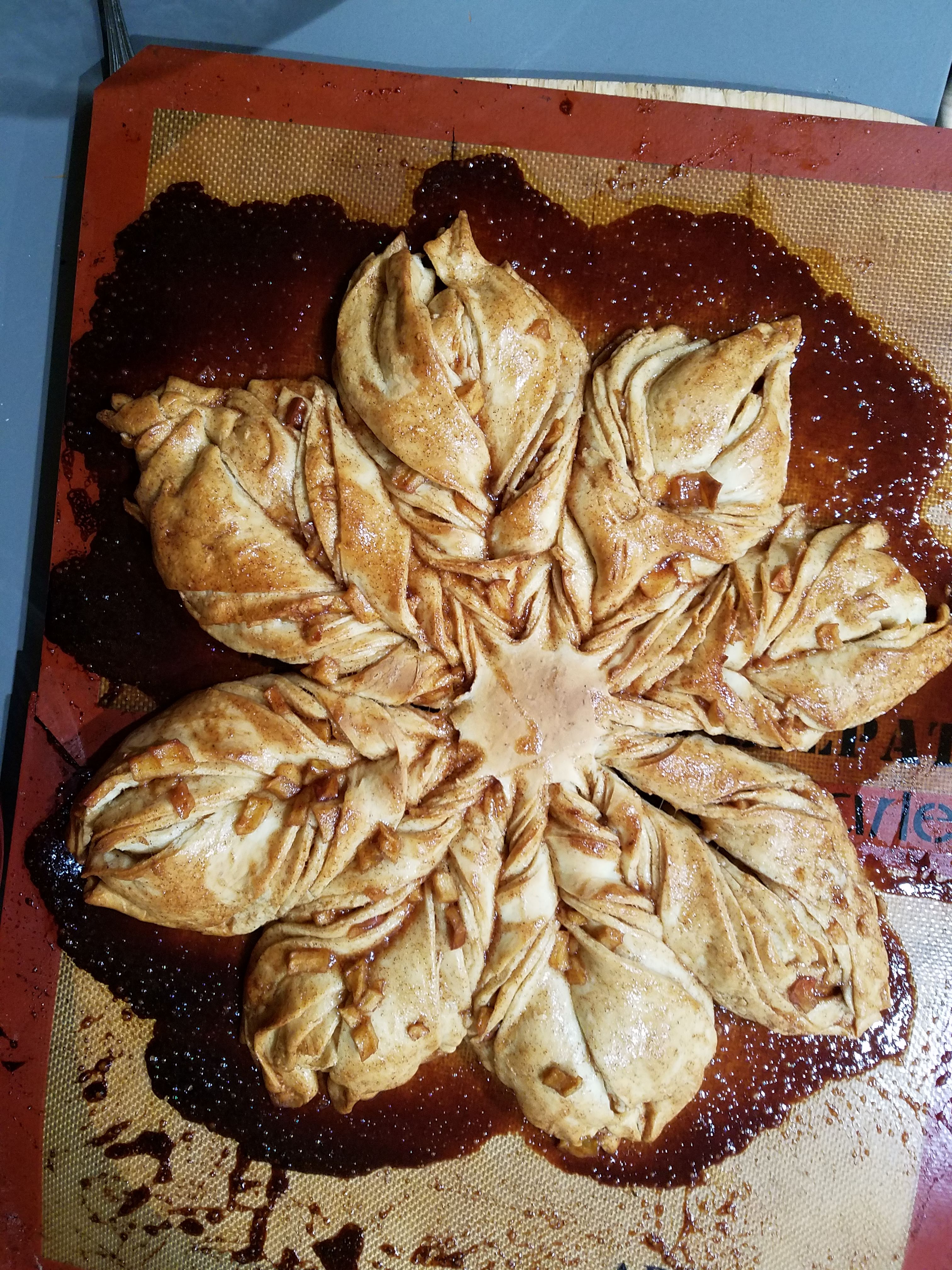
How beautiful is that!! Ela cleaned up as much of the excess sugary syrup as she could with a paper towel, but when it bakes, some of the sugary syrup is going to leak out anyway. Do the best you can. Let the star rise/rest (not in bed this time!) about an hour, longer if you need to time it so it comes out right as you finish dinner. This is best warm out of the oven. The syrup that leaked out forms thin candy which looks almost burned, but isn’t quite.

done.jpg

Well, maybe part of it is. If you pull a piece of the star off the pan carefully, it looks kind of like a lobster with claws.  Zach had the best lobster. We all enjoyed this star bread very much! Thank you, Ela!

Zach with his piece (2).jpg


Monkey Bread: A Baking First

It was not the original plan to make monkey bread this morning. I have never even made it before. Other than having seen it (though not purchased it) at Vive la Tarte yesterday, I only vaguely even heard of it. Having only random fragments in my mind about a thing, disconnected from personal experience, generally would not translate into Let’s Make That Thing.

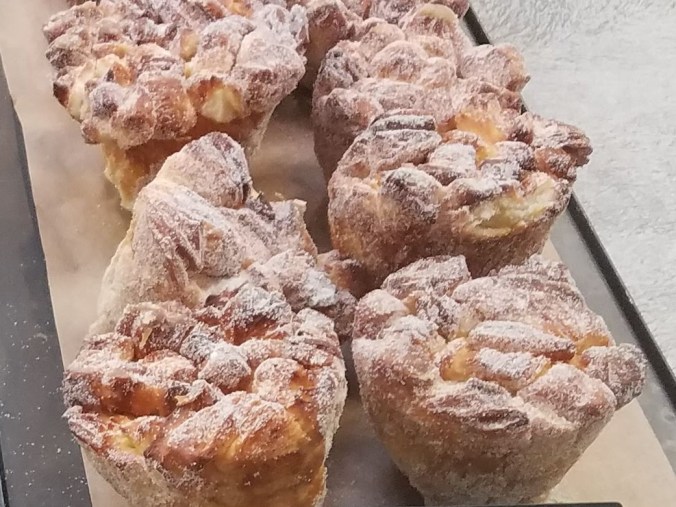
But if you had seen the monkey bread yesterday, you might be motivated to try it too. This is what we saw.

croissants monkey bread (2)

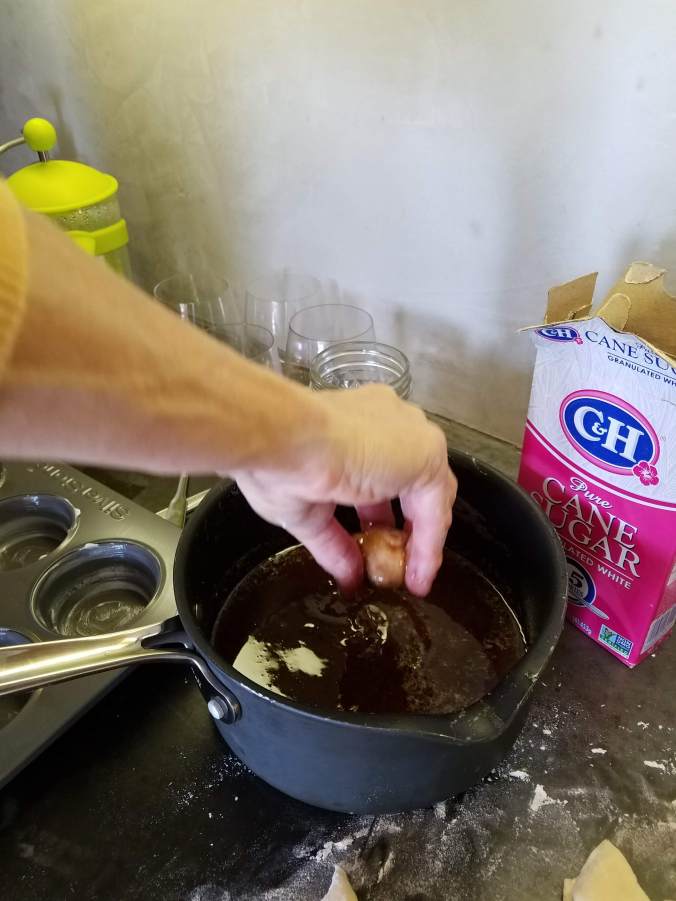
You have small chunks of dough individually coated with cinnamon, sugar and butter all baked together into one multi-chunk, sweet treat.

Drew and Nicole and I had started talking about the buttery, sweet, cinnamony goodness of monkey bread, and I said to myself: It Can’t Be That Hard.

Suddenly there we were with a plan. Early morning grocery run for yeast, butter and other essentials followed by fun in the kitchen. Meet at 8, eat by about 10, right?

Oh, dear. Jet lag is real, and I still have it. Every morning since I got to the west coast I have woken up by about 4am. Thinking about the monkey bread project, I was allowing two hours for all of the following: a four-block walk to the store, shopping, walk back, prep of dough, rising of dough, assembly of sweetened dough chunks into muffin tins, re-rising of dough and baking – all to make something I have not made before and in somebody else’s kitchen! Yeah, I was way off. Can I blame this on jet lag?

All to say, the idea-to-results sequence took way longer than anticipated. Nonetheless, we would have our monkey bread.

When you have never made something before, it’s a good idea to have a good recipe. I read a few online. They were all different, but basically we’re talking about a sweet, soft dough that is smothered in butter, sugar and cinnamon and baked into delicate, pull-apart, heavenly rolls. I have a great recipe for soft dinner rolls. Add the sweet element and that should work, I thought. It was going to be, shall we say… experimental. Thankfully my sister Lynn came to the rescue. She is a great cook, has made monkey bread many times and gladly sent me her recipe. See below.

I had no doubt that this was the best plan. And perhaps if I had followed the instructions, these would have been even better than they were.

You read that right: IF I had followed instructions…

Let me back up. I love my phone. I think smart phones are amazing. But one downside is that they are very small. I opened up the recipe on my phone and it was really hard to read. I did not have a printer or a larger screen. My eyes aren’t that good. Then you set the phone down to do the next thing, and by the time you do that next thing, the screen has gone black. You open it again, get to the download again, try to read the tiny writing again. It was problematic. I know I got the ingredients right, but why I thought to put the brown sugar in with the melted butter in preparation for rolling the dough balls, I am unsure.

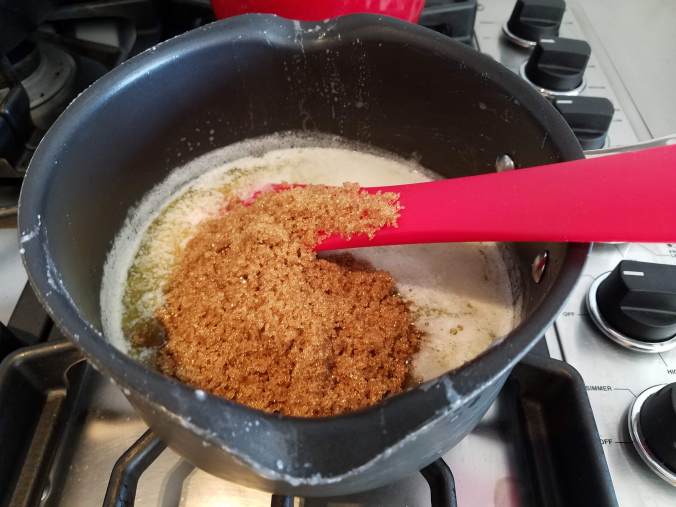
This was my deviation, putting the brown sugar into the melted butter. Then Drew added the cinnamon and I got to stirring.

sugar into butter

I actually got quite excited about how beautiful the sugar and cinnamon looked as I was swirling it in there with the butter. That’s about the time I got a flashback to the actual words of the recipe which was something to the effect of “Dip the dough balls in butter, then roll in the sugar/cinnamon mixture.” Oops.

swirling in pot

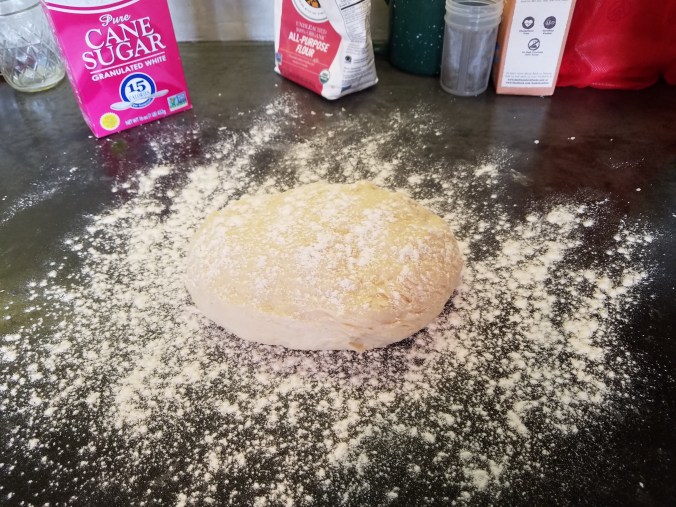
I did most everything right, I promise. The dough was soft and elastic.

dough

I covered it and let it rest.

covered dough

I buttered the muffin tins. Lynn’s recipe says to use a bundt pan, but I wanted ours to be like Vive la Tarte’s, so I used muffin tins. See all the pieces of butter waiting to coat the inside of each cup?

buttered pan

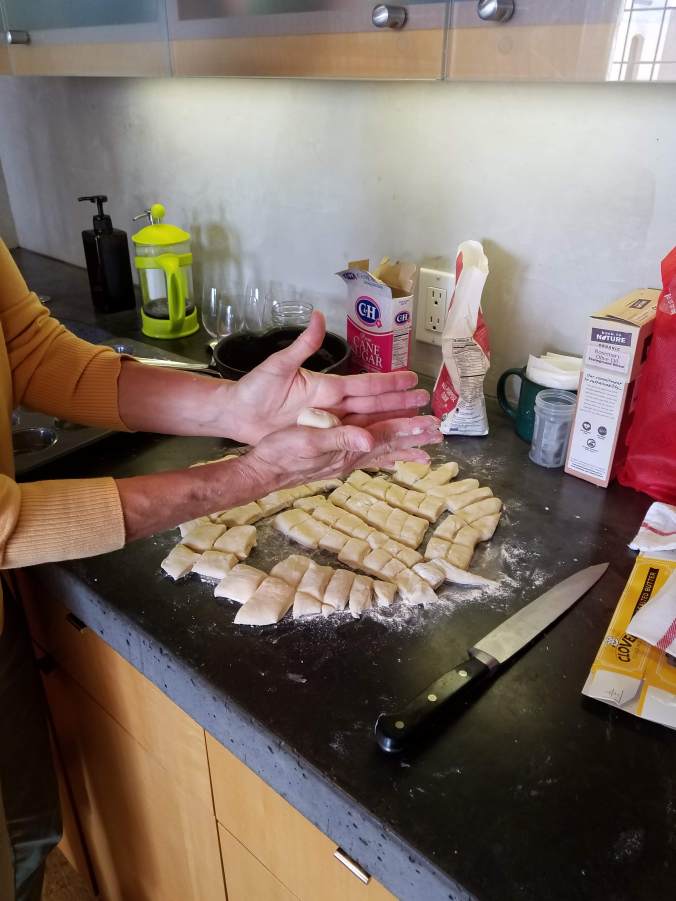
I cut the dough up into pieces and formed little irregular balls.

cutting up dough and forming balls

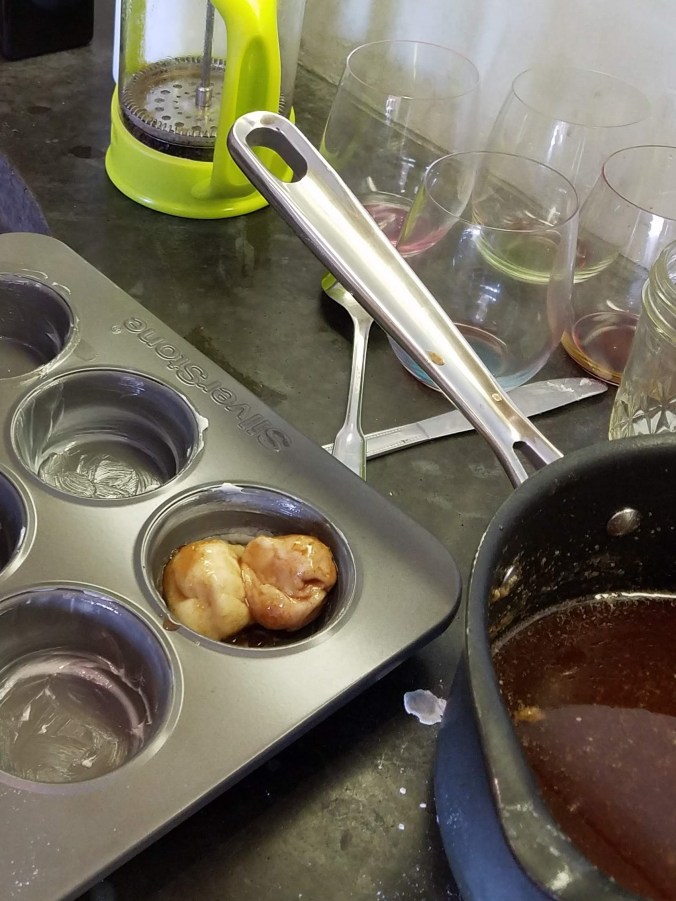
But then I had no choice but to dip the pieces one by one into the butter/sugar/cinnamon goo

dough ball

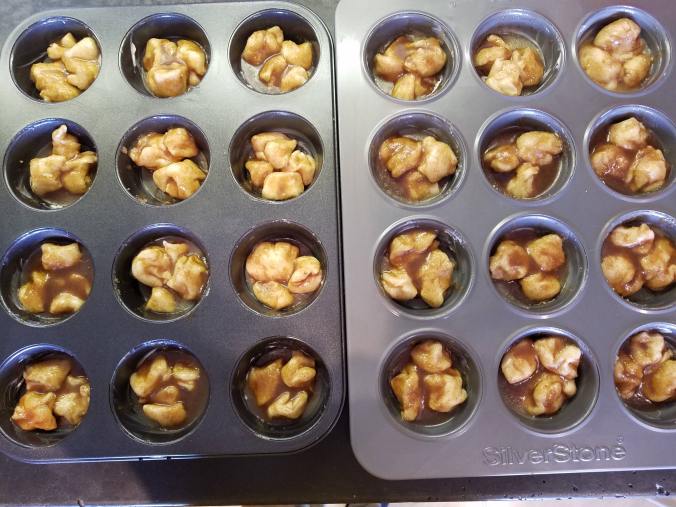
and put them in the cups of the muffin tins

balls in pan (2)

until they were all in.

in pans unbaked

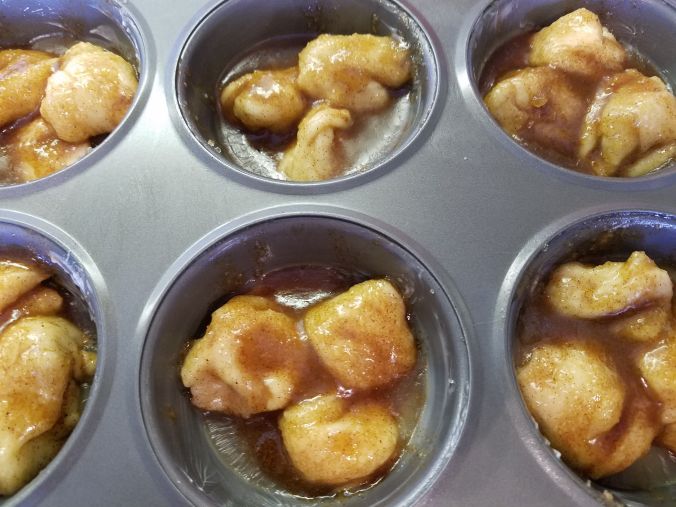
Up close it looked like this.

up close unbaked

Baked, like this. We had waited so long by this time. It was long past when we had had the rest of the brunch we’d planned. I didn’t take the time to put powdered sugar or a glaze on top.

baked on plate

Still, they pulled apart like nothing. The dough was soft as a pillow. The sweetness surrounding the dough was divine (seemingly none the worse for having been done wrong). If I had sprinkled powdered sugar on this plate, or put the suggested glaze on them, it would have looked better, but hot out of the oven Drew and Nicole loved them. Loved them. Do wait a few minutes until they are not quite so hot but still warm. Yes, do eat them warm out of the oven.

Still, I was not perfectly happy with them and will try again another time. I think more balls per cup would be better. Letting them raise longer would have been better (we were in a hurry to get to the Exploratorium so I rushed that part). Following instructions about the butter-dipping and sugar-rolling might have been better (not sure, that part seemed okay).

And this is how we learn. Try it, work with what you have, try to recover if you make an oops, see what happens. Try again another time, a little smarter than the first time. This is how we learn anything.

Lynn’s recipe:

Monkey Bread

DOUGH:

  • 4 tablespoons butter, divided, 2 tablespoons softened and 2 tablespoons melted
  • 1 cup milk, warm (about 110 degrees)
  • 1/3 cup water, warm (about 110 degrees)
  • 1/4 cup granulated sugar
  • 2 1/4 teaspoons instant yeast
  • 3 1/4 cups all-purpose flour, plus extra for work surface
  • 2 teaspoons salt

BROWN SUGAR COATING:

  • 1 cup packed light brown sugar
  • 2 teaspoons ground cinnamon
  • 8 tablespoons butter (1 stick), melted

GLAZE:

  • 1 cup confectioners’ sugar 2 tablespoons milk
  1. Butter a Bundt pan with the 2 tablespoons softened butter. Use a pastry brush or a paper towel or anything that will really help get inside all of those nooks and crannies. Set aside.
  2. In a large measuring cup, mix together the milk, water, melted butter, sugar, and yeast. Mix the flour and salt together in a standing mixer fitted with dough hook (see below for instructions to make the dough by hand). Turn the machine to low and slowly add the milk mixture. After the dough comes together, increase the speed to medium and mix until the dough is shiny and smooth, 6 to 7 minutes. If you think the dough is too wet (i.e. having a hard time forming a cohesive mass), add 2 tablespoons flour at a time and mix until the dough comes together (it should still be on the sticky side, just not overly wet). Coat a large bowl with nonstick cooking spray. Place the dough in the bowl and turn to coat lightly with the cooking spray. Cover the bowl with plastic wrap and let the dough rise until doubled, 1-2 hours (alternately, you can preheat the oven to 200 degrees, turning it off once it reaches 200 degrees and place the covered bowl in the oven to speed up the rising time).
  3. For the sugar coating, while the dough is rising, mix the brown sugar and cinnamon together in a bowl. Place the melted butter in a second bowl or shallow pie plate. Set aside.
  4. To form the bread, gently remove the dough from the bowl and press it into a rough 8-inch square. Using a bench scraper or knife, cut the dough into 64 pieces.
  5. Roll each dough piece into a ball (it doesn’t have to be perfect, just get it into a rough ball-shape). Working one at a time, dip the balls in melted butter, allowing excess butter to drip back into the bowl or pie plate. Roll the dipped dough ball in the brown sugar mixture, then layer the balls in the Bundt pan, staggering the seams where the dough balls meet as you build layers.
  6. Cover the Bundt pan tightly with plastic wrap and let the monkey bread rise until puffy and they have risen 1-2 inches from the top of the pan, 1-2 hours (again, you can use the warm oven approach to speed this up).
  7. Heat the oven to 350 degrees F (remove the pan from the oven if you placed it there to rise). Unwrap the pan and bake until the top is deep brown and caramel begins to bubble around edges, 30 to 35 minutes. Cool the monkey bread in the pan for 5 minutes (any longer and the bread will be too sticky and hard to remove!), then turn out on a platter or large plate and allow to cool slightly, about 10 minutes.
  8. For the glaze, while the bread cools, whisk the confectioners’ sugar and milk together in a small bowl until the mixture is smooth. Using a whisk, drizzle the glaze over the warm monkey bread, letting it run over the top and sides of the bread. Serve warm.


Vive la Tarte

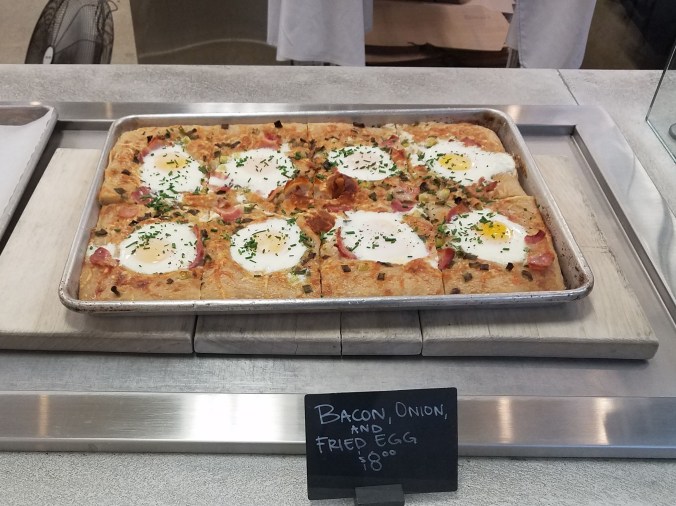
It isn’t every day you have pizza for breakfast. It isn’t every day your breakfast pizza includes an egg. I want to think that the eggs on our breakfast pizza today came from chickens as happy as mine at home in Virginia, but of this I cannot be sure. Regardless, this breakfast pizza with its bacon, egg and shallots, was (note past tense) an excellent way to start a Saturday in San Francisco. It was absolutely the perfect balance of its three simple toppings on a soft-on-the-inside, crisp-on-the-outside, bread-like crust. What else can you say but Oh yum!?

breakfast pizza (2)

The full pan of them looked like this. Drew told me that by 11am, these, and all the delectables you see below, will be gone, disappeared into the happy stomachs of Vive la Tarte’s customers. Notice they don’t call it breakfast pizza. I think they should. Drew did.

breakfast pizza2 (2)

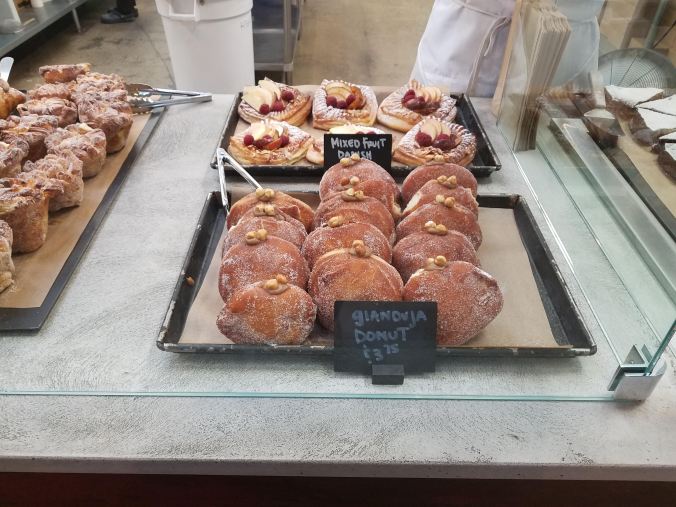
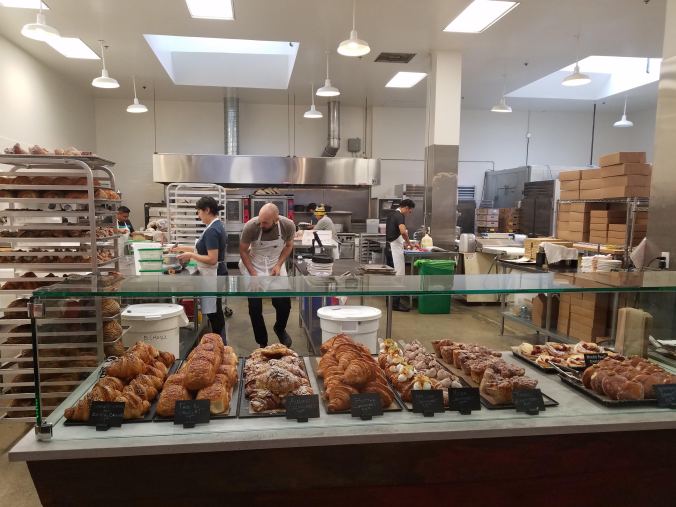
Vive la Tarte is one of those places you hope the residents of this city are very grateful for.  It’s popular for good reason — its food shares the same basic descriptors as most good foods, the most important descriptors: simple and delicious. You know you have come to a wonderful place when you want to eat one of every single thing they offer. I’m talking croissants,

croissants up close


more croissants, monkey bread,

croissants monkey bread

donuts, Danish,

donuts danish

quiches,

quiches

and the pizza, which was at the end of the line and became mine because walking through the line again would not have made it any easier to choose.

Seeing all of these wonders makes me want to bake more at home, to play around with different ingredients. That middle quiche has goat cheese in it. Why didn’t I ever think to put goat cheese in mine? And monkey bread – what’s monkey bread? Think pieces of soft bread dough baked together with cinnamon, sugar and butter in such a way that the adjectives to describe it include: soft, sweet, gooey, sticky, golden, cinnamon, buttery and last but not least sinful.

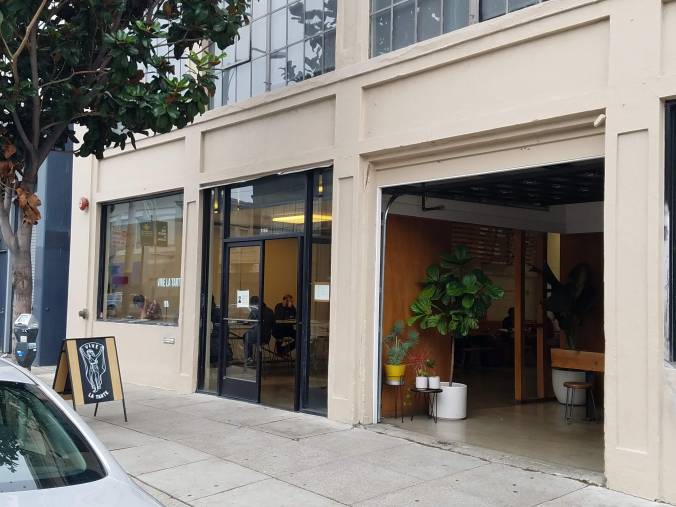
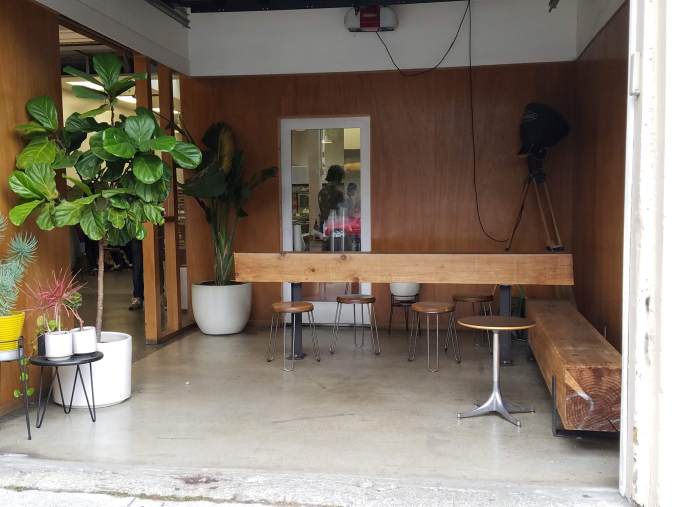
From the outside, Vive la Tarte doesn’t look like much.That large open space on the right, that’s called the sunroom. It was too cloudy a morning for me to attest as to any sun that might on a different day stream in there, but if they want to call it the sunroom, so shall it be. There’s an opening within the sunroom that leads into the restaurant, besides a main entrance. See the sandwich board outside the main entrance?

outside2

As you are walking down Howard Street, that’s your indicator. This is the place to be.

sandwich board

The same simple block-lettered name in the window identifies the bakery. Look elsewhere for fancy.

outside1

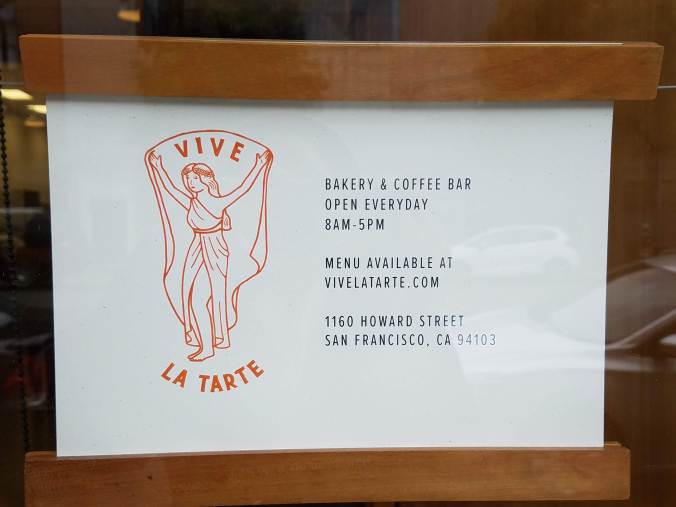
Two simple signs hang in the windows. One has the basics.

window sign.jpg

And one informs you of the dog policy.

dog policy (2)

Not to worry if you have your dog with you. That open garage door, a.k.a. the sunroom, is indoor-outdoor space is just for you and your dog. No takers while we were there.

sunroom

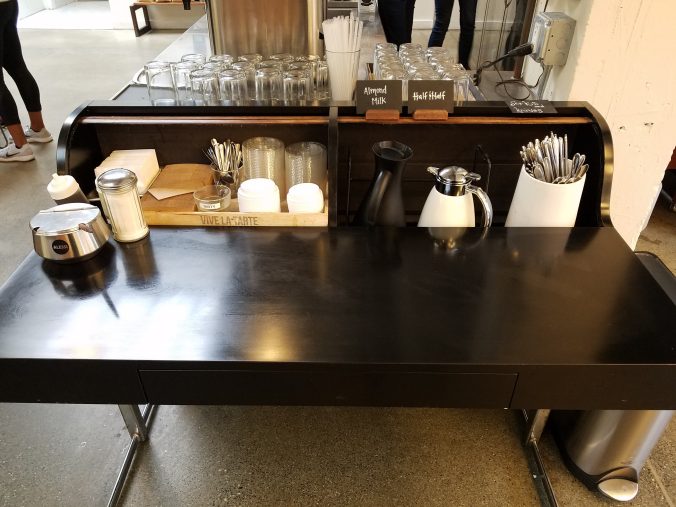
I am especially enamored of San Francisco’s evident commitment to producing less waste. The coffee station does not have sugar in packets that become trash, plastic or wooden stirrers that become trash, or half and half in little plastic cups that become trash. I know these things have their place, but the less of them the better.

milk and sugar

You have real spoons for measuring your sugar out of a glass jar (and for stirring), a cup to put the dirty spoon in, ceramic cups and real glasses to drink from and a helpful staff to get you anything you need that you don’t see.

coffee station

After I finished my pizza and tea (which I grant does not, without context, sound like a good combo but you know what my pizza looked like), I stood back and took the whole scene in. It’s huge and wide open.

long view inside

The kitchen is in full view as you approach the counter. I like when you can see what they are doing.

kitchen

I watched the lady banging her huge whisk to get most of the meringue off it. It’s a quantity of meringue that is inconceivable in a home kitchen, but oh how delightful a dollop of it is on a lemon tarte. Meringue is a kind of free-form marshmallow fluff, a simple mix of egg whites and sugar beat up till it’s fluffy as a cloud. Oh, the incredible ways people have come up with to make food so delicious!

meringue2 (2)

I wish I could come here for breakfast every day.

No, I don’t.

If I did, at least two things would happen that I don’t want to happen.

1. Vive la Tarte wouldn’t be special any more. It would be normal, every-day-ish, and I want places like this to always be special to me. (Once a week maybe I could live with though…!)

2. I would not be incentivized to play in my own kitchen or somebody else’s, which a visit here has very much made me want to do. For starters, monkey bread… So guess what we are going to do tomorrow in Drew and Nicole’s kitchen! I’ll let you know how it comes out 😊

Simple Shortbread Cookies Better Than Any in a Tin

“Patricia, there’s a mouse in my bed.” I had been asleep when my friend Eileen gently shook me awake with these very calm words in her very sweet voice one night many years ago when she came to visit us in Vermont. A mouse? How could there be a mouse?

I am not disturbed by mice, but one early experience – it’s vague, but it includes my mother up on a chair all in a flutter because of a mouse somewhere in her room – taught me that some people don’t like them. I followed Eileen downstairs to where she had been asleep and then awakened by said mouse. Sure enough, a small rodent was nestled among her sheets.

“This is not a mouse, Eileen,” I said, somehow thinking this would improve the situation. “This is a hamster. How on earth did it get out of its cage?” I never did learn the answer to that question, but perhaps should have expected such things to happen. After all, I’m the one who allowed the kids to have hamsters as pets. The first one died when Bradley decided to give it a bath in the bathroom sink (surprise, surprise). I was never sure exactly what aspect of that experience sealed the furry little thing’s fate, but I allowed another and another until I even allowed a rat they called Templeton, for which I always thought I should get extra credit as a mom. Thankfully these things do not live forever, bath or no bath.

Eileen didn’t hold the hamster incident against us – though now that I think of it, perhaps this is why she hasn’t come to visit since…

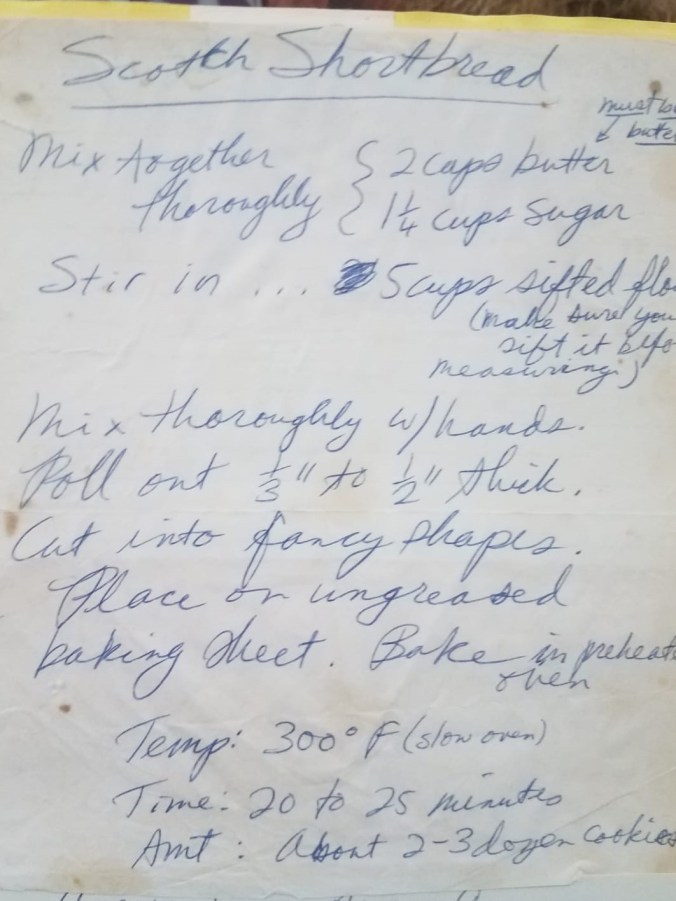
Ironically, Eileen lives in New Jersey with her dear cat. She will forever be associated in my mind not only with the small-rodent-in-the-bed experience, but also with the shortbread cookies I make for my cottage guests. She gave me the recipe years ago. I can’t look at its determined handwriting and explicit instructions without recalling the intelligent woman who wrote such succinct instructions as “must be butter” and “Cut in fancy shapes” and left it at that.

This is Eileen’s recipe.

recipe2 (2)

These are tasty, easy and simple. You don’t have to wonder if someone likes nuts or raisins or chocolate (though I know only one person on the face of the earth who doesn’t like chocolate!). If you like a simple, buttery, crisp, non-foo-foo cookie, you’ll like these. My son Drew tells me that when I send them to him, they last only a few hours and then are gone. (Last night, in a moment of supreme delight, I handed him a little sleeve of them face to face here in San Francisco!)

I know you will appreciate how exact Eileen is about the measurements. All that is good. And you are welcome to follow her instructions on the rolling out and cutting out of the cookies as well. But I have a much quicker way once the dough is together.

Three ingredients: butter, sugar, flour. Mix together, form into logs, wrap and refrigerate, and then, when you are ready, slice and bake. Bake as many as you want that day or the next week. The reason this works well for cottage guests is that I can make the dough, keep it chilled, and bake fresh as many as I need just before they arrive.

Start with a pound of butter, that wonderful dairy product that makes so many foods so much better. (When Tracy came for dinner on Wednesday I put a few pats into drained, boiled potatoes along with some chopped, fresh parsley – oh yum! Oh, did I get distracted there? Back to cookies!)

Take the butter out hours before you want to make the cookies so that it is as soft as it can get at room temperature. If you are in a hurry and want to soften the butter in the microwave, that’s fine, but watch it carefully. You want it soft, not melted.

Add the 1 ¼ cups of sugar and stir up until creamy. This should not take long if your butter is properly soft. Then add the five cups of flour. Eileen’s recipe says be sure to sift before measuring. You can do this, but pre-sifted flour has worked fine for me. Your call.

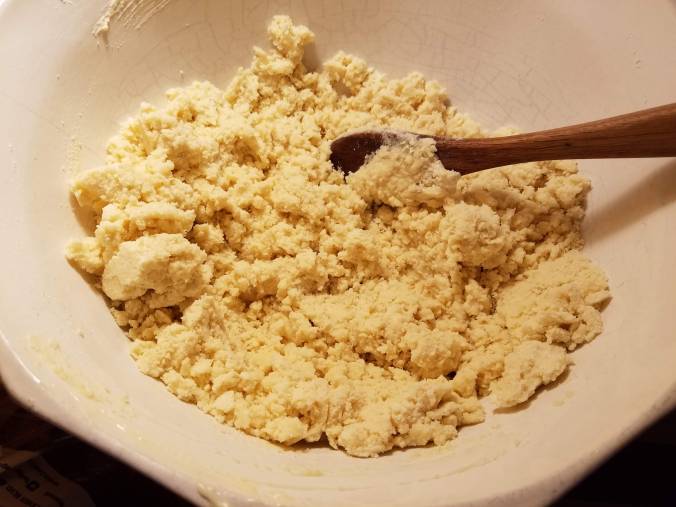
The mixed-up butter-sugar-flour will look like this in the bowl.

dough loose in bowl

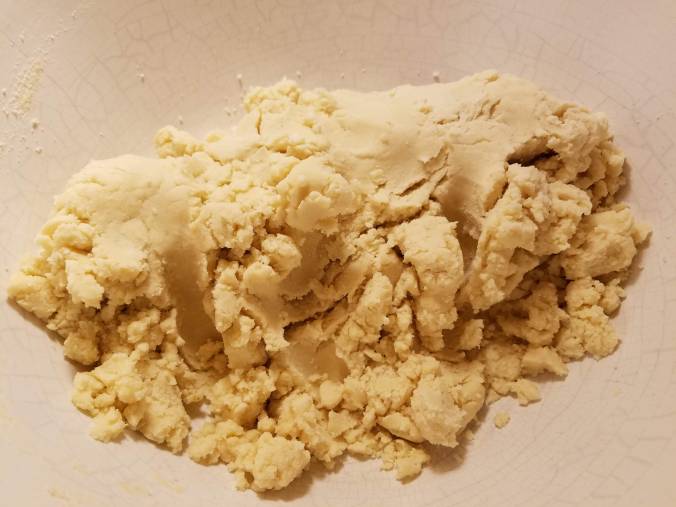
Now use your hands to smoosh that dough together, like this.

dough together in bowl

I don’t mind the hands-in-dough aspect of this process, in fact it is a pleasure like none other, but you will get a better result if, for the next part, you enlist the help of waxed paper.

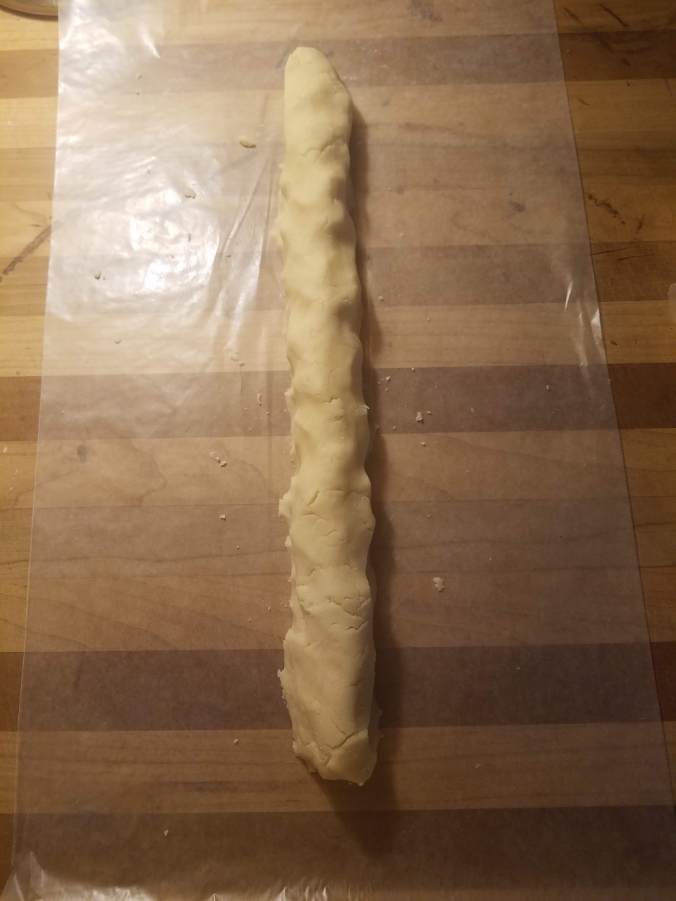
This is where Eileen and I part ways. I was right there with her with “Mix thoroughly w/hands.” But the rolling out and cutting into fancy shapes I do only when my granddaughters are around or it’s a holiday and we want to make hearts or stars or dogbone shapes. Normally I cut four pieces of waxed paper about 18” long. Divide the dough roughly in quarters, form a rough “log” on each sheet and elongate it by hand, like this.

elongated by hand

Then use the paper to help you form a smoother log. Be gentle with the paper or it will tear. Your logs will look like this.

rolling with paper

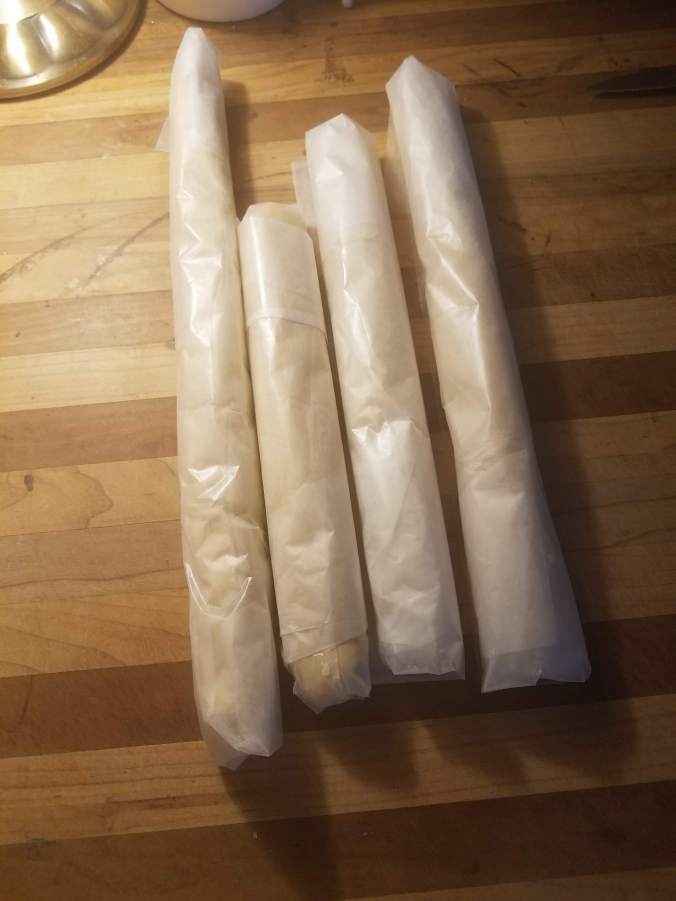
This amount of dough, when rolled into logs about 1 1/4” in diameter, makes about 52 linear inches total. Mine looked like this, wrapped up and ready for the refrigerator.

wrapped

I put the logs in a plastic bag closed up tight and leave them there at least an hour, sometimes days or even a couple weeks, and slice them for baking when I am ready. Of course, you can slice off and bake only as many as you need. I seldom make this many at once, but I was going to be traveling and taking some with me.

sliced

Place them on the pans about this distance apart.

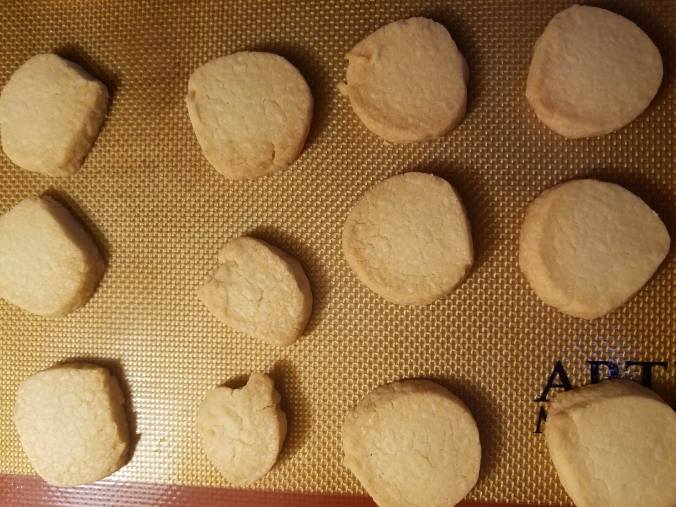
on pans unbaked

The shapes are not perfect as you can see. To me this is part of their beauty, their individuality, their authenticity. Make them perfect if you prefer 😊 The dough is easy to work with.

Bake them to about this color. Eileen’s recipe says 300 degrees for 20-25 minutes. I always found that with such a slow oven, they took much longer than that. No harm ever came in my kitchen from upping the temp to 350 and just keeping a close eye on them. In my experience, 350 degrees for 20-25 minutes is more like it.

on pan baked2

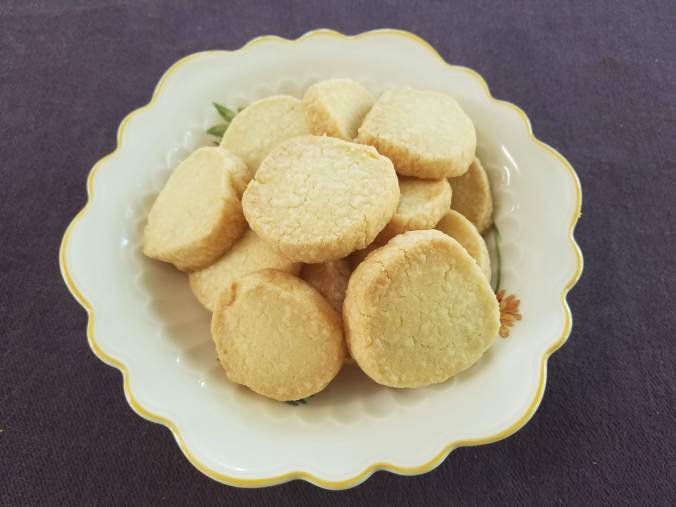
To serve to guests, pick a pretty plate or shallow bowl and make it nice.

in bowl to serve

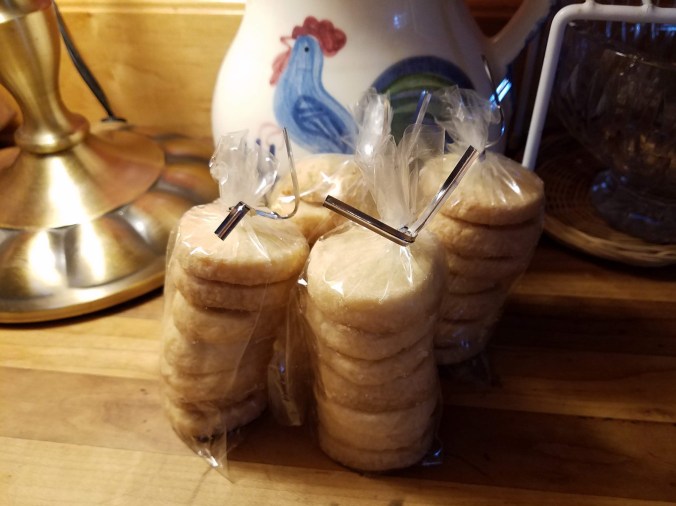
Or put them in plastic sleeves (the kind you can get at a craft store like AC Moore or Michael’s). They travel well this way. Cut the recipe in half if you want fewer cookies, but why would you do that? These make great gifts!

in sleeves (2)

And By September…

The geese are calling to each other in their southward journey. The chill in the air made me put on a long-sleeved shirt this morning. My toes are asking for booties. Claudia is making amazing apple strudel. It must be September!

Claudia's apple strudel (2).jpg

Yesterday the sun shone and the sky was blue-blue for the first time in a while – all grave danger of hurricane Florence seeming to have stayed distant and now passed. Maybe the rain we did get helped my property look especially splendorous to me recently, or maybe it’s that I’m going away to visit my children and grandbabies and therefore am imprinting images with especial effort. In any case, I am struck with awe not only at the beauty around me, but also at how things have grown by September.

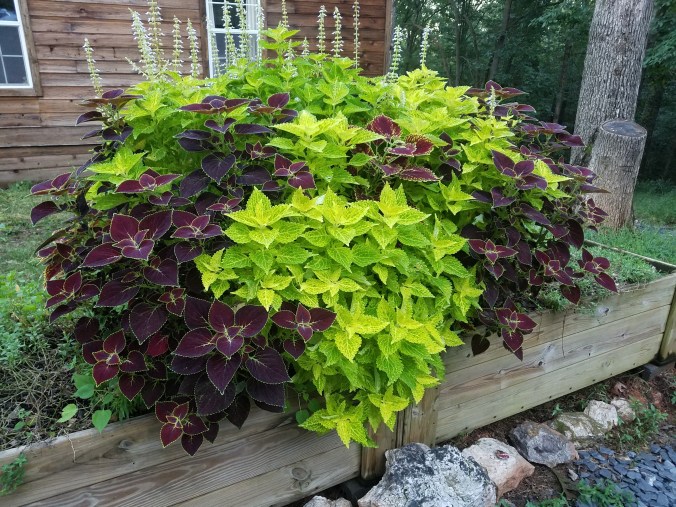
First and foremost, I have never seen coleus get so huge, let alone in my own planter boxes! Planted in April (the ones toward the back with the multi-colored leaves), by June my show-offs looked like this:

coleus in June.jpg

By July:

coleus.jpg

Relocated because of the upcoming Big Dig, and placed next to each other, they now look like this:

coleus 9.18.jpg

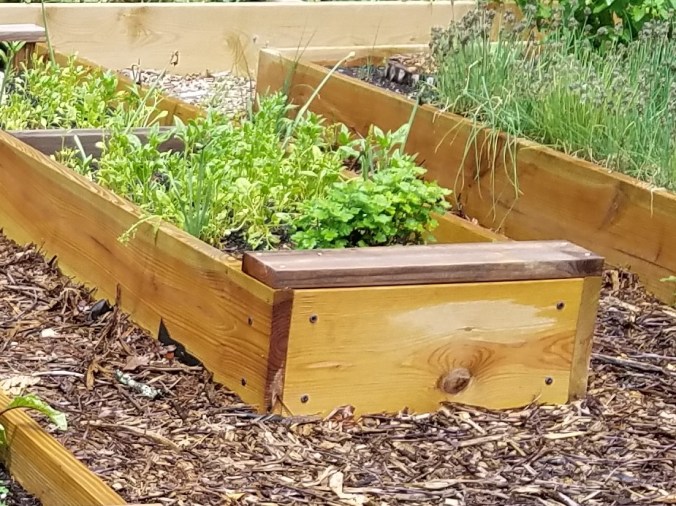
Happy plants, to be sure! Perhaps the chrysanthemum is in competition with the coleus. It is a holdover from last year, having survived not only the winter but also being transplanted to a new box. It is close to bursting into color, though I will miss the peak I expect.

This was in May. You can hardly see it, but just in front of the beets, closest to the seat on the end of the box, that’s the mum.

mums in May.jpg

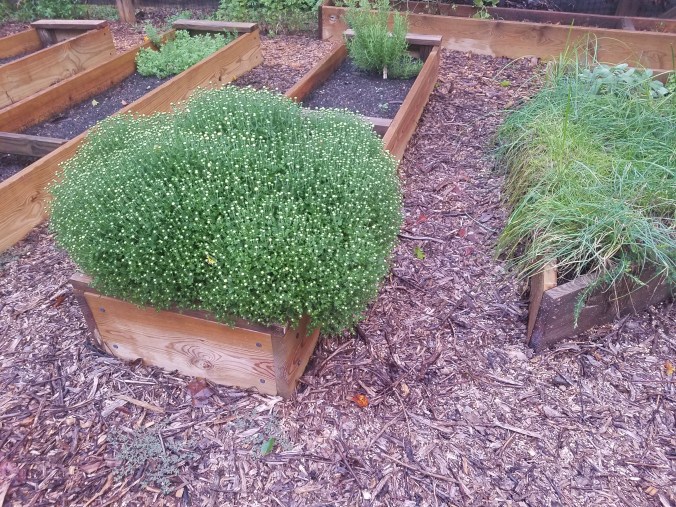
By last week, Mums Gigantus!

mum gigantus!.jpg

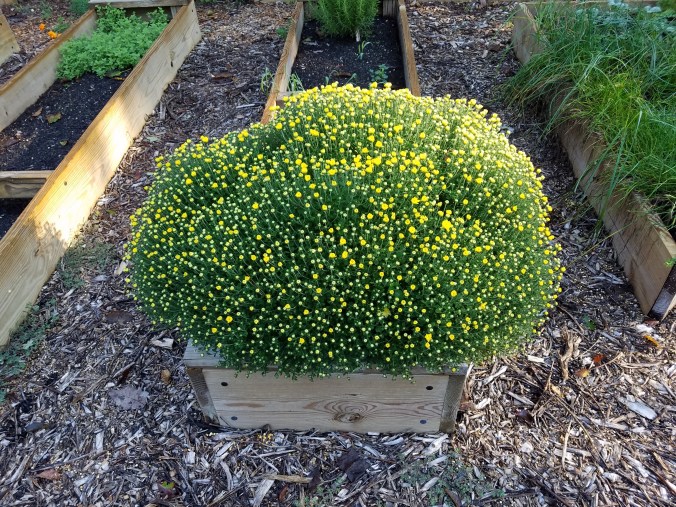
And today. The bursting of color begins!

mums 9.19.jpg

The scarlet flame caladium doesn’t get as much sun and has not even trebled in size, but its colors are glorious.

scarlet flame caladium.jpg

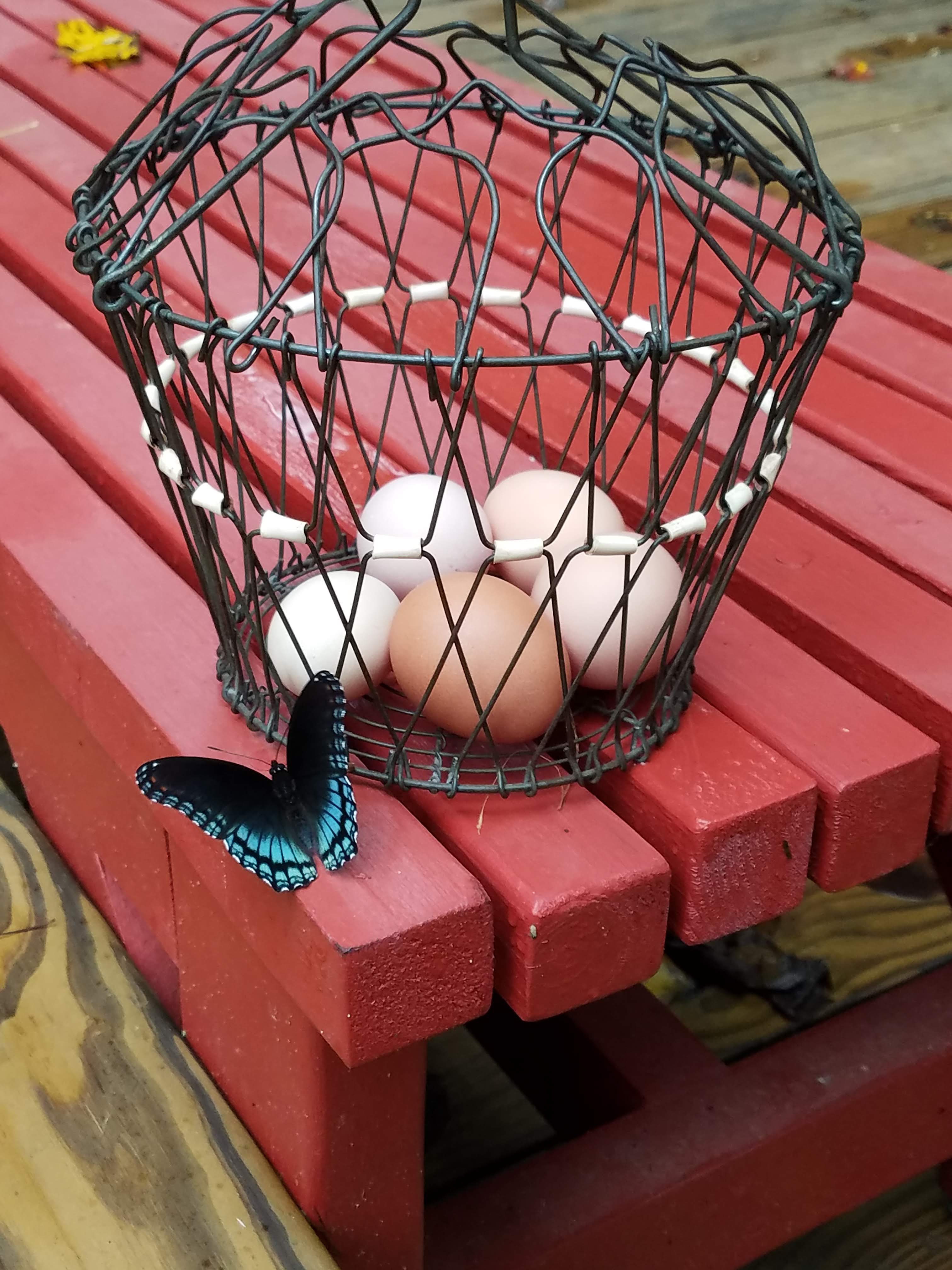
Speaking of glorious, this butterfly has a most amazingly delicate transition from blue to black on its wings.

butterfly on bench.jpg

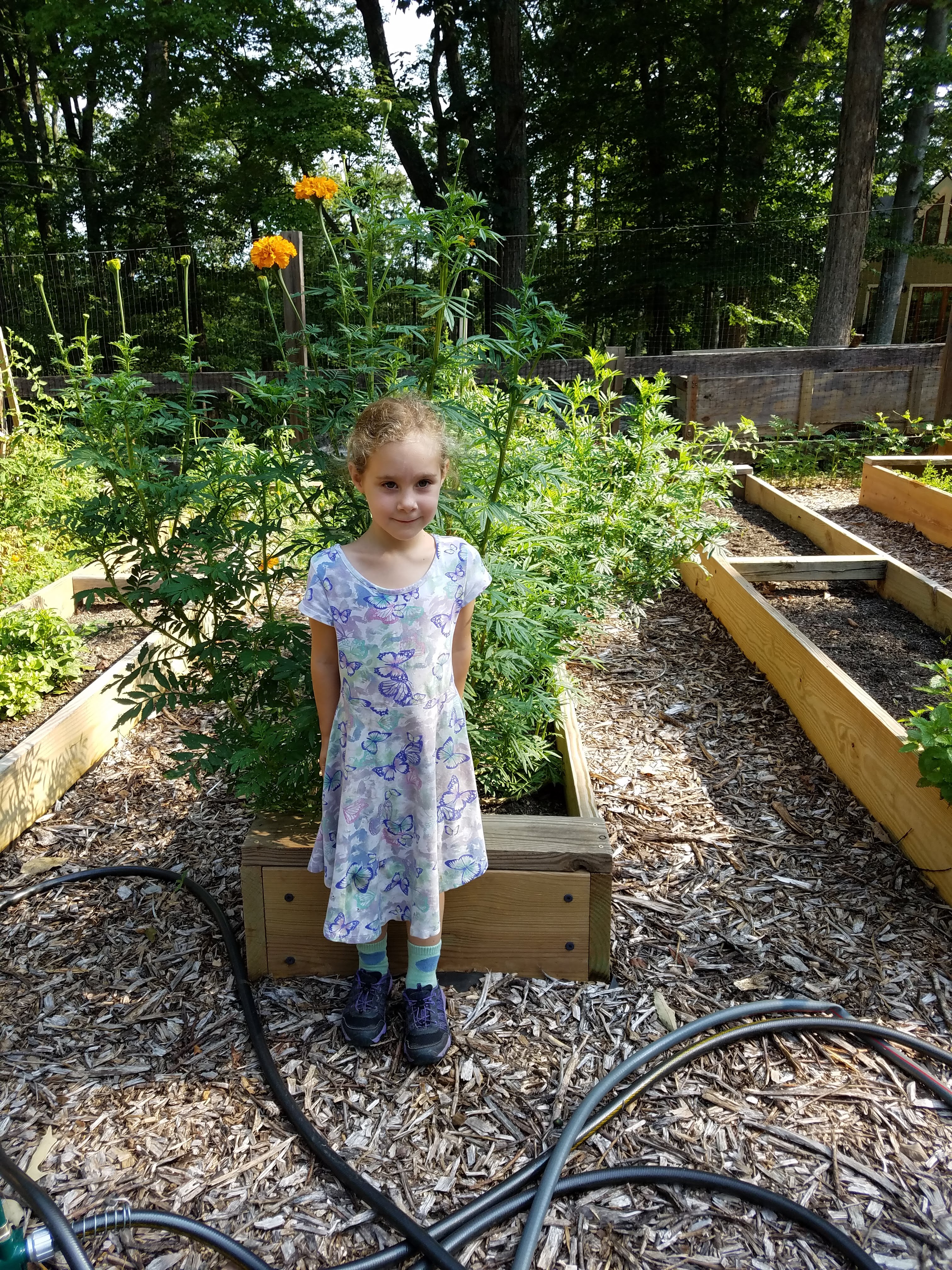
Fall seems a good time for spots of color. The marigolds were also gigantic this year, as is clear in this photo with Rise about six weeks ago:

rise marigold.jpg

But their splendor is perhaps best appreciated up close.

marigold close up.jpg

The lemon grass also went crazy, but no crazier than usual. I gave it its own bed this year.

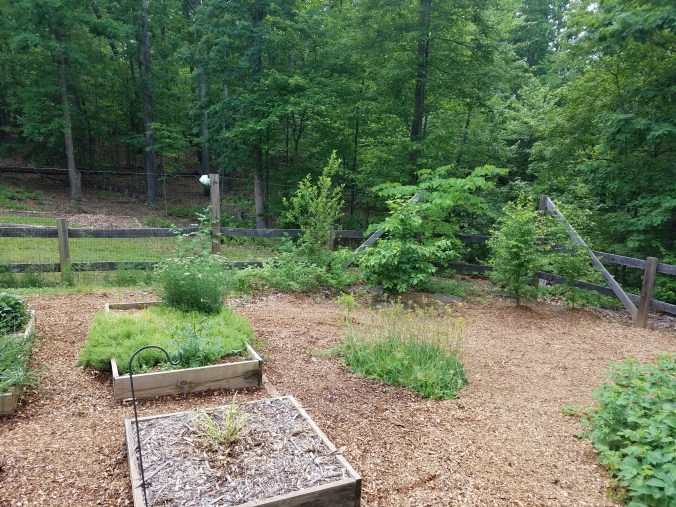
Here it is in May, just planted (foreground bed).


lemon grass in May.jpg

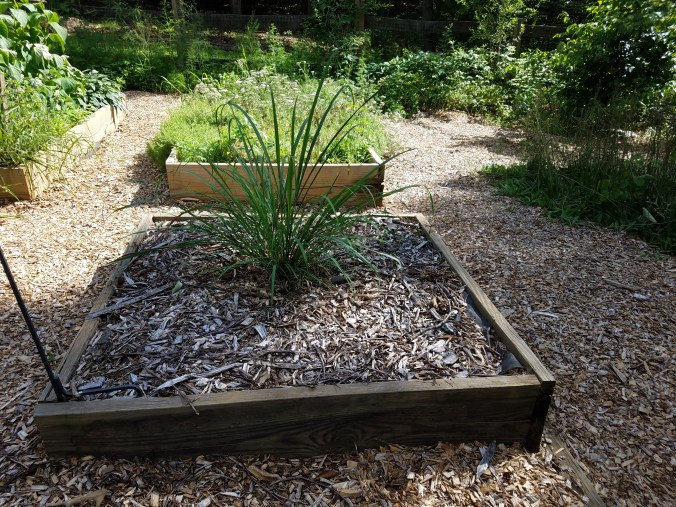
And in June.

lemon grass in June.jpg

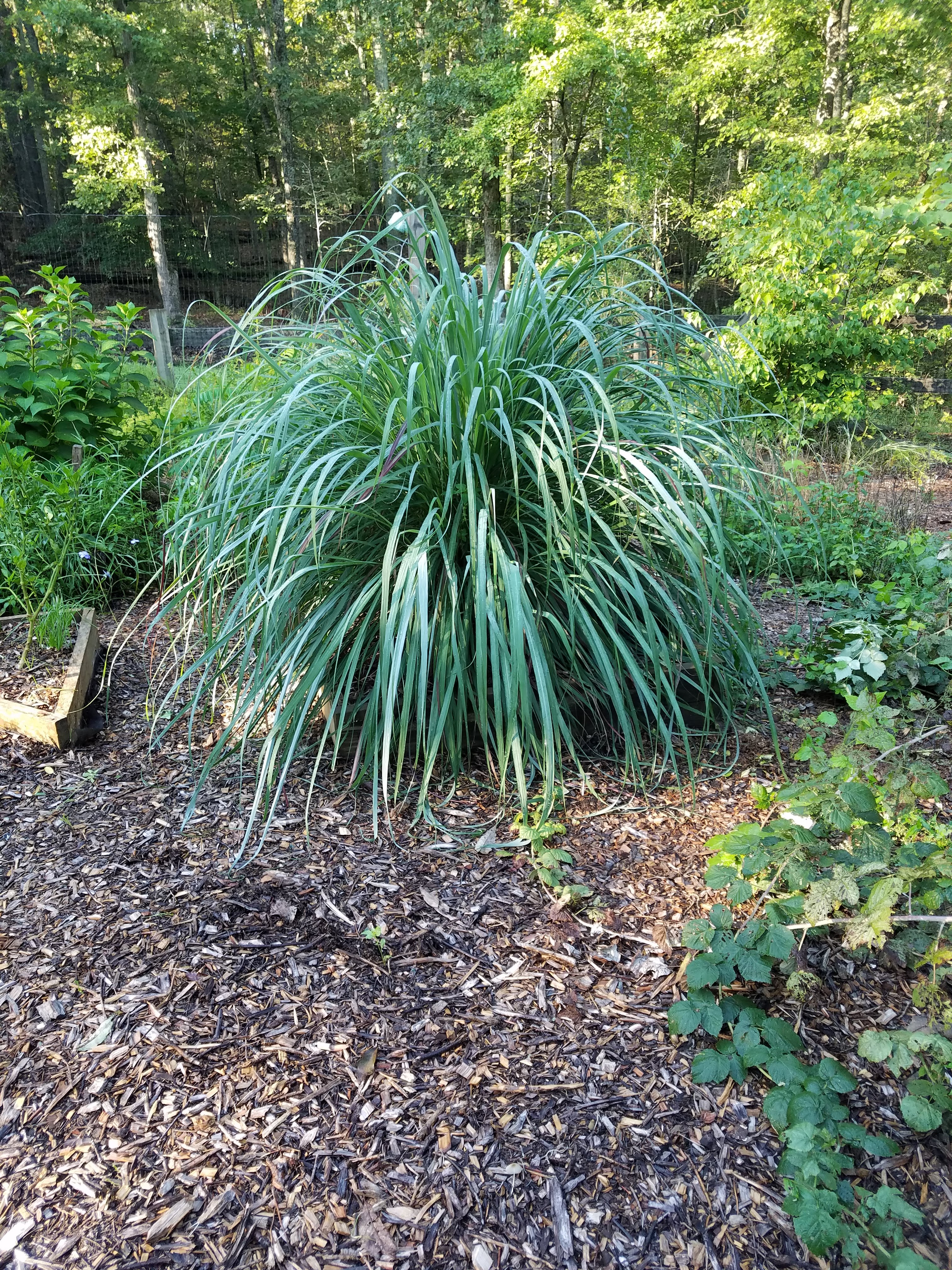
And today. You can’t even see its bed!

lemon grass 9.19.jpg

You almost wonder what’s lurking inside there!

What’s lurking is the same thing that’s lurking inside them all – life! Here we are, every one of us, with life and beauty all around us, a gazillion different examples, we and they all enjoying moments, catch as catch can, in the sun, in the rain, no matter the situation. If we have open hearts, beauty will make itself clear at almost every turn.

Bobbe’s Granola, a.k.a. 5K Granola

For 22 years I lived in Vermont – made my own bread, homeschooled my kids, wore Birkenstocks year-round. I was a Granola Mom and proud of it. As you would doubtless expect, I also made my own granola. At some point my friend Bobbe gave me her recipe, and I made it and tweaked it and gave it away many times since. For a few years I even got to serve it to runners and walkers (along with little yogurts) at the annual 5K fundraising event our local hospice organization held at Keswick Golf Club.

Hospice of the Piedmont in Charlottesville, Virginia, has all my admiration for the outstanding job it does of ensuring that no one in this community dies alone or in pain, and that the families of those with terminal illnesses get the help they need too. I loved helping with the 5K every spring. Four or five years ago, thinking of my granola, I suggested that at a 5K, we should have food that the runners will remember. You want them to come back, to choose your race instead of some other race. Every event like this has banana halves and orange smiles, and lots of them have donated waters and bagels. But who has yogurt and homemade granola? It worked! The runners loved it!

Last year this amazing group of women, led by rock star Melba Campbell on the far right (who, for those of you who see the balloons, was also the birthday girl that day), raised more than $176,000 through this event that included just over 300 runners and walkers – a phenomenal ratio of dollars to runners. Every single volunteer contributed heart and soul, and I could not be prouder to have worked alongside them.

5K 2017 group photo.jpg

But a funny thing happened this morning. I took out my cookbook to look at the original recipe, you know, just in case it was in Bobbe’s handwriting, which would have been very cool, but instead the handwriting was mine. She must have dictated it to me. Too bad, a missing piece of authenticity. Nonetheless, I laughed to see, right there in blue ink on an old index card, the very technique I thought I had “discovered” only a few years ago, the critical step, the “secret” to making the granola crunchy but not overcooked! Yes, it was a piece of humble pie for breakfast. How did that happen?!

It happens when you have made a thing many times, so many times that after a while you don’t look at the recipe because the ingredients and steps are all in your head. You begin to feel comfortable with eyeballing the quantity of, let’s say, the cinnamon, you use a different kind of wheat germ instead of the kind you always used, you decide you like it a little darker so you leave it in the oven longer – that sort of thing.

One time a few years ago, while working long days at the hotel, the glass, gallon-size jar that I keep my granola in was empty and I didn’t want to delay making a new batch any longer. Because of my schedule, I made it late that night. By the time it was done and I had turned the oven off, I was super tired. Eh, I’ll finish it in the morning (meaning I’d take it off the pans then and put it away). And off I went to bed. The next morning as I positioned the spatula at the edge of the pan to begin the process of breaking it up for transfer to said jar…

scraping.jpg

… I heard a different sound, a sound like crunch.

Words are great and they come in very handy for a lot of communication. Pictures add tremendously to the understanding of anything. But sounds! Sounds have their own benefit. When something has sounded a certain way all along, and then suddenly it sounds different, you pay attention. I deduced, from the sound that morning that sounded like crunchy, that the overnight stay my granola had had in my oven had pulled more of the moisture out of it than if you take it out of the oven after it’s cooked and let it cool on the counter. It was drier, crispier, crunchier. I loved it! I was elated!

This was a breakthrough, and I had my crazy work schedule to thank for it. The granola was better in yogurt, better in milk, just plain better. When Lori Woods, one of the exceedingly competent and dedicated hospice workers, asked me for the recipe last year, I included in it:

Bake at 375 until the tops get brownish, which takes about 25 minutes. I happen to like mine a little on the darker side, but the shade of brown is up to you. When you have decided it’s right, turn off the oven but leave the pans in there. I found out by accident that leaving the pans in the oven overnight to cool slowly allows the residual heat to pull any excess moisture from the granola and gives it (and allows it to keep) a wonderful crunch if stored without fruit in it. 

See that part: I found out by accident…? I did! At least I think I did! But maybe I didn’t. Maybe the very clear instruction on the original recipe came out of deep storage in my brain, came right up to the front and presented itself anew. Here it is, see it? Plain as day: Turn oven off & leave in overnight.
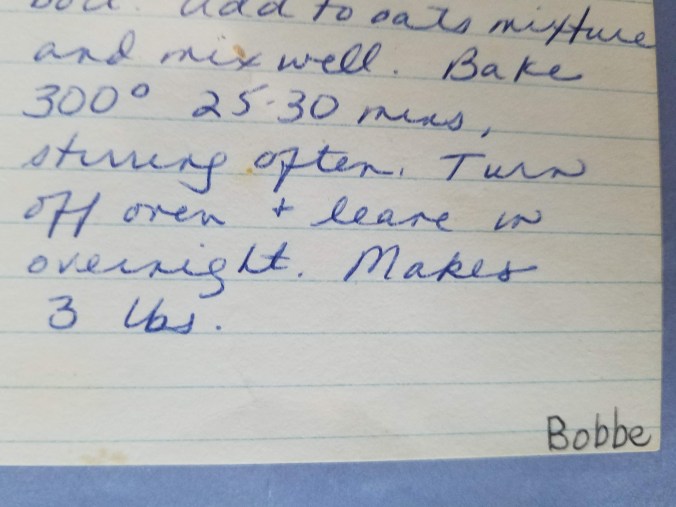
recipe (2).jpg

Now I know you think the moral of this story is: Every now and then you should look at the recipe! Yes, that’s part of it. But something else interesting happened this morning. When I took my pans out of the oven, having baked the granola last night and left it to dry overnight, as I pushed the edge of the spatula along the bottom of the pan to loosen it up, I did not hear the crunchy sound as usual. It sounded, well, softer. This story is NOT unfolding as it is supposed to!

Food is funny that way. It does not always cooperate the way you expect it to. Boxed cake mixes used to have alternate instructions for people who live at high altitudes (probably they still do, I haven’t bought one in a long time). This is because, for one thing, the air pressure is lower and foods take longer to cook. I never lived at a high altitude but if you did, it would make sense to pay attention to that.

I have never seen alternate instructions for hurricanes or other weird weather situations, but I think maybe, just maybe, the excessive humidity in the air right now because of Florence affected my granola, even inside the oven. Could it be? For several years now, I’ve done the overnight method. Why this time is it different? Lucky me: I have another batch to compare with mine.

Mom wanted to make some too because Jerry is a big fan of this granola and he was running low. (Poor man, must keep him well supplied.) She made it herself a few weeks ago and it didn’t come out right, so I made a batch together with her yesterday morning and then a batch of my own when I got home. This was great not only because I could spend some fun time with Mom, but also because I could see the process through the eyes of someone who was new at it.

Start with these ingredients.
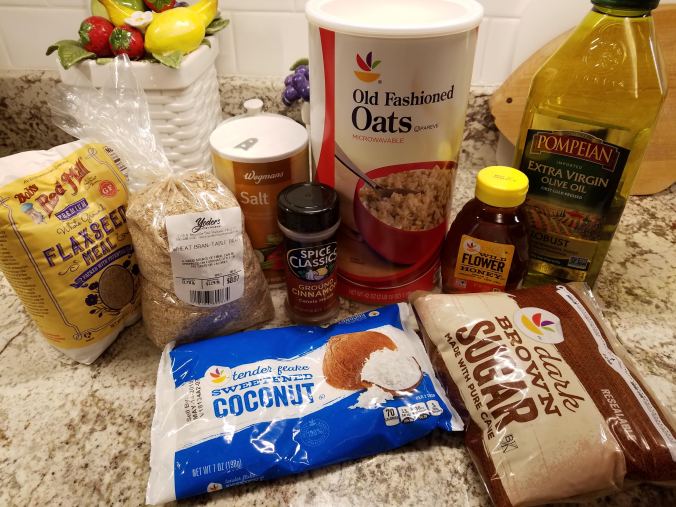
ingredients.jpg

Specifically,

1 large round container old fashioned oats (42oz, 1.2kg, which is 15 8oz measuring cups full in case you buy your oats in bulk packaging)

1 ½ cups shredded coconut (this 7oz bag was a little more than that, I used the whole thing)

1 cup wheat germ

½ cup flax seed meal (optional)

1 cup brown sugar, light or dark

2 tablespoons cinnamon

1 teaspoon salt

Several points to note.

  1. Old fashioned oats are better than quick oats for this.
  2. You might like your granola sweeter or not as sweet. You can add some more brown sugar, or use less. You can use unsweetened coconut.
  3. Your wheat germ might be toasted or some other variety. Fine.
  4. I use flax seed only when I have it. Mom had it and wanted to use it.
  5. There are no nuts in this list. There are two reasons for this. One, I do not eat nuts. Two, if you eat nuts and want to add them, it is best to do them after the granola is baked and cooled.
  6. There is no dried fruit in this list. If you add the dried fruit before baking, you will end up with fruit that is hard as rocks and hard to chew. Put it in later.

My 8-quart, 14” dough bowl works well for this amount of ingredients. I brought mine to Mom’s because she doesn’t have that big a bowl. She said to add to these instructions that you might want to either use a big pot as a big bowl or cut the recipe in half so that you can use a smaller bowl.

Mix all of this together well in a very large bowl. Make sure you break down any brown sugar or coconut clumps at this time. Fingers or the back of the spoon work well.

Once the dry ingredients are mixed together, add 1 ¼ cup extra virgin olive oil (or whatever cooking oil you prefer) and then 1 cup honey (local is best, you know what they say about it being good for you). Measuring the oil first, then the honey in the same measuring cup, helps your honey not stick so much to the inside of the measuring cup. When you have added both, stir it up carefully.

I loved stirring it all up using this beautiful hardwood spoon that my son Bradley made for Mom years ago. The very tools we cook with evoke good emotions sometimes!
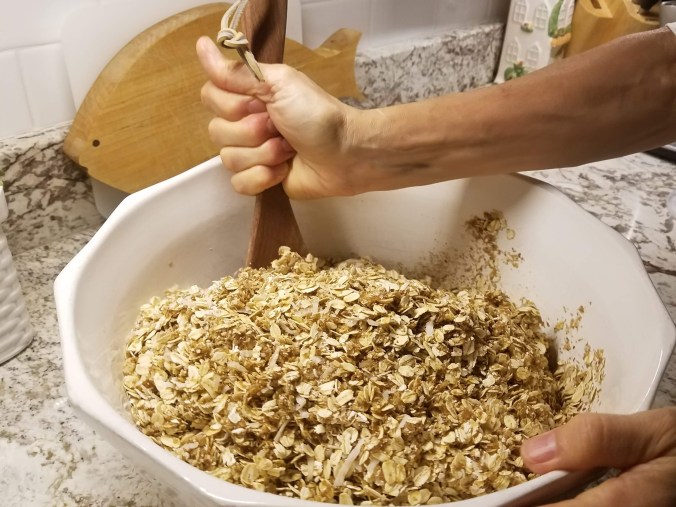
stirring (2).jpg

Once the mixture looks well mixed, which is to say de-clumped, divide it between two 12×18” pans or the equivalent. These have a nice standing-up edge and that’s important against spillage. The silicone mats are underneath, but you can’t see them. Bradley made that fish cutting board too, by the way.
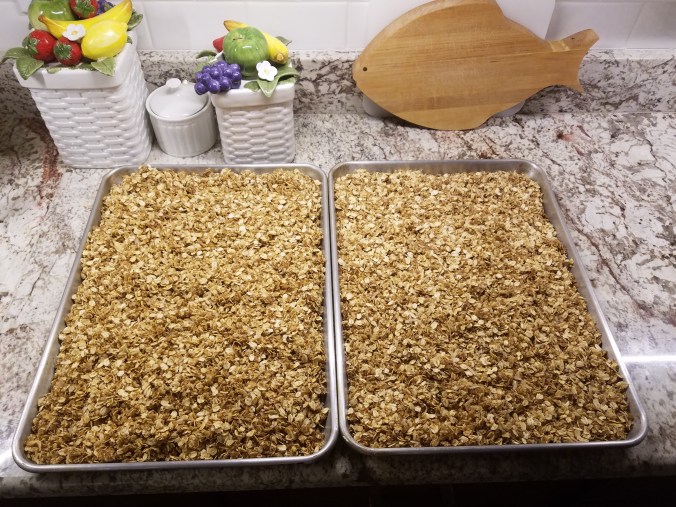
pre-cooked.jpg

We preheated Mom’s oven to 375 and left the pans in there for 25 minutes. The top pan got browner than the bottom pan.
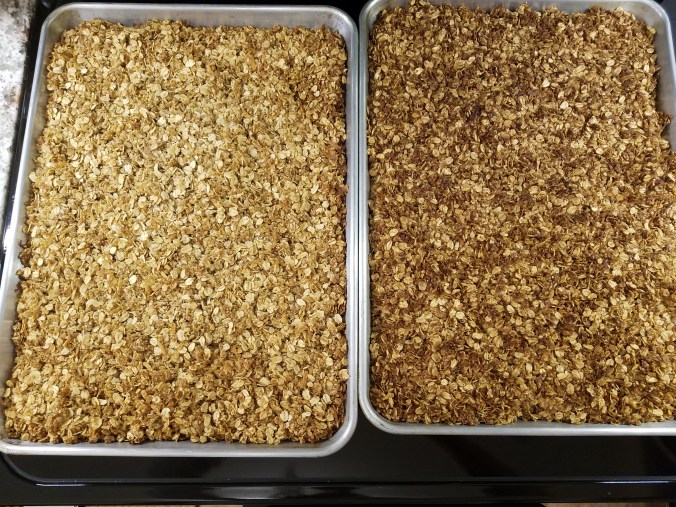
dark and light, cooked.jpg

Both are acceptable. You make it however dark you like. The original recipe does say a 300 degree oven, oops, I also see today. Maybe I got impatient somewhere along the line and upped the temp. Either way, it bakes, and you decide how brown you want it.

Do note that brown corresponds directly to crunch. The browner, the crunchier, regardless of residual oven heat. Getting back to the humidity question, Mom’s granola turned out crunchier than mine despite the humidity and I think this is because hers stayed in the hot oven longer. She mixed up the darker and the lighter before putting it away and got a very acceptable result. SO… maybe it’s the combination of length of time in the oven (how much it cooks in the first place) plus length of time in the residual heat plus the (random, uncontrollable amount of) humidity in the air.

All right, so you mixed up the dry, stirred in the oil and honey, de-clumped, spread in pans, baked for 20-25 mins, turned the oven off and let it sit overnight in your oven. The next morning, use a spatula to loosen the granola from the pan and use your fingers to break up the larger pieces. Now either put it directly into jars or tins to store without dried fruit and/or nuts, OR combine with the fruit and/or nuts now and then put away for storage. I store mine without fruit. IF you store your homemade granola with the dried fruit mixed into it, the dried fruit will put some of the moisture back in it and your granola will be softer. Adding nuts before storing the granola should not affect the moisture the way fruit does, but I cannot be sure about this. The 5K race day fruit was dried cranberries, cherries, cut up apricots and golden raisins; use whatever you like and quantities you think are appropriate. Almonds, walnuts or pecans are good I’m told, but I cannot be sure about this either.

My favorite combo in a cereal bowl is equal parts granola and Grape-Nuts (which contains neither grapes nor nuts, but that’s another story) with some dried cranberries on top (dried cherries on special occasions or to treat myself). I use the Grape-Nuts because the flavors and textures combine well and it helps to stretch out the batch of granola, meaning I don’t need to make it as often (which was super important back when I was working ten or so hours a day at the hotel). Mixing some granola into plain yogurt with a little bit of strawberry jam is also very nice…

Granola makes a great gift because it keeps well and looks nice in a tin or a mason jar or a clear plastic bag tied up with a bow.


Lasagna Pizza Galette

Oh, look, ricotta. What can I do with that?
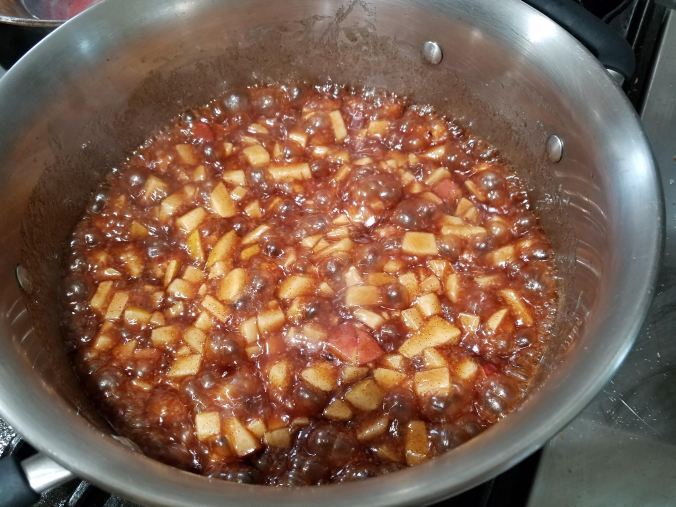
I came home from being away for a few days and opened the fridge to see what might be possible for dinner, and there was a container of ricotta, front and center, staring at me, practically begging. You know you want to use me. I did, not only because I had an idea brewing, but because it had been in there almost too long.

Two experiences contributed to the new concoction I made tonight. New for me anyway.

  1. While in D.C. this past weekend, we stopped for a bite to eat at a pizza place and were intrigued with the one that had pickles on it! That’s right, pickles along with ham, pulled pork, feta cheese and a bit of mustard. They call this a pizza, and I’ll play along. It has a crust like a pizza, is round like a pizza, and has creamy, melted cheese on it like a pizza. The rest is a stretch, but it didn’t matter because it was totally delicious. The server described it as an “open sandwich.” Put whatever you want on a pizza crust. Hmmm.
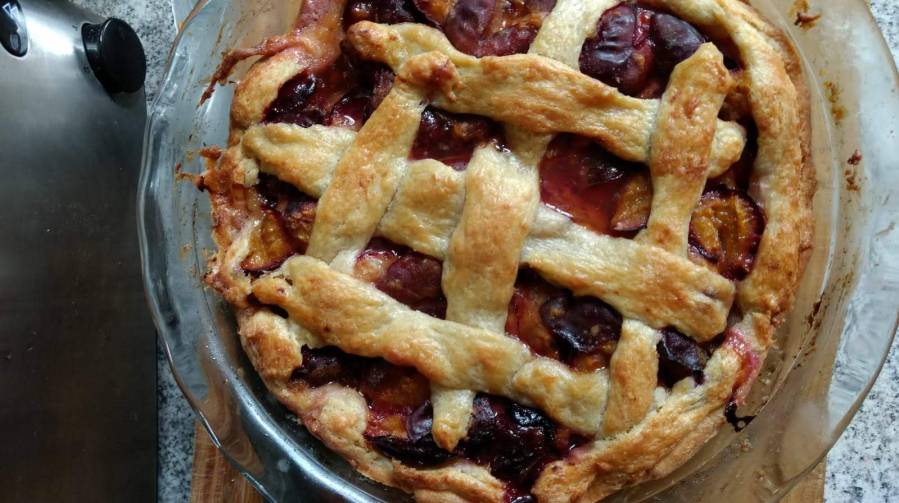
  2. Claudia and I had a conversation about pie vs. galette. I think of galette as the free form version of pie, I said. To me pie has more fruit than galette, she said. Deeper maybe, ok, fair, I said. Look at us, she said. 🙂 Claudia made a plum pie. The sticky dough made with gobs of butter was hard to work with, hard to make pretty, but oh how amazing it must have tasted. I could only dream about it because she lives in Germany. I’m sure it’s long gone.

Claudia's plum galette.jpg

So here I was thinking free form and wanting to do something with my must-be-used ricotta when I saw it in the fridge. That’s all there was at first.

Okay. Start with a pizza dough, which we have discussed in my pizza pile post https://anunboringpath.com/2018/07/31/pizza-pile/. While the dough was resting I gathered basil and oregano from the garden (oh, how glorious basil and oregano are in August!!) and cut it up, took out the ricotta, looked for mozzarella but didn’t happen to have any so settled on a small chunk of asiago (it’s a stronger cheese – don’t need too much, but the flavor works), grated that, chopped up a red pepper and a couple handfuls of spinach, defrosted the half a can of Don Pepino pizza sauce I had put in a jar the last time we made pizza, and took out the jar of grated parmesan that I keep ready to go in the fridge. I oiled the pan with olive oil and sprinkled cornmeal on it. I’m hungry, worked fast.

Ready. I rolled out the rested dough bigger than my pizza pan by about 4” all around. Truth be told, that’s just how big it rolled out. Looked good to me. Not overly picky when I am hungry. I set the pan on the first thing that caught my eye on the counter that would raise it up high enough for the dough to hang down, which happened to be my teapot without its lid waiting by the sink to be rinsed, which you cannot see in this photo, but trust me, the teapot is under the pan and the dough is hanging down the sides.

True confession: I was just making dinner for me and Samuel. That’s all. This is the point where I realized the idea might work and it might be yummy and I ought to be taking some pictures so I could share it!

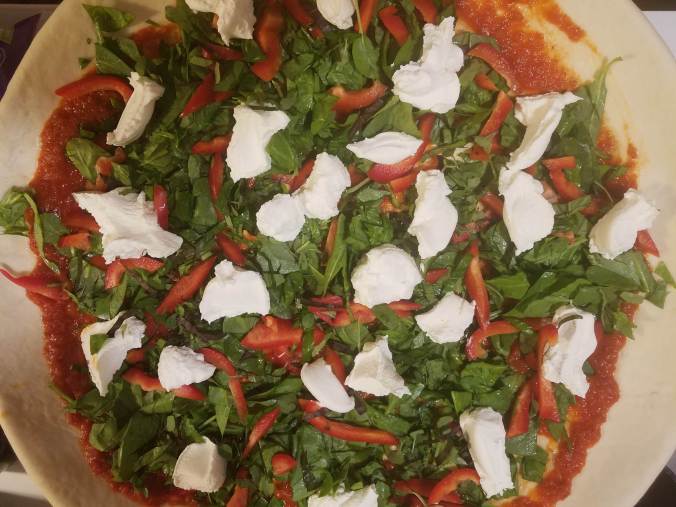
Here it is with the pizza sauce, then the spinach, basil and oregano, then the red pepper, then small blobs of ricotta.

1.jpg

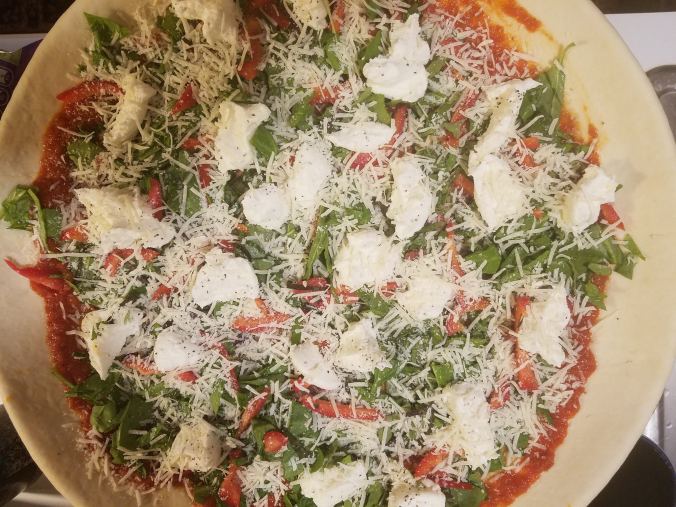
Next came the salt and pepper and parmesan.

2.jpg

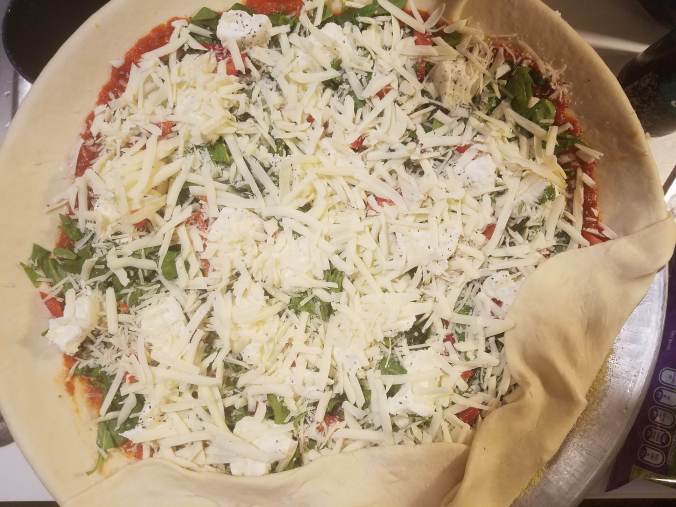
Then the grated asiago. I began flipping the sides up. This is the part that reminds me of a galette. Wherever it lands, it lands. After it’s done, the whole thing is fabulous, but the part encased in the dough all around the edges is extra fabulous. But I am getting ahead of myself. And I know I’m being terribly UN-EXACT this time. So sorry. Been away. Hungry. Slacker!

3.jpg

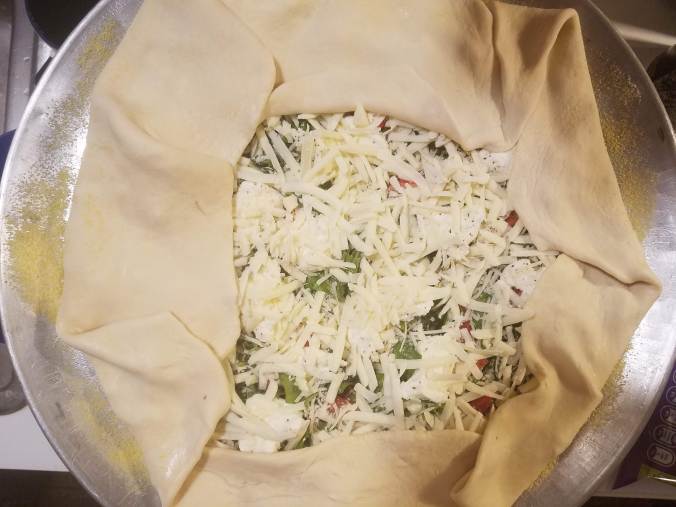
When all the sides are flipped up, it looked like this.

4.jpg

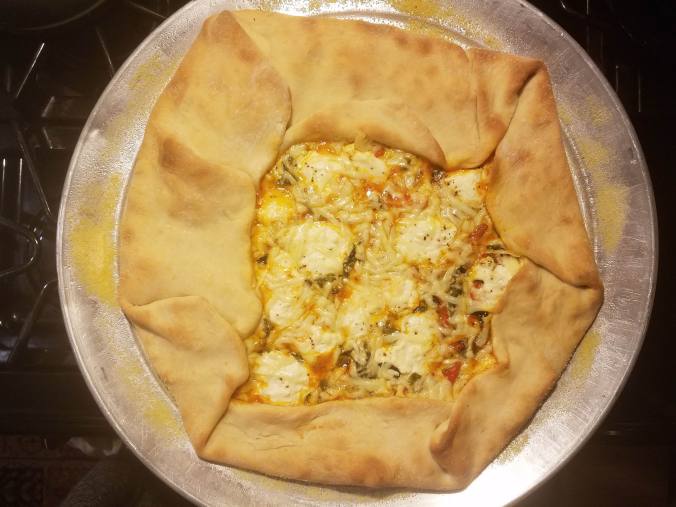
And when it has cooked until it’s almost done, it looks like this.

cooked 1.jpg

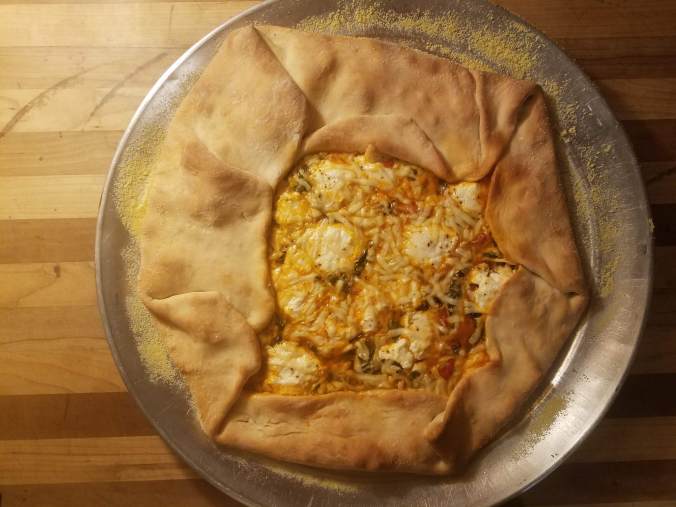
I like mine a little darker and the bottom crust a little crisper, so I slid it off the pan right onto the oven rack and in five more minutes ended up with this.

cooked 2.jpg

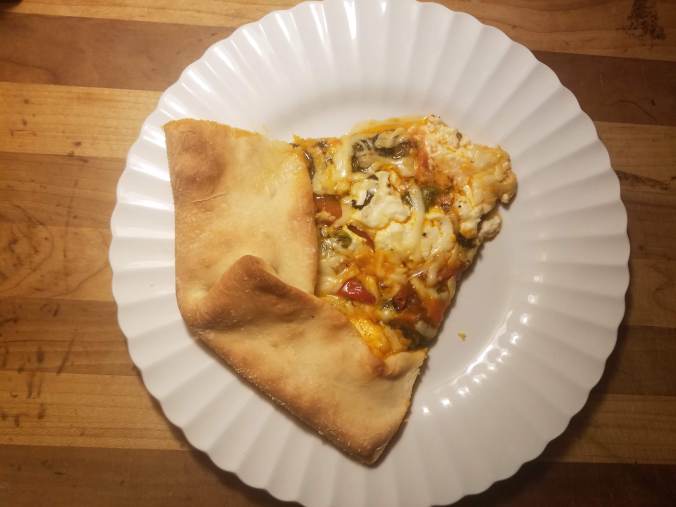
Seems to be a combination of pizza, Stromboli, calzone, lasagna and galette.

  • Round, thin crust, creamy cheese on top like a pizza.
  • Crust enveloping cheese like a Stromboli or calzone.
  • Ricotta to remind me of lasagna or calzone.
  • All in a free form that still reminds me of a galette.

I have no idea what to call this! But it was divine. Note past tense verb was.

piece on a plate.jpg