The Happy Lion

The long-range result of most anything is hard to predict, but in general, good begets good. When I was a kid, twice a year or so we had a book fair at school. My mother, God bless her, let me choose a few each time. I remember there being a flyer ahead of time describing the available books so that I could make careful selections. Bound pages with captivating drawings and compelling stories have always been a thrill for me; perhaps it started here. I eagerly devoured each new little book, unaware (as children are) that ideas and attitudes take root in the early years.

I remember only two books specifically, and of these, only one survived: The Happy Lion by Louise Fatio with pictures by Roger Duvoisin. I loved the exotic, Parisian setting and the characters’ foreign names, the lion’s unexpected adventure in town, the looooong sounds of the fire engine, and the sweet, unlikely friendship between the lion and Francois.
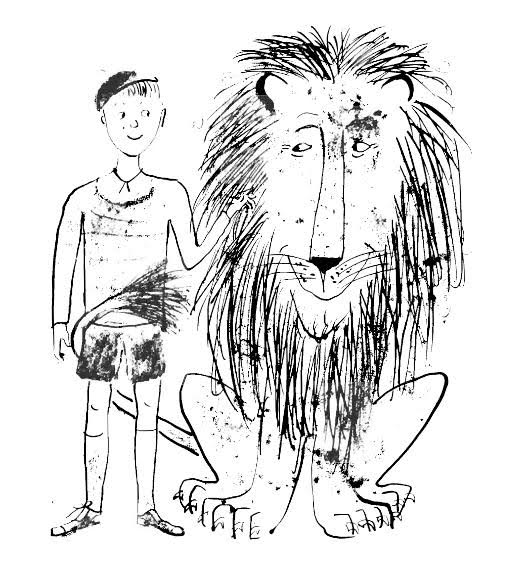
happy lion jpg

This simple drawing on the last page of the book of Francois and the happy lion together says it all: We are friends, and that is that.  It doesn’t matter what everyone else thinks about that, or if they approve or understand or appreciate. We just are. The text confirms it:

From then on, the happy lion got the best tidbits the town saved for him.

But if you opened his door

He would not wish to go out visiting again.

He was happier to sit in his rock garden

While on the other side of the moat

Monsieur Dupont, Madame Pinson,

and all his old friends came to see him again

like polite and sensible people

to say “Bonjour, Happy Lion.”

But he was happiest

when he saw Francois walk through the park

every afternoon on his way home from school.

Then he swished his tail for joy,

for Francois remained always his dearest friend

I never felt like I had a dearest friend when I was a kid. I had friends, but not a dearest. It sounded very nice. What is a dearest friend? Let’s even forget the superlative for now — what is a dear friend? Once you have been around the block a time or two, you have a general idea about the definition, or at least you have your own definition, and whatever that is, I say stick with it: the way you look at it is the best way to look at it.

As for myself, the very idea of a dear friend warms my heart, and warmth is not usually a quick thing. I don’t think Francois became the happy lion’s dearest friend the first day he visited. Instead, as is generally true, I suspect their friendship happened little by little. One day the sun was shining and the birds were singing and the lion was basking in his safe and comfy world, when along came a boy, not doing much, just near. Maybe he walked along the edge of the moat, glancing up at the tawny gold fluff now and then, staring more than he realized, wondering, admiring.  He wants to be near me, the lion thought, and was happier than he had been before. The boy, for his part, was fascinated with the big, beautiful creature: the lines of the body, the gleam of the fur, the fluff of the mane, the size of the yawn, the graceful gait, the thoughtful eyes. The lion did nothing extraordinary (for a lion) but the boy did just like to be near him. And the lion felt special, chosen even. They made eye contact, which did not scare either one of them, so they looked at each other some more. It was a mutual like — interesting, unthreatening, pleasant. Something to go on.

On another day, clouds blocked the sun and the breeze was a bit chilly, but still the boy came and still the fur gleamed and still the lion’s eyes drew the boy’s attention away from everything else. He sat across the moat, not noticing that the bench was damp from the night’s rainfall, not noticing that he pulled the collar of his jacket a little higher on his neck against the chill, not noticing anything but the incredible animal. He gazed less shyly. Bonjour, Happy Lion, said the boy softly, and the lion smiled to himself and thought: I knew I liked him. Now I think he likes me. It’s not my imagination. Lucky me!

Day after day, the boy came. They did not change the world around them — the sun shined or it didn’t, Monsieur Dupont groomed his beard in that pointy way, Madame Pinson knitted scarves and socks all the day long, the squirrels and birds competed for food and nesting places. But Francois and the happy lion changed each other. They made each other feel different than they had felt before. To be liked, just because, this was something remarkable.  To have a friend, to have someone you could call a dear friend, this too was something remarkable.

Time. Togetherness. Smiles. Softness. More time. Care. Gentleness. More time. Understanding. Ease. Peacefulness. More time. Increasing beauty. Precious moments. Depth. Comfort.

And then a need.

It was not a need at first. The lion was simply curious and took a step through the door of his house and into the bigger world. He did not intend the hubbub that followed. He was just being his calm and friendly self, but the world was suddenly different. Things happened that he did not understand, people acted in ways that confused him.

“I can’t think,” said the happy lion, “what makes them do that. They are always so polite at the zoo.”

He began to lose faith.

“People in this town are foolish, as I begin to see.”

Just when the situation might have gotten ugly and frightening, along came Francois and met the need of the moment perfectly.

SUDDENLY,

behind the lion,

a little voice cried, “Bonjour, Happy Lion.”

It was Francois, the keeper’s son, on his way home from school!

He had seen the lion and had come running to him.

That’s what friends do. They run to us, come alongside us, walk with us through the confusing stuff, the scary stuff. They make us feel better just by being there.

The happy lion was so VERY HAPPY

to meet a friend who did not run and who said “Bonjour

that he forgot all about the firemen.

And he never found out what they were going to do, because Francois put his hand on the lion’s great mane and said,

“Let’s walk back to the park together.”

“Yes, let’s,” purred the happy lion.

“Being there” used to mean being there with someone, with in the sense of physical presence. Francois met up with the lion in the confusing city scene. Two kindred spirits, side by side, faced it together. In almost all cases, being with someone includes not only presence but also some kind of touch, a sense of comfort or perhaps even safety, and words. Words may be slippery and at times unreliable, but they have been part of our world for a very long time. In-person interactions include words as well as instant responses, the option to show rather than tell, and lots of nonverbal cues, mood indicators and behavior predictors. But we are not always in person. Sometimes words are written and communication changes.

Don’t get me wrong – I am ever grateful for written language, poor and incomplete a tool of communication as it may be at times. Words of greeting, news, counsel, humor, or desire help people who are not in the same physical space connect with each other. Until not so very long ago, distance communication between two parties was mostly limited to words on paper, sent via painfully slow routes. Letter-writers waited (interminably it seemed) for responses. Couriers sped along when a matter was urgent, and telegrams improved that speed. When the telephone was invented, people got used to hearing a voice through a device. And then the internet came, and email and cell phones and texting and skype and facebook.

I remember when email was new. I remember explaining it this way: I will type a letter to my friend and see the words on a screen in front of me, and then I will hit one of these buttons (keys, we now call them) and the letter will be sent (God only knows how!) to the person I am sending it to, who will be able to read my letter on their own screen. What a wondrous thing!

The frequency and methods of communicating not in person keep increasing. All this technology, in theory for some and in practice for others, improves the connection between people, easing the physical distance. Each advance seemed specifically designed to get closer and closer to the real thing, to enhance that connection, to lessen or seemingly negate the physical separation.  Email and text afford nearly instant responses (assuming you respond to every beep and buzz), and often include visuals that add enjoyment and understanding. Face to face video interactions (skyping, facetiming, whatever you choose) get you closer still.

I will grant there is good in technology – a lot of good — and I am very grateful for it. We do keep trying to get close. We do recognize the value of closeness. We know and want the real thing and we do what we can despite the miles. Also, while technology may not be the real thing, it is something, and something is better than nothing. We have more something than we used to.

But I will not grant all good. Technology is not the real thing, no matter how good it gets. The screen may be a window, but it is also a barrier. No technology will replace physical presence. Words on paper or on a screen are still devoid of eye contact, touch, smell, intonation, smiles, detail, and subtle clues that something is delightful or amiss or needed. Emoticons help a little. Video goes a step farther. I applaud the effort and intention and the bits of time people spend thumbing a text to a friend, but I will venture that if the happy lion had a cell phone during his rather confusing and challenging situation, he may have heard the beep and seen “Bonjour, Happy Lion” from Francois and it would perhaps have helped a little, but I doubt it would have met the need of the moment perfectly, as Francois being there in person did. Francois put his hand on the lion’s great mane and said, “Let’s walk back to the park together.” There is no emoticon for that, no substitute.

The other downside of communicating via technology is that it can remind us of what we don’t have. Like having bowl of steaming soup in front of us on a cold day that we must just stare at but are not allowed to eat. Like window shopping when we have no money. Like watching lovers when we are alone. Is something always better than nothing? We each must decide what, and how much, we can handle.

Can you be or have a dear friend using technology alone? Of course. You will just miss some things, and will miss them by noticing the absence of them and possibly by lamenting the absence of them. You will miss the gentle touch of a hand on your shoulder (or your mane, as the case may be), the smell of coffee brewing in the background, the almost invisible look of delight when a certain something is mentioned. An hour with someone we care about is worth a thousand texts. Nonetheless, we do, and will continue to do, the best we can with the tools we have. Technology will improve yet again and will get us as close as we can be without actually being there. But I will hope that we are coming full circle, that all the advancement in ways to simulate physical presence will serve to remind us more pointedly of what we’re missing and this in turn will urge us strongly to get to a place that is not simulated. Now that’s something to look forward to.

In the end, dear friendship involves doing what we can with what we have, working within our own bounds of time, resources, comfort and ability to enrich, strengthen and protect the life of someone we care about. In the pencil drawer in my desk is a tattered index card with the following quote handwritten on it by me long ago. More times than I can remember, it has reminded me that I don’t have to do everything, but I should do what I can.

I am only one

But still I am one.

I cannot do everything, 

But still I can do something.

And because I cannot do everything

I will not refuse to do the something that I can do.

                                        —Edward Everett Hale

Francois did what he could do, and look what it meant to the happy lion. What he did was very good, and it was enough. Technology or no technology, that’s all any of us can do. And the best thing to do next? Rest. Smile. Then do more.
A carrot doing flip flops

How can it be the first of December? Leaves have fallen, chickens have gone through their bare-bottom phase and re-feathered themselves, geese have taken flight to warmer places. I got a little potted fir tree and located it on the ground in front of the house as a hint of Christmas, and reminded myself that it’s time to cut open the decorative pumpkin that has been sitting on the corner of the cottage deck and let the hens have a feast with it. As I stare out the north-facing windows at the range of foothills so striking through the empty branches, I think about the people who have come and gone from this very place, who have seen this view and wondered, as I do: Could it be more peaceful?

I have no monopoly on peaceful settings. Riding through vast expanses of prairie, walking along pristine, empty beaches you can surprisingly still find, teeing off on a well manicured golf course, gliding in and out of lush, tropical glades, whooshing through a moonlit forest on your cross-country skis — even rocking on your own front porch if you have one — these and many other settings evoke visions of peace and call our name softly. Come… here is where you want to be.

But for such a quiet, calm thing, peace is mighty hard to capture and hold onto. It is not so simple to get to that place, and I don’t mean plane fare. Our images of lovely settings might be the dangling carrot we reach for, but often it seems like that carrot is not just dangling, but doing crazy gymnastics in a wild storm and trying its darndest not to lose its connection to the string that holds it to something, anything, that’s not moving.  

Why is it so hard?

As of two days ago, it had been so warm and dry lately here in this pocket of Virginia that we really needed rain. We were glad to hear the reports of it coming soon, and battened down the hatches, in this case finishing the half-finished roof and putting the tools away. Sure enough it came, softly, two mornings ago. There is nothing quite like waking to the sound of soft rain when you know it is needed. A gentle soaking rain blessed the land on and off for two days. Good! Just what we needed. Isn’t that nice?

Then last night, out of the dark, dark blue, the skies opened wide. I’m talking Whoa! Where did that come from?! It poured in sheets, it rained cats and dogs, it deluged! That dangling carrot would have been doing flip flops. The sound was so jolting I had to go see. The porch light showed those massive drops bouncing hard and high off the wood surface. I felt gladder than before that the roof was secure.

As I took my comfy seat again on the couch and listened to the wildness go through its motions for the next fifteen minutes or so, the thought came to me that we did not ask for that. We do not control such things. We do not turn other powers on and off. Our own power goes only so far. But c’mon, I thought, the gentle rain would have been enough. The earth got its drink in a lovely way for two days. Why did we need the torrent?

Whoever knows? Maybe there is a meteorological reason that makes perfect sense in a textbook, maybe some atmospheric story needed a few minutes of dramatic fury, maybe it’s random. Maybe, like so many things that happen that we do not ask for, we can’t and won’t know why. We simply find a way to deal. We observe, we react, we protect, we carry on.

You can look for peace all you want. You may well find the loveliest of settings, the one that beats all others in your estimation. You might be able go there on a regular basis, and bask. Isn’t it nice? But even there, at some point, in some way, wildness will come in some unasked-for form. It will challenge your heart, your resources, your body, your circumstances. It will include elements you did not anticipate and will get you out of your comfy spot and force some kind of realignment. Sounds like a bother, and again I ask Why does it have to be so hard? The fact is: peace is more than a setting. Peace is inside you, an inner intangible something that doesn’t come from sitting in a chair.

Chairs are good. We need them for rest. Rest is essential. But the groundwork for peace lies in getting up and facing the thing that comes our way, whatever it may be, one moment at a time, one decision at a time, one bend in the road at a time, one conversation at a time. It comes from assessing the situation, weighing the options, choosing a path, seeing it through, knowing we did our best despite what we didn’t ask for.

There is so much we don’t control, so much that wants to throw us off our feet. At the end of the day, the inner part of us that yearns for peace finds it (in part) in knowing we successfully navigated the Wild World — if even just a little corner of it, even just for this day. We did what we could — overcoming obstacles, tidying messes, finding and corralling stray ends, bringing order, controlling some of the bits that make up the whole and making whatever good we can.

When the wind is howling (and I don’t just mean the wind of weather), you hold fast and get through it the best you can. When it has spent itself, you rest a bit and then keep going. Last night’s storm is a thing of the past, but its mad splashes muddied up the container that holds my little potted fir. This is no great problem, I understand, certainly not tragic, and does not hold a candle to, let’s say, cleaning up the wreckage after a tornado. It’s miniscule, in fact, in overall importance, one could say microscopic.

Nevertheless, I said to myself, the whole is made of the sum of its parts, and you do what you can with what you have, one little bit at a time. So I took that old pumpkin to some very happy chickens, brought the fir to the corner of the cottage deck and cleaned the outside of its container. A new look for the upcoming season is delightful, and if such a little thing can lift the spirit, so be it.

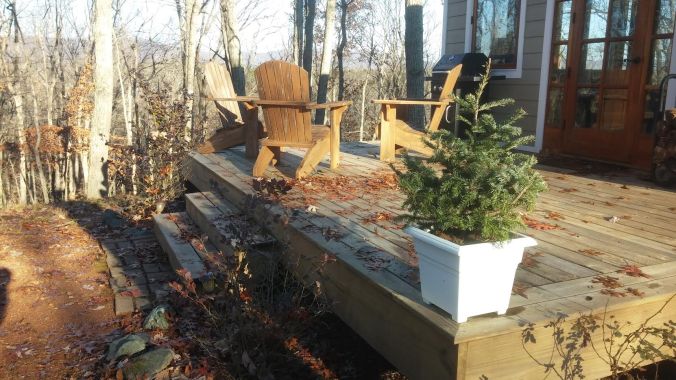
I smile at the image. Yes, leaves are strewn on the deck where the wind left them, and the wood bin needs to be filled again, and maybe someday grass will grow where there is now dirt, but the foothills are still in the background, even though they are invisible much of the time, and the majestic oaks still stand. I smile and feel peace deep inside me. In my little world, in my little way, I made one little thing better. It’s what we all do every day, or should, in a great variety of ways. Of course it doesn’t matter whether we fix something that isn’t working right or take someone to an appointment they can’t get to on their own or create a lovely present or tell a funny joke that makes someone laugh. Jimmy Durante inimitably sings a song: Make someone happy. Make just one someone happy. And you will be happy too! 

It’s the little things we do that make the world a better place, the little things that bring us to a place of peace — the kind that goes far beyond setting. 

fir on cottage deck.jpg

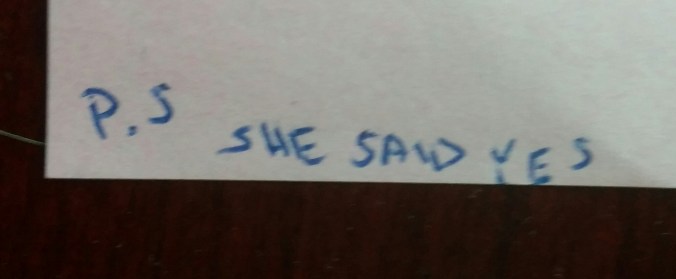
P.S. She said yes

I did not ask for heavy rain this summer. I did not know that hidden places in the roof above my head had holes. I mean holes. The kind rain gets through. But I did know what I had to do when I saw and heard water dripping into my hallway and through my walls during a recent storm. I had to call a roofing guy, and I had to do it quickly.

Jorge is a busy man, and after I saw him and his team in action, I knew why. They do good work, and fast. In one day I had a new roof. I can rest easy during the next rainfall. But you can’t plan everything, and I could not be choosy about which day Jorge would come. Saturday, he told me, and every other weekend day after that was booked for a long time. I had to have them come Saturday.

The timing seemed really unfortunate. Guests come to Golden Hill, my airbnb cottage, for a lot of reasons. This weekend I was honored to host Luis and Joy. In his introductory email, Luis had told me, “I am looking for a quiet secluded place where I can ask my girlfriend to be my wife. The plan is to ask during a quiet walk with just the three of us in a secluded setting. Me, Joy and our pup Lily.”

Notice he used the words “quiet” and “secluded” twice each. Secluded I’ve got. The house and cottage are at the end of a 900’ driveway near the end of a mile-long country road. It’s the quiet I was worried about. I’ve never had to have my own roof replaced before, but anything outdoors involving a god bit of hammering is going to be loud.

It was a conundrum. Luis and Joy were coming, and he wanted quiet. But there was no getting around it: I had to have a new roof.

I spoke to them about it on Friday evening — it was only fair to warn them — and they told me not to worry. He is in the navy. She lives in Dubai. They have heard noise before. But he asked for quiet so I worried anyway. Jorge and his guys arrived as they had said they would at around 8am on Saturday. I tried to speak to them directly, but I don’t speak Spanish so I had to hope that my nonverbals would speak for me. I think I was clear, I think they understood. Still I fretted. Once the old shingles started landing (loudly) in the truck bed, I knew it was for real and got nervous. As the hammers really got going around 9am and some kind of (loud) machine was turned on, I agonized.

The noise of a new roof going on is worse inside the house. I went outside to transplant one tree and pull a thousand weeds, and it was not as bad. By then, Luis and Joy had gone out for the day and I breathed a bit. But when the tree was in and the weeds were out, it was time to bake. Yes, bake. Nothing says “apology” like something fresh and sweet out of the oven — or at least I hoped! I used my tried-and-true pound cake recipe, added lemon peel and poppy seed, and called it Lemon Poppy Seed Cake. They came back. I wrote a note, put the cake on a pretty plate, put the plate and the note under the clear glass topper on the pedestal cake stand, set it on the side porch and sent a text telling them to look on the side porch. Luis was so understanding. He texted back, “Aww thank you. Things happen and we make the best out of them.”

I felt a little better when I read that, then tremendously better when Jorge and team were packing up. At least the rest of the evening would be quiet, as well as the morning. I woke at 6am on Sunday morning to the sound of crickets and whatever else is out there making nature noises. It was cool and perfect for a walk. As I passed the garden on the way back, I decided to plant some fall seeds as well, and set about it. By then it was daylight.  Lily, the pup, saw me in the garden from her post by the door inside the cottage by about 7 — and barked. I can’t win, I thought! Now I’ve woken the dog!

Of course, I need not have worried so much. Luis came out to begin packing their car and we spoke for a bit. He assured me that Lily did not wake them up and the roofing noise did not bother them. “We were in our own world,” he said. It reminded me of when you see couples who are clearly in love, sitting at a table for two in a busy restaurant . All the commotion around them does not matter a bit. I guess we probably could have also had a back hoe digging or the chainsaw buzzing, and it would have been all the same to Luis and Joy. She said yes (see his note) — and what else matters in the world??

0913160733~2.jpg

So why do I worry so much? I know I want things to be perfect, or as close to perfect as I can make them. Surely this is a simple case of, as Luis puts it, “Things happen and we make the best out of them.” The worry comes because of the transition to the plural pronoun that you all undoubtedly noticed in the last few sentences. It’s all well and good that I am doing everything in my power to smooth over the potentially disturbing impact of the noise that these circumstances create and make things as close to perfect as I can make them– what really matters is that we make the best of them. What I cannot control is how, or how well, the next person deals. Luis is a gem. I don’t know if he saw my worries, my intentions, my wish that they had truly had the quiet he wanted. Most likely he simply has a good heart, and this makes him a fantastic son, brother, uncle, and friend and soon will make him a wonderful husband too.

“We make the best of things” depends on good hearts. Several weeks ago a similar situation took place with guests at the hotel. Things did not go well. Mainly, they did not like their room. We moved them into a better room (finagling room assignments we had for other guests at a time when we had a full house), and they still did not like it. We dealt with them as courteously and professionally as humanly possible, but nothing we did mattered. They threatened, they fussed, they twisted the story, and finally they left. No matter how hard we tried — no matter how good the heart behind the action —  the only conclusion we could draw was that some people just want to be miserable. They carry it with them, they inject it into their surroundings, they leave it in their wake. Piercing words, sour expressions, obstinate attitudes — these gave me pause. I needed some time to process the experience. Be honest now: Had I/we worked hard to offer the best possible solution? Had I/we shown empathy, remained calm, spoken kindly, practiced integrity? Being honest now: Yes, yes, yes, yes and yes. You can do only your own part.

What a gigantic difference it makes if good hearts on both sides do what good hearts do.

A snail in the cabbage!

Turtles we have seen hiding under the cucumber leaves. Once we watched her burying eggs next to the raspberries. Disgusting green horned worms we have seen on the tomato plants. A different, practically invisible (they are so camouflaged), also green and almost as disgusting green worm we have seen on broccoli (almost as because the broccoli worms lack the horns). Japanese beetles we have seen too many of — once they find the grape leaves, they munch so greedily that the leaves disappear fast. Collecting them makes a feast for the chickens. Beth used to find and destroy squash bugs. I did not want to deal with these, so I didn’t plant squash. Potato bugs are also gross; thus no potatoes, at least this year.

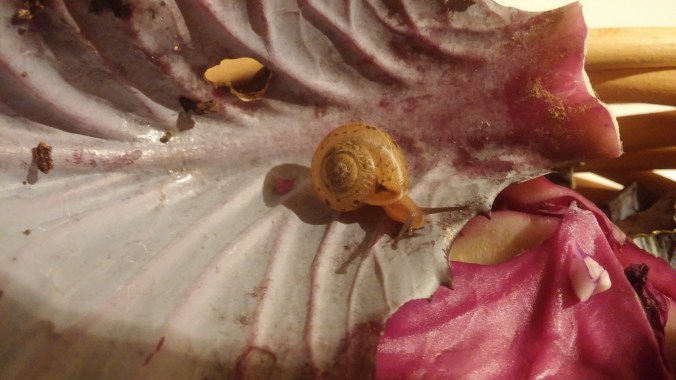
Today though, a snail! I have never seen a snail in the garden. It was real, hiding in one of the looser outer leaves of a red cabbage recently harvested. I know a snail when I see one.

snail.jpg

But where did it come from? How did that one snail find its way to that cabbage? Are there more out there that I have not found? Will I be battling snails henceforth?

A quick google search of “how do snails get into gardens” reveals many ways to get rid of the little creatures that are noted as both  “unwanted” and “pests.” I know I am not the most patient google searcher, but in this case I am a bit disappointed in google. I asked How do they get there, and it gave me How to get rid of them. At last count, I had only one, and I got rid of him. But where did it come from? Why is it in my garden? What vehicle did it enter on? (Surely not via its own power– snails being right there with turtles and sloths in the slow lane.)

This question very likely has a reasonable, logical answer that numerous people have taken time to come up with. I appreciate that effort, and the science behind the effort, and I would appreciate ideas anyone would like to contribute to help solve this mystery for me. But as happens (surely it has happened to you), one thing makes you wonder about something else. Today, snails make me wonder about woodpeckers and grass and wasps. As mysterious as “Where did the snail come from?” are the following: Why did that redheaded woodpecker a few weeks ago not realize that the side of my house is not a tree to peck at? Why does the grass grow extremely well in the gravel driveway and not in the yard? (I think we should put gravel in the yard so that grass will grow there!) And why do wasps have to congregate in the corner of my roof when there are countless nooks and crannies in the countless trees in the many surrounding acres that would make excellent home bases for them?

Mysteries serve various great purposes. For one thing, mysteries are at the core of curiosity. They make you ask why, make you ponder, make you think. Snails and horn worms aside, let’s think for a moment about indoor plumbing, cell phones, vaccinations, air conditioning, movies on demand and other luxuries. Most of us take these advances of the modern age for granted, but the fact is that humans did not always enjoy them, nor did they did not fall from the sky as a stroke of luck. Much of what we have resulted instead from the curiosity and subsequent brain power of various individuals asking why and how and what can we do about that. The wonders, mysteries, puzzles, conundrums and challenges that we are confronted with every day make us sharp and keep us sharp. We figure things out. Remember in The Grinch Who Stole Christmas:

“And he puzzled and puzzled till his puzzler was sore. Maybe Christmas, perhaps, doesn’t come from a store. Maybe Christmas, perhaps, means a little bit more.”

The wonders, mysteries and puzzles also keep us humble. Smart as we are, capable as we are, outstanding puzzlers that we are, some things are simply unknowable. Where does all that hair come from that dogs keep on shedding? Why do people do stupid, self-destructive or hurtful things? Why does your aunt think mice are adorable and your uncle is creeped out by them? Why are peanut allergies a thing to worry about now (and they didn’t used to be)? Why are we drawn a particular man or woman so strongly that their words are gold to us, their presence a gift unspeakable? How many creatures live in the oceans?

The sharp ones among you are aware that red cabbage — indeed no edible food from my garden — will not last long in its garden state, but will soon be under my knife or in my pots and pans and then in my jars or my fridge before appearing on the table. Now here is another mystery.

Red cabbage from the garden was sitting in a basket on the kitchen counter since yesterday. It’s easy to make — you chop it up fine, steam it, add salt, pepper and some cider vinegar to taste. All by itself, however, this is not a meal (to me). How is it, then, that while grocery shopping today I came across top round sliced super thin — like flounder filets but even thinner — and labeled for bracciole? Who even knows what bracciole is? (It is pronounced bri-zholi in case you were wondering.) How often do you see this in the meat section? But there were four packages there, I promise. I can’t remember the last time I saw beef sliced specially for bracciole for sale. One of the packages, my eagle-eyes-for-bargains noted, was marked down. Hmmm, haven’t had bracciole in a while, would be yummy. So I bought it. Trust me, it relates to red cabbage.

Then Samuel came into the picture. Clearly I did not make this dish often in his childhood because he had no idea what I was talking about when I asked him if he preferred me to make bricciole or rouladen (pronounced roo-lahden). Both use thinly sliced top round. Bracciole is what you do with it when you want something leaning toward your (in this case my) Italian heritage, and rouladen is for when your German taste buds call louder. It truly has been a long time and I was pulling files from deep inside my culinary brain to try to explain the choices to him. “It’s meat, rolled up, with stuff inside… flavors…”

“Not helpful descriptions, Mom.”

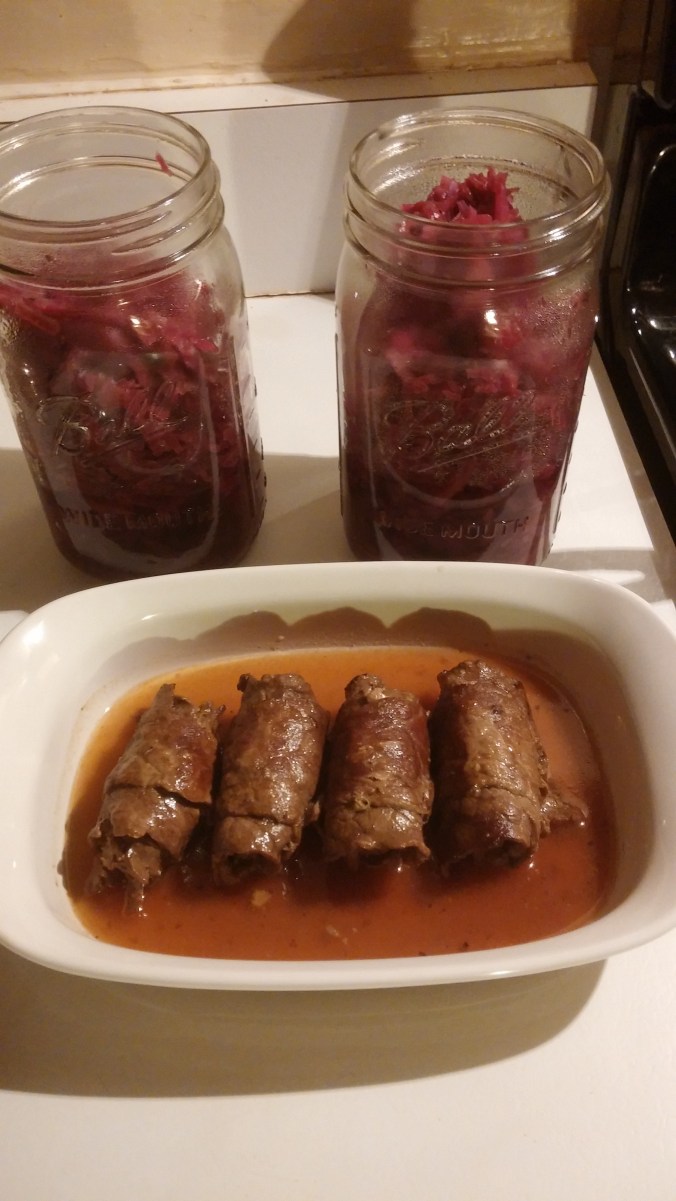
I was forced to recall the specifics. “Bricciole has bread crumbs and romano cheese and salt and pepper, and after you sear it in olive oil, you braise it in tomato sauce. And rouladen has pickles and onion and mustard and salt and pepper — best as I remember anyway — and it braises in its own juices.” Did I remember at that point that red cabbage goes well with rouladen? Not at all. Instead, I looked for the recipe for rouladen in my own cookbook, failed to find it there, failed to think of checking the internet for a recipe, and made the one he asked for (the rouladen) from memory. He pointed out a potential problem — that I did not have mustard — and I said Oh yes I do, in that cabinet over there. He said Those are empty, and we laughed at our different definitions of empty. There were three containers of mustard: one that said Dipping Mustard and therefore to Samuel was not mustard per se, and two (one brown and one yellow) admittedly not expelling mustard at a normal rate and in need of scraping the inside to retrieve enough, but there was plenty of mustard for this dish.

After carefully slathering the brown mustard on the filets of beef, placing (homemade!) pickles and thinly sliced onion in a proud row on each, sprinkling with salt and pepper, rolling, securing with a toothpick, searing in oil, adding a bit of water, covering the pan and lowering the heat, I walked away. Those rouladen will be yummy tomorrow, I thought. I checked my wordfeud, played some words, and smiled at funny and delightful texts I received. Some time later, I walked back into the kitchen, and there were the red cabbages, staring at me. Hello! Remember us??  We work well with rouladen!

Of course you do! I was taken in. Out came the knife, the pot. One by one I peeled off the outer leaves of the cabbage to start the process. Alas, a snail, a real live snail came into the picture. I got my phone to take its photo. But where did it come from?

I suppose I will never know, and this will remain among the Unknowables in my life. I’m ok with that, even though I just remembered that rouladen should also have bacon in it (how could I forget the bacon?). Still, I get to eat red cabbage and rouladen tomorrow! And it will be yummy!

rouladen and red cabbage.jpg


A voice of reason and … crackers!

Hankerings come in handy. Yesterday in the afternoon a colleague called me. “I have a personal favor to ask. I need about an hour of your time. Things with my daughter right now are…let’s just say…I need a voice of reason.” I said How about dinner? We settled on tonight.

Last week we had had a conversation about who pays for dinner when friends go out. We had agreed that the person who holds the ball and runs with it is the one who asks or suggests in the first place. I realized I did just blurt out How about dinner? A case could be made otherwise, but I owned this one.

The simplest, most straightforward thing to do would be to just go out. Most people would just go out. It would be good sometimes to be like most people. I might have been able to in this case if I had not had a hankering for crackers.

Crackers had been a lifesaver for me during a particularly demanding stretch of months some years ago when I was writing my book on my old laptop, comfy on the couch next to a good fire, poring over sentence and paragraph construction and dealing with the too-hot computer resting on my lap which was burning the tops of my thighs more and more as the fan in it became less and less effective over time. I remember the red marks. I graduated to using a pillow between my lap and the steady warmth. It was a happy day when I got a new laptop. Thank you, Mom and Dad!

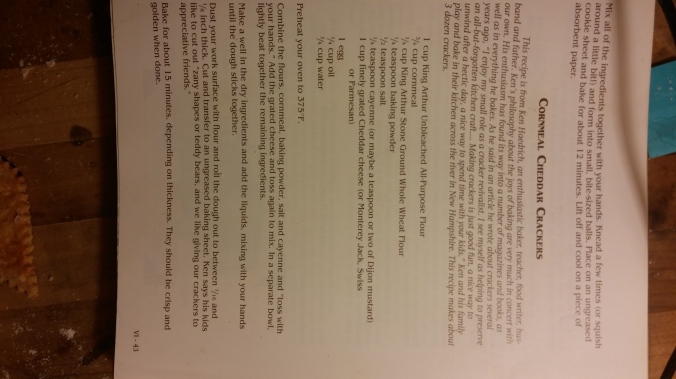
But not just any crackers. Back in the day I had been one of the lucky ones who got a first edition of King Arthur Flour’s 200th anniversary recipe collection in a smart three-ring binder. And one lucky day Ken Haedrich’s recipe for Cheddar Cornmeal Crackers on page VI-43 had caught my eye. Samuel had fatefully experimented with that recipe one day, found a clear winner (you never had store-bought crackers like these), and obliged himself henceforth to provide them as sustenance when I was too occupied with transcribing interviews or piecing together disparate pieces of text to have time to cook dinner. To be fair, he did enjoy cooking and did volunteer for this service. I will remember his willingness and skill fondly, always. The crackers hit the spot on numerous occasions before the book was done. I especially liked the darker ones — still do. When you make them yourself you can take them out of the oven at exactly your choice of the right golden color. Or you can tell the very kind and loving son who is making said crackers for you the exactly goldenness you are longing for, and he will take them out at the right time. Bless him forever.

For a long time after the book was done and after Samuel left home, I did not make these crackers. Fond as my memories of them were, it was as if they were his crackers, not mine, and I couldn’t bring myself to do it. I elevated them in my mind to a place where they downright intimidated me. My crackers couldn’t possibly be as good as his. One Christmas I hinted that he might fill a tin of them for me, and oh joy! He came through! But those didn’t last overly long, naturally, being as good as they are, and I finally realized that if I wanted these, I would have to make them myself. And did, now and then, over the last year or so.

So, dinner with a friend combined with a hankering for crackers. The grocery store is not far away, but I like working with what I have on hand. The recipe calls for cheddar cheese, but suggests you can also use swiss, monterey jack or parmesan. How handy that I had just — the very night before — grated (with the very fine grater) a hunk of parmesan enough to nearly fill a quart mason jar. The image of this jar in my fridge triggered my Brain of Debatable Reason to say Well, I’m halfway there already, so why not make crackers?Serve them with some good cheese, a few nice salads, a bottle of wine and a bit of chocolate for afterwards, and voila — dinner!

Anyway, I had had a rough day and there is nothing like getting busy in the kitchen as a means to decompress. I started with the cucumber salad because they were still warm from having sat still attached to their vines in the hot sun all day. Cucumbers don’t get fresher than this, I assure you. I grated them with the not-so-fine grater, layered it with salt and put the bowl in the fridge to cool.

On to the cracker dough. Having already grated the parmesan saved me all of five minutes in this process, but hey, we count our blessings. All I had to do was dump the contents of that jar into the bowl with all the other ingredients and carry on. Thankfully there was a bag of whole wheat flour in the freezer, which is of course where you keep it when you use it infrequently. I tripled the recipe and therefore did not have enough corn meal, but just put that much extra regular flour in instead. It worked out fine. Here is the recipe. I forgot the pepper but it worked.

0726162059.jpg

If you decide to make these, remember olive oil is the best. And add enough water (which might be a little more than the recipe calls for) to make the dough just shy of sticky. It has to hold together when you roll it out, and there is a fine line between too much water and not enough water. I tried a new way to roll these out this time to save myself time. It was, after all, 7pm already when I started all this. I cut two pieces of waxed paper as big as my sheet pan, laid them flat on the counter, floured the center area, and rolled the dough right on the paper. Then I was able to slide the whole big flat piece of dough up and over the lip of the pan, trim the edges, brush with beaten egg, cut shapes with my little zigzag wheel, salt them and pop it right into the oven.

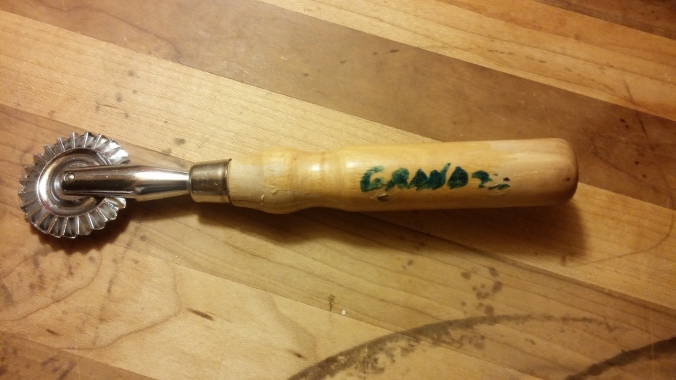
This is my cutter. My mother had marked it GRANDMA when she gave it to me because it belonged to my grandmother. You can see that the letters are wearing off, but that only makes it better.

0727160535.jpg

The recipe calls for a 375 oven, but as I said, I like them dark, so I bumped it to 400. Two of my three pans have the silicon liner,  which did not by the way affect the crackers or the clean-up in any perceivable way. Tripling the recipe gave me a lot of crackers. Having a lot of crackers is not a problem because 1. They keep. 2. They do not last long anyway. This is half of them:

0726162040.jpg

While the crackers were baking, I used the not-so-fine grater to shred the beets that Sandy had pulled from the garden the night before. They had been rinsed, boiled in water until soft (skins and all),  put in a bowl, covered with water and chilled until I decided what to do with them. It was handy that they were there waiting there in the fridge for such a time as this. I love sticking my hands in the water and easing the skins off. The beets are smooth as velvet underneath. Now shredded, they again sat and waited. Next thing was to squeeze the water from the grated cukes. It’s a good thing vegetables are patient.

I smiled as I thought about this upcoming dinner that would include cucumbers and beets from the garden made into yummy salads and crackers that brought fond memories. As I grated the veggies and squeezed the cukes and rolled out the stiff dough, I looked at my bare arms (it is summer after all), realized how much they were working, and thought This is how women burned calories in the old days. Who needs a gym when you have an agenda like this?  

Over the weekend, in my favorite grocery store in Charlottesville, Food of All Nations, I had bought two items that also evoked fond memories. Beemster is a hard cheese with little pockets of salt and sharp, delicious flavor. It used to be a staple on the cheese board during Villa Lunch at Keswick Hall. Quark is a German dairy product that makes the best cheesecake you ever had. It’s like a cross between yogurt and sour cream. This one comes from Vermont besides. Be still my heart.

0723161227.jpg

The word here is Providence. There is not a lot in my fridge, but there was Beemster and there was Quark. Slices of Beemster would be handy to go with the crackers along with Jarlsberg and Manchego. Quark would work in the dressing for the cucumber salad. Quark plus lemon juice and a bit of salt, pepper and sugar. The beet salad I dressed with olive oil, cider vinegar, salt, pepper and oregano which, shame on me, I did not go get fresh from the garden (it was dark by then, really).

Into an old tin went the crackers. Into a basket went said tin, two plates, two forks, two knives (for pushers), two wine glasses wrapped in white cloth napkins, a wine key, a bottle of pinot noir (always keep a bottle of red on hand), and a small cloth for the tabletop.Into the fridge went a small container of cut up cheese, a mason jar of cucumber salad and a mason jar of beet salad.

I am ready for dinner. There is a park in town that has a pavilion with picnic tables. It will be quiet there and hopefully a good atmosphere for good conversation.  I hope I can be a voice of reason for my friend. One could argue that I did not demonstrate much reason in the preparation of this dinner. It would have been easier to go out. But I had a hankering. 

Boys

It’s easy to think that by the time you reach a certain age (we don’t have to say what age) you have learned a few things. But to a point we are still trapped in our own experiences and our own understandings. As I recently came to appreciate anew, I am not a boy. I do not see or understand things the way boys do. I had four of them. I watched them closely for many years. But I am not one. And some things I don’t remember well.

Boys were coming to the cottage. Two boys, seven and ten. I did the logical thing and asked my 22-year-old son for help. “You are seven, and you are ten,” I began. But I did not get far.

“Mom, I’m not seven.”

Clearly my preface did not work, but I liked it, so I tried it again. “You are seven, and you are ten, and you are a boy.”

“Mom, I can’t be seven and ten at the same time.” He had a point.

“Samuel, work with me here. Pretend you’re seven or ten or both or somewhere in that range.”

“OK.”

“You are going to an airbnb cottage in the woods with your parents for a few days. What do you wish were waiting there for you? I mean toys.”

He did not hesitate. “G.I. Joes.”

“G.I. Joes?” Whose child was this?

“Sure. Soldier toys are the most classic toy.”

Laugh now if you want, but I did say a most female thing. “But won’t that make them want to fight and go to war and do nasty things?”

There was no hesitancy whatsoever in his responses. “They want to do those things because they’re boys.” This was not at all what I had expected from the conversation. It was not improving. I had to try to turn it around.

“But you don’t like those things.” Samuel likes reading and acroyoga and coffee. I thought I had him, but I didn’t.

I quote: “No, but I understand the appeal of weaponry, engines, fast cars and things that go boom.”

I expect I looked entirely disillusioned because it is how I felt. He continued. “When I was ten, my toys were in nonstop combat. Bionicles and legos.”

“Legos? You build with legos.”

“Mom, you fight with legos. Remember all those little swords and shields?” Could this get worse? Of course it could. “The only time they weren’t fighting was when I was creating things for them to fight with.”

I cringed then. I cringe now even thinking about it. There’s way too much nastiness in the world, and here was more evidence. Images flooded my mind of bloody, cruel, heartless people doing bloody, cruel, heartless things to each other and (most awfully) to innocents.

But he redeemed himself, and quickly, and gave the much-needed upside to all this horror. “As much as the war-faring genes allow for all that, they also allow for what stops that.” Hallelujah. Now we were somewhere more comfortable for me, and I could start to relax. Better images came to mind. I could think about bravery and strength and why some people make me feel safe. I could be thankful to live in a peaceful place, thankful for those who came before me and made it peaceful. It’s not Memorial Day or Veterans Day or any other day set aside for remembrance and thankfulness. Holidays like that are good. But I wish our moments of remembrance and thankfulness were not confined to them. I wish more people realized every day how very fortunate they are.

This was a completely unexpected outcome of airbnb cottage guests coming for the weekend. A seven-year-old boy and a ten-year-old boy were on their way. If they had been girls, I would not have asked Samuel for advice. One thing led to the next. Entirely without having any idea about it, the boys brought warmth, thankfulness and reassurance.  Samuel, in his own (roundabout) way, explained a thing so simply that it makes far more sense to me than it ever did before. He balanced the images. 

“How about if you choose what to put in the cottage for them?” I asked him. “All the old legos are downstairs, and other stuff. Whatever you think they would like.”

He chose a box full of matchbox cars. I put it in the cottage off to the side by the back windows. The guests arrived and I greeted them and welcomed them in. I did not point out the cars. It did not take even 30 seconds for the seven-year-old boy to find them and sit down on the floor next to the box and begin to make one of them go fast…

My galette

I never heard of a galette before yesterday, but my mom led me to think about it. We were talking about being stuck in a food rut, and that made me think about food. Thanks, Mom.

Some people, as they think about food, eat some. But yesterday was the kind of day when, as I thought about food, I wanted to make some. A week ago I bought a bag of plums — beautiful purple plums. I had a hankering for Pflaumenkuchen, a wonderful German plum cake made on a sheet pan. This is not your ordinary sheet cake, especially if you have 9×13 with gooey frosting in mind. This is a sweet yeast dough (like a giant, flatter hot cross bun without the candied fruit) rolled out to fit the big (true half sheet size) pan, then topped with sliced fresh plums and a crumbly streusel and baked till it is golden. Heaven.

Pflaumenkuchen  was on the docket. It’s very tasty, and it’s been a long time since I had it. The bag of plums sat patiently in the refrigerator all week, waiting, as perfect plums do, knowing that glory is to come. Then, surprise! Thirteen (13!) cucumbers appeared before my eyes when I went to the garden to get lettuce on Friday night.  There was nothing to do but pick them.

0715161842.jpg

You don’t need 13 cukes to make a cucumber salad for dinner. Two will do, and did. (And it is really easy to make, by the way: Grate the cukes, squeeze the water out, and mix in a bowl with half an onion, very thinly sliced. For a dressing use lemon juice, sour cream, S&P and a little sugar to taste.)

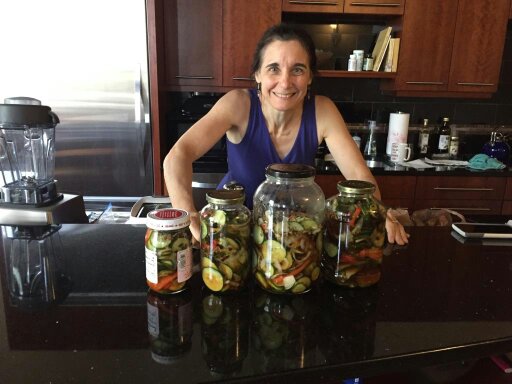
After dinner, eleven gorgeous cukes remained in a row on the counter, rejected for salad but nonetheless happy to serve. I know it is not what every person would think of when faced with this image, but what came to my mind was pickles. There was nothing to do but make more pickles. I’ve made pickles three times this season already, once at Millicent’s and twice at home. Last year when I made them with my sister Lynn, I discovered how easy and yummy they are. Thanks, Lynn!

Here I am with Millicent’s pickles. I would be surprised if she has any left.

1468764268777.jpg

Yesterday was beginning to look like a busy Saturday. I won’t get into the sewing, or the flipping of the cottage for new guests, or the long overdue brushing of Bridget. We’ll get right to the kitchen. I have a huge white Pfalzgraff bowl that I have used a thousand times. It is the only bowl for eleven sliced up cucumbers — one of which was a whopping 13” long on account of having hidden itself under massive leaves — all layered with salt and topped with super thinly sliced red onion. The salt draws out the water from the cukes and the red onion adds flavor and makes the pickles prettier in the jar. Millicent’s pickles had red pepper in with them, which is prettier than red onion in my opinion. But we work with what we have.

Whatever you do, don’t forget to put the sugar in the brine, which I almost did one time. Bread and butter pickles are not the same without the sugar, you can take my word. I remembered the sugar this time, and was grateful to Millicent for having gifted me with a jar of pickling spice last weekend in Charlotte.  So I had everything I needed, mixed together in a pot waiting for a flame: vinegar, salt, sugar and spices.

But you have to let the cucumbers sit a while in the bowl with the salt, and a person needs breakfast.

Three critical factors conspired and led me down The Road to Galette.

  1. It was Saturday.
  2. I was by myself in the house.
  3. Fine Cooking magazine came this week (thank you, John).

If it were not Saturday, I would not be sitting with a leisurely breakfast.

If I had not been alone, I would not have been reading while eating.

If that particular magazine had not come, I would have been reading something else.

This month’s issue has a wonderful article on both sweet and savory galettes, and wouldn’t you know, the featured sweet galette was “plum, ginger and poppy seed galette.” Well, well. So much for Pflaumenkuchen.

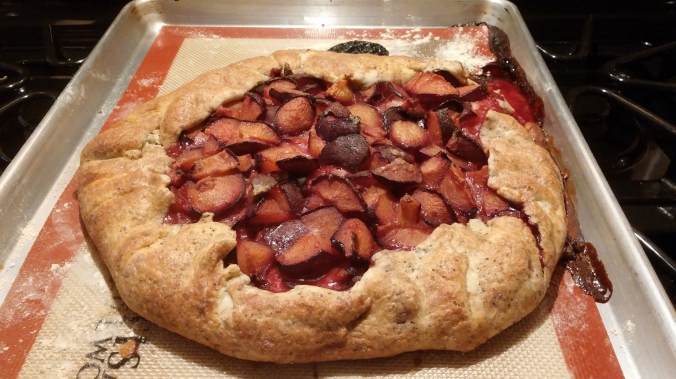
Seriously though, who ever heard of a galette? What is it? If you are a chef, you know these things. My chef friend Danny didn’t miss a beat when I told him what I was doing. “My favorite is an apple galette with a little almond paste in it,” he said. “But I love all of them.” The rest of us have a thing or two to learn. A galette is basically an open, free-form pie. You roll out the pie dough, lay it on a flat sheet pan that has a short rim to it (to catch any oozing goodness), put the filling in the middle of the dough, and bring up the sides any way you want, fancy or not (in my case clearly not). The dough holds (almost) everything in and has that tender/crispy/flaky combo going for it. In the case of “plum, ginger and poppy seed galette,” poppy seeds are mixed into the dough, adding a texture you don’t encounter every day, which pairs perfectly with the sweet plums touched with the flavor of ginger and cinnamon.

The pickles happened while the galette was baking and I was wishing for a bigger kitchen. Soon the jars were cooling and the aroma of sweet baking plums filled the house.

My galette is not as pretty as the one in the magazine, but for a first try, I was pleased. In fact I was so pleased that I immediately took a picture of it still on its baking sheet.

0716161650.jpg

Then I wanted to stage it better, so I slid the galette onto one of my favorite glass cake plates. I always loved the ring of hearts etched into the glass on the bottom of this one. In my mind, hearts = love. When you make delicious food, you present it with love to those you love. Anyway, this made a better photo.

0716161659.jpg

But it was a bad idea. I did this same thing a long time ago, but the lesson sat in a dusty file too far back in the recesses of my memory. I hereby pass along a simple rule to keep in mind in such situations: Don’t slide hot objects onto cool glass plates. Let’s just say it’s a good thing my mother, some time back, off-loaded some cake plates she no longer needed. The crack I heard a few minutes after the fateful transfer told me in an instant that henceforth there would be a shorter stack of cake plates in my cabinet. I then transferred the galette to a different, flat (metal!) surface and in we dug. Oh, how I wanted to share with everyone I love! Of course if they were all here, this one galette would not be enough. But that is a problem I would love to have.

This morning as I put the pickles in the fridge, I discovered two half-full jars of yeast, and proceeded to combine the two into one to be efficient with space. Two did not quite fit into one, however, and I had a little yeast left in one jar. Lo and behold, there was just enough for… a sweet yeast dough! I used the plums yesterday, so Pflaumenkuchen was out of the question, but while getting the vanilla for this delectable dough, the box of currants in the cabinet caught my eye.

These sweet rolls aren’t exactly hot cross buns, but with a little honey and butter, I am very happy. It’s a good weekend!

sweet rolls1.jpg

Sauce and cheese

This week I was reminded how words can mean such different things to different people, how easy it is to think someone else knows what we mean, how words are so little yet encompass so much.

Two little words: sauce and cheese. You know what I mean, right? I don’t have to say more. If you would look in my freezer and see a plastic container labeled sauce, you would know what is in that container and what it goes with. You would know how often I make it, how often we eat it and what else would be on the table with that meal. If we were at the table together and I was eating soup and I said This would be really good with cheese, and got up to get it, you would know before I returned to the table what I was getting. You would know what color it is, what has been done to it since it was purchased and how and where it is stored. We would understand each other, right?

When I was growing up, we ate pasta three times a week. We did not call it pasta. We called it macaroni. You boiled the macaroni in a big pot on the stove, and in another smaller pot you heated the sauce. On Wednesdays for dinner (5:00ish) and on Sundays for dinner (1:00ish because you ate Sunday dinner after church) we had our macaroni with a red, meat sauce, a.k.a. sauce. We had it so often that there was no need for modifiers. Seriously we ate this every Wednesday and every Sunday of my childhood. That’s 104 times per year x approximately 18 years, or somewhere around 2000 times. The very same meal.

My mother made sauce (not the sauce, mind you, just sauce) on a regular basis such that we were never out. It would be inconceivable to not have sauce ready to go on Wednesdays and Sundays. I am quite sure my mother would never have let that happen. The basic ingredients were the same every time, but if we had had a pork or lamb roast recently, she added these bones for flavor. Here is the recipe exactly as I wrote it many years ago when I decided it needed to be in my cookbook for reference. I did not need it myself of course. The recipe is etched in my mind’s file. But someone else might need it.

07021608201.jpg

This recipe is perfectly clear to me. You could follow it, right? You would know how many onions and how finely to chop them. You would know what chop meat means and what percentage of fat content was normal. You would know to put these first two ingredients together in a large, heavy pot over a medium flame and cook them together until the onions are clear and the meat is browned. You would know what size the cans of tomatoes are, what brand to buy, and whether they are whole, plum, chopped, diced or pureed. You would know what paste is, and how to get it all out of the can — even the parts that stick stubbornly to the sides — and why you need two cans of water per. You would know to dump all of this over the meat and onions at just the right time and stir it up. You would then know to add just the right amounts of s&p, garlic powder, oregano and basil. Strictly following tradition, it would not occur to you to use fresh garlic, oregano or basil. You would shake these out of jars you bought in the store and you knew the perfect quantities to shake and how big each little pile would need to be as it sat on top of the tomato-meat mixture in the pot. You would stop shaking when each pile was the right diameter and height. If you had leftover bones from a recent roast, you would add them in at this time. Then you would mix it all together and turn it down. You would know how low to turn the flame down, and you would let it cook for a few hours and walk away and do something else. You would know by the smell that it was done. The smell was normal. This was home.  Every Wednesday and every Sunday we had our macaroni with sauce for dinner.

On Fridays for dinner (5:00ish), being Catholic, we had our macaroni with a non-meat sauce, maybe red and maybe not. The non-meat red was called marinara and the non-meat other could be onion or ceci (you know what those are, right?). In my memory we ate all macaroni meals with a salad. We did not additionally (and it never occurred to me until much later that others might) eat long thin loaves of crusty white bread. On Sundays, however, you might also have meatballs (either softened from having been taken from the freezer and heated up in sauce, or crispy from having been freshly fried in oil) or a veal or eggplant parmesan or a roast (beef, lamb or pork) on the side. Thus the leftover bones that might go into the next batch of sauce.

Onto any of these macaroni dishes you put cheese. You put imported, finely grated, sheep’s milk peccorino romano stored in a little glass jar which had little holes in the chrome screw-on lid. This jar was stored in the cabinet, by the way, not the fridge. You turned this jar upside down and shook it, and cheese landed on your macaroni. At some point prior to the meal someone had taken the four-sided stand-up grater out of the cabinet and stood there holding the fist-sized hunk of cheese in one hand and the handle of the grater with the other hand, and with well practiced vertical up-and-down motions, pressing the hunk against the sharply perforated side of the grater, created tiny, slightly curly shavings of this ivory colored, aromatic, aged wonder. I did not think of it as a wonder. It was just cheese. Cheese went on macaroni. Macaroni had sauce.

The conversation about sauce came about because Samuel was fishing around in the freezer and found a container labeled SAUCE. What kind of sauce is this? he asked. What kind of sauce? Is there another kind? I see SAUCE on top of a plastic container in the freezer and I know exactly what is in there. But he doesn’t. Oh.

Can it be that he wouldn’t know what I mean when I use a simple word? I thought everybody knew what that word means.

What about cat?

House?

Party?

Surely he knows what those are. Surely you do.

Words evoke images. Do you have a lithe, grey feline in mind, one that snags large moths and bats them around until they give up? A white clapboard Cape Cod with three dormers set up on a hill with a large stand of maple trees behind it? A lot of well dressed people in a small room, holding fancy drinks and trying to hear one another above the loud music? Or do you imagine a tiger, a brick ranch, and a wild frat house?

This gets harder when the images associated with the words are not so concrete:

Honorable.

Divine.

Patriotic.

It’s no wonder we get tripped up sometimes. I am sure you know what I mean when I use certain words and you are sure I know what you mean. But do we really? John Durham Peters in his Speaking into the Air, says that there are hints and guesses in communication, which “at its best may be a dance in which we sometimes touch.” Thankfully we use lots of words to fill in the mental pictures, and usually manage to understand and be understood. Usually.

At least we are now clear about sauce. After Samuel fished it out of the freezer and I explained it and thought I knew what we were having for dinner, he asked another question: What’s onion sauce? Ah, onion sauce!

Chop three large onions. Saute them slowly (I mean slowly) in butter until they are soft and golden. This will take at least half an hour. Turn on the pot to boil the macaroni in only when the onions are almost done. In the meantime, finely dice that wonderful aged peccorino romano till you have a handful or so. Once the water is boiling, put small macaroni like ditalini in there with some salt and stir to make sure they do not stick to each other. When the macaroni is almost done, put the cheese in with the onions and butter. You don’t want to melt it, just soften it. Some ground black pepper and a little bit of cream in there with that rounds it out nicely. By now your macaroni is done. Put your colander over the bowl you will serve this in. Pour out the pot of boiling water and macaroni so that the water ends up in the bowl and the macaroni ends up in the colander (this makes the bowl hot, which keeps the food hot on the table longer). Dump the water out of your serving bowl, put the macaroni in there, top with the onion mixture and stir it all together. The word for this is divine.

Unboring defined

I walked out to feed the chickens yesterday morning and ended up with a clearer understanding of my unboring path.

There are now eleven chickens. We lost three when I started to feel sorry for them being cooped up in the coop all the time, nice as the coop is — even (one has to think) from a chicken’s point of view. Oh, let them out, voices said. Let them scratch in the dirt and find bugs and dust themselves in the sun if they want to. Give them The Life of a Chicken to Beat All. But place (any place) has its perils, as we may recall from the last post. I don’t know what got the first three, but let us assume a wandering fox or raccoon got lucky and slept that night on a very full stomach.

The fourth chicken may have met the same end, but I blame her demise on Bridget, my anomaly of a golden retriever. Whoever heard of a golden retriever that was anything but nice? Certainly she is mostly nice, but there are moments when she forgets her breed, when something else in her brain kicks in, and we have to bring her back to the norm, which is to say nice, which is apparently too much to ask on a consistent basis of this old rescue dog who endured in her earlier life only God knows what. Someday I hope I will again have a dog that is unequivocally nice. In the meantime it’s an imperfect world.

Bridget decided a few days after the now-twelve chickens were once more cooped that she wanted the hunk of bread that had been given to them, and pawed and gnawed at a weak area of the fencing and made a hole. How a bird got through that I cannot imagine, but clearly one did.

The now-eleven chickens of mine are the best-fed chickens in town. I bring scrap from the kitchen at work — leftover tomatoes and toast, carrot peels, squash seeds, etc. — and provide a frequent feast. Chickens, like most creatures, are seemingly oblivious to how good they have it, and carry on as if I am the average chicken keeper. As I deliver the pickle bucket full of goodies, they act like it’s run of the mill. Fine. I do not depend on their appreciation. We must just know we do good and keep on doing it regardless.

Ordinarily in the mornings I feed my [ungrateful] flock and put the now-empty bucket into my car and rinse it out when I get to work. But this time I chose to walk to the garden and use the water pump that Bradley and Beth thoughtfully put in the middle. It was a cool morning for late June in Virginia. Rain was in the air. I could not help but take a moment to look around at the various raised beds proliferating. I have to think whether I would describe them as proliferating beautifully or proliferating wildly. Either descriptor will do.

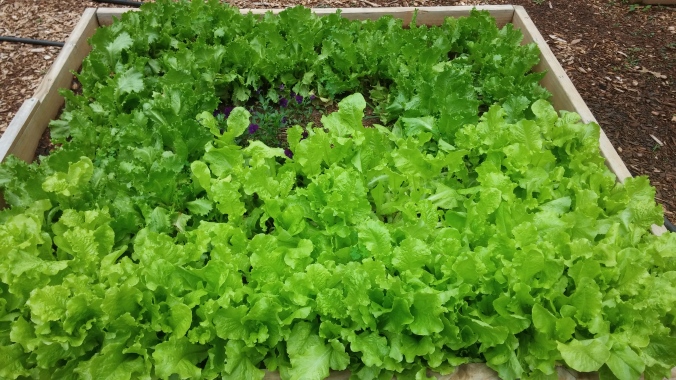
The lettuce catches my eye. Spectacular lettuce! We have been feasting on it for weeks and it just keeps coming. If you have not had lettuce fresh picked from a garden lately, you will have to remember how tender and tasty such lettuce is, though I served a salad to my friend Vernon the other night and his comments focused on the maple dressing instead. I was pleased just the same.

0625160846.jpg

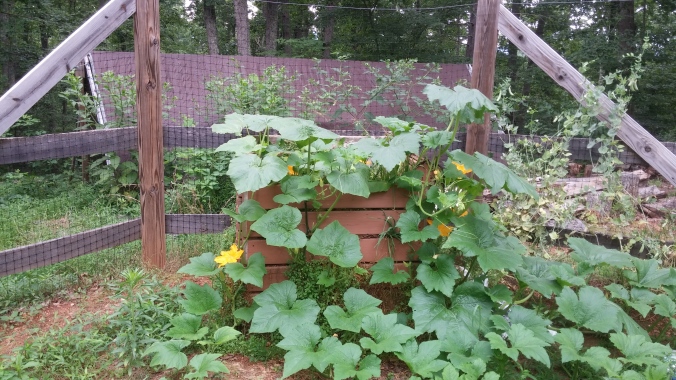
There is not much else in the garden I would call spectacular right now. The sugar snap peas and this planting of spinach are past. The catnip is ridiculously tall but I don’t need it. The cabbage, beets, peppers, tomatoes, eggplant and cukes are on their way. The onions failed. There is one volunteer squash of an unknown variety that has taken over the compost. Whatever it is (and I expect we will soon know), it loves its bed. These leaves might be called spectacular.

0625160846a.jpg

The beets need weeding. Some of the weeds have been food for Japanese beetles, some of whom are still munching. As I pull the unwanted plants out, I considered leaving them in. What if, after I remove the obviously favored weeds, the beetles go after the untouched beet greens instead? But the weeds make it a mess and my sense of order triumphs. Out they go, regardless of my not having garden gloves on, because of course I came to the garden not to pull weeds or admire the lettuce or assess the glorious (if wild) results of rain + sun + healthy plants.

This half hour — this sequence of feeding chickens (because I will continue to curry their favor with goodies even if they never acknowledge me) to cleaning buckets (because it was Saturday and I didn’t want them sitting in the shed until Monday) to admiring lettuce (because there is nothing else you could do with that, other than pick and eat it, which came later) to weeding the beet bed (because of my need for ducks in a row) to muddy hands (because of recent rain and my unwillingness to go get gloves) — might strike the reader as a lot of boring tasks and a lot of justifying boring tasks, but in fact this half hour represents a portion of my unboring path.

It occurred to me that I call this site “an unboring path” and presumed that would be self-explanatory, but maybe it isn’t. Using a somewhat unorthodox word, I mean just what you think. I mean the opposite of boring, the opposite of uninteresting (I suppose we could follow the pattern here and say un-uninteresting?), the opposite of dull. 

Tasks themselves are of course sometimes boring. Some people find baseball boring, or ironing, or reading technical manuals. I’m not talking about any one thing here as being boring or not. I’m talking about an enjoyable path, a richness, a fullness, a continuously evolving forward movement that you are joyfully and willingly engaged in through task, purpose, circumstance, feeling and decision. An unboring path is interesting, yes, but it’s interesting because you decide to be — wherever you are and as best as you are able — a part of what’s going on, involved. Interesting moments, ideas and experiences happen only sometimes by chance. They are also sought out or, when presented to you, chosen. They can lead to something new or something familiar. What matters is that you embrace your world, using what you have — your brain, your body, your hands, your heart, your time, your surroundings, your circumstances — to get the most out of life. What you have is partly of your choosing and partly not, an ever-unique, ever-evolving combination of factors that you help shape.  An unboring path is not about passing time or sitting on the sidelines. It is not about lamenting what you don’t have. It is embracing what you do have and getting in there and doing the best you can with that and enjoying every minute.

I barely began contemplating this idea when a large, stinging-type insect appeared on the screen of my window — on the inside — unsure how and unable (though valiantly trying) to get to the other side of the screen. The word for him is doomed. Soon he was, first by my hand feebly, then by Samuel’s more definitively, dead as a door-nail as they say. Why do we say dead as a door-nail? he asks when the deed is done. What’s a door-nail?

I have slowly acclimated to the ease of using a search engine to answer questions, though I still often forget how easy and handy this is. This time I did not think twice, but instantly googled door-nailThe first benefit of this search came in the form of the passage often associated with this word, the introduction of Marley at the beginning of Charles Dickens’ A Christmas Carol:

Old Marley was as dead as a door-nail.

Mind! I don’t mean to say that I know, of my own knowledge, what there is particularly dead about a door-nail. I might have been inclined, myself, to regard a coffin-nail as the deadest piece of ironmongery in the trade. But the wisdom of our ancestors is in the simile; and my unhallowed hands shall not disturb it, or the Country’s done for. You will therefore permit me to repeat, emphatically, that Marley was as dead as a door-nail.

An unboring path includes the unexpected. It’s June, not Christmas, but here you have it, a most famous passage about a door-nail. I am very familiar with it. Our local Shakespeare theater http://www.americanshakespearecenter.com/ performs A Christmas Carol every year, and every year I go there to see it if I can. George C. Scott in the film version is outstanding as well. I have heard this door-nail passage many times, and every time I do, I marvel at it. If you don’t find yourself marveling, read it again, slowly. Marveling will come. This short passage plainly and unexpectedly gives us the mastery of Charles Dickens: his cadence, word choice, imagery,  humor. Truly marvelous. Even in June.

An unboring path includes things you didn’t know before. We have now found out that door-nails were/are a specific kind of nail that 1. need to be hit hard on their heads repeatedly to get through the wood and naturally end up “dead,” and 2. were historically longer than the thickness of wood they penetrated and therefore had to be hit from the other side to knock the point into the wood so that there would be nothing sticking out to hurt anyone, rendering the nail permanently lodged in said door and henceforth unable to ever move (even if it were animate in the first place), or to ever be retrieved, or to ever be useful again (on account of its point being bent) even if it were somehow taken out, and therefore in these ways also “dead.”

In the search that produced the door-nail passage, Shakespeare was mentioned as not being the origin of the door-nail idiom, but the Bonus Facts part of the article included several other Shakespeare facts, including this one about his use of un- words.

Shakespeare is, in fact, the first known user of many words that start with un-. He was a fan of the prefix and attached it to words that previously hadn’t used un-. Examples include unhelpful, uneducated, undress, and unreal, plus some 300 other un-words.

After the chickens and after the garden, the stinging insect came unbidden, producing the door-nail question that unleashed Dickens and Shakespeare. I feel quite certain that Shakespeare would approve of “unboring.”

The peril of place and the beauty of Real

Every place you go, there is or is the possibility of something unpleasant.

Where I live it is sometimes humid. Most everyone thinks of humidity as something bad. One morning last year I was playing tennis with a woman from Tennessee. It was about 7:30, and shaping up to be a scorcher of a day. In Virginia that means mid-90s or so. This particular morning it was also humid, and we both were feeling it — but one of us not in the usual way. Of this I am certain because at one point, as we were energetically whacking the ball back and forth, she said to me in such a way as you would have to think she really meant it: “Don’t you just love this humidity?!”

I don’t usually stop the ball but I stopped the ball. “Did you just say you love humidity?” I felt sure I must have heard her wrong. She assured me she had indeed just said that. Well, aren’t humans the most unpredictable creatures? Whoever heard of such a thing? But to her, humidity is not a bad thing. “It reminds me of home,” she said, “and I like home.” Huh. Maybe a thing I always thought a negative doesn’t have to be.

Where you live, there might be the risk of hurricanes or wildfires or tornadoes. It might get to 20 below in the winter, or colder. Maybe the black flies buzz around your head for a few weeks in the spring or the Japanese beetles eat your garden produce. Maybe you do not walk through the safest areas on your way to work, or you have to listen to someone else’s music blaring from their apartment, or your taxes are really high, or there is no good bakery!

Black snakes are harmless but creepy, I grant. Twenty below is very cold. Black flies are irritating, humidity is sticky, and if you ask me, hurricanes, wildfires and tornadoes are downright scary. I am sure you have your own feelings about unsafe areas, bad music, high taxes and the lack of excellent bread.

Every place has its risks and annoyances. Every place has its quirks too. In two corridors of the hotel where I work, there are wide carpet runners going the full length of the space. All around the carpet there are beautiful old floor tiles imported from Europe to lend authenticity and character, which they do effectively. But during my tours I have fun telling guests that when the staff was doing the installation 20+ years ago, they discovered they did not have quite enough, meaning that under the carpet is plain concrete. Think about it, I say. You all have somewhere in your own homes where you know it isn’t perfect but you covered or patched or ignored it and said That’ll do!

The imperfection makes it real. Very often, when something is Real, it’ll not only do, it’s better.

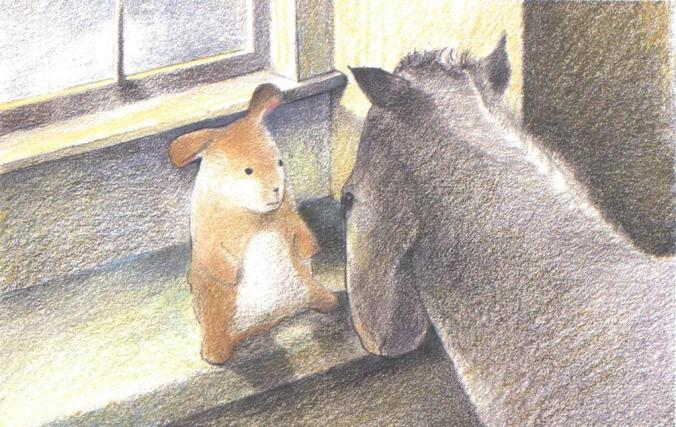
The very best description of Real that I ever read came from Margery Williams’ version of The Velveteen Rabbit. In it, the Rabbit is feeling troubled, insecure and out of place, and the Skin Horse comes along to comfort him.

velveteenrabbit-page-001.jpg

         The Skin Horse had lived longer in the nursery than any of the others. He was so old that his brown coat was bald in patches and showed the seams underneath, and most of the hairs in his tail had been pulled out to string bead necklaces. He was wise, for he had seen a long succession of mechanical toys arrive to boast and swagger, and by-and-by break their mainsprings and pass away. He knew that they were only toys and would never turn into anything else. For nursery magic is very strange and wonderful, and only those playthings that are old and wise and experienced like the Skin Horse understand all about it.

         “What is REAL?” asked the Rabbit one day. “Does it mean having things that buzz inside you and a stick-out handle?”

         “Real isn’t how you are made,” said the Skin Horse. “It’s a thing that happens to you. When a child loves you for a long, long time, not just to play with, but REALLY loves you, then you become Real.”

         “Does it hurt?”

         “Sometimes.” For he was always truthful. “When you are Real you don’t mind being hurt.”

         “Does it happen all at once, like being wound up, or bit by bit?”

         “It doesn’t happen all at once. You become. It takes a long time. That’s why it doesn’t often happen to people who break easily, or who have sharp edges, or who have to be carefully kept. Generally, by the time you are Real, most of your hair has been loved off, and your eyes drop out, and you get loose in the joints and very shabby. But these things don’t matter at all, because once you are Real, you can’t be ugly, except to people who don’t understand.”

         “I suppose you are Real?” And then he wished he had not said it, for he thought the Skin Horse might be sensitive. But the Skin Horse only smiled.

         “The Boy’s Uncle made me Real. That was a great many years ago; but once you are Real you can’t become unreal again. It lasts for always.”

         The Rabbit sighed. He thought it would be a long time before this magic called Real happened to him. He longed to become Real, to know what it felt like; and yet the idea of growing shabby and losing his eyes and whiskers was rather sad. He wished he could become it without these things happening to him….

Just like weather and insects and corridors and Rabbits, places are real. Home is real. Like the woman from Tennessee, I like home. I’ve always liked home. I have lived in four states and spent some time feeling quite at home overseas as well. Not a single place has been perfect. I know this. I accept it. Every place has something about it that must simply be tolerated.

But perhaps I did myself a disservice when I wrote a few weeks ago about the black snake. Worse was adding a photo of the fellow. Today I received a note from a dear friend who does not live locally. She said, “If I could get that picture of the snake in front of the cottage out of my mind, I might consider driving down to see you!”

Oh dear. This is a little bit like the proverbial opening your mouth and inserting your foot. I did post that. And I cannot take it back. But as I think of it, I don’t want to. Illusions are pretty and clean and perfect, and they look great on magazine pages and in films, but our everyday worlds are clearly imperfect and we all know it. Occasionally, the Midwest gets a tornado, the Northeast gets a blizzard and the West gets a drought. Occasionally, my mother in New Jersey sees a black bear scampering across her front lawn and my son in San Francisco deals with street crime. This week, my sister in Phoenix is trying to keep cool in temperatures well over 100 degrees Fahrenheit.

Somehow we all manage. Somehow we sidestep (literally perhaps when it comes to critters) the inconveniences and imperfections of the places where we live. Somehow I deal with the occasional black snake, even if I don’t like it (and let there be no illusions — I don’t like snakes!). But in a world that’s Real, somehow we get by. The lucky ones — some would say the smart ones — do more than that. The lucky and smart ones are like the Skin Horse. They prefer wisdom and grace and they gladly (if sometimes reluctantly at first) accept the various imperfections about their worlds and themselves. They understand that regardless of its downsides, imperfect is better. Imperfect is Real.