The New Chicken Coop Starts to Take Shape

Whenever you venture into anything new, it can’t be all new. You always take yourself into it, and you are not new. You are well established. You know what you like, what you feel comfortable with, how you envision the outcome. You proceed with energy, intelligence and peculiarities as per your age, health condition and background. You work with resources you’ve either earned or been gifted, and with people you know, who in turn have their own well established set of norms. As Carly Simon put it (specific context of that song aside): Nobody does it quite like you!

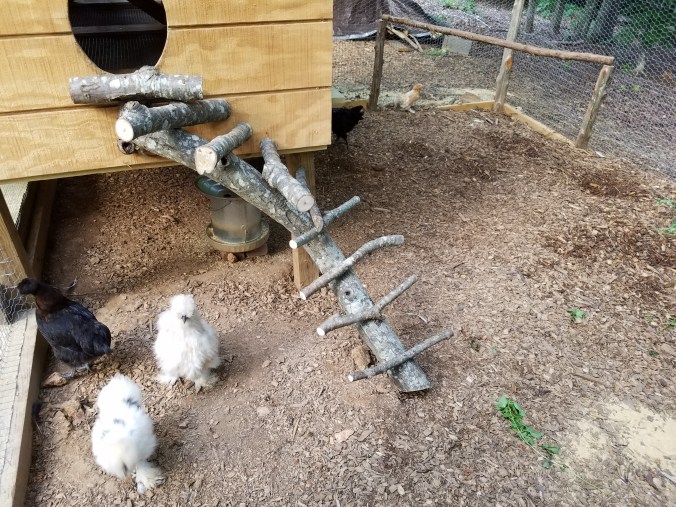
Or like me. And thank God. Isn’t the unending variety of outcomes unendingly unboring? There’s nothing that says a chicken coop (or anything you make) must be unique — you can buy cookie-cutter chicken coops, and there is a place in the world for those — but I’m glad mine is unlike any other. The unique combination of ideas, skills, time, resources and energy, to say nothing of the site itself, all played into the original design and subsequent creative touches that make it one of a kind. I mean, how many chickens can enter their coop through an egg-shaped door by way of a ladder that looks like this?

20180617_190404.jpg

Sandy gets all the credit for the idea, design, retrieval of branches from the woods, angle cuts to make the edges fit against the coop, good cheer throughout (who can’t smile looking at this?). But I am getting ahead of myself.

You start with basics, the basics of construction that other people have done a gazillion times before. The goal here – building a chicken coop – can be accomplished (or at least you can start this way) by doing what many people do when they want to do something and want to get familiar with it: Watch a YouTube video. Well, maybe more than one video. There are some great ideas out there, and no one has to reinvent the wheel. Just as we can do with cooking or exercising or gardening or anything, we take ideas from different people and make our own thing.

We also look at those guys and we say That’s not rocket science. And we gain some confidence and start to play. Besides confidence, we get all kinds of useful info: Trays that slide out for easy cleaning of, you know, chicken poop. Rocks around the outside perimeter as an extra measure against digging predators.  Watering and feeding systems. An egg-shaped entrance for the birds!

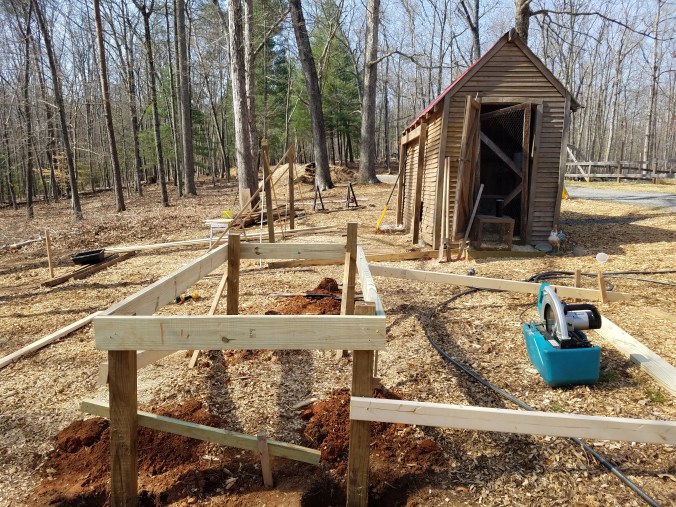
But let’s keep it simple. Plywood comes in 4’x8’ sheets. Seems like a good size for a coop. How we got to 4’x8’3” I am not quite sure, but I think it happened during the initial setting of the posts. I’m here to say that setting four posts in the ground — such that they are correctly positioned (in relation to the existing coop), level, square and plumb – may not be rocket science, but it is harder than it looks. That alone took three of us pretty much all of one day.

20180413_102303.jpg

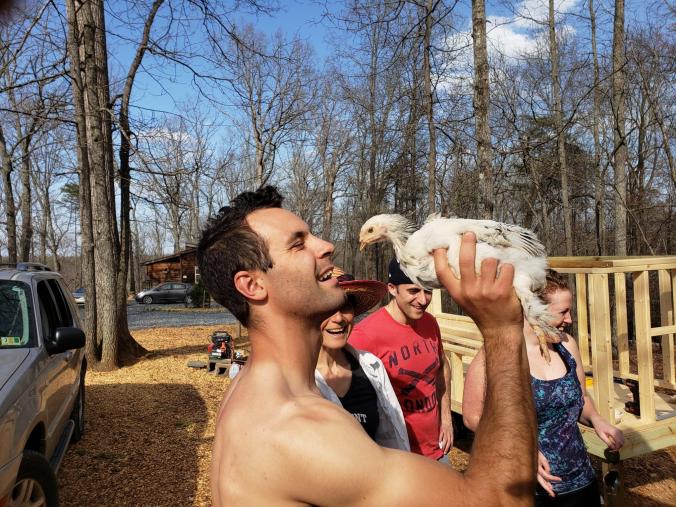
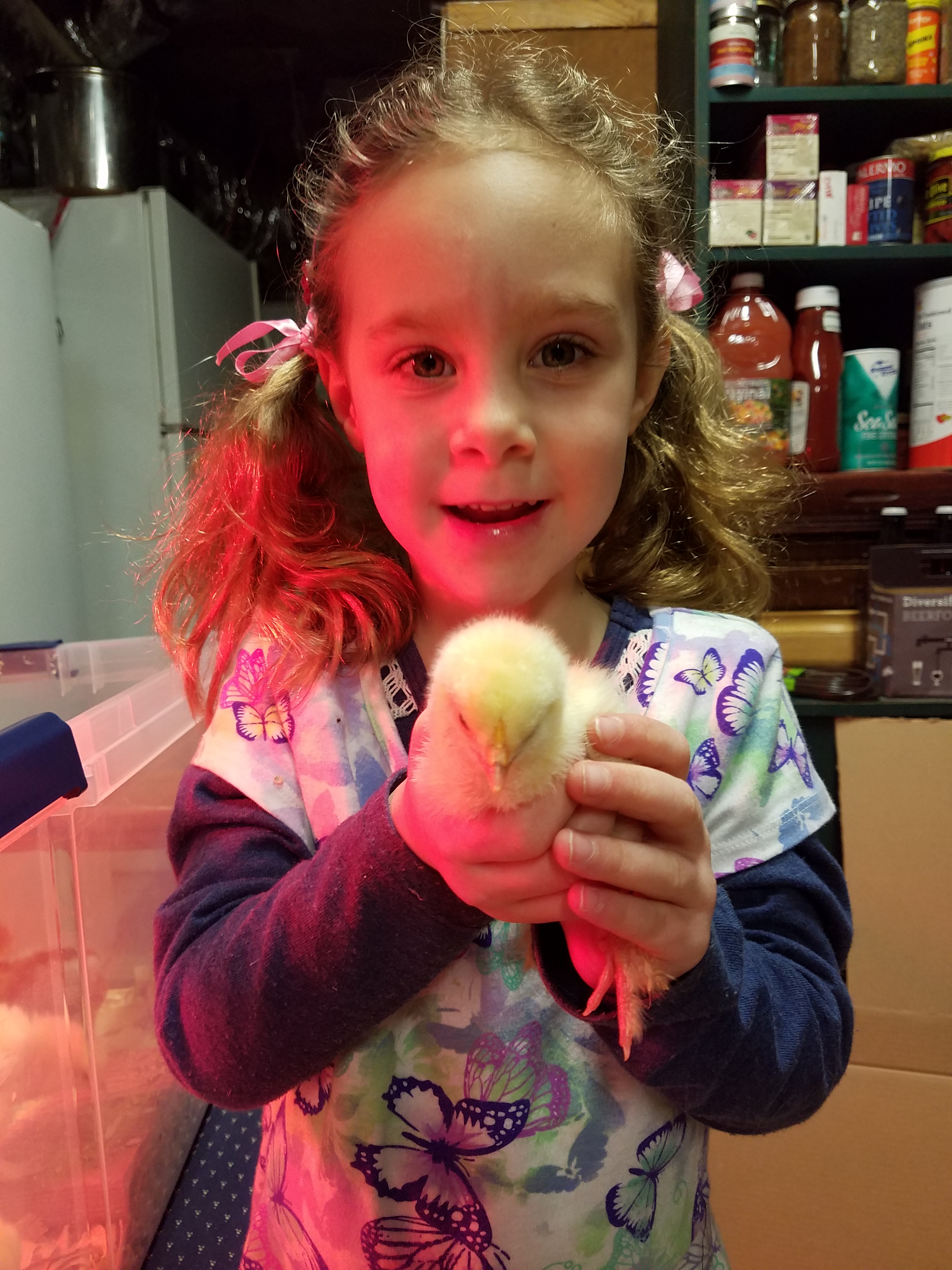
It’s a bit nerve-wracking, but eventually you get it. Once it’s in place, you sure don’t want it to move, so you start mixing cement for the holes and you throw in a bit of prayer! I look at this picture now and I am amazed that 1. I did not get discouraged, and 2. I thought this was a weekend project! (Which is maybe why I didn’t get discouraged – how our inability to see the future serves us well sometimes!) It’s a lot of work, yes. But those chicks were in the basement and getting bigger every day and they had to get out of there, sooner rather than later. Look how big!

34481.jpeg

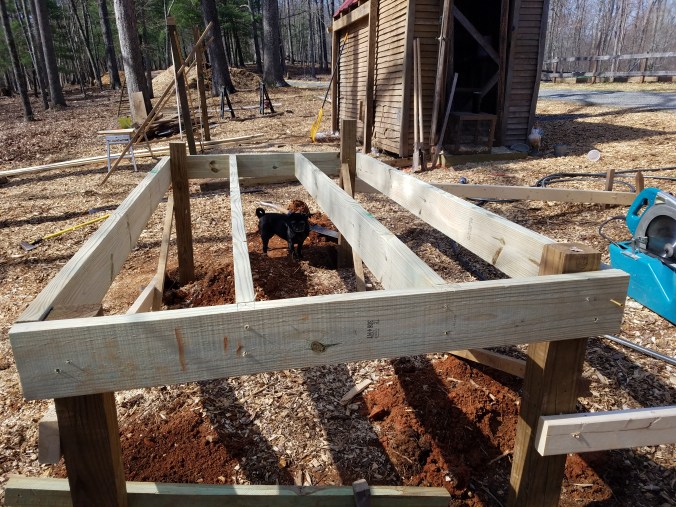
One step at a time, as they say. Or in this case one cut at a time, one screw at a time. The number of cuts, the number of screws – not only the permanent ones, but also the temp ones that braced the structure while the cement set – caused me to step back in time to when a person would have to make each cut with a handsaw, screw in each screw in with a screwdriver. Imagine. How good we have it! And onward we go. Plumb, square, level and with joists.

20180413_103111.jpg

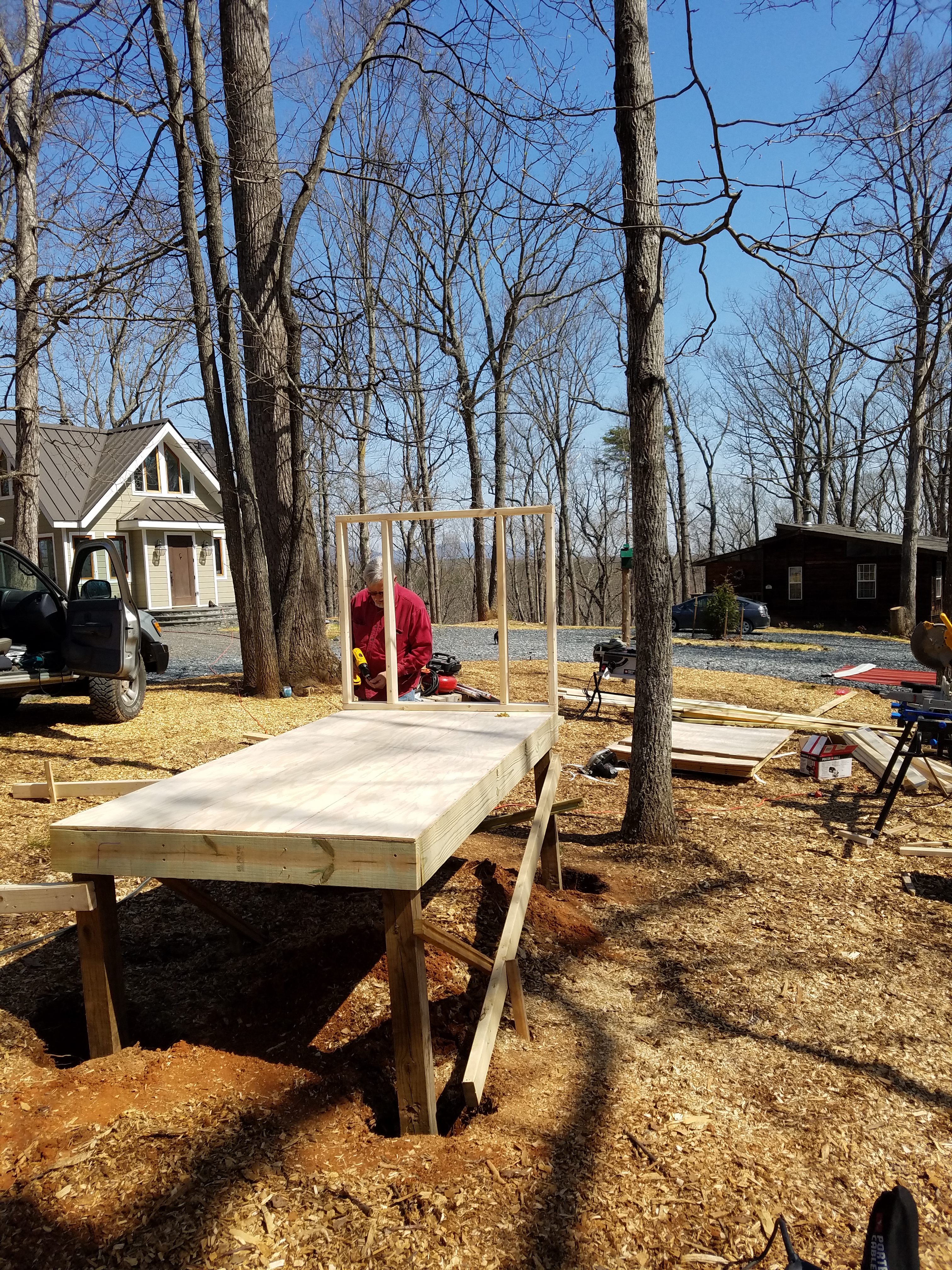
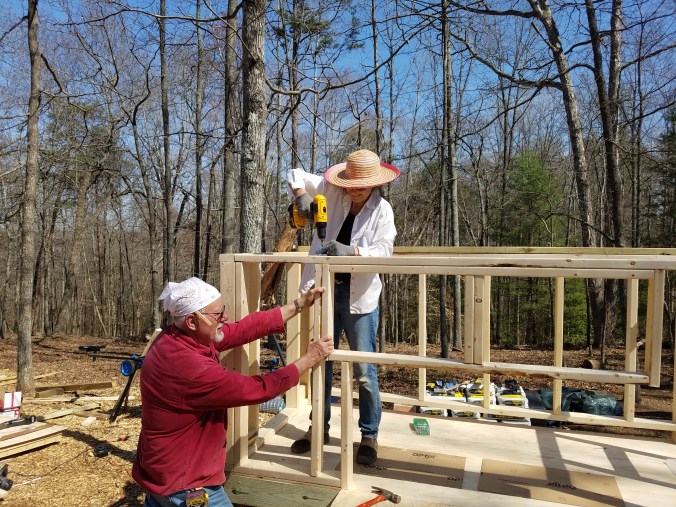
The next time we were all free to work on this, maybe two weeks later, came the platform. Now we can really start to see it. This is Henry putting up the first wall. He’s framing out an access door on that end.

20180413_112022.jpg

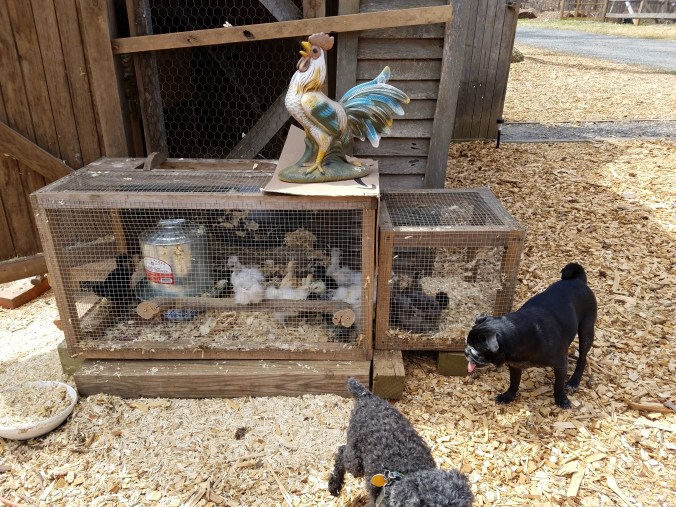
The weather was so nice, perfect for this work (no bugs yet!) but the chicks had been in the basement for over a month now and it was starting to smell, so we decided to bring them outside. The dogs were highly entertained. Who wouldn’t be? What are those fluffy things?

24.jpg

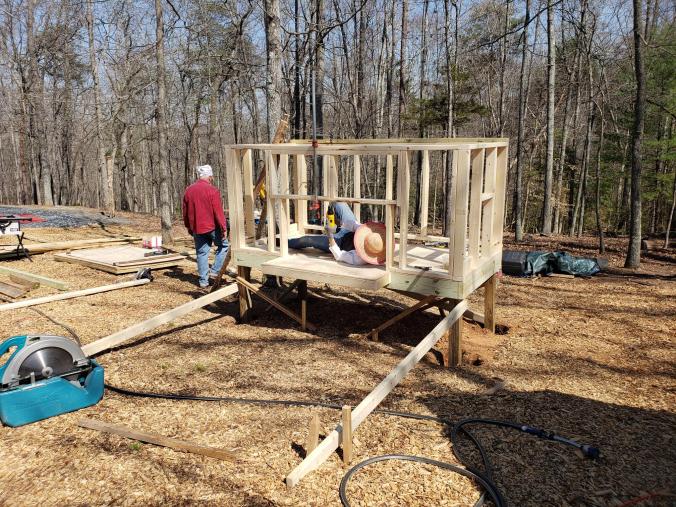
The walls were next. The excitement of seeing it take shape really does keep you going.

20180413_151205.jpg

34278.jpeg

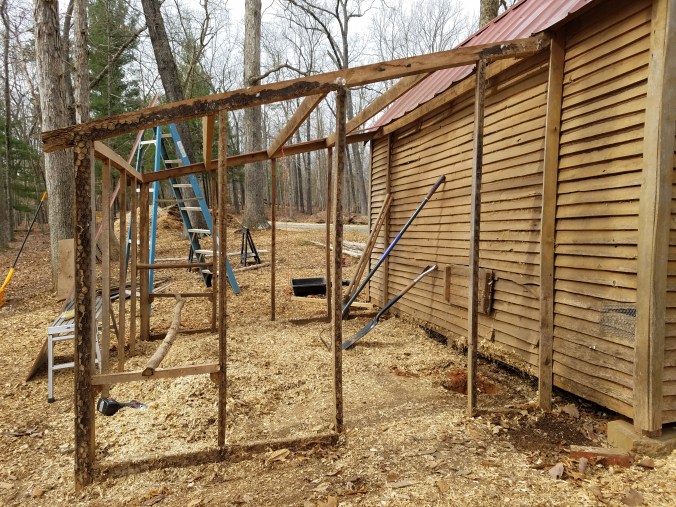
On the front side, where the floor sticks out a bit, will be the brooding boxes for the hens to have their privacy while laying. Centered above that are the openings for two plexiglass windows  so that we all can have the pleasure of seeing chickens on the roosting pole inside. (That is, if we can ever get them to go in their luxurious coop!) On the back side, between the platform and the horizontal 2×4 just above it, will be a long, horizontal flap of a door to get to the trays. On the near end will be the egg-shaped door.

Right, it’s not overly comfortable trying to use a heavy (heavy for me) cordless screwdriver when you are in an awkward position. But see, good weather, good friends, good eggs someday…


Dismantling the Old Coop Run

I live in the woods, surrounded by giants. I always guessed that the oaks were about a hundred feet tall, which is deemed “somewhat tall” by tree standards. A hundred feet is in fact the average height for a mature white oak. Watch them sway in a strong windstorm and somehow they feel even taller. Mixed in with the oaks are beautiful beech trees, some also gigantic in my estimation, and cedars with their beautiful purplish wood.  As happens in the real world, the strong crowd out the weak, blocking the sun, hogging the nutrients, leaving the struggling underlings often spindly or dead. One can ponder the parallels to our human existence while at the same time noting Hey, that dead cedar would make a good pole!

Thus the poles for the project were acquired, trimmed, propped up off the ground, and left waiting for their new useful purpose. If a tree could have preferences, I like to think it would rather be a pole for a chicken run than left to rot on the forest floor.

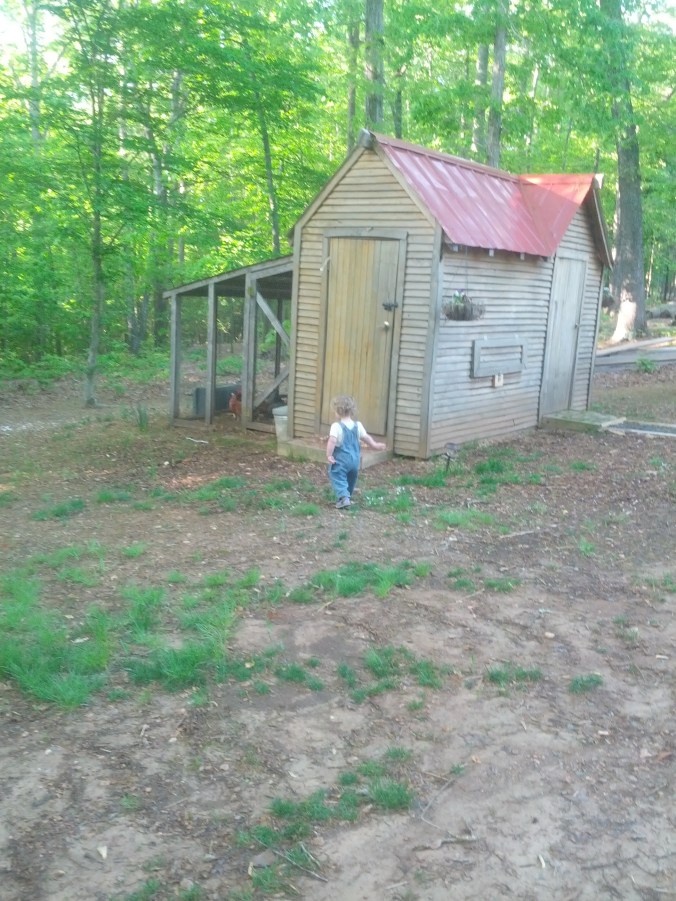
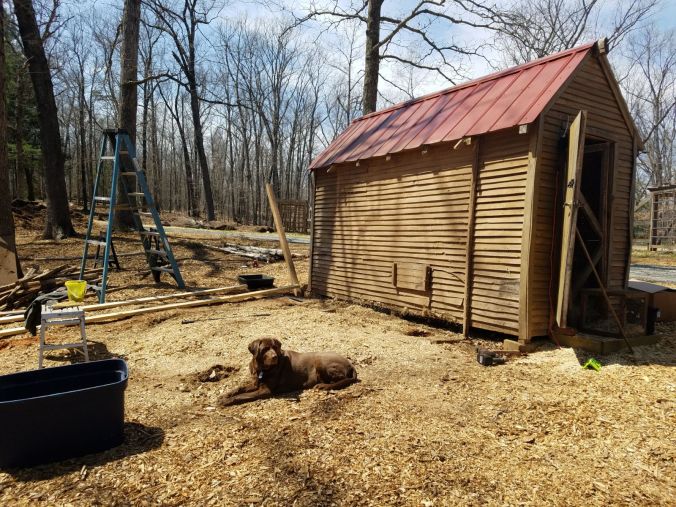
While in this early stage, I could not help but notice (and begin to accept the implications of the fact) that the project necessarily involved replacing the old coop’s run with a new run. This is the coop four years ago before the chicken wire became brittle and predators got in and we had to cover the lower half with lattice to protect the birds. Bradley and Lincoln had used oak they milled from trees on the property to build it, and I loved every aspect of it, but time and weather and bugs do their thing.

That’s Rise toddling toward it, seems like ages ago.

Rise at chicken coop.jpg

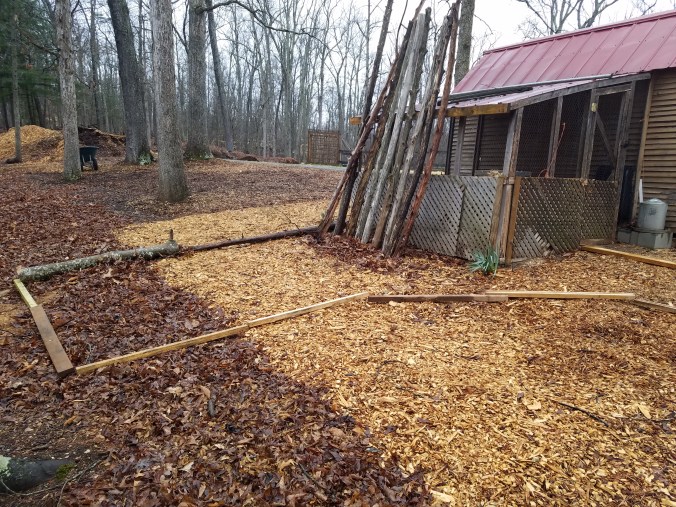
When you are going to build something, you have to ask yourself: How big do you want it? After some experience in these matters, you know that there are two questions you don’t want to ask yourself when it’s done: 1. Why didn’t I make it bigger? and 2. What was I thinking!? So I took some logs and 2x4s and roughly laid out the dimensions of the new coop and runs.

20180407_080414.jpg

My ambitions were kept in check (thankfully) by the fact that the new run – to be attached to the old coop, to be attached to another new run and the new coop — is adjacent to the forest with its giant unmovable trees that defined the space. I am grateful that some decisions are not up to me.

So that we have our terms straight, the coop is the wooden building that houses the chickens at night and where they go to lay their eggs. This assumes the chickens are smart enough to go inside at night, which is debatable sometimes. In any case the run is the area that extends from the building, a partly sheltered enclosure that gives the birds space to move around in the fresh air, scratch for bugs, dust themselves, look busy. The run has to be enemy-proof, i.e. fox-proof, hawk-proof, raccoon-proof, owl-proof, coyote-proof, even nasty-neighbor’s-dog-proof. A run is essentially poles surrounded by wire fencing, but predators also have claws so you have to dig a trench and sink the wire into the ground so they can’t tunnel underneath. We’ll come back to that fun part.

By the way, if you have not seen a chicken dust herself, come visit sometime. It’s part of the entertainment here.

The poles and the layout were as far as we had gotten by the time we got the chicks in March. Remember how cute they were? (Your decision if I mean the little chicks or the little girls!)

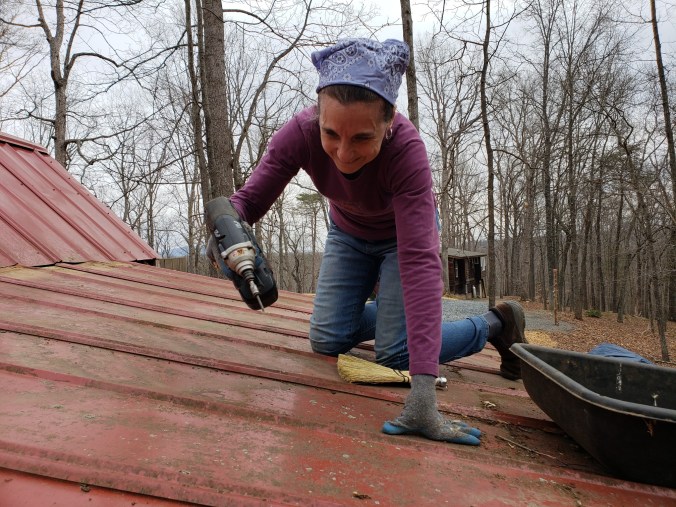
So the old coop would remain but the old run with its sheltering roof had to be entirely dismantled. The supports were badly rotted, though I did not know the extent of the rot till later, so I climbed up there and, with a great deal of encouragement, got familiar with this tool and unscrewed the metal roofing.

34160.jpeg

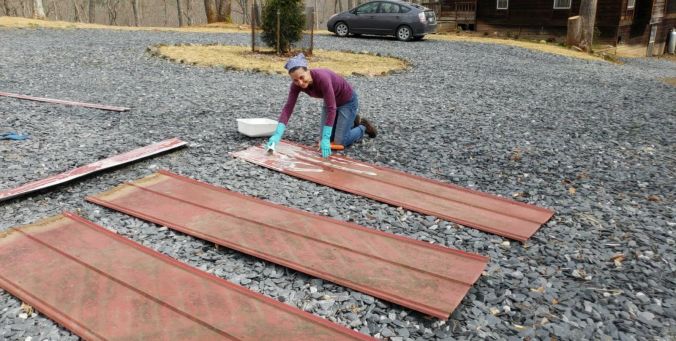
Roofs that sit under a forest canopy get dirtier than you think. Seven years of leaves and sticks falling on it, plus some decomposition, growth of moss, etc. make it not so pretty. I have to say I quite enjoyed this task though because in no time at all…

IMG-20180413-WA0003.jpg

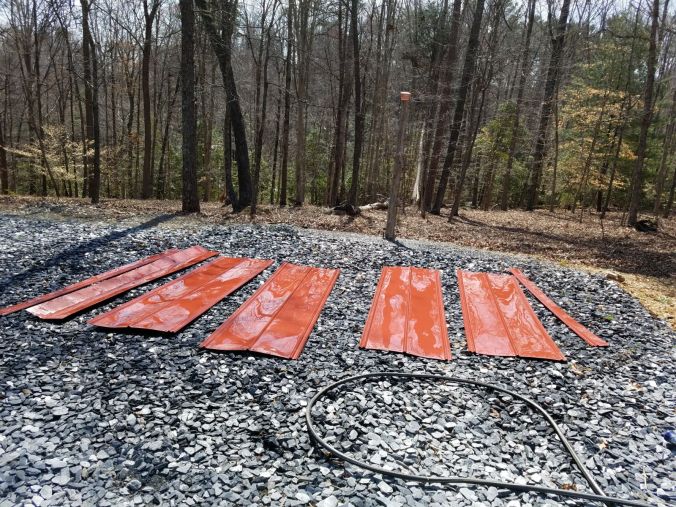
…look how shiny! Metal roofing is amazing! It was like brand new after its scrubdown and rinse.

IMG-20180413-WA0004.jpg

In the meantime Sandy was taking the old framework down.

20180412_101342.jpg

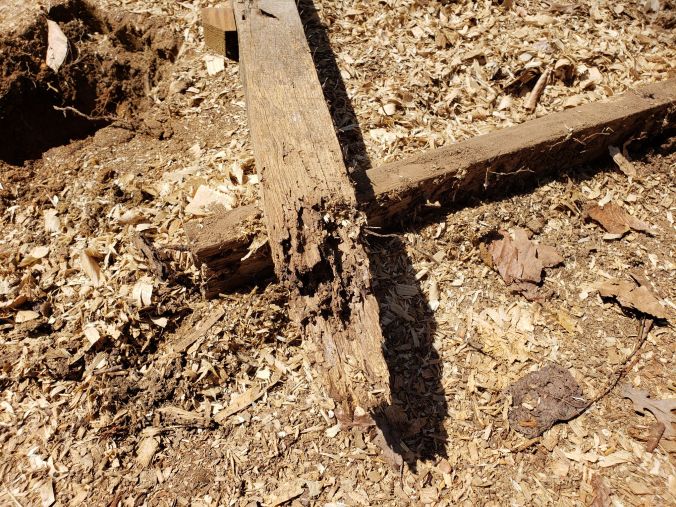
It’s probably good I didn’t know how rotted these boards were when I was up on top. But down they came. Good call to replace them, wouldn’t you say? Surprisingly, some of them came in handy later.

34285.jpeg

The documentation of this project makes me realize how involved it was. Once the old run was gone, we had hardly begun!

IMG-20180413-WA0001.jpg


A New Coop There Must Be

All I wanted was to have fresh eggs again. Just a few hens, enough eggs to keep up my supply and have a few to give away. The remaining three birds from the last batch were over two years old and for reasons unknown not producing. I tolerated their freeloading for a while, then tried to give them away (to a good home or a pot somewhere, I don’t want to know). The weather in Virginia is nice for chickens, especially in the fall, so I let them free range more than usual, figuring nature could take its course. When it was two down, one to go, I went soft and kept the last, resilient old gray cooped up all winter. It’ll get nice again, of course, I thought, and then I’ll get some newbies and deal with integrating them.

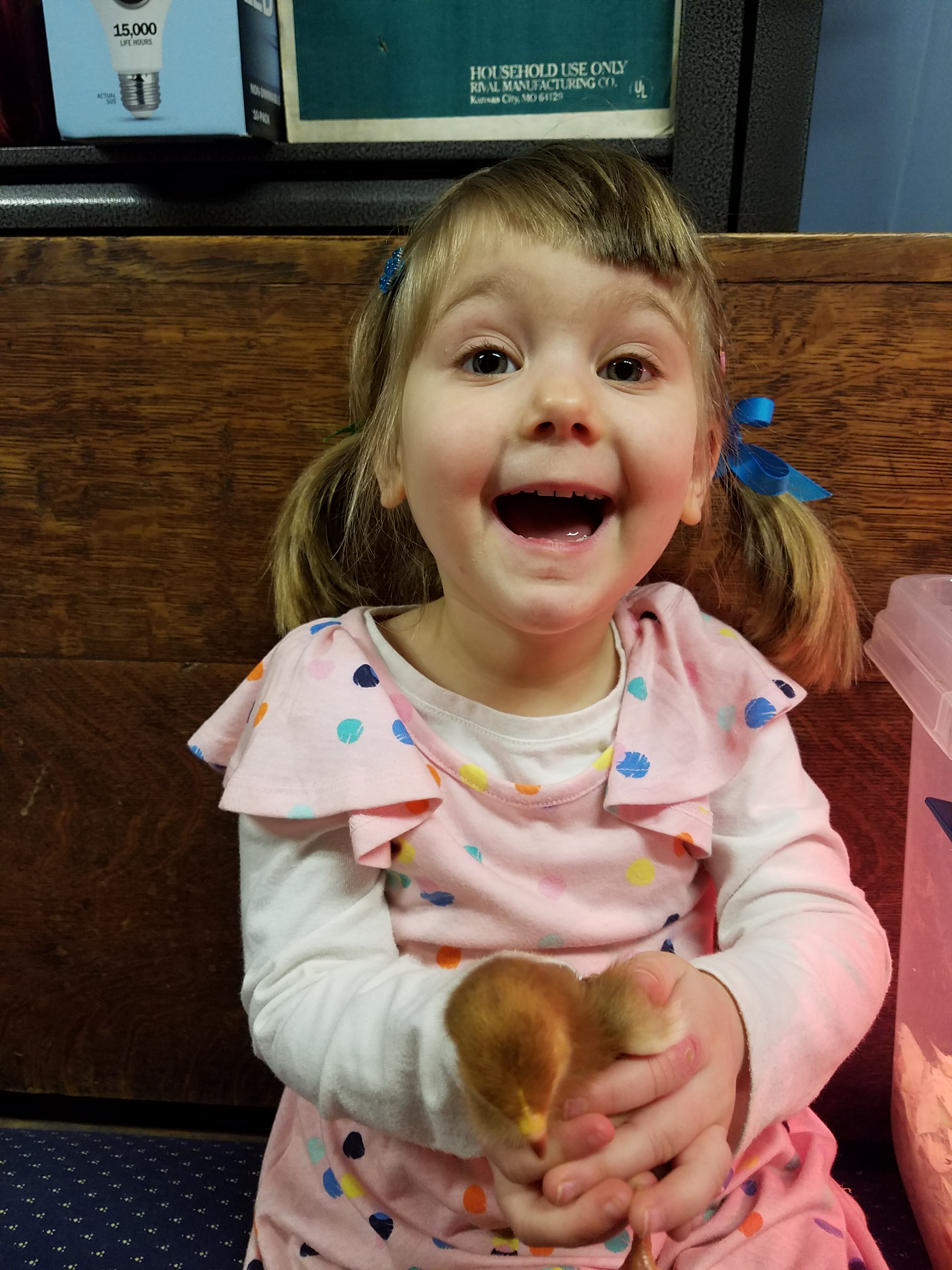
March came, and with it, my granddaughters Rise and Eppie (aged 5 and 3) – a perfect time to get chicks. The day after the girls came, we drove to Crozet to get five silkies and six brahmas and to Southern States to get six Rhode Island Reds. The next day we stopped in Tractor Supply, unintending to get any more, but the name got me: Cinnamon Queens. Their heads had a swath of color like a chipmunk, which I admit is no reason to buy them, but the two little girls were staring alternately at me and these adorable little creatures, so yes, we left with four more chicks. Seems like enough, don’t you think?

This is Rise with one of the brahmas. I hope she never forgets when Oma got chicks!

20180307_104035.jpg

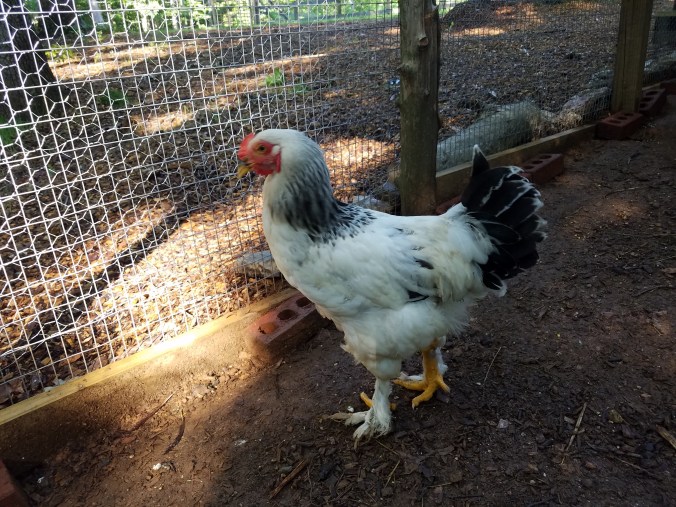
How did that fluffy little chick got to be this massive chicken? (Turns out three of the six, including this one, are Brahma Boys and therefore need a new home, which I’m working on, sorry, fellas.)

brahma rooster.jpg

And here’s Eppie with a face only she can make.

20180307_105026.jpg

My friend Sandy was very helpful with the set-up – the shavings, the heat lamp, the various ways of keeping these jumpy little birds from getting out of their designated space. I should have paid more attention, however, when he told me about his friend who had other kinds of chicks and how pretty and interesting and special they were. I had a lot going on with my own chicks in the house, two delightful little girls here, etc. Next thing I knew, Sandy showed up with a dozen more: four D’uccles, three black copper marans, a silkie/Easter egger mix, a bard rock/silkie mix, a maran/Easter egger mix, and two other beauties of unknown heritage.

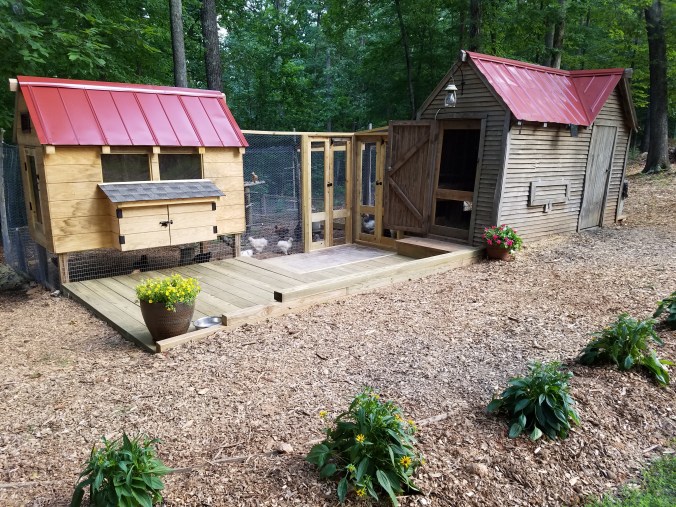
This is a lot of chicks. You do the math. I’m too embarrassed. No way were these going to fit into our existing coop. We’ve had 15 in there, but not (gulp) that many (did you add it up?)… Plus, Sandy’s batch, which we combined with the silkies, were considerably smaller than the brahmas, reds and queens, happily chirping away in a separate enclosure. It slowly began to dawn on us that a new coop would solve the problems that might occur if we tried to integrate the Smalls with the Bigs. Note that two coops was not part of the original plan. All I had wanted was fresh eggs again.

Stay tuned for how the new coop took shape.

new coop.jpg


Patti LaBelle Rocks the House

Mom and I went to see Patti LaBelle in concert at the Paramount. The extraordinary, powerful, beautiful quality of her voice rocked the house. God blessed her with that amazing voice, and bingo, success. Right?

Listening to her made me think about what she had going for her in the first place. We’ve all got to start somewhere. We’ve got to have something to work with (and most of us, if we’re honest, know that we do).

Patti LaBelle started with that voice. And at some point I bet she said to herself something like, “I want to sing in front of an audience,” and proceeded to take steps to make that her reality. I am sure there were obstacles and challenges along the way that she did not anticipate. Probably a bit of luck came into play as well, and some supportive people, and I bet she worked hard when she would have rather taken it easy. She has no doubt had her own limitations, setbacks and heartaches, but at 73 is a phenomenal example of someone who kept going, doing the thing she loved over and over till she makes it look easy, giving a gift — the gift of her voice — to the public countless times. I stand in awe.

When you look at people like this — people with incredible talent, a loyal and highly competent team,  seemingly boundless determination, vibrant energy — it’s easy to feel like Yeah, well, I could never be like that. It’s true. I will never be like that.

For one thing, there is only one amazing Patti LaBelle. We each walk a different road. But she did not get from being a young woman with a dream to being a highly successful, well known performer overnight. She got there one day at a time using the same 24 hours each day as everyone else has. She used them to build something good for herself and for others. She did not sit back waiting for things to happen that would further her dream, but instead “took the bull by the horns,” as we used to say.

I wish more people would look at what she did over time and continues to do every day instead of at what she has as a result of what she did over time and continues to do every day. Look at the action — and the determination, support and character defining it — instead of at the outcome. Look at the journey, admire the journey — not just the end point. For me, that outlook makes her performance so much fuller and richer.

Habits of Good

My cousins Matt and Austin grew up in New Hampshire playing hockey incessantly, or at least that’s how it seemed to me. Every time I visited, one or both of them had to be at practice at 5 in the morning or some other crazy time, and the next day the same thing. I wondered if they were training for the Olympics. But no. When I asked my aunt about all the practices, she simply said, “If they are busy doing something fun, and it makes them tired, they won’t have time or energy for getting into trouble.”

This reminds me of CJ, the washroom attendant I admire so, who occupied his time so fully with doing his job and so consistently with being the nicest guy you’d ever want to meet, that he didn’t have time to complain.

The holiday season that’s fast approaching will, as usual, cause people fill their time with lots of fun activities and lots of good works, and on the surface this seems above reproach. We will not only be buying presents for our loved ones and going to special parties and dinners, we will also be singing carols at nursing homes, giving turkeys to the needy, deciding what to do about the Salvation Army Santas collecting on the street corners — pass them by altogether, give a few dollars to each one, tell the next one you gave to the last one?

When we were homeschooling for all those years, we were not the homestead-on-the-mountaintop sort. It was important to me that my kids develop a sense of community. Besides attending local theater, watching local crafters in their studios do their glassblowing or basketweaving or woodworking, and being part of Little League and other sports, we  made it our business to serve and interact with people in other situations.  Together we prepared and delivered meals for the emergency shelter, attended events that included a wide swath of culture and characters, and visited the elderly. I didn’t want my children to think that everyone lived the same way and I didn’t want them to get the idea that the world revolved around them.

One year in November I called a local nursing home to set up a time for our little coop group of kids to come in December to visit the residents and maybe sing some Christmas songs. The woman who answered the phone made me think about the frenzied few weeks of the holidays — and giving in general — in a different light.

She graciously said, “Your offer to come is much appreciated, but frankly we are inundated at this time of year. When January comes, the residents can feel like everyone did their good deeds and can now forget about them for another year. Really, the better thing for you to do is come at random times when they don’t expect anyone to be thinking about them. That’s what really makes them smile.”

Spread out the good, she was saying, and it will do more good than if a lot of good is crammed in all together. Too much good all at once can be counterproductive, and maintaining a balance is healthier for many reasons. My aunt didn’t send her boys to a hockey camp for a week or two and then leave them to their own devices for the rest of the year. CJ doesn’t speak kindly some of the time. Both of them developed what could be called Habits of Good

When I see the word “habit,” I think of nuns. What they wear is called a habit. They wear it every day. The woman on the phone at the nursing home was suggesting the same for us — that visiting the residents would be not a sometimes-thing, but instead, a habit, sure and steady. For us, her suggestion turned into a relationship with one individual who ended up spending his last days on earth at our home. We became his family.

Time is short. We all know that. We all know that something could happen later today that utterly changes our world. Therefore it’s a good question: In the time we have each day, do we wisely allocate time for ourselves, time for others, time for good? Might we want to rethink how we divvy up our days, perhaps shift our energy to something that matters more, consider developing some habits of good? 

Keep the Joy

We lived in Vermont during the homeschool years, half an hour or so from the facility that produced Ben & Jerry’s ice cream. When family and friends came to visit, we took them for the tour that ended with a sample of whatever flavor they were making that day — always a good reason to make the drive, unless you are like me and wonder why they can’t just be making chocolate every time! My everlasting confusion about crazy flavors aside, I remember the tour being rather homespun. In the short movie at the beginning, Ben and Jerry both spoke fondly about the early days of the business in a renovated old gas station in Burlington, and they made sure to include their bumper sticker slogan: “If it’s not fun, why do it?”

I can hardly believe it now, but the first few times I saw that movie, I’d cringe when they came to that part. “Ha!” I’d say to myself. “You don’t know anything about real life. You’re just a couple of guys who struck it rich with great ice cream. Easy for you to say — how hard can making ice cream be? There are a lot of things that aren’t fun in this life, but you have to do them anyway.”  

Now I cringe that I used to think that! What a humbug I was!

Obviously we have to do a lot of things that aren’t fun. Cleaning the bathroom comes to mind. A lot of what life throws our way is not fun. Anyone who has been to an ER lately will agree. A lot of people do not help make the day fun. Are there any grumpy people in your life?

My grandfather lived with us from the time I was eight years old. If it was sunny, that hurt his eyes. If it was rainy, he couldn’t work in the garden. If it was a glorious spring day, then surely it was going to rain. A glorious fall day, winter was coming. Spectacular summer day, too hot. Full moon shining on freshly fallen snow, freezing out.

No wonder I turned into a humbug. No wonder I scoffed at Ben & Jerry.

But so many things are better when we see them through the lens of fun, of joy, of delight, of beauty, of wonder. Why does it take us humans so long to figure that out?!

Very many moons ago when I decided that homeschooling my kids was the thing to do, I had no idea I would embrace Ben & Jerry’s philosophy and that it would shape and affect so many parts of my life. In fact, it landed on my list of reasons to take on this gigantic task, though in retrospect this item looks more like a goal rather than a reason. Three words summed it up for me:

Keep the joy.

Those three words were my shorthand for: Whatever you do, start by looking on the bright side. You can say this any way you want: see the glass half full, highlight the good, be optimistic, expect the best, manifest hope.… Then make sure it’s as engaging and fun, as likely to bring a good outcome, as you can make it. The keyword here is joy. Then do your best to keep things going that way (keyword: keep). Doing a thing with good spirit can happen randomly or because you have to or because someone is paying you. Continuing to do it joyfully, this doesn’t just happen. This is where choice comes in. We have to choose to be of good cheer, then actually behave that way, then choose that again — until it becomes such our pattern, our norm, our M.O.

What I see now is that no matter how you express it, two good things happen if you choose to Keep the Joy. First, the thing (whatever it is) gets done with less suffering. That is, you suffer less. I don’t know how this can be a bad thing. Why would people want to do the thing that means more suffering if they can in any way lessen it? Even if you just have music playing in the background while you clean the toilet, you can at least marvel at the gift of music or the technology that brings it into our homes or the power of someone’s voice. Or you can sing along!

Subsequently, if the thing you are doing is not as bad as it could be, if it is indeed better because of your choice to improve it with a mindset that refuses to be an Eeyore, you are more likely to want to do it again — or at least to complain less the next time you have to do it. And less complaining is a way to lessen the suffering for those around you, a way to make someone else’s world a little brighter — and that is a good thing too!

I worked with a man named CJ for about 12 years. CJ could be called the washroom attendant, which is a nice way of saying he cleans other people’s messes. In my view and in my experience, cleaning the toilet is not only not fun, it is icky. CJ cleans them as part of his job, day in, day out. Now in his mid-70s and still working full time, he shows up for work on time, greets everyone cheerfully and by name, gets the job done, always has a kind word. Every time you see him, there he is, the epitome of a joyful person, full of politeness and kindness, doing the epitome of an icky job.

A few weeks ago, as he was on his way to clean the toilets again, I ran into him and mentioned that the locker room doors had been locked earlier when they should have been open. He smiled at me, exuded kindness, assured me he would check on those doors being still locked at that hour and then said “It’s always so nice to see you, Miss Patricia!”

“CJ,” I said, “You never complain!”

“I don’t have time,” he said with his beaming smile. And on his way he went.

Oh, for more CJ’s in the world!

Mashed Potato Technique and other Unconventionalities

Last night I watched incredulously as my mother and my grown son Samuel make a pool of gravy inside their respective little mountains of mashed potatoes. Maybe it’s better to call the whole thing a volcano — the potatoes being the mountain and the gravy being the lava. To both my mother and my son, this is the normal, obvious, what-other-way-would-you-do-it technique.

In case you are not clear, let me explain. You create the structure by making a depression in the top of your potato-mountain and filling it with gravy. You then eat around from the outside, dipping each forkful of potato into the gravy-lava. Some people (I won’t name names) rotate their dinner plate, no kidding, so their fork can pierce the mountain at just the right angle. Assuming a healthy appetite, excellent gravy and creamy and fluffy mashed potatoes, you eventually of course you have eaten enough of the mountain that it can no longer hold the gravy-lava, but no one talks about this part. Perhaps you just hope no one sees the breakdown. Perhaps you have to plan it just right so you never have a lava spill. 

I cannot say. I do not reside in this mashed potato camp. I confess to not having given it much thought. Surely, I now see, there must be a great variety of techniques out there besides the lava-mountain one, each with their own peculiarities and advocates. (May you choose as your inner potato voice leads you!) Before this meal, I had not understood how serious some people are about this food, and was chided for allowing some lava to dribble down the face of the mountain as I was serving one of them. (No tip for this server!) When I questioned the seriousness of my error (I probably also gave the you’ve-got-to-be-kidding look), I was told, “Mom, you’re an accomplished eccentric. You should understand these things.”

“An accomplished eccentric.” This nice compliment easily made up for the teasing that followed in regard to my own inferior, poorly executed mashed potato technique, which is clearly not consistent with Samuel’s description of me, though I think I could make a case for the two of them being the eccentric ones on this point. It’s unfortunate timing though, seeing as I am addressing unconventionality here. Nonetheless I will try to carry on. 

Potatoes aside, being unconventional has been a great ride! I have reveled in unconventionality to the point where it helps define me. Unconventional not in the crazy, scary sense, you understand, but in the benign, mashed potato sense. That is — at least let us hope this is true — no one really cares how you eat them as long as you don’t make a mess. Certainly I (generally) play by the rules and abide (many) norms — at least most of the time I think — or maybe I am so set in my odd ways by now that I don’t even know where I veer off the track!

Choosing to (and having the freedom to) homeschool my children beginning in 1988, and having done it for nearly 20 years, was then and can still be regarded as an unconventional choice. I know it gave me the opportunity to develop certain ways of thinking more fully than I probably would have otherwise. When all is said and done, chances are good I learned and grew at least as much as my children did. But in the beginning, I didn’t know that would happen. What I did know was that if I didn’t at least try, I would wish I had.

When something odd, unusual, different, peculiar, eccentric, unconventional (pick your descriptor) is calling your name — ask yourself not only what happens if you do it, but what happens if you don’t. Let that be one of the questions you use to evaluate the choice to make your list of why you are doing that something.

Homeschooling can be like anything else — part of the journey. It happened to have been part of mine, weird, out of reach or unthinkable as it might be for you. What I learned along the way does NOT apply strictly to homeschooling though. It applies to life. Even if you are not homeschooling, never would, never could, never even considered it (and frankly always thought those people were nuts), you might want to think about the reasons I chose it, the reasons I, we, you, they (pick your pronoun) choose anything.

As often happens when we say things, a few words can be shorthand for many others. A succinct thought encompasses a broader scope than it lets on. My list of Why I Choose Homeschooling actually included

  • What sets this choice apart from the alternatives?
  • In making this choice, choosing this path, what might I accomplish that I might not be able to accomplish some other way — both for myself and for those around me?
  • How might this choice (and my choices within this choice) provide something that’s better than something else I might choose — both for me and for those around me?
  • What happens if I make this choice, and what happens if I don’t?

Can’t these same questions be asked of any choice we might make? Perhaps we should be asking them when we face a new fork in the road and have to explain, even just to ourselves, Why I Choose __X__.

A Good List in the Early Homeschooling Years

Every now and then you find a stick that walks. You don’t find one every day so when you do, it takes you back a little. You see what looks like a very thin stick. But appearances are deceiving. It’s not a stick. It moves slowly and carefully sometimes. It appears to be tuned in to its environment. It responds to air movement and touch. It’s an insect. You see this, you know this, but you stare at it a while because it looks remarkably like a stick.

I live in a little house in the big woods of Virginia. My house and airbnb cottage are both surrounded by trees, so on the ground off to the side you find the typical forest floor mess: fallen branches and tree trunks in various stages of rot, leaves from years ago next to the ones that fell yesterday, acorns by the tens of thousands, clay that tries to pass for soil, stones of all sizes, dried up seed pods.

Guests at the cottage not long ago, a super nice couple looking to be in their 30s, had two daughters aged 4 and 9. One morning I awoke to the sound of delighted squeals outside that went on for at least five minutes, the girls clearly having found something that had their attention and wasn’t moving too fast. On the ground next to the cottage they had found a walking stick.

From my bed I imagined they had found the turtle that visits the garden now and then, a specimen just as comical as a stick that has eyes and antennae. Regardless, I basked in their reaction to it. I didn’t need any actual words to tell me they thought something was very cool. The delight of discovery. How many of us can say we have we have had such moments recently?

The family was here for a “Homeschooling Day” at Monticello. In the brief interactions I had with them, I was not only impressed with their approach and dedication, I was reminded of the many years that homeschooling was our life, our choice. Here was a family in 2017 doing what was completely within our scope of “normal” back when you didn’t have a cell phone. I was reminded of why it seemed the best thing to do, some good advice I got and what I did to keep myself on the right track.

The first thing I understood about homeschooling was that it’s not for everyone, and therefore the first thing I had to decide was: Is it right for me, and if so, why? In my own head I had to justify the decision and something told me that sooner or later I would be called upon to state these reasons to others.

Very early on, my friend Crissie and I went to a homeschooling seminar. Among other helpful bits of advice, the speaker said that a time would come when you, a well meaning, hard working, homeschooling mom, would wake up  in the middle of the night, fretful, panicked even, and say to yourself: What was I thinking!!??

That’s when you will need your list. Make a list, he said, and post it on your fridge until you have looked at it so many times that you can see it in your mind’s eye when the same fretful thought occurs to you in the grocery store or the park or your car. Make a list of the reasons you choose this path. Keep it simple, unwordy, short. If you have thought it through carefully, your list will serve you well over time. It will be the anchor that holds you fast when your boat is tossing about.

I did what he suggested. In a nutshell my list of reasons defined my approach, my values, my priorities. It helped me better evaluate and often say no to competing approaches, values and priorities. I posted it until it etched itself in my brain and became such a part of me that I hardly remembered I had a list any more, in fact didn’t need it. I trained myself without knowing it.

So much about my homeschooling experience parallels other situations. How many times have I thought — about other important decisions: Stop, think, articulate your reasons. Of course I don’t always do it. Time is short! But a good list of why you’re doing anything will serve you well.

A Lesson from Pooh

I don’t hold with grumpy. I don’t hold with people being mean or unfeeling or stupidly obstinate or making things harder, sadder or more complicated for others than they already might be. I often wonder “Why can’t people just be nice?”

The version of this idea that comes to me this morning is the line from the story in Winnie the Pooh called IN WHICH EEYORE HAS A BIRTHDAY AND GETS TWO PRESENTS. In it Pooh declares, “Nobody can be uncheered with a balloon.”  

For those of you unfamiliar with this gem, it involves Pooh happening upon Eeyore, who does not respond in kind to Pooh’s cheerful morning greeting. “If it is a good morning,” he said. “Which I doubt,” said he. Clueless Pooh asks for explanation.

“Nothing, Pooh Bear, nothing. We can’t all, and some of us don’t. That’s all there is to it.”

In his inimitable way, Eeyore clarifies, lamenting the lack of “Gaiety. Song-and-dance. Here we go round the mulberry bush.”

“Bon-hommy,” went on Eeyore gloomily. “French word meaning bonhommy,” he explained. “I’m not complaining, but There It Is.” Bonhommy he wants, the exuberant friendliness that he expects should define a birthday, his birthday, which this particular day is, as Pooh comes to find out.

Pooh, in his inimitable way, puzzles over Eeyore’s obscure clues. He sings a song about a riddle — calmly, quietly, kindly sings — but understands no better. He then presses gently, wants to know, can’t leave it alone until he gets to the place of understanding. When Eeyore reveals that it is indeed his birthday, Pooh slowly, through Eeyore’s roundabout presentation of the facts, understands the situation, hurries away to find Eeyore a present, and finds Piglet: “I have just seen Eeyore is in a Very Sad Condition, because it’s his birthday, and nobody has taken any notice of it, and he’s very Gloomy–you know what Eeyore is–and there he was, and—- “

Pooh and Piglet decide to do something nice. They give of themselves, choosing something that matters to each of them personally, willingly gifting it for the sake of Eeyore’s happiness and well being. Pooh decides to give a pot of his precious honey, and Piglet announces that he will give his fabulous red balloon. This prompts immediate approval from Pooh, who responds famously, “That, Piglet, is a very good idea. It is just what Eeyore wants to cheer him up. Nobody can be uncheered with a balloon.”  

The pot and the balloon do not make it to Eeyore in their proper state, nonetheless Eeyore receives them. The heart of this story, for me, is that Pooh and Piglet decide and act upon the idea that someone else’s happiness matters. Pooh, who even by his own admission is a Bear of Very Little Brain, finds a way to do something nice. Piglet, his adorable sidekick, gladly goes along with the plan and likewise contributes. They may not be solving mathematical theorems or inventing the next great electric car, but they make their world a better place. They do their bit for the betterment of someone else. It’s only a little bit, but what a difference it made to Eeyore.

To this day I love children’s books. Nassim Nicholas Taleb has said: A good book gets better on the second reading. A great book on the third. Any book not worth rereading isn’t worth reading. If I were asked to put a number on how many times I have read the children’s books in my library, I would have to say countless times. Granted, these are short books. You can read most of them aloud in five minutes or fifteen. Besides the imagery — pleasing, endearing, poignant illustrations that cut through all the stuff we don’t need to see and get visually to the heart of the matter — I love their simple messages of kindness, friendliness, cooperation, love. I want to think that having immersed myself in these messages has been good for me.

In the end, what matters but that we have made a difference for someone? What matters but that we have contributed to someone’s happiness and well being? Acts of kindness, thoughtfulness and helpfulness are the grandest and most important things we do. It doesn’t matter if these acts are little. Little is almost better. Little can come more often. Little adds up. Do a little. Do it often. See what happens.

P.S. Do read the complete text of this story below — how Pooh and Piglet accomplish their goal is so perfectly written and therefore so powerful. Better yet, find a version with Ernest Shepard’s illustrations. You won’t be sorry.

P.P.S. I have sometimes wondered if my delight at the concept of “Nobody can be uncheered with a balloon” is increased by my admiration for A.A. Milne’s use (invention?) of the word “uncheered, and if this contributed to my further delight in calling my own path “unboring,” which it most certainly is.


CHAPTER VI

IN WHICH EEYORE HAS A BIRTHDAY AND GETS TWO PRESENTS

EEYORE, the old grey Donkey, stood by the side of the stream, and looked at himself in the water.

“Pathetic,” he said. s’ That’s what it is. Pathetic.”

He turned and walked slowly down the stream for twenty yards, splashed across it, and walked slowly back on the other side. Then he looked at himself in the water again.

“As I thought,” he said. “No better from this side. But nobody minds. Nobody cares. Pathetic, that’s what it is.”

There was a crackling noise in the bracken behind him, and out came Pooh.

“Good morning, Eeyore,” said Pooh.

“Good morning, Pooh Bear,” said Eeyore gloomily. “If it is a good morning,” he said. “Which I doubt,” said he.

“Why, what’s the matter?”

“Nothing, Pooh Bear, nothing. We can’t all, and some of us don’t. That’s all there is to it.”

“Can’t all what?” said Pooh, rubbing his nose.

“Gaiety. Song-and-dance. Here we go round the mulberry bush.”

“Oh!” said Pooh. He thought for a long time, and then asked, “What mulberry bush is that?”

“Bon-hommy,” went on Eeyore gloomily. “French word meaning bonhommy,” he explained. “I’m not complaining, but There It Is.”

Pooh sat down on a large stone, and tried to think this out. It sounded to him like a riddle, and he was never much good at riddles, being a Bear of Very Little Brain. So he sang Cottleston Pie instead:

      Cottleslon, Cottleston, Cottleston Pie.


       A fly can’t bird, but a bird can fly.


       Ask me a riddle and I reply:


       “Cottleston, Cottleston, Cottleston Pie.”

That was the first verse. When he had finished it, Eeyore didn’t actually say that he didn’t like it, so Pooh very kindly sang the second verse to him:

      Cottleston, Cottleston, Cottleston Pie,


       A fish can’t whistle and neither can I.


       Ask me a riddle and I reply:


       “Cottleston, Cottleston, Cottleston Pie.”

Eeyore still said nothing at all, so Pooh hummed the third verse quietly to himself:

      Cottleston, Cottleston, Cottleston Pie,


       Why does a chicken, I don’t know why.


       Ask me a riddle and I reply:


       “Cottleston, Cottleston, Cottleston Pie.”

“That’s right,” said Eeyore. “Sing. Umty-tiddly, umty-too. Here we go gathering Nuts and May. Enjoy yourself.”

“I am,” said Pooh.

“Some can,” said Eeyore.

“Why, what’s the matter?”

“Is anything the matter?”

“You seem so sad, Eeyore.”

“Sad? Why should I be sad? It’s my birthday. The happiest day of the year.”

“Your birthday?” said Pooh in great surprise.

“Of course it is. Can’t you see? Look at all the presents I have had.” He waved a foot from side to side. “Look at the birthday cake. Candles and pink sugar.”

Pooh looked–first to the right and then to the left.

“Presents?” said Pooh. “Birthday cake?” said Pooh. “Where?”

“Can’t you see them?”

“No,” said Pooh.

“Neither can I,” said Eeyore. “Joke,” he explained. “Ha ha!”

Pooh scratched his head, being a little puzzled by all this.

“But is it really your birthday?” he asked.

“It is.”

“Oh! Well, Many happy returns of the day, Eeyore.”

“And many happy returns to you, Pooh Bear.”

“But it isn’t my birthday.”

“No, it’s mine.”

“But you said ‘Many happy returns’–“

“Well, why not? You don’t always want to be miserable on my birthday, do you?”

“Oh, I see,” said Pooh.

“It’s bad enough.” said Eeyore. almost breaking down “being miserable myself, what with no presents and no cake and no candles, and no proper notice taken of me at all, but if everybody else is going to be miserable too—-“

This was too much for Pooh. “Stay there!” he called to Eeyore, as he turned and hurried back home as quick as he could; for he felt that he must get poor Eeyore a present of some sort at once, and he could always think of a proper one afterwards.

Outside his house he found Piglet, jumping up and down trying to reach the knocker.

“Hallo, Piglet,” he said.

“Hallo, Pooh,” said Piglet.

“What are you trying to do?”

“I was trying to reach the knocker,” said Piglet. “I just came round—-“

“Let me do it for you,” said Pooh kindly. So he reached up and knocked at the door. “I have just seen Eeyore is in a Very Sad Condition, because it’s his birthday, and nobody has taken any notice of it, and he’s very Gloomy–you know what Eeyore is–and there he was, and—- What a long time whoever lives here is answering this door.” And he knocked again.

“But Pooh,” said Piglet, “it’s your own house!”

“Oh!” said Pooh. “So it is,” he said. “Well, let’s go in.”

So in they went. The first thing Pooh did was to go to the cupboard to see if he had quite a small jar of honey left; and he had, so he took it down.

“I’m giving this to Eeyore,” he explained, “as a present. What are you going to give?”

“Couldn’t I give it too?” said Piglet. “From both of us?”

“No,” said Pooh. “That would not be a good plan.”

“All right, then, I’ll give him a balloon. I’ve got one left from my party. I’ll go and get it now, shall I?”

“That, Piglet, is a very good idea. It is just what Eeyore wants to cheer him up. Nobody can be uncheered with a balloon.”

So off Piglet trotted; and in the other direction went Pooh, with his jar of honey.

It was a warm day, and he had a long way to go. He hadn’t gone more than half-way when a sort of funny feeling began to creep all over him. It began at the tip of his nose and trickled all through him and out at the soles of his feet. It was just as if somebody inside him were saying, “Now then, Pooh, time for a little something.”

“Dear, dear,” said Pooh, “I didn’t know it was as late as that.” So he sat down and took the top off his jar of honey. “Lucky I brought this with me,” he thought. “Many a bear going out on a warm day like this would never have thought of bringing a little something with him.” And he began to eat.

“Now let me see,” he thought! as he took his last lick of the inside of the jar, “Where was I going? Ah, yes, Eeyore.” He got up slowly.

And then, suddenly, he remembered. He had eaten Eeyore’s birthday present!

“Bother!” said Pooh. “What shall I do? I must give him something.”

For a little while he couldn’t think of anything. Then he thought: “Well, it’s a very nice pot, even if there’s no honey in it, and if I washed it clean, and got somebody to write ‘A Happy Birthday’ on it, Eeyore could keep things in it, which might be Useful.” So, as he was just passing the Hundred Acre Wood, he went inside to call on Owl, who lived there.

“Good morning, Owl,” he said.

“Good morning, Pooh,” said Owl.

“Many happy returns of Eeyore’s birthday,” said Pooh.

“Oh, is that what it is?”

“What are you giving him, Owl?”

“What are you giving him, Pooh?”

“I’m giving him a Useful Pot to Keep Things In, and I wanted to ask you “

“Is this it?” said Owl, taking it out of Pooh’s paw.

“Yes, and I wanted to ask you–“

“Somebody has been keeping honey in it,” said Owl.

“You can keep anything in it,” said Pooh earnestly. “It’s Very Useful like that. And I wanted to ask you—-“

“You ought to write ‘A Happy Birthday’ on it.”

“That was what I wanted to ask you,” said Pooh. “Because my spelling is Wobbly. It’s good spelling but it Wobbles, and the letters get in the wrong places. Would you write ‘A Happy Birthday’ on it for me?”

“It’s a nice pot,” said Owl, looking at it all round. “Couldn’t I give it too? From both of us?”

“No,” said Pooh. “That would not be a good plan. Now I’ll just wash it first, and then you can write on it.”

Well, he washed the pot out, and dried it, while Owl licked the end of his pencil, and wondered how to spell “birthday.”

“Can you read, Pooh?” he asked a little anxiously. “There’s a notice about knocking and ringing outside my door, which Christopher Robin wrote. Could you read it?”

“Christopher Robin told me what it said, and then I could.”

“Well, I’ll tell you what this says, and then you’ll be able to.”

So Owl wrote . . . and this is what he wrote:

      HIPY PAPY BTHUTHDTH THUTHDA


               BTHUTHDY.

Pooh looked on admiringly.

“I’m just saying ‘A Happy Birthday’,” said Owl carelessly.

“It’s a nice long one,” said Pooh, very much impressed by it.

“Well, actually, of course, I’m saying ‘A Very Happy Birthday with love from Pooh.’ Naturally it takes a good deal of pencil to say a long thing like that.”

“Oh, I see,” said Pooh.

While all this was happening, Piglet had gone back to his own house to get Eeyore’s balloon. He held it very tightly against himself, so that it shouldn’t blow away, and he ran as fast as he could so as to get to Eeyore before Pooh did; for he thought that he would like to be the first one to give a present, just as if he had thought of it without being told by anybody. And running along, and thinking how pleased Eeyore would be, he didn’t look where he was going . . . and suddenly he put his foot in a rabbit hole, and fell down flat on his face.

BANG!!!???***!!!

Piglet lay there, wondering what had happened. At first he thought that the whole world had blown up; and then he thought that perhaps only the Forest part of it had; and then he thought that perhaps only he had, and he was now alone in the moon or somewhere, and would never see Christopher Robin or Pooh or Eeyore again. And then he thought, “Well, even if I’m in the moon, I needn’t be face downwards all the time,” so he got cautiously up and looked about him.

He was still in the Forest!

“Well, that’s funny,” he thought. “I wonder what that bang was. I couldn’t have made such a noise just falling down. And where’s my balloon? And what’s that small piece of damp rag doing?”

It was the balloon!

“Oh, dear!” said Piglet. “Oh, dear, oh, dearie, dearie, dear! Well, it’s too late now. I can’t go back, and I haven’t another balloon, and perhaps Eeyore doesn’t like balloons so very much.”

So he trotted on, rather sadly now, and down he came to the side of the stream where Eeyore was, and called out to him.

“Good morning, Eeyore,” shouted Piglet.

“Good morning, Little Piglet,” said Eeyore. “If it is a good morning,” he said. “Which I doubt,” said he. “Not that it matters,” he said.

“Many happy returns of the day,” said Piglet, having now got closer.

Eeyore stopped looking at himself in the stream, and turned to stare at Piglet.

“Just say that again,” he said.

“Many hap–“

“Wait a moment.”

Balancing on three legs, he began to bring his fourth leg very cautiously up to his ear. “I did this yesterday,” he explained, as he fell down for the third time. “It’s quite easy. It’s so as I can hear better. … There, that’s done it! Now then, what were you saying?” He pushed his ear forward with his hoof.

“Many happy returns of the day,” said Piglet again.

“Meaning me?”

“Of course, Eeyore.”

“My birthday?”

“Yes.”

“Me having a real birthday?”

“Yes, Eeyore, and I’ve brought you a present.”

Eeyore took down his right hoof from his right ear, turned round, and with great difficulty put up his left hoof.

“I must have that in the other ear,” he said. “Now then.”

“A present,” said Piglet very loudly.

“Meaning me again?”

“Yes.”

“My birthday still?”

“Of course, Eeyore.”

“Me going on having a real birthday?”

“Yes, Eeyore, and I brought you a balloon.”

“Balloon?” said Eeyore. “You did say balloon? One of those big coloured things you blow up? Gaiety, song-and-dance, here we are and there we are?”

“Yes, but I’m afraid–I’m very sorry, Eeyore– but when I was running along to bring it you, I fell down.”

“Dear, dear, how unlucky! You ran too fast, I expect. You didn’t hurt yourself, Little Piglet?”

“No, but I–I–oh, Eeyore, I burst the balloon!”

There was a very long silence.

“My balloon?” said Eeyore at last.

Piglet nodded.

“My birthday balloon?”

“Yes, Eeyore,” said Piglet sniffing a little. “Here it is. With–with many happy returns of the day.” And he gave Eeyore the small piece of damp rag.

“Is this it?” said Eeyore, a little surprised.

Piglet nodded.

“My present?”

Piglet nodded again.

“The balloon?”

“Yes.”

“Thank you, Piglet,” said Eeyore. “You don’t mind my asking,” he went on, “but what colour was this balloon when it–when it was a balloon?”

“Red.”

“I just wondered. … Red,” he murmured to himself. “My favourite colour. … How big was it?”

“About as big as me.”

“I just wondered. … About as big as Piglet,” he said to himself sadly. “My favourite size. Well, well.”

Piglet felt very miserable, and didn’t know what to say. He was still opening his mouth to begin something, and then deciding that it wasn’t any good saying that, when he heard a shout from the other side of the river, and there was Pooh.

“Many happy returns of the day,” called out Pooh, forgetting that he had said it already.

“Thank you, Pooh, I’m having them,” said Eeyore gloomily.

“I’ve brought you a little present,” said Pooh excitedly.

“I’ve had it,” said Eeyore.

Pooh had now splashed across the stream to Eeyore, and Piglet was sitting a little way off, his head in his paws, snuffling to himself.

“It’s a Useful Pot,” said Pooh. “Here it is. And it’s got ‘A Very Happy Birthday with love from Pooh’ written on it. That’s what all that writing is. And it’s for putting things in. There!”

When Eeyore saw the pot, he became quite excited.

“Why!” he said. “I believe my Balloon will just go into that Pot!”

“Oh, no, Eeyore,” said Pooh. “Balloons are much too big to go into Pots. What you do with a balloon is, you hold the balloon “

“Not mine,” said Eeyore proudly. “Look, Piglet!” And as Piglet looked sorrowfully round, Eeyore picked the balloon up with his teeth, and placed it carefully in the pot; picked it out and put it on the ground; and then picked it up again and put it carefully back.

“So it does!” said Pooh. “It goes in!”

“So it does!” said Piglet. “And it comes out!”

“Doesn’t it?” said Eeyore. “It goes in and out like anything.”

“I’m very glad,” said Pooh happily, “that I thought of giving you a Useful Pot to put things in.”

“I’m very glad,” said Piglet happily, “that thought of giving you something to put in a Useful Pot.”

But Eeyore wasn’t listening. He was taking the balloon out, and putting it back again, as happy as could be….

“And didn’t I give him anything?” asked Christopher Robin sadly.

“Of course you did,” I said. “You gave him don’t you remember–a little–a little “

“I gave him a box of paints to paint things with.”

“That was it.”

“Why didn’t I give it to him in the morning?”

“You were so busy getting his party ready for him. He had a cake with icing on the top, and three candles, and his name in pink sugar? and “

“Yes, I remember,” said Christopher Robin.
Potatoes, Onions and Push Brooms

Yesterday when I served lunch, I was told, “You should add this to your cookbook.” But it’s not a recipe, I thought. It’s potatoes, onions and sausage, cut small and baked on high till crisp. To be fair, I did coat it with olive oil and throw some salt and pepper in there.

“I don’t have a cookbook,” I countered.

“Well, you should.”

As discussed in previous blogs, it is hard to go wrong with onions, potatoes, olive oil, salt and pepper. In this case I simply added sausage. It is also hard to go wrong with good sausage.

20170501_100106.jpg

But first, a bit of background. I discovered a lot during the years when I worked full time and had a business (or two) on the side. One is that regardless of how busy you are, you still need to eat. Another is that while food fills the stomach and fuels the body, good food feeds the senses and the soul. Hot, fresh from the oven, crisp on the outside and soft on the inside, a little bit salty and a good bit flavorful — this is as close to heaven as we may get.

Naturally, a vast majority of manufactured, prepared foods are aimed at this sensory combination. Some people, however, (like myself) want to know what they’re eating. If I had any prepared foods in the house — you know, the kind that come in packages and boxes — I would take a picture of the ingredient list and ask you: What is that all that stuff in there? What would it do to my body? 

When I was a child, I made a picture in my mind of what happens to your food after you eat it. I’m sure this image was the result of too many Saturday morning cartoons, nonetheless it worked for me, and might work better for you if you imagine you’re five. I observed that food goes in your mouth a few times a day and something else, less often and less fun, comes out you know where. In between I imagined a kind of path, like a tunnel, and what you ate traveled along this tunnel. If I had been older or more thoughtful (some might say more intelligent) I would have realized that things happen along the way to the food and because of the food, that parts of it are used for this and that so that your body functions correctly. But what do you want from a five-year-old?

Specific usefulness never came into my scenario. The food was simply moved along toward the exit. This is the cartoon part. I knew I had this thing called a stomach, which in my five-year-old mind was like a cave within the tunnel, vast and high-ceilinged. In the cave were workers with push brooms, pushing the food along. It was their job, and they did it well.

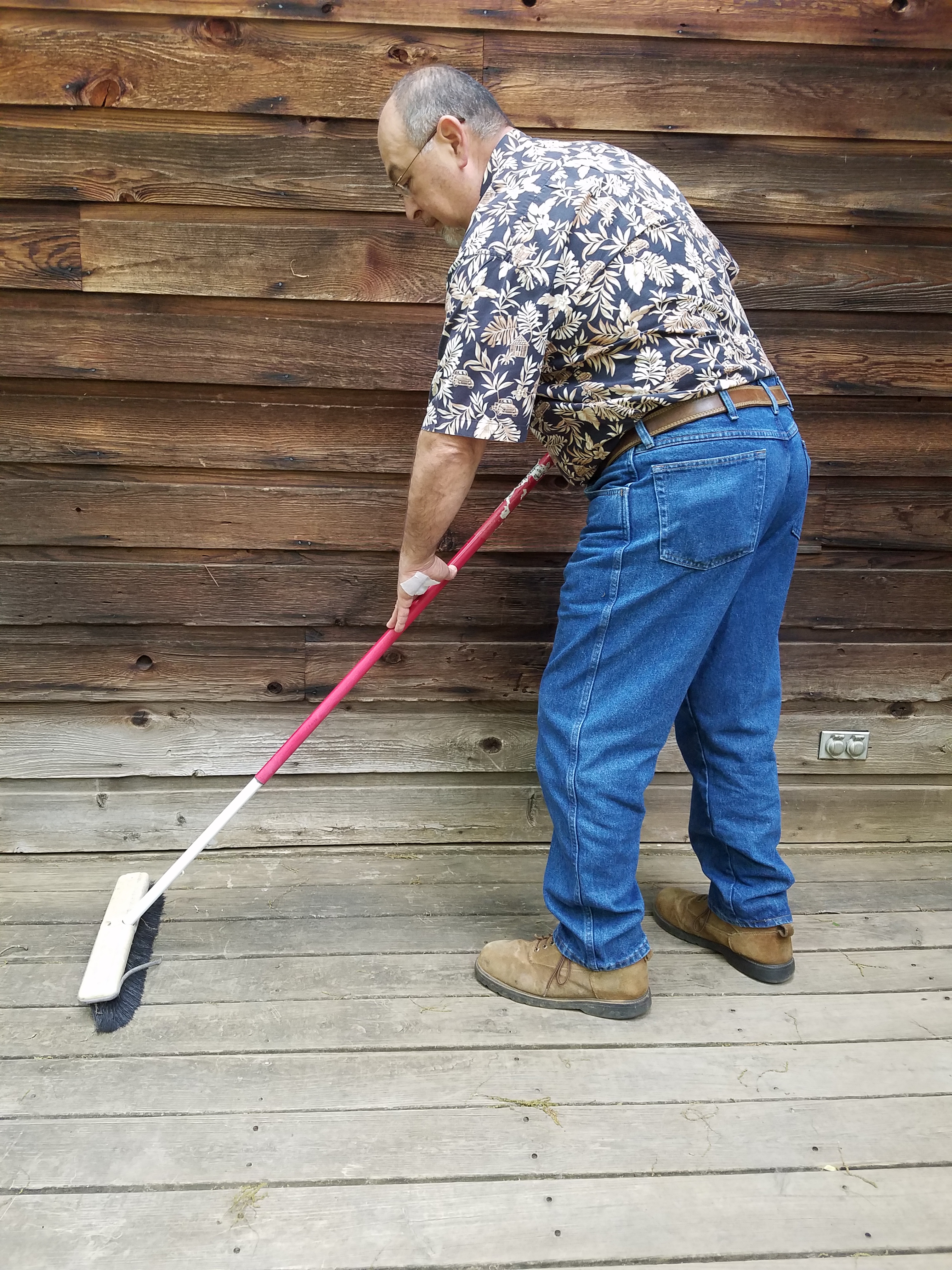
Thank you, Sandy, for demonstrating the correct technique for the use of a push broom. You have hopefully made it easy for everyone to imagine my little workers.

20170501_083425.jpgSandy with push broom.jpg

I think I was seven or eight when I started to think about what’s in food, and this greater understanding  was because of vitamins. My mother gave me a chewable every day, saying vitamins had in them what your body needs to be healthy. One day in the car (specifically I remember we were on Route 31 heading south out of Washington Township in Warren County, New Jersey) I asked her what people did in the old days when they didn’t have vitamins. How did their bodies get what they needed? My dear, wise mother said they simply listened to their bodies and ate the good food it asked for, and the good food had everything you need. I might have asked Why do we need vitamins then? Don’t we eat good food? But I didn’t. I just took it as a good answer and after that I didn’t worry if I forgot my vitamin. I knew we were eating pretty well.

I admit I carried this push broom image into adulthood, but of course I enlarged it to include the vitamins and other nutrients scooting off to parts unknown to serve their specific purposes, whatever those were. Imagine my joy while taking Nutrition 101 in college and finally learning what all those vitamins do!

In the adult version of this image, however, The Big Bad enters. It works like this: the good food still does what it is supposed to, that is, it moves along by way of the push broom in the direction the worker sends it, with the vitamins and other good parts knowing when and where to take their leave and go do their thing. But the bad food, in my mind the unpronounceable ingredients on that package list, waits in its devious and menacing way till the worker with the push broom isn’t looking and then sneaks off in order to take up residence in a tiny corner of the body somewhere, hiding, waiting for years sometimes until one day it meets another nasty, ultimately ruinous, additive and together they make a kind of bad magic in my body.

Thus The Big Bad becomes The Big C. Some cancers are preventable. Don’t smoke if you want to avoid lung cancer (not that this always works, but your chances are tremendously better). But some were mysterious — who knew why you got them? When I was 23, I lost my sister Lisa to Hodgkin’s disease. I don’t think her diet had anything to do with it, and I doubt she could have done anything to prevent it. But her death changed me. I became more aware of how precious life is and more determined to live it fully. This meant doing what I could to take good care of myself. I might not prevent every bad thing from happening to my own body, but by golly I would prevent what I could.

My silly workers with their push brooms, my simplistic, juvenile images of the digestive process are no less ridiculous things for having helped me eat better food my whole life, but they are my workers, thank you very much, and I hold them dear.

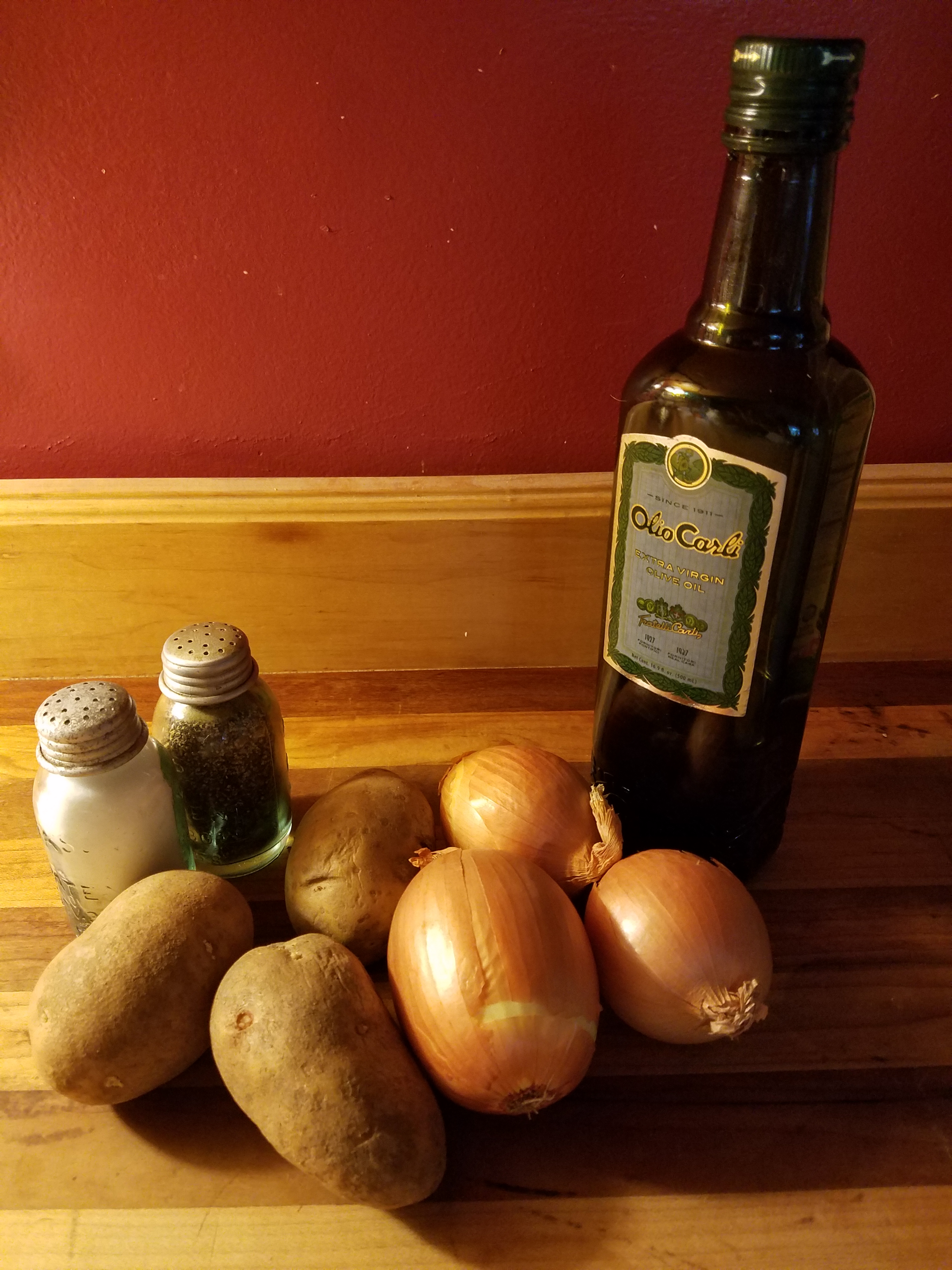
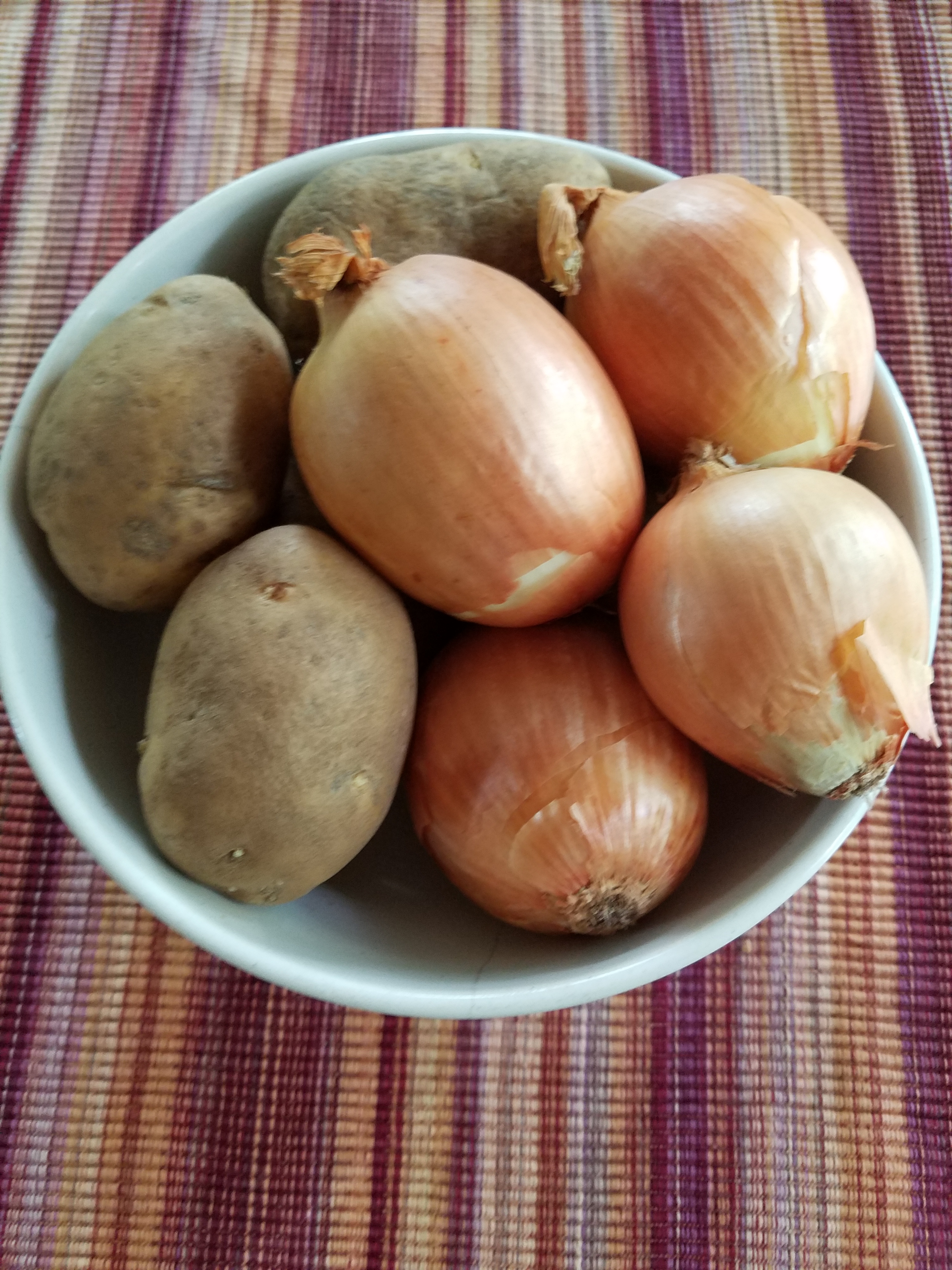
Let us return to potatoes and onions. I know what they are. I don’t have to wonder about or worry about what they might do to me. I can hold them in my hands, peel them, slice them, cook them with other simple ingredients — salt, pepper, olive oil — and enjoy them enormously.

20170501_095623.jpgpotatoes, onions, olive oil, s&p

Yesterday all I did was add sweet Italian sausage to the equation. I know, I know — some might see a conflict here. How do you know what’s in the sausage?? I do buy the good sausage that lists only pork and spices as the ingredients. Nonetheless, point taken. To which I respond that I am not fanatical. Some bad gets in sometimes, I accept that. My control only goes so far. We do what we can.

Now for my “recipe.”

You will need potatoes, onions and sweet Italian sausage. I’m sorry I can’t give you amounts. Use your head. How many people are eating? Determine your own proportions. Do you like the potatoes more than the sausage? Are the onions a flavor for you, or a vegetable? Do you want leftovers? Use however much you want of each.

Take those sausages and slice them as thinly as you can. If they are fresh or have been thawed completely, this process is not so easy, given those bothersome casings. Frankly they are kind of a mess. I found the easiest way to do this is to freeze them or thaw them to the point where they are easily sliceable. I’ve heard that this is how they slice meat so thin for jerky. If you don’t have a freezer or the patience or the right timing for this step, just use your hands to squish the sausage meat out of the casings and break it up best you can. Find humor in this step. Put the pieces in a bowl.

I used a mandolin to cut the potatoes and onions this time. I am still getting used to a mandolin, having been strictly a knife girl my whole life, and at first I used the wrong blade so the potatoes were more shredded than sliced. I switched to something that made them more a french fry cut, which seemed reasonable. It doesn’t really matter, as long as they’re thin. Of course I used the shreds too. No waste in my world. Same for the onions, just cut them thin somehow, however works for you. Add these potatoes and onions to the sausage pieces in the bowl.

Right about now you should turn on your oven to 400 degrees. This gives it time to heat up while you are finishing up the prep work, but not too much time. You wouldn’t want a hot oven to sit there unused for too long.

Drizzle some olive oil over the top of your cut up potatoes, onions and sausages. Again sorry I can’t give an exact measure.  Use common sense for quantities of the olive oil and the salt and pepper. It depends on how many potatoes, onions and sausages you decided to use, as well as your taste.

You want enough olive oil to coat everything thinly, but not so much that you would see the oil pooling anywhere. Add a little at a time and use your hands to toss everything together and ensure an even coat. Yes, a spoon works if you don’t want to use your hands, but your hands are better. They are the best tool in the kitchen. Focus on the coating of the potatoes. No need to worry about the sausages, as they have their own fat, and the onions are just along for the ride.

Once you are confident that the potatoes are coated (and you didn’t forget the salt and pepper), turn the bowl upside down over a heavy sheet pan that has sides (some call this a cookie sheet) and spread everything evenly. A 9×13″ glass or metal baking dish works well too, so long as you don’t have too much. You want one layer, not a big thickness. Use two pans if you have to. Thank me later.

Put the pan in your hot oven and let it bake until the potatoes are crispy and the sausages are cooked, probably about 40 minutes. Again use your own judgment. When I made this recently, I made two pans worth. I did think to rotate the pans, switching racks halfway through to ensure evenness of browning and crisping. But we needed only one pan for that meal. I left the second pan in the oven, which had been turned off but was still hot, while we ate, and when I took it out later I wished we had eaten that second pan instead. The extra ten minutes in the heat made the potatoes sinfully crispy and delicious. I had a hard time not eating too much!