Pierogi Production Party in Virginia

Lynn and Billy are Pierogi Pros. There is no thinking required following the question: How about if we make pierogies when we come to your house? Yes!

The first question is How many cans of sauerkraut? Lynn routinely uses 15 or 16 for her own party (and made 974 pierogies last time!), but that seems excessive for me and Mom. In February we used five cans. For the December party we settled on three (and maybe we’ll be sorry, but we’ll adjust next time if we are). Imagine the difference in the number of little footballs you have to make ahead of time and the number of pierogies you line up on the pan. Here’s Mom doing an excellent job! Look at those perfect rows!

IMG-20180211-WA0015 (2).jpg

Making pierogies is not for the faint-hearted or weak-willed. It’s complex, time-consuming and has various nuances of technique that Lynn and Billy have perfected over the years. Nonetheless, as they say, if we can do it, so can you! What follows is a brief pictorial overview of the process. You are invited to ask questions of me or Lynn if something doesn’t make sense.

Day One:

Make the potato-cheese filling and the little cabbage rolls. You do this the day before because 1. It spreads out the work and 2. It allows time for the fillings to cool, making them much easier to work with.

Filling for Potato-Cheese Pierogi

Sauté 2 large onions in 2 sticks (1 cup) butter until just golden. Add 3-4 cups mashed potatoes, 2 (8-ounce) packages softened cream cheese and salt and pepper to taste. An electric mixer is great for this. We used the stand mixer. Let mixture cool, put in a bowl, cover and refrigerate.

Filling for Cabbage (Sauerkraut) Pierogi

Melt 2 sticks (1 cup) butter in large pan. Add 2 large (27-ounce) cans sauerkraut that has been rinsed and drained, and salt & pepper to taste. Cook slowly (low heat) for about 45 minutes until sauerkraut is soft. Let cool, put in a bowl, cover and refrigerate.

Day Two:

First, make little cabbage footballs using your hands like this. Lynn calls them rolls or logs, but their ends do tend to taper down like footballs, just saying…

This slideshow requires JavaScript.

These little footballs will fit in the form like this.

cabbage footballs in form.jpg

But let us not get too far ahead.

Once your cabbage footballs are formed, clear your workspace and gather your tools. You never saw my butcherblock so clean! This is, in fact, a good opportunity to get the dust and you-know out of those corners and crevices, a bit of pre-production deep-cleaning, one might say…
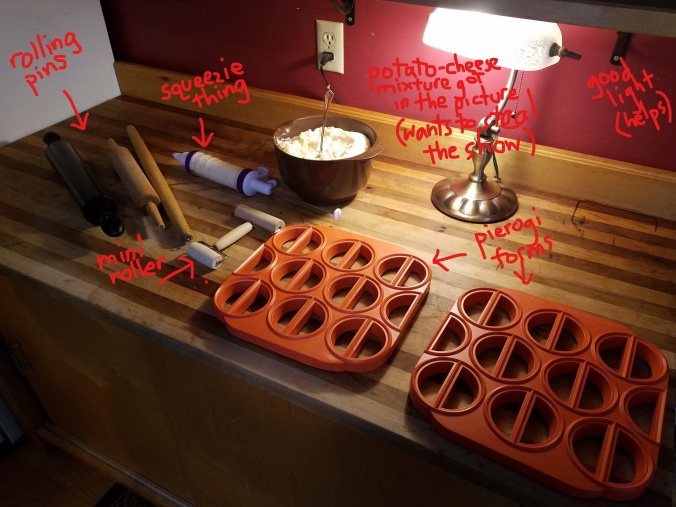
equipment_LI.jpg

You see three rolling pins. Billy’s is the big, black, marble, heavy, hefty one. You will see why. Mine are the two rather average wooden ones. I didn’t know which one of those Samuel would prefer, and he did not show up until the last minute, being involved with his coding during every other possible minute, so I brought them both out.

The potato-cheese mixture in the bowl on the butcherblock is clearly an ingredient and not a tool, but since it didn’t get its own set of photos while being made (and secretly thinks it’s better than the cabbage footballs), it snuck into the photo here to make sure, at the very least, that it is not forgotten.

Now you are ready to call the troops in and get going with the full operation. These are the ingredients for the dough, all set up in their own space. We are nothing if not organized! Okay, Lynn is nothing if not organized!

IMG-20180211-WA0000.jpg

The recipe says:

Dough

Combine 4 cups flour, 2 eggs, 4 tablespoons melted butter, 1 ½ teaspoons salt, ½ cup water. ½ cup milk. and roll out thin. Transfer to pierogi forms. Fill with filling. Top with another thin layer of dough. Press with roller. Trim away excess dough.

I mean, how simple is that?

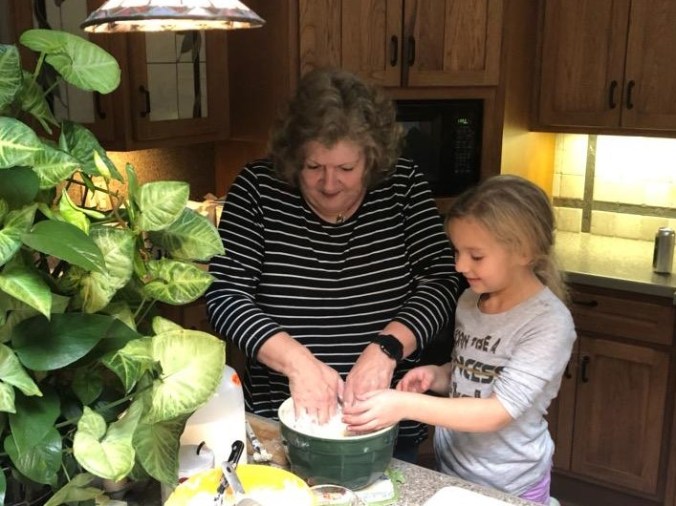
Here it is again, starting just before “roll out thin…” This is enough mixing in the bowl. Billy did the rest with his hands.

dough in bowl2.jpg

And then he divided that amount of dough into four pieces.

dough divided.jpg

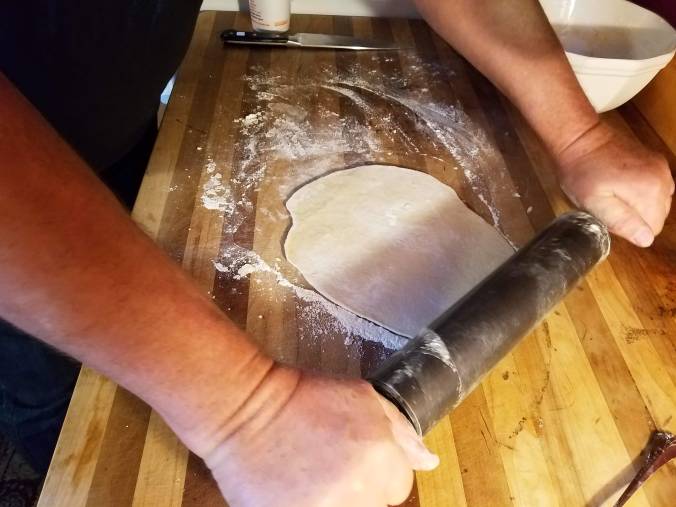
Then “roll out thin.” When we say thin, we mean thin. You go from this…

dough to roll (2).jpg

…to this…

dough rolling.jpg

…to thin enough to fit on the 14×14” form.* Move it gently and carefully.

first layer 2.jpg

Billy is the Official Dough Roller. This task requires strength, endurance and no small amount of organization (is this the dough you rolled out twice already? – all looks the same to me!). This guy knows what he’s doing. His smile really says Trust me, I rolled out that dough twice already. You don’t argue.

Billy and dough.jpg

For the record, Samuel followed Billy’s dough-rolling lead (which dough was that again?) and will someday be glad he participated in this craziness, even if right now he would rather be coding.

Samuel rolling dough.jpg

I squeezed out potato-cheese filling and placed little cabbage footballs in the form and pressed edges together and in general tried to be useful when not temporarily holding up the works with my (frequent) “hold, hold, hold!” while I stopped to take pictures, a habit I expect was not altogether appreciated at the time, but here we are with (yes, folks!) pictures!

Once you have placed the first layer of dough on the form, you milk the edges (with milk) to help the top layer of dough stick better…
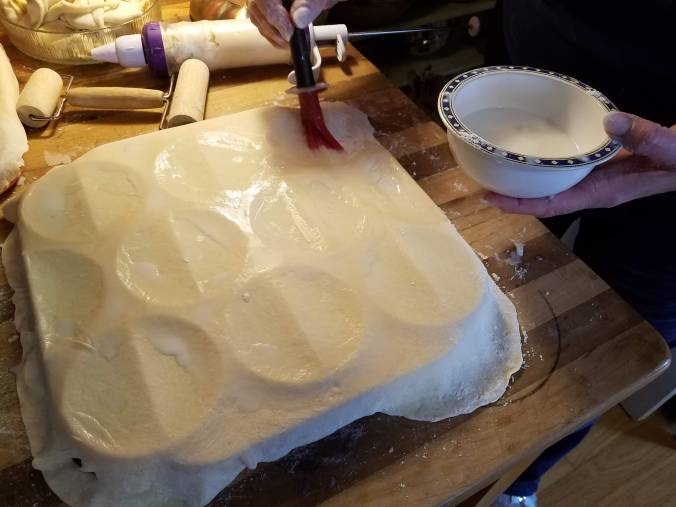
milking the edges.jpg

…and put the fillings in. Lynn, Master Organizer (aside from deferring to Billy on the question of Has this dough been rolled out twice already?), presides over the squeezing out of the potato-cheese filling.
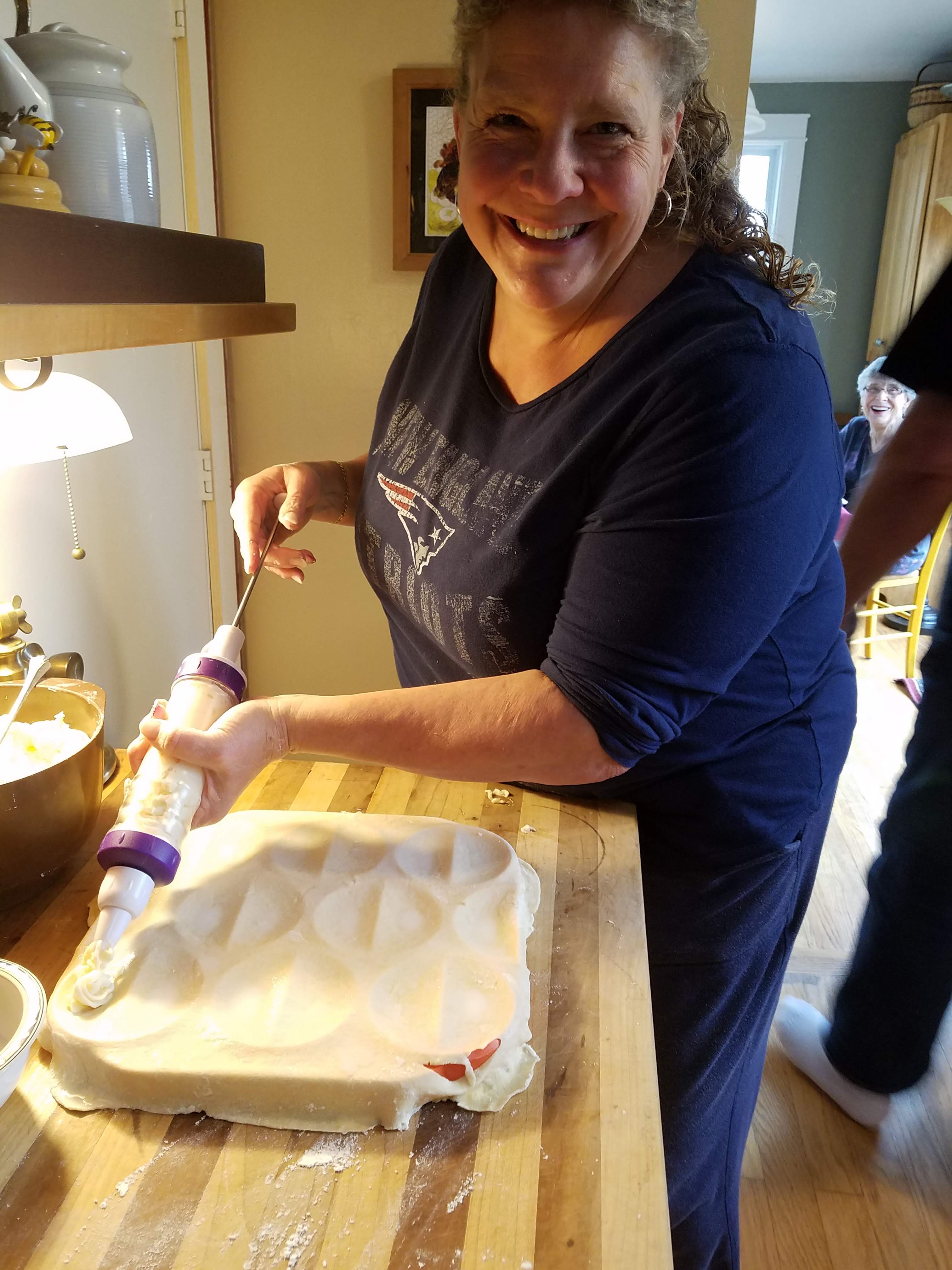
Lynn with potato.jpg

You see in the next photo that the portions are not exact and the shape of the dollop is not the same in every one. They are not perfect. We are not perfect. This is not an automated production line in a pierogi factory. We are not automated machines making every dollop the same. That squeezie thing has a mind of its own sometimes, and getting it to break off the desired quantity is a practice-makes-respectable kind of thing. This is my home and we are perfectly at ease with (at least certain kinds of) imperfections. Imperfections make it real and fun and challenging and wonderful and everything a store-bought pierogi can’t be.

potato filled.jpg

Once the form is filled, you put the second layer of dough on top

second layer on top.jpg

and take the mini-roller and press against the semi-circular edges of the form. You could manage with one of the regular rolling pins or even a straight-sided glass jar.

IMG-20180211-WA0007

Lynn likes the wider side of the roller and I like the narrower side. Either way, the job gets done and the edges are pressed together enough to hold.

rollig edges.jpg

You have to press hard enough that the pierogies practically break away from the form on their own (see the orange of the form showing through?).

pressing2 (2).jpg

And then you can remove the excess dough, which gets re-rolled once and once only, thus the previous “which dough was that again?” to keep track of the dough’s cycle.

pulling dough.jpg

You remove the excess dough carefully, then take the whole thing over to Mom and her waiting tray, and flip them out. (Not the standard usage for the phrase “flipping out,” I grant, but the right phrase nonetheless.)

flipping and tray waiting (2).jpg

See how wonderful they look! Like Mary Poppins: Practically perfect in every way!

IMG-20180211-WA0011 (2).jpg

We kept track of numbers this time by writing with a sharpie on a corner of the waxed paper that divided the layers (three layers max). C=Cabbage  P=Potato  (But you knew that.)

marked paper.jpg

Layering the pierogies with waxed paper and using a little cornmeal on the surface helps keep them from sticking to one another. You freeze them right on the pans like this. When they are frozen solid, you put them in bags and label them.

We of course couldn’t help it and had pierogies for lunch. How does one say YUM most emphatically!!?? And between my freezer and Mom’s we have the remainder. To give you an idea of quantity, we made 67 cabbage pierogies using 3 cans of sauerkraut and 166 potato-cheese pierogies using 4 pounds of potatoes. That’s a far cry from Lynn and Billy’s 974 total, but Mom and I and everyone who eats at our tables over the next half year or so will enjoy every last bite of these. Plus, we know it won’t be long until Lynn plans a trip and says How about if we make pierogies when we come to your house? Yes!


*In case you are interested in this form, here is the info on it.

form info (2).jpg

Making 974 Pierogies

Granted, not everyone wants to make 974 pierogies. But if you do, I suggest a party. It works great for Lynn and Billy, who have been doing it for years. The deal is: you come, you work a few hours getting your hands sticky and/or your shirt spattered with flour, and you go home with zip-lock bags full of deliciousness. It’s worth every minute!

Getting a bunch of people together to make good food is, all by itself, a fun idea. Getting together to make a family favorite, something that is best made with lots of help, something everyone is happy to take home – that’s even better. The party invite should say Bring an apron.

Pierogies,* a filled dumpling, are part of my brother-in-law Billy’s Polish background. They make two kinds, potato-cheese and cabbage.  The potato-cheese kind is creamy and comforting in the same way as mac and cheese is creamy and comforting, and the cabbage ones are filled with slowly sautéed (in lots of butter) sauerkraut, i.e. fermented cabbage cooked down to tender sweetness. Both kinds are amazingly good.

Traditionally, you boil them as you would any filled dumpling (or pasta, if you think along Italian lines), douse with melted butter and serve. I like to sauté some onions in a pan over a low flame, lay the frozen pierogies on top, add a little water, cover, and let them steam into tender puffs …

in pan side 1.jpg

…then flip to get the other side just a little crispy.

in pan side 2.jpg

It is not a piece of cake to make pierogies, but here are several good reasons to venture into the Pierogi Party Production arena: 1. Many hands make light work. 2. Food is a powerful motivator, meaning you can get people to do work when food is the reward. And 3. Assuming you have someone like my sister Lynn in charge, you know it’s going to be good. She is a master organizer and keeps things going with admirable efficiency and poise. Anyone who can get 12 people to show up at 10:00 on a Saturday morning to do four hours of work with zero monetary compensation deserves applause.

Lynn gets all her ingredients ahead of time. This last time, just before Christmas, they weren’t aiming for 974 pierogies, but they were aiming high! She got six pounds of potatoes, five pounds of butter, 16 (!) large cans of sauerkraut, six large onions, three dozen eggs, a gallon of milk and 35 pounds of flour. The day before, she gets out her recipe (it’s fairly straightforward, you’ll see) and prepared the potato-cheese mixture and the cabbage footballs. Then when her “guests” – all of whom want in on this action because they’ve had these before and they want them again – start coming, she gives everyone a task according to age, ability and stamina, and organizes the steps in such a way as to crank out large quantities in a very short time. It’s a model of productivity.

Four-year-old Brea isn’t going to roll dough, but she can help crack eggs into each batch of dough.

6 (2).jpeg

The rolling out of the dough Lynn assigned to the strong and energetic. If my calculations are correct, Evan and Matt needed to roll out 108 pieces of dough about the same size you’d need for a deep-dish pie.

4.jpeg

The pierogi form, this thing…

flipping and tray waiting (2).jpg

…makes 18. That’s 54 times you need to flip pierogies out of it to make 974 total, but 108 times you roll the dough because there’s a top and a bottom. That’s a workout!

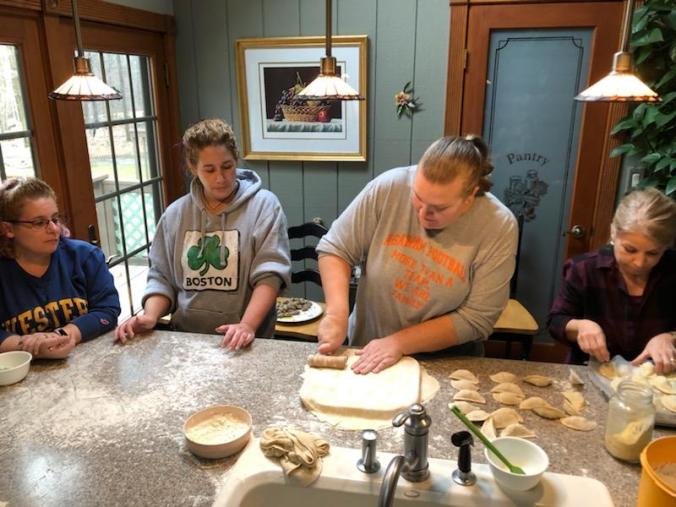
Some people press the mini-roller on the pierogi maker to seal the edges together (go, Erika!), some separate the finished ones and some wait their turn.

3.jpeg

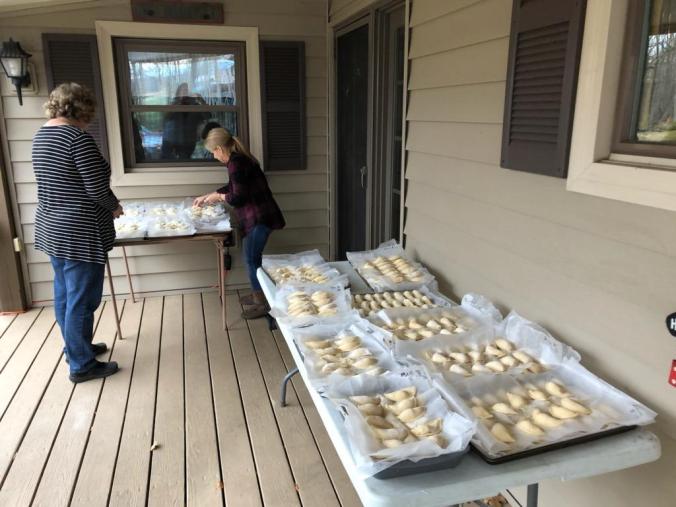
In the end, they ran out of room inside the house and set up tables out on the porch until these made it to the freezer. 974 is a lot of pierogies! If you don’t believe me, I am sure one of them will confirm the truth of this statement.

1.jpeg

The mere 233 we made last February when Lynn and Billy came to my house to visit pales in comparison, but we had our own Pierogi Production Party. We had so much fun (and the pierogies were sooooo good!), we did it again when they came in early December. Tomorrow I’ll give the specifics…


*In case you were wondering, pierogi = pierogies. Both are plural. Both are correct (or at least in our modern English usage correct). I use the -es ending for the plural because that’s how I learned it.

Puzzling Puzzles

On Christmas Eve I spent hours bending over the coffee table trying to see the difference between pieces as alike as these. I know, I know – you can see plainly that the one on the left has a little bit of dark on its top outie.

3.jpg

If you’ve ever done a jigsaw puzzle, you know that the difference is not so easy to see when the table looks like this.

partway (2).jpg

The pieces below give you a little more to go on because clearly the very pale green (which makes you want to have a stern conversation with the artist who painted this picture or the marketing person who decided that it would make a good puzzle) – if you can see the very pale green under artificial light when people are walking around making intermittent shadows – is going in two different directions. Do they fit together?

2 (2).jpg

It could be hours before you discover that they do. In the meantime there are several hundred other puzzle pieces competing for your attention – Pick me! Pick me! – and you can look through all the as-yet-unplaced pieces a thousand times and not see the obvious. Of course they go together.

1.jpg

Sometimes I think I have a disorder, you know, the kind that has to do with not being able to sit still. I keep pretty active in general and have been known to forget what I’m doing because I get distracted doing something else. Is this a human characteristic or a disorder? I don’t know, but I have also been told that I should relax more.

For the record, doing a puzzle like this is totally relaxing for me and I did not jump up and down away from it every time I thought of something else I should /might be doing. In fact it was so relaxing I forgot about the scalloped potatoes I should have made, which in the end Samuel made and which were fabulous. And now he knows that this is a recipe.

scalloped potatoes.jpg

He made this dish on Christmas morning (with some supplemental verbal instruction), and naturally we were doing a bunch of other things, and I forgot how we did the onions last time – on top or mixed in – so we thought it best to put them on top, which trust me was a very good decision. This is how it looked on the table — that white dish between the wine bottles with the golden brown, soft, sweet onions on top. You will have to imagine how good it tasted.

at the table (2).jpg

My point is that I was so absorbed in the puzzle on Christmas Eve that we were scrambling to do the scalloped potatoes (which were none the worse for the scramble) on Christmas Day. Does this sound like a person with a disorder? Okay, maybe a disorder of forgetfulness rather than a disorder of distractibility. Never mind about the disorder discussion!

Puzzles are challenging! Why do we do them? For me and my family they are a holiday activity, and I do not remember ever keeping a puzzle in its finished form beyond a few weeks. Sooner or later we break it all up and put the pieces back in a box. All that work! All those hours! Why do we take time to do something that in the end goes away? It reminds me of what my mother used to say about Thanksgiving – you do all that food prep, days of food prep, and in ten minutes they’ve eaten it all up! My Airbnb cottage guest, Rob, was saying last night that the different sweeteners you use in mixed drinks react differently (and make a different drink) depending on the temperature of the liquid. There is a whole chemistry behind mixed drinks that he is clearly an expert on, but why does he take the time to study this?

Why does Trish make amazing little appetizers like this to bring to a holiday gathering? Why does anyone take time to make food look like adorable little mice? We don’t eat mice! But when they look like this and we know they are sweet, we eat them!

Trish mice.jpeg

We do these things because they bring a certain kind of satisfaction. We use our brains and our hands and put them to work alongside creativity, competence, curiosity and confidence. We love knowing we can do a thing that not everyone can do — even if we couldn’t do it ten years ago and had to learn. Rob had a succulent turkey going inside a foil pan inside my gas grill. He showed me. I smelled it and knew that he and Kelsey would be having a fabulous Christmas dinner. He said he loves to cook but can’t bake anything. Kelsey, on the other hand, can bake! Why? Who knows?

Does it matter? We share our strengths and in the end there is both entree and dessert. There is both passion and reason, strength and flexibility, activity and rest. We need all the components that make us human, but we don’t each need everything all the time. The unboring joy of life includes a little of A, a little of B, some of R sometimes, some of Q another time, learning M this year and N the next, one person doing X, another person doing Y (and it all gets done somehow!). It’s like one big puzzle in which no two pieces are exactly alike yet they all fit together to make a satisfying, wonderful whole.

done.jpg

The Right Knife for Slicing Biscotti

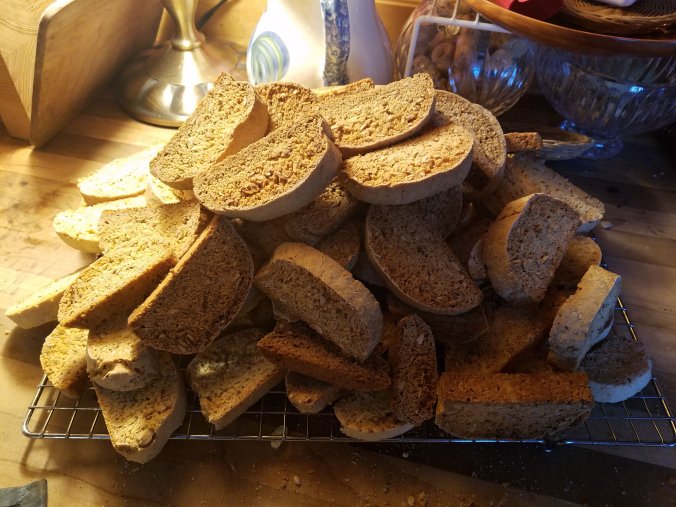
Yesterday I quadrupled my biscotti recipe. That’s a lot of biscotti! But I like giving them as gifts, and in this gift-giving season, a pile like this comes in handy.

12.12 pile.jpg

I have made these lemon-anise-almond biscotti many times, but this time I had a problem. I formed the loaves and baked them until they were firm to the touch, but I’ve got things to do, you know, so when they came out of the oven, still hot, I wanted to slice them right away.

This has been a challenge for me before, but it was worse today – as I sliced the hot loaves, every time my knife hit a larger almond piece, the piece started to break apart, especially at the edges. You don’t want this. See how some of them are full pieces and some have broken edges?

12.12 broken_LI.jpg

You want full pieces. You want all full pieces. Why was this happening?? I was not using my ordinary, everyday serrated knife, the one that fits in my wooden block holder, the one I’ve been using so long that its teeth are worn down (which would surely jam up against the almond pieces and cause breakage).

Instead I was using what I consider my best serrated knife, the one I hold in reserve for special jobs. It lives in the drawer because there’s no slot for it in the wooden block. It’s hefty and shiny and has very sharp teeth (for making short work of almond pieces) and I think it was expensive. It looks expensive. (It was a gift so I can’t be sure.) I was being very careful. Okay, the loaves were still hot, but that shouldn’t matter so much.

But I can’t have broken pieces. It’s true that they would taste just as good, but c’mon, I am not going to give them as gifts. And I am not going to eat them myself (no nuts for me, and almonds are the worst). And I would feel pretty bad saying to someone Here, would you like the broken ones? Yet they seem too good for the chickens!

Then I looked at that gorgeous knife as if it’s the knife’s fault that I had this problem, and I realized: It’s the knife’s fault! It’s too fat! Heft in a knife is perhaps not always ideal. I then remembered another serrated knife that I got at the county fair decades ago, you know the kind: “This knife will slice through wood” and some guy behind a table is demonstrating the amazing strength and sharpness of a $5 knife with a plastic handle. You can hardly believe it’s that good but you see the proof for yourself. I had bought the knife. It didn’t fit in the holder either so it too lived in the drawer. And there it was.

These are the two knives side by side, the poor cousin and the rich uncle.

12.12 both knives2.jpg

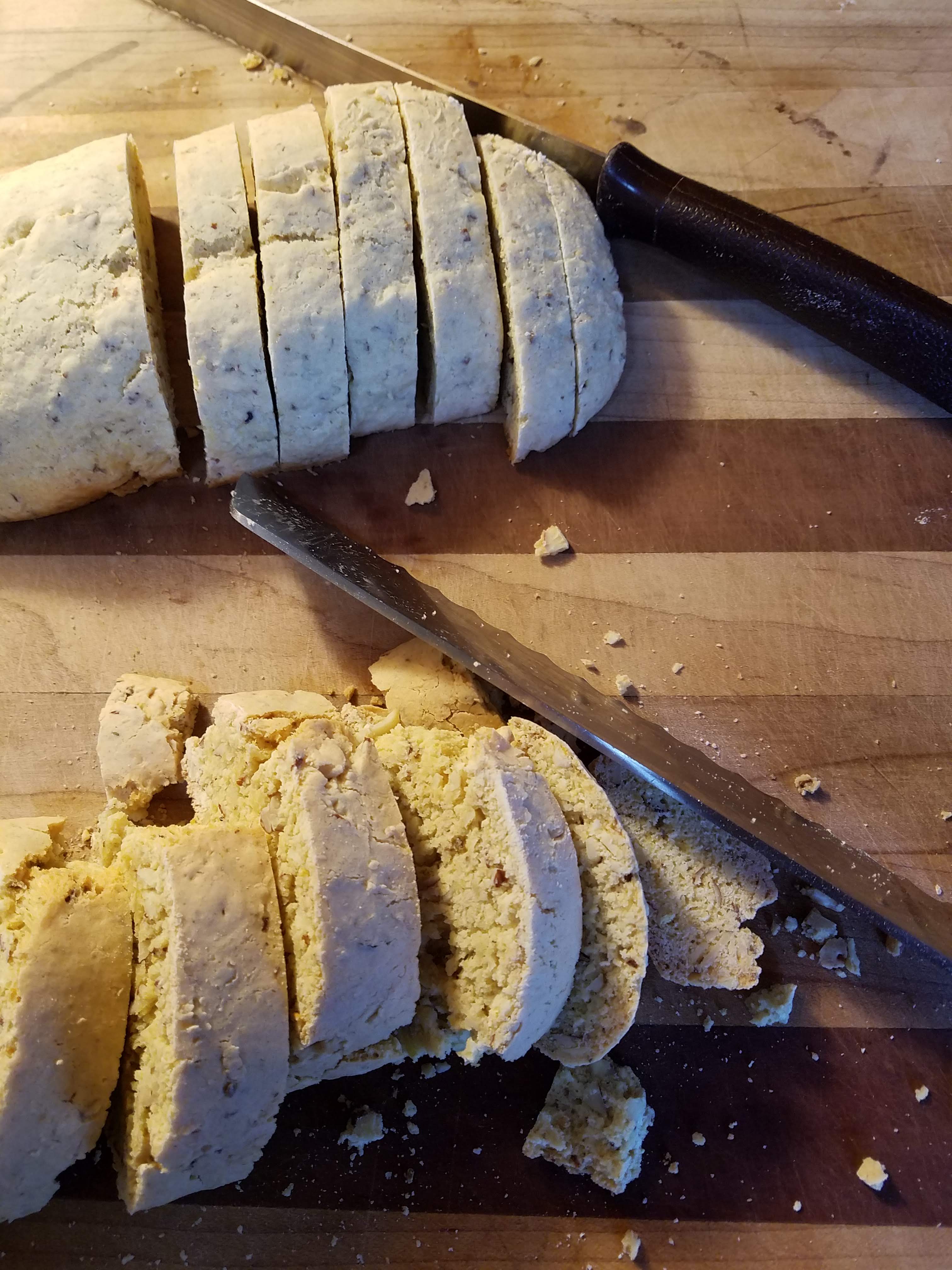
Standing up on their teeth, look at the difference in their thickness. And see what a difference in the slicing!!

12.12 both knives.jpg

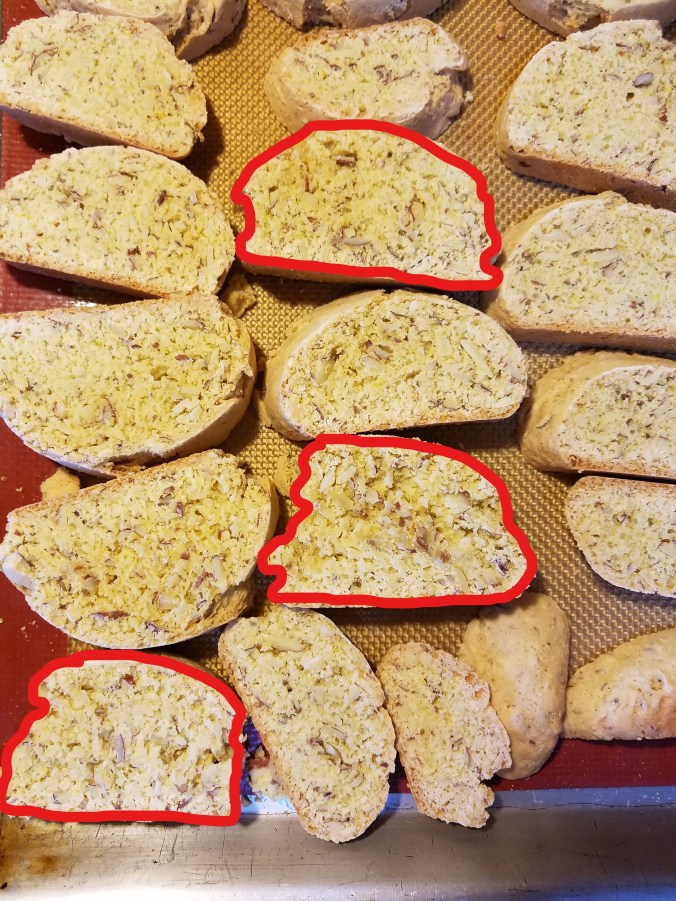
That cheapo knife made perfect slices for me every time. See how each piece on this baking sheet is a full piece, like the one I’ve outlined in red, no broken edges?

12.12 unbroken_LI.jpg

Needless to say, I was very happy I had kept the cheap one, very happy to have the right tool for this job. Bigger, heftier, pricier and stronger is not always better. Only one question remains.

What should I do with the broken pieces??

A Saint Barbara Day Cake!

Last week Mom told me she was invited to a “tiny tea party” on December 4, St. Barbara’s Day, a party that included all the Barbaras who live in her community. The host is a Barbara who has been hosting Barbara tea parties since starting the tradition in Park City, Utah, in 1999. What a lovely idea!

I asked the host if I could come and take a few pictures. Here they are posing with a cutout of Marilyn Monroe, whose real name was Norma Jeane, not Barbara. Whatever. You don’t get to pose with Marilyn every day.

ladies.jpg

And again the Barbaras at the table with Norma Jeane looking on – see her in the mirror? (Another Barbara came later and another had the date mixed up.) During the party, Host Barbara (in red) showed them various St. Barbara items she has collected over the years and even gave them a crossword puzzle entitled “Barbaras We Have Known.”

ladies at table.jpg

“St. Barbara was quite a lady,” Mom’s invitation had said. Indeed she was. Virtuous, beautiful, locked in a tower by her self-serving father, Barbara of the legend lived in the third century, converted to Christianity (when that was not the thing to do) and was publicly humiliated and finally beheaded, thus the head she holds in her hand.

st barbara.jpeg

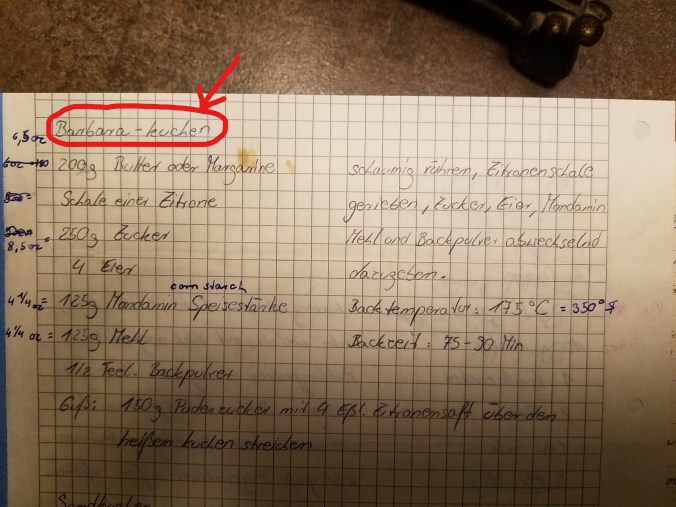
For many years I have had a recipe in my cookbook for Barbara-kuchen, or Barbara cake. The handwriting is my friend Anett’s, who lives in Germany, where St. Barbara is more widely celebrated. It’s really quite a simple cake, even if it looks unintelligible. The main thing is to see that it says Barbara-kuchen at the top.

recipe_LI.jpg

As a way to thank the host for allowing me to come take pictures at her tiny tea party (and a wonderful excuse to bake), I decided to make the cake. Ingredients are:

14 Tablespoons butter, softened
the grated rind of one lemon
1 cup sugar
4 eggs
1/3 cup corn starch
1 cup flour
½ teaspoon baking powder

You soften the butter (in my microwave this took 1 minute 20 seconds on defrost), add the sugar and eggs, and whisk it till creamy. A hand mixer would have been handy at this time – for such a small amount of batter I didn’t want to get out my big, wonderful stand mixer, but I had to beat the ingredients with a good bit of wrist action to get the fluffiness I wanted. If you have an electric hand mixer, or your stand mixer on the counter, it’s better to use it.

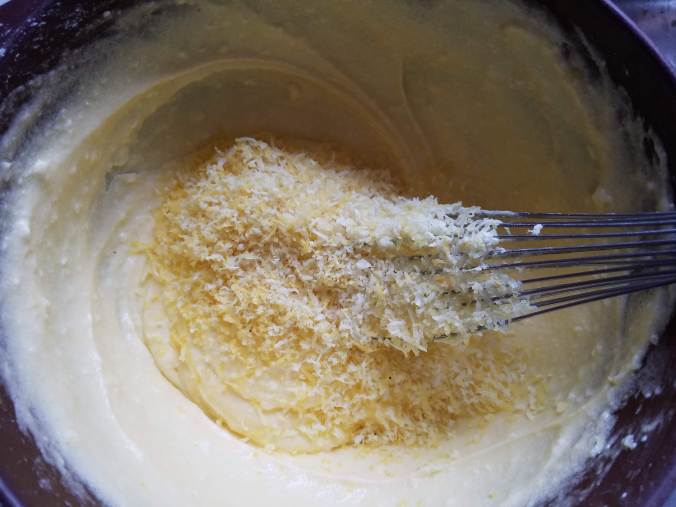
I added the lemon rind after that. You can see the teeny bits of butter still in the batter (my wrist is only so strong). I decided it didn’t matter and kept going.

adding lemon peel.jpg

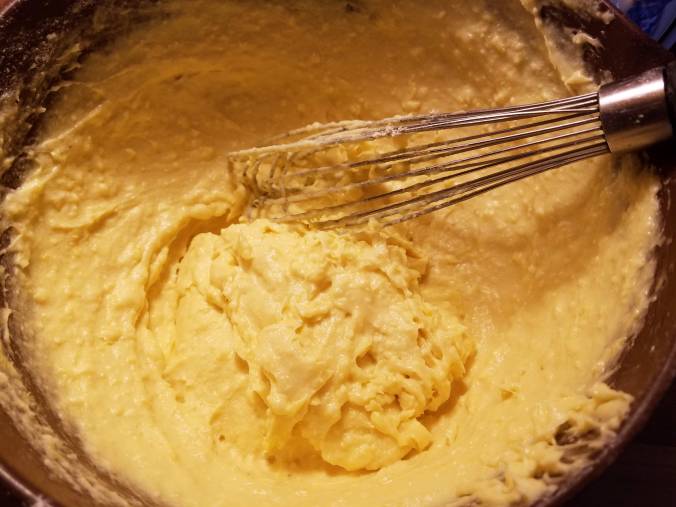
By the time I added and stirred in the rest of the ingredients, it looked like this.

batter.jpg

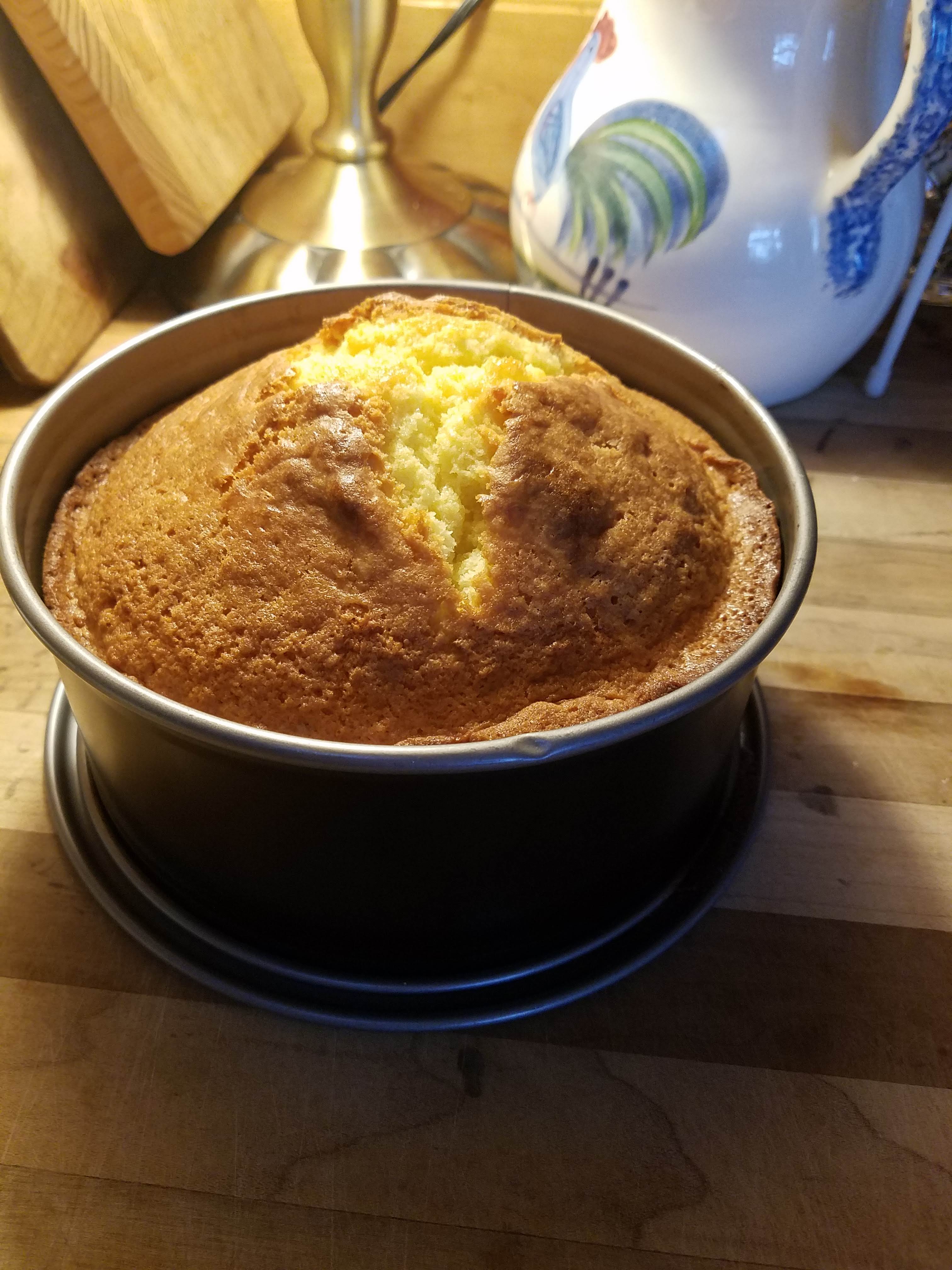
Those amazing eggs of mine made the batter so golden! I chose a small springform pan to bake this cake in because, Claudia tells me, traditionally in Germany the cake is baked in a “Kastenform” resembling the tower in which St. Barbara was imprisoned. I reasoned that a larger pan would make a flatter cake and a smaller pan would make a taller cake, so I went with small. My pan is 7 inches (18cm) across and 3 inches (8cm) high. I baked mine for 35 minutes at 375F (a toothpick inserted came out clean). I see now that the recipe says 350F. I missed that earlier.

But it came out okay. See? Bit of a tower, no? (Use your imagination now…)

cake in pan.jpg

I made the frosting with the juice of the same lemon I grated plus enough confectioner’s sugar added little by little until it seemed stiff enough. I can’t tell you how much sugar. I was in a hurry trying to get to this party in time!

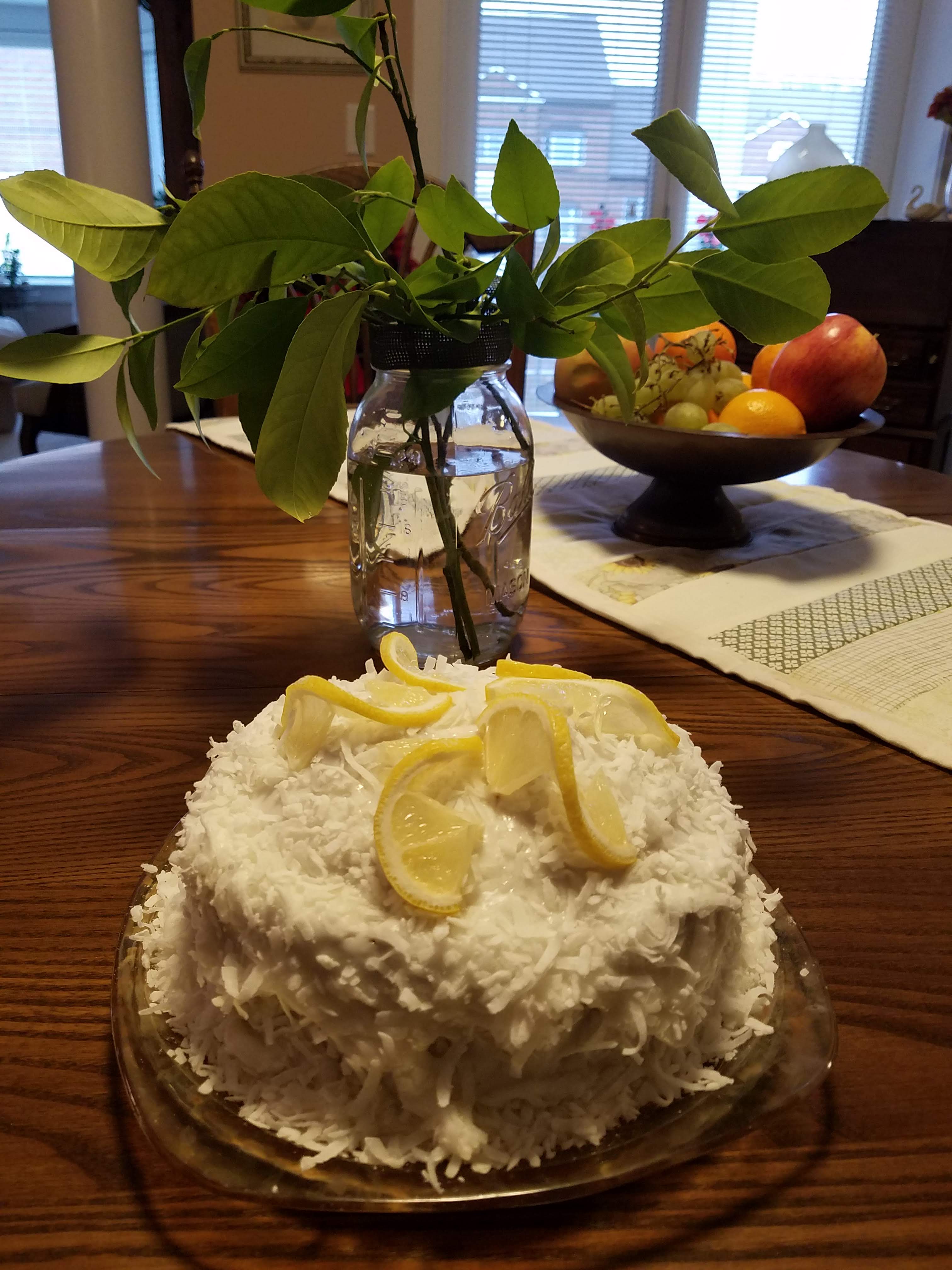
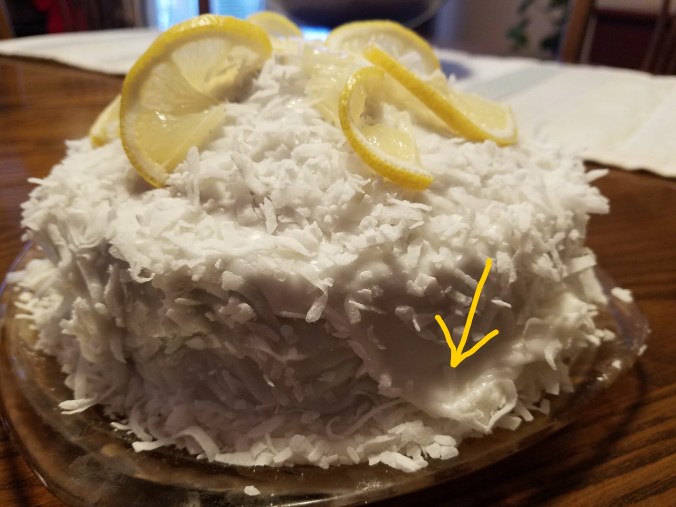
After I put the frosting on, I realized it was not stiff enough, in fact was beginning to sag a bit down the sides, so I decided to remedy this by adding a lot of coconut all over it. Anyway you can’t go wrong putting a whole lot of coconut on top of lemon frosting that is covering a lemony cake. You just can’t. Then I thinly sliced another lemon and twisted them to make the cake pretty on top (as if loads of coconut is not inviting enough). Here’s the cake on Mom’s table before we went over to the party.

cake1.jpg

See those leaves in the jar behind the cake? I brought them too because of another part of the legend. It is said that on her way to prison, St. Barbara got her robe caught on a small cherry branch and it broke. Somehow the branch was put in water and then a new blossom opened on that branch on the day of her execution – the stuff of legends to be sure! I cannot imagine she was allowed to bring her broken cherry branch into the 3rd century prison with her and that someone gave her a jar with water in it, which she then used for her branch until they took her away. But what do I know — maybe this happened!

There is a lot I don’t know about 3rd century prisons. It is not useful to be sticklers about unknowable information like this. Just know that if you cut a branch (cherry or apple traditionally) on December 4, it is supposed to bloom by Christmas. I don’t have a cherry or apple tree, and neither does the community where Mom lives, so I brought branches from my lemon tree (thinking there’s lemon in the cake, so why not lemon?).

I want you to see how droopy my frosting was.

cake drippy_LI.jpg

Time was not on my side, as I said, so I let it go. Anyway, I decided, it would taste the same (delicious I hoped!) and I am not trying to win any pretty-cake contests. Things that are made with love don’t have to be perfect.

To all the Barbaras, but especially to my mom (the best Barbara ever!), I wish a Happy Saint Barbara Day!

Yummy Cookies Baked When You Need Them

I have hosted Airbnb guests at my charming cottage for more than four years. Among other gifts, I leave them something home-baked, usually cookies. If I remember right, last year I had guests 161 nights. That’s a lot of cookies. Imagine if – each time – I got out the butter and sugar? Creamed them in a bowl? Added eggs, vanilla, flour, etc. and mixed it all up and spooned the dough onto baking sheets and baked the cookies? No way would I have time for this.

You learn a lot if you keep your eyes open. Depending on where you are, you learn a lot about certain things. I spent eleven years working in a luxury resort, and a good bit of that time in and out of the kitchens there. Professional chefs have remarkable skills, including knowing how to manage feeding a lot of people at different times and making it all (seem so) fresh. One thing I learned from the pastry chefs but should have learned from Ben and Jerry: Cookie dough freezes well.

We all knew this. Ben & Jerry made chocolate chip cookie dough ice cream famous.

ben and jerry's.jpg

If you have tasted this frozen decadence, you will remember how the cookie dough part freezes hard but not too hard. Hard enough to be frozen, but soft enough to bite into. (Oh yum! If only they would make this with a chocolate base!)

Now think about it: If you can bite into frozen cookie dough, you surely can put a knife through it. And there we have the solution to my needing fresh cookies very often – homemade slice and bake! I mix up a batch of dough, portion it out, freeze it in little logs, then slice and bake as needed for incoming guests. Voila! Everyone has fresh baked homemade cookies! (I once heard a speaker say that the secret to success is Preparation, Preparation, Preparation. This applies to cookies too!)

The log-freezing method is great for guests, but also for those who enjoy their cookies fresh, soft and chewy, right out of the oven — like you! Realistically, you can eat only so many this way, and the rest go in a tin and, well, they aren’t as good in a few days. By freezing the dough in smaller amounts, you can spread out the joy of fresh-baked without getting out the ingredients and going through the whole process every time.

Think co-workers, neighbors at the holidays — or make them for random, unexpected gifts. Prepare ahead and bake only as many as you need for each person or occasion. Fresh every time! (So-and-so invited us to dinner, honey… What?? … Oh, I could bring along some freshly baked cookies! Watch this — super quick!)

I know that chocolate chip cookies are an all-time favorite, but I have preferred to make oatmeal cookies with mini chocolate chips in them. Somewhere in my brain there is better justification for cookies that have whole grain in them. Often I also put dried cranberries or golden raisins in them, but this time I didn’t because … I forgot.

The recipe I use has been in my cookbook forever. Here is the list of ingredients:

Oatmeal (Chocolate Chip) Cookies

3 sticks (1 ½ cups) butter, soft (use the defrost setting on your microwave if you want)
2 cups brown sugar
1 cup white sugar
2 eggs
½ cup water
2 teaspoons vanilla
2 cups flour
2 teaspoons salt
1 teaspoon baking soda
6 cups oats

(For the cookies I make for my guests, I also add a teaspoon of cinnamon, 2 cups of mini chocolate chips and sometimes a few handfuls of dried fruit like currants or golden raisins.) BTW, other cookie doughs work well with the log method, including shortbread cookies.

First cream the butter and sugars with a strong wooden spoon. This mixture will pull away from the sides of the bowl.

butter and sugars.jpg

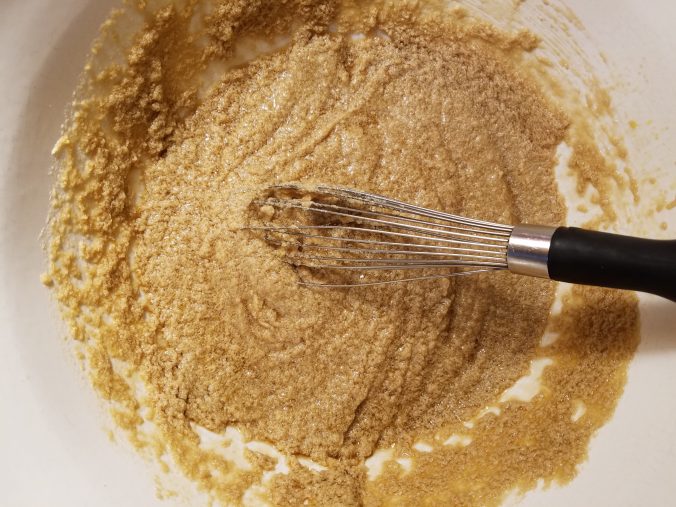
Adding the eggs, water and vanilla changes it quite a bit. Now it looks almost grainy. Notice I changed to a whisk to be sure it all got mixed in thoroughly.

pre flour.jpg

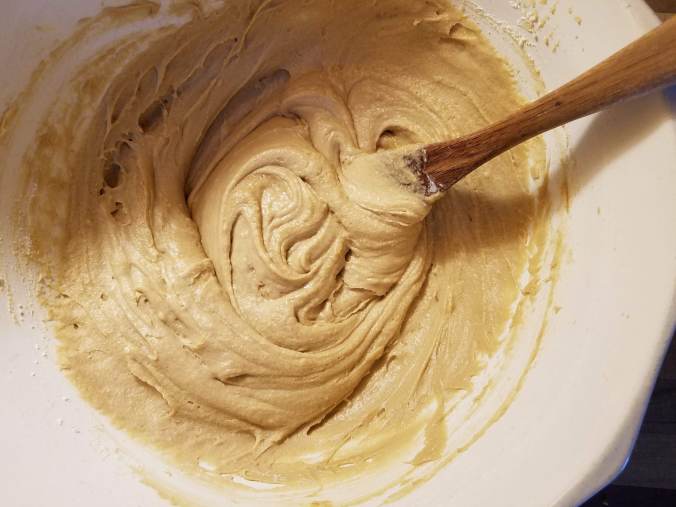
Once you stir in the flour, salt and baking soda, the consistency changes to almost velvety smoothness. Look how beautiful! (And back to the wooden spoon!)

pre oats.jpg

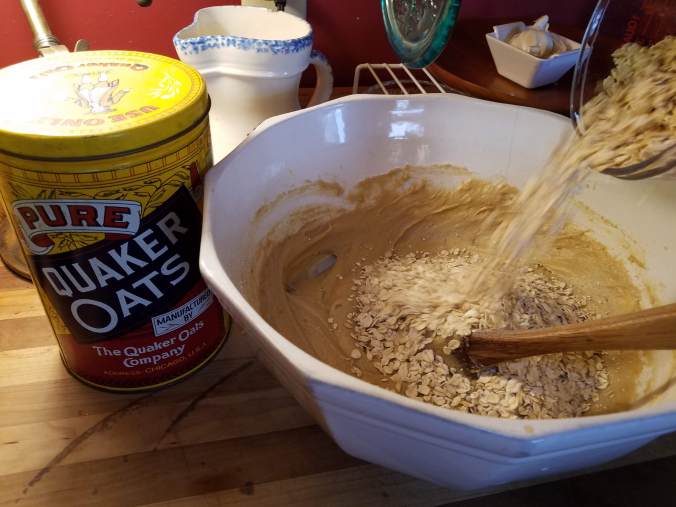
Now add the oats. How’s this for action photography!?

dumping oats.jpg

I put my oats tin in this photo too because (like the allspice tin I showed in Colonial Pumpkin Pie) it is another one that has been around for a long time and is among my favorites.

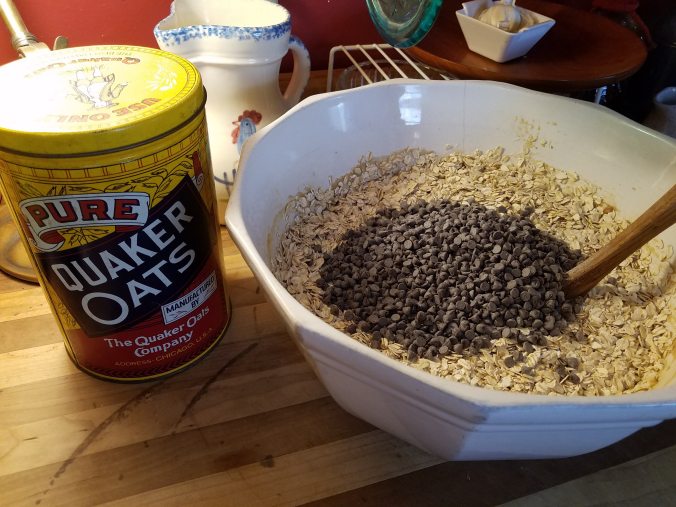
Once you have the oats in the bowl, add the mini chips too.

chips and oatmeal.jpg

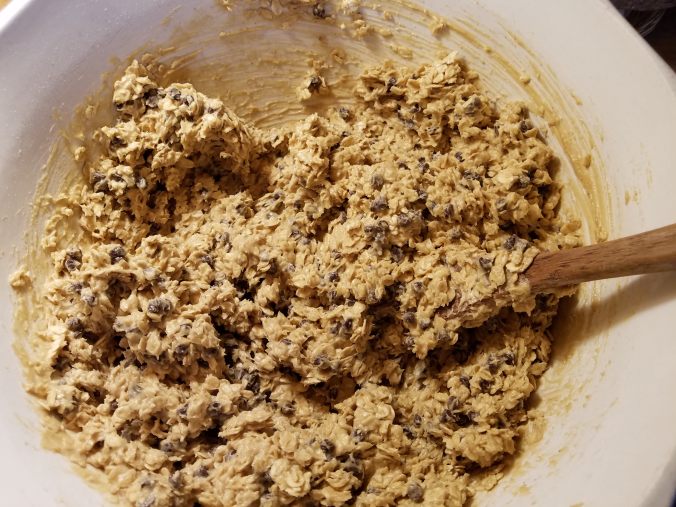
Stir it all up till it looks like this.

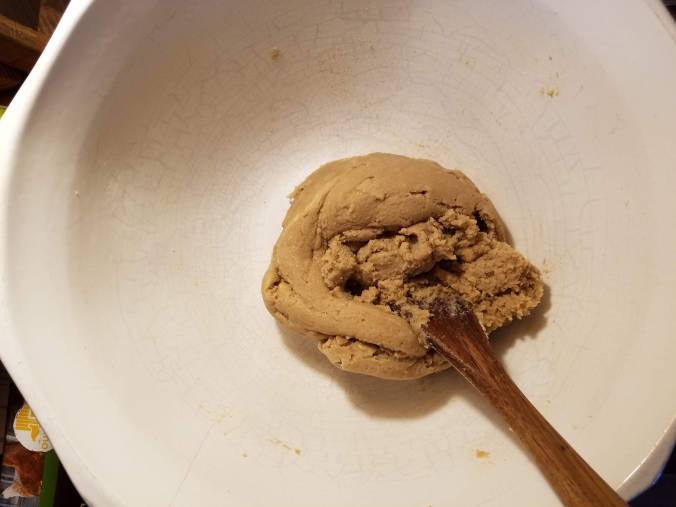
dough.jpg

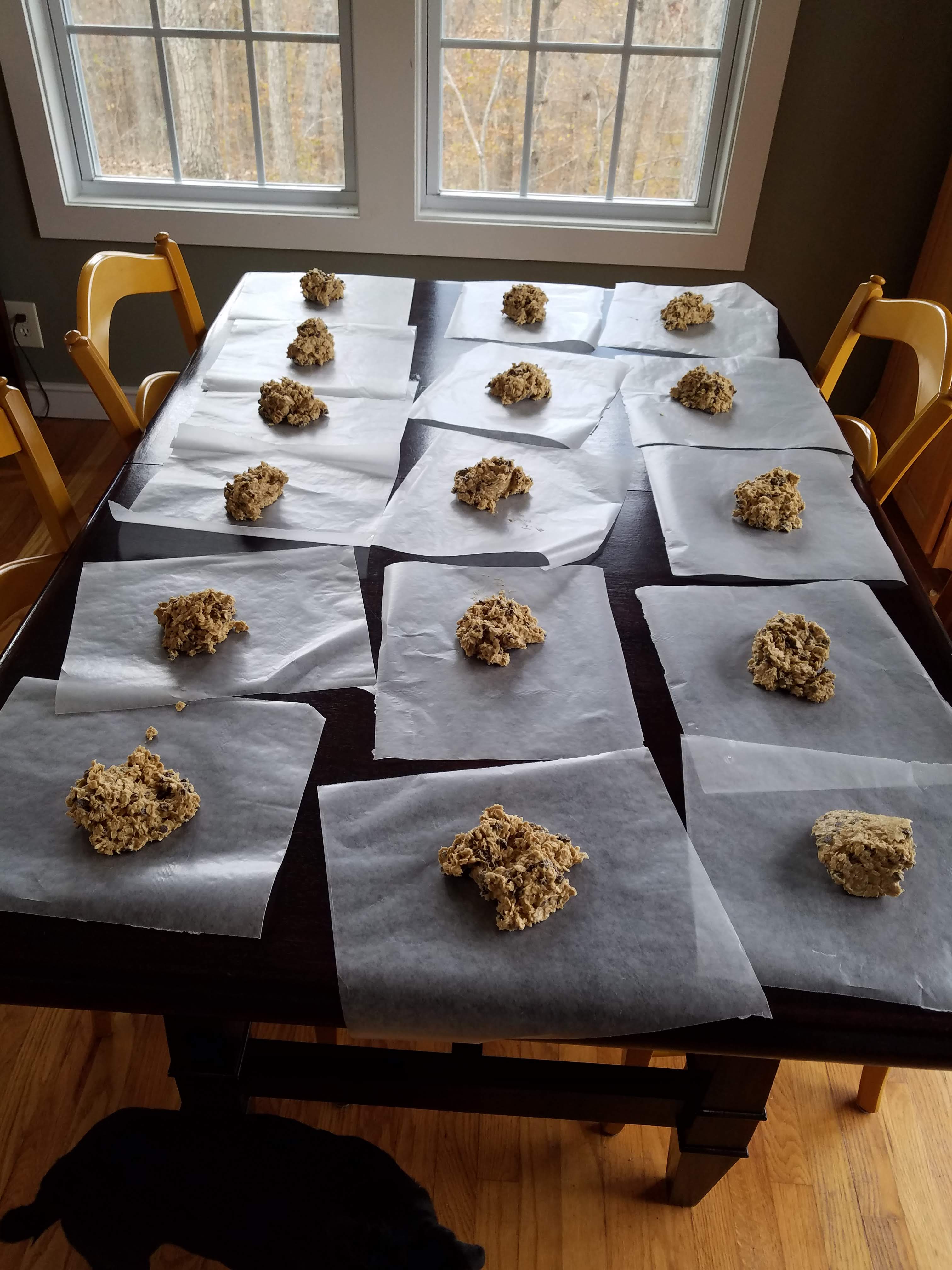
Now clear your biggest surface (for me this is my table) and lay out as many pieces of waxed paper as you want. I give my guests 8-10 cookies on a plate (under a glass dome) and have found that a log about 6 inches long yields that many cookies. That means 16 pieces of waxed paper and between ½ and 2/3 cup of dough on each one.

ready.jpg

I don’t measure the dough – I just divvy it up into approximately equal size blobs. It doesn’t matter if it’s exact. In my case it only matters that they are about the same amount, and this is the amount that makes 8-10 cookies. You can make your logs however long you want, some longer than others if you want. Just remember you need longer paper for longer logs!

To make the logs, I hold the paper underneath, cradling the dough and using the paper to help form the log.

Use your fingers from underneath to mush the dough into the log shape. I make mine about 1 ½ inches in diameter, but you can do what you like. Once you are happy with your log, wrap it up snug in the paper.

This slideshow requires JavaScript.

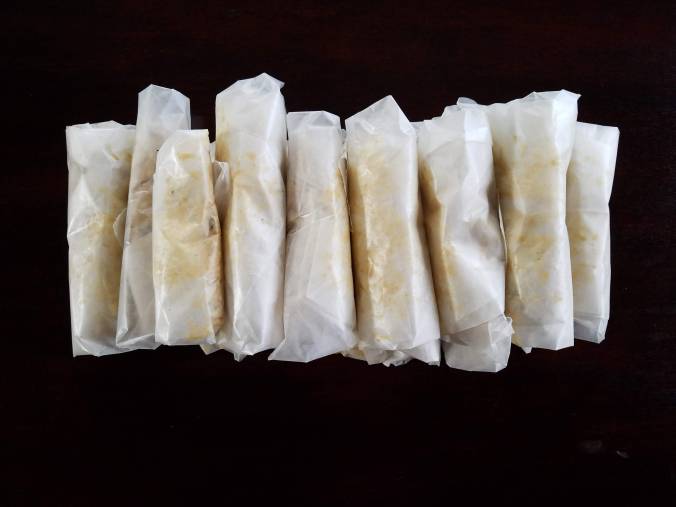
Do the same with all your blobs until you have a neat pile of wrapped logs.

wrapped.jpg

My very dark table is making them look suspended in mid-air, don’t you think? Okay, maybe not a prizewinning photo, but still cool.

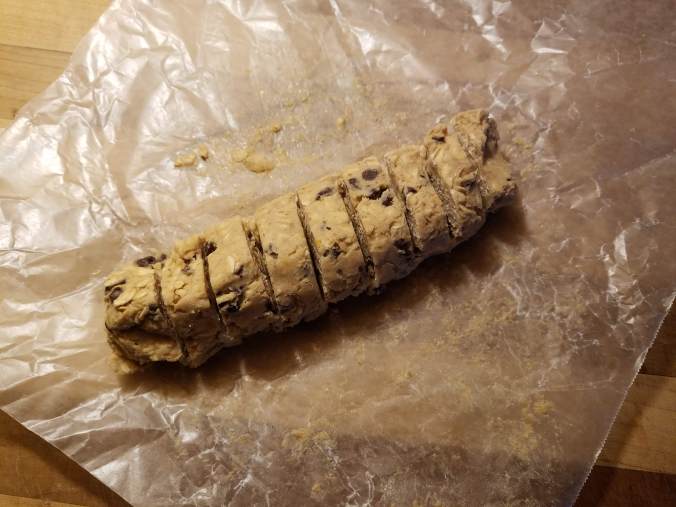
Put these wrapped logs in a plastic freezer bag and freeze them. When you are ready to bake some, take out a log and cut it into the slices about 1/2 -inch thick.

cut.jpg

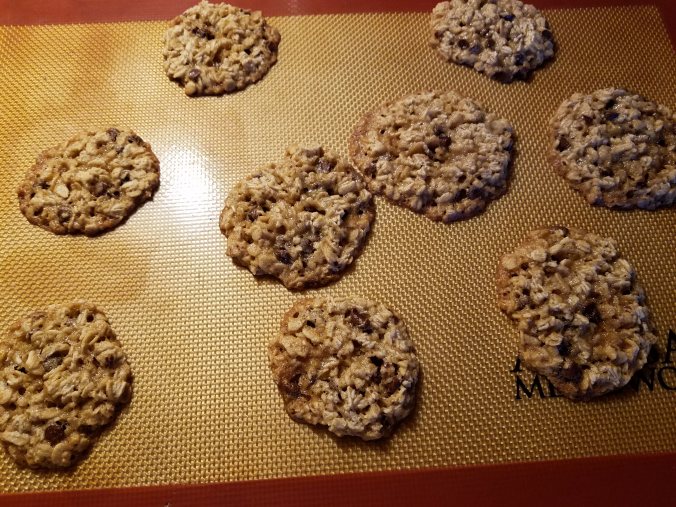
Place cut-side-down on your baking sheet and bake at 375F until they look not quite done. In my oven this was 13 minutes today. If you take them out when they look just a little bit uncooked, just ever-so-slightly brown at the edges, they will be chewier. I love them that way. If that sounds good to you, try it!

done.jpg


A Birthday Cake Worthy of Mom

My mom likes gooey frosting. If you are going to make a cake for her, that’s the first thing to know. If you are going to make her birthday cake, that’s perhaps the main thing to know. She will eat all around the frosting, saving the best for last, and savor every melt-in-your-mouth bite until it hardly looks like there was any cake at all on the plate.

I take that back. If you are going to make her birthday cake, the main thing to know is that the cake should be worthy of her. What is a birthday after all? To me it’s a time to celebrate that a person was born, that they came into the world, that they are part of your world. Clearly moms are in the enviable category of people essential to the fact of our own existence. But that doesn’t make them necessarily good, or in my case, great. I know I am blessed. My mom is amazing and I love her to no end. For as long as I can, I will celebrate her.

Last year, Mom moved to Charlottesville. For the first time in my adult life, I was close by – ten minutes from her place to be exact, as compared to six or seven hours as in the past. This year, on this birthday, she is happy and settled and nearby. Let the baking begin!

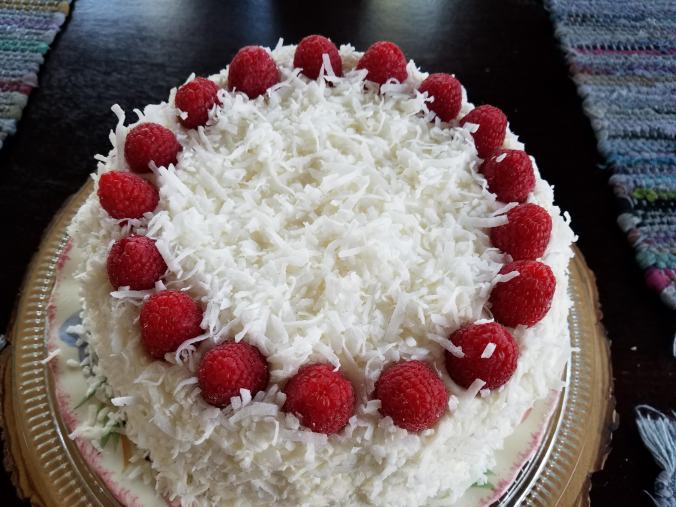
Fortunately for me, Mom not only loves gooey frosting, she also loves coconut. I’ve seen her eyeing those coconut-smothered cakes in the glass cases in bakeries. I’ve long known of her love of coconut macaroons, with or without a chocolate base. I’m safe putting as much coconut as I want on a cake. Does this look like enough? For a person who doesn’t eat nuts, oh, how I love coconut!

finished.jpg

This is the finished cake. It is two layers of sponge cake (also called genoise) with a filling of homemade lemon curd that has fresh raspberries and blueberries imbedded in it. The white fluffy frosting is a mix of buttercream and cream cheese appropriately smothered with coconut and decorated with more fresh raspberries. It is possible that I never made a cake for anyone that I was so anxious to eat myself!
The sponge cake part was new to me. What I mean is: I do not have a tried-and-true recipe for sponge cake nor do I remember ever having made one. To make this one, I did what any self-respecting wannabe baker would do, I consulted with an expert baker, or at least a credible one, which nowadays you do online. When you get a recipe online, you get not only the recipe, but often the many comments that others have made after trying said recipe. That’s a good bit of credibility, though not foolproof. I went with Natasha’s Kitchen and followed the instructions for her easy sponge cake.

One of the comments had to do with the consistency of the batter after it has undergone eight minutes of whipping in your stand mixer. The instructions said to whip the batter for 8-10 minutes and a reader said she had a trick to know if you had whipped it long enough: Detach the whisk attachment, lift it above the batter, make a figure 8 and see how quickly the 8 sinks into the batter. She said if you can count to ten and the figure 8 is still visible, you had whipped it long enough. At eight minutes (I used my phone timer) I stopped and did this trick. My figure 8 sank before I had counted to 2. I gave the batter another two minutes of whipping. It sank again. Uh-oh. Natasha said 8-10 minutes of whipping. I gave it one more minute on high and my 8 still sank. That’s where I said Bother this, it has to be good now, and poured it into the pans. It was very good.

The best part of this recipe is the suggestion to cut out circles of parchment paper for the bottoms of the cake pans. After the designated baking time, I let the two layers cool in their pans for ten minutes or so on a rack, then took them out of the pans, and let them cool the rest of the way, they wrapped them tightly in plastic wrap and froze them. This paper peeled easily off the frozen cake layer when I was ready to assemble and frost the cake. Another hint if you try this recipe. Use three pans instead of two. The amount of batter the recipe makes divided into my two standard cake pans spilled onto the sides of the pan. In the end this meant trimming off the edges when I took the cakes out of the pans, which left me having to eat them! Oh, yummy preview! Hmmm, maybe this extra, spilled-over part is not such a bad thing?!

Sandy brought marvelous raspberries the day before, and they are so pretty and so delicious, I wanted to use them in and on the cake. But they need something to sit in. On top they will sit in the frosting but in between the layers they needed something. Lemon curd seemed just right. Again I went online, this time to Taste of Home, having never made homemade lemon curd.

Again I followed instructions, and again the mixture didn’t seem thick enough after the amount of time it said to stir in a pot over a flame. I got impatient at that point and put a teaspoon of cornstarch in a cup and added just enough water to stir it into a thick paste, then added that paste to the hot lemon mixture. This worked. I can’t say whether the curd would have been fine with more patience and without my remedy. Probably it would have.

My last bit of improv concerned the frosting. You make a buttercream frosting with butter, confectioner’s (powdered) sugar and a little milk (and vanilla if you want but I ran out last time I used it, and know I have another bottle around here but couldn’t find it, so no vanilla this time). Again I used the stand mixer because I wanted the frosting really fluffy, so I let the whisk beat it like mad for ten minutes or so. But I got concerned that I didn’t have enough frosting for the sides and top of the cake, and I used up all the powdered sugar I had, so I decided that I could add some leftover cream cheese frosting (from another cake sometime recently) just to make sure there was enough. I let this all whip together in the mixer. When I relayed this story at the table while we were eating the cake, my daughter Marie said this example of make-do illustrated my lifelong culinary style. So be it. The frosting worked 😊
The last essential birthday cake element in my house is the plate that is used for the Birthday Girl’s piece (or Boy’s, as the case may be). Long long ago I got this plate and have always brought it out along with the other plain dessert plates. I am not good with balloons for calling attention to the person we are celebrating. But a plate I can do!

my birthday plate.jpg

I can’t say I like this plate’s design all that much, and have never been crazy about the orange, but it’s what I have and what we’ve used and it serves! Mom’s piece went on this plate.

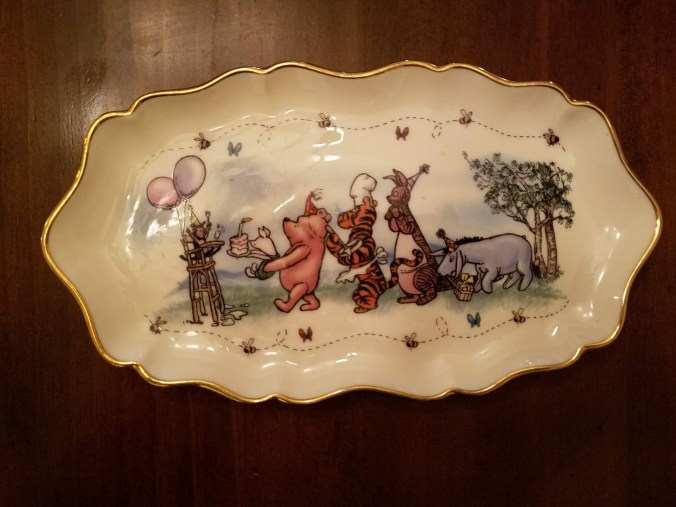
Whether or not my children follow this birthday-plate tradition, I don’t know. But I hoped they would. At one point a few years ago I searched on ebay and got them each a birthday plate. My favorite is the one I found for Marie. I have always been enamored with the original Winnie the Pooh stories and illustrations. Could there be a better Happy Birthday plate than this? I hope she uses it on everyone’s birthdays!

Marie's birthday plate.jpg

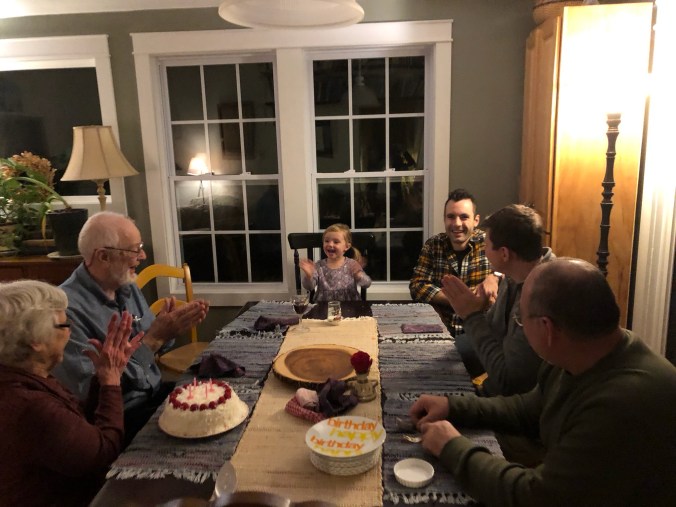
Our tradition, like many people’s, is that we bring the cake with lighted candles in from another room while singing Happy Birthday.

We sang,  Mom blew out her candles and we celebrated this wonderful lady I get to call Mom!

53746blowing out candles.jpeg

celebrating

Where our tradition differs from most people’s perhaps is that after the Birthday Girl or Boy blows out the candles, she or he gets to make the first slice into it. They do not cut their whole piece, just the first slice into the cake, which Marie said was my way of retaining control over portion size, but this is not actually true – that’s just the way my mom did it, so I did! Mom never explained why she did it, but the way I always saw it was that the Birthday Girl or Boy gets to be involved, gets to start the process, but is not burdened with the work of cutting up the cake (which, c’mon, can be messy and tricky and require more concentration than a person celebrating a birthday can rightly be expected to have at that moment) – a perfectly plausible alternative reason to do it this way, wouldn’t you say!?
Mom cut the first slice and I so enjoyed watching her enjoy her piece – down to the last bit of gooey frosting! And I enjoyed mine too!

Creamy Rice and Cheese Croquettes

I am on a roll with recipes because my daughter and her husband and their darling little ones are coming to visit for five days. I have more food in the house than we could eat in two weeks, but I’m ready for them! Besides bananas, grapes, a persimmon (thank you, Jerry!), banana muffins, coleslaw in a jar, salad fixings, bracciole, manicotti and numerous other things, I now also have a pile of creamy rice croquettes ready to reheat in the oven one of these evenings.

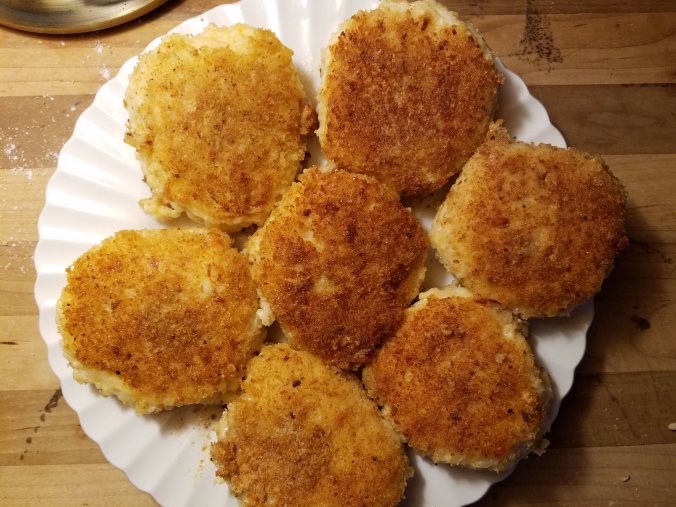
If you like mac and cheese, if you count it as a comfort food, if you enjoy the creamy cheese sauce complementing the texture of the pasta, get ready for a variation that adds a little crunch and a little spice. These croquettes use rice instead of pasta, and are bound up in a cheddar cheese sauce that’s flavored with paprika, formed into a patty and pan-fried.

patties done2.jpg

The recipe is another one from my mom. Thanks, Mom! I had these as a kid and made them for my own family as well. They are another tried-and-true. Gotta love tried-and-true.

You cook up the rice, set it aside (even overnight), make a regular roux and add extra egg yolks and a bit of paprika, and stir together the rice, the creamy roux and the cheese. Quantities are as follows (I quadrupled this recipe today, so I needed my biggest bowl!)

1 Tablespoon butter

2 Tablespoons flour

½ cup milk

2 eggs, separated

2 cups cooked white rice* (2/3 cup uncooked**)

½ cup grated sharp cheddar cheese (Cabot cheddar from Vermont gets my vote!)

¼ teaspoon paprika

1 teaspoon salt

1/8 teaspoon pepper

1 cup fine bread crumbs

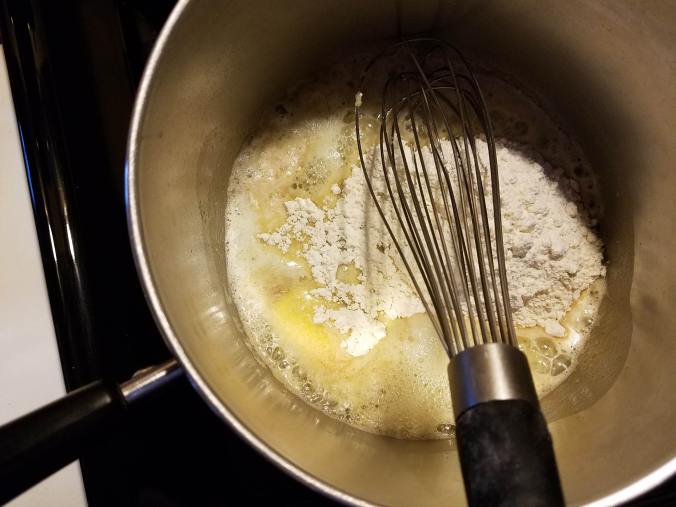
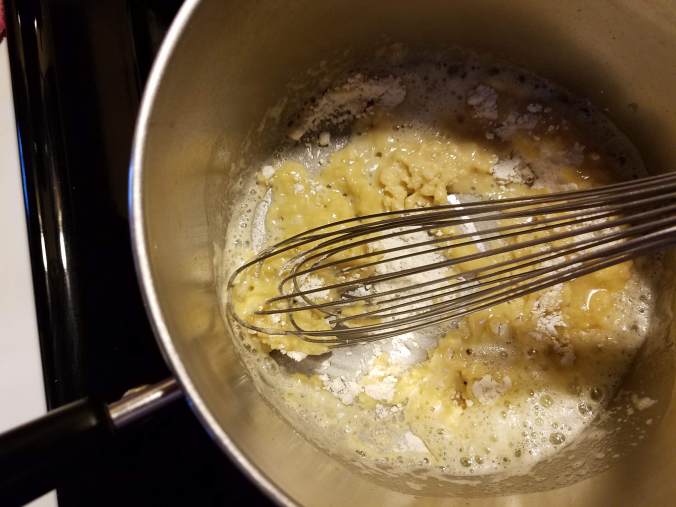
If you have never made a roux before, you’ll be glad to learn the technique. It comes in handy for thickening so many things – not only cheese sauces, but also many gravies and soups. Melt the butter in a saucepan over a medium flame and add the flour.

roux1.jpg

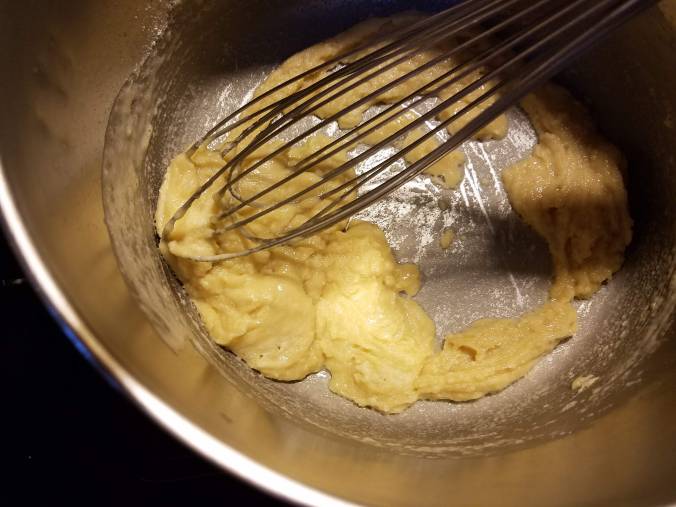
Whisk together until it begins to pull away from the pan. Get all the flour whisked in.

roux2.jpg

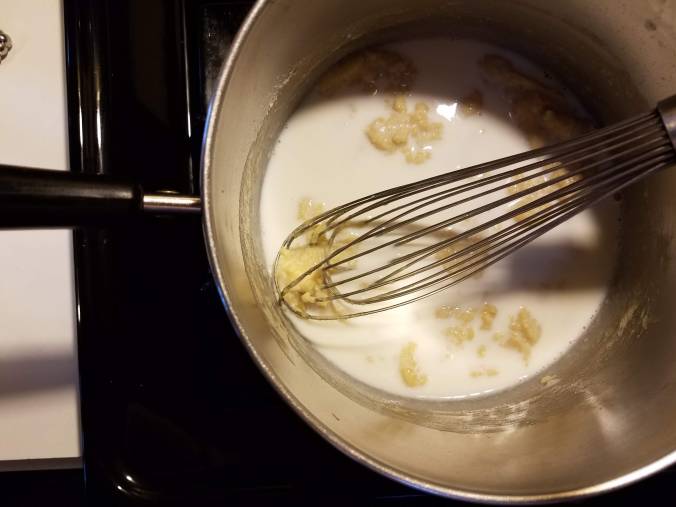
Add the milk in increments, stirring carefully until the milk is thoroughly incorporated and the texture is smooth – each time you add milk, bring it to smoothness again. This is with the milk just added.

roux4.jpg

This is with the first addition of milk incorporated.

roux3

And with about 2/3 of the milk stirred in.

roux6.jpg

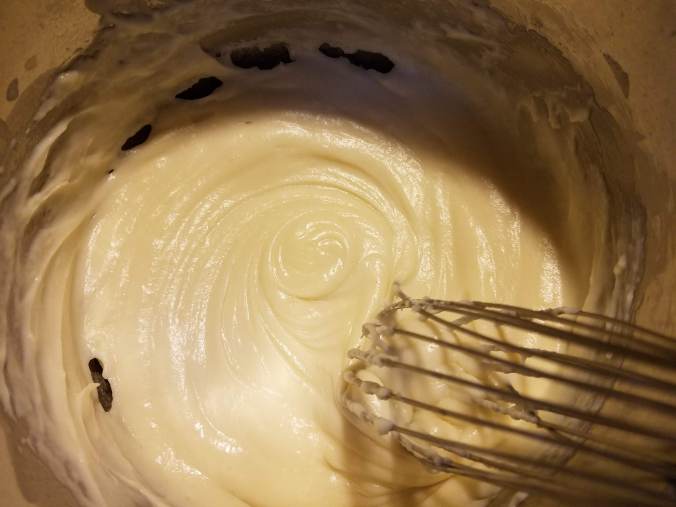
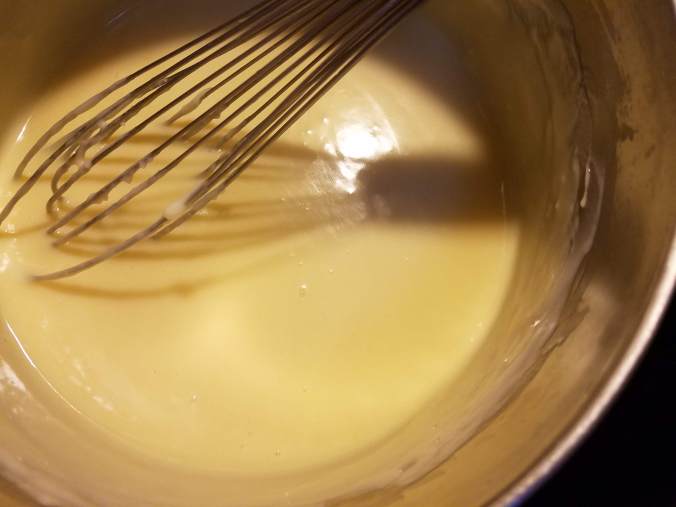
By the time you add all the milk, the roux is a thick, smooth liquid and looks velvety smooth like this.

roux7.jpg

Now is when you add the egg yolks. Whisk them right in. If you forget, you can add them when you are mixing the rice together with the cheese and sauce (not that anybody I know did that… this time…).

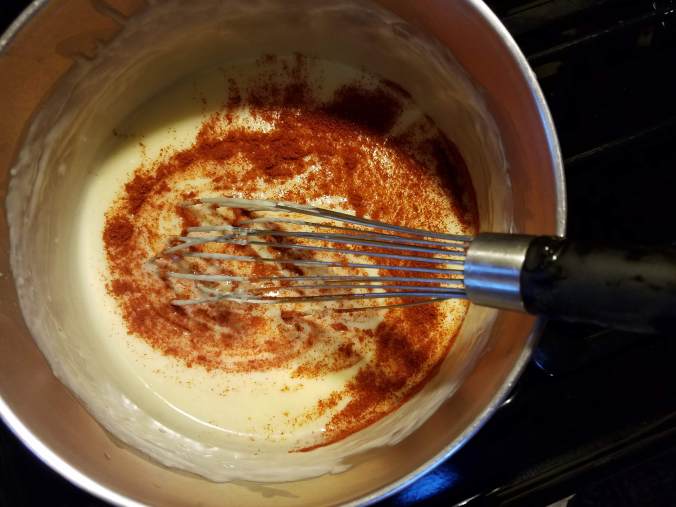
I love adding the paprika because it is such a pop of color.

roux adding paprika.jpg

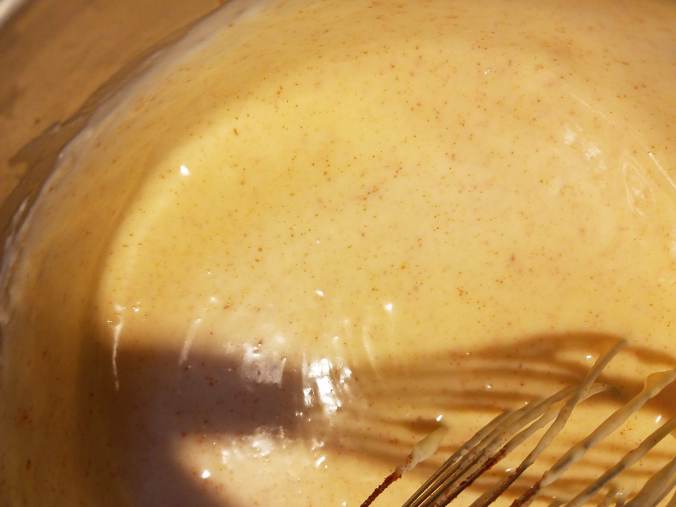
Mixed in, the speckles are still pretty!

roux with paprika.jpg

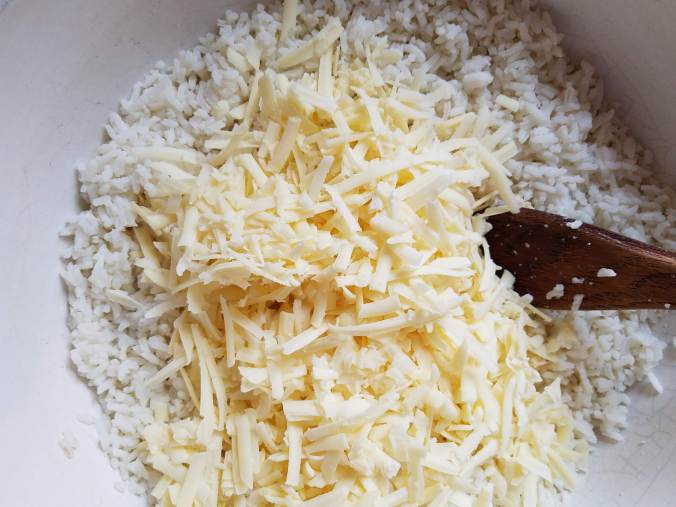
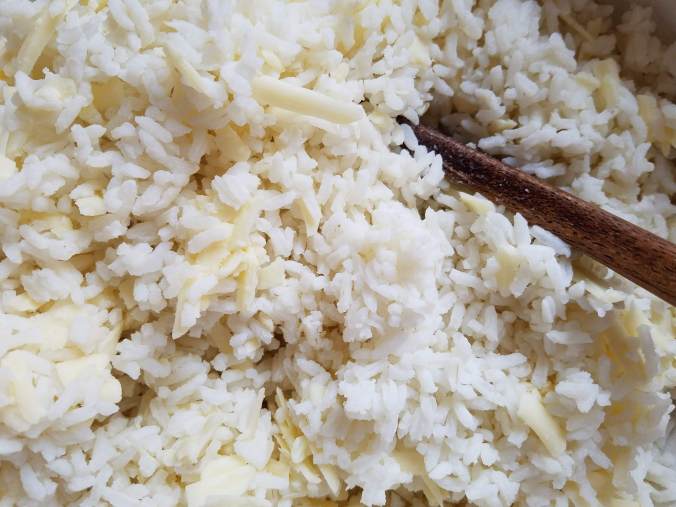
I had made my rice the day before, so it was cold in the bowl. To this I added the grated cheese.

rice and cheese.jpg

And mixed it in.

rice and cheese2

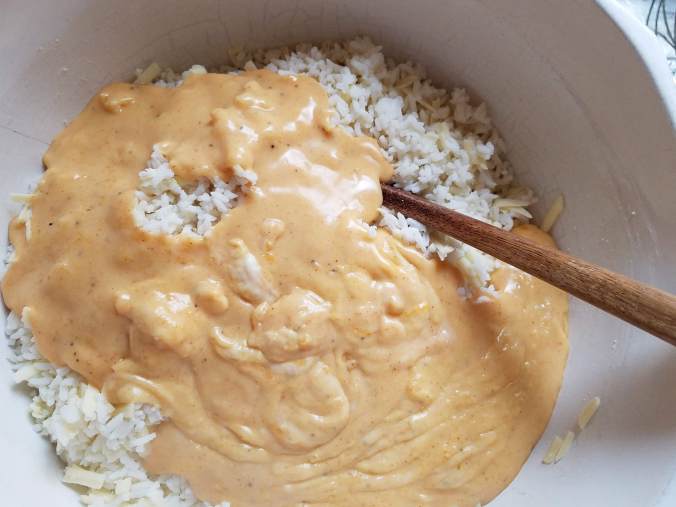
Then I poured the sauce over the top.

sauce in.jpg

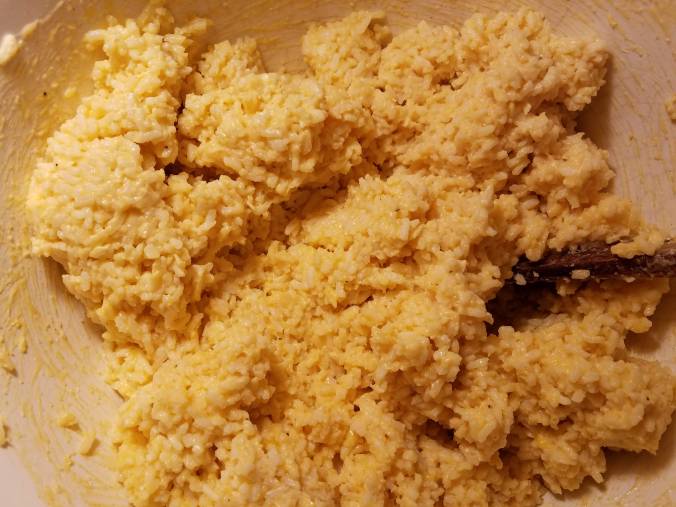
And mixed it in.

sauce mixed in.jpg

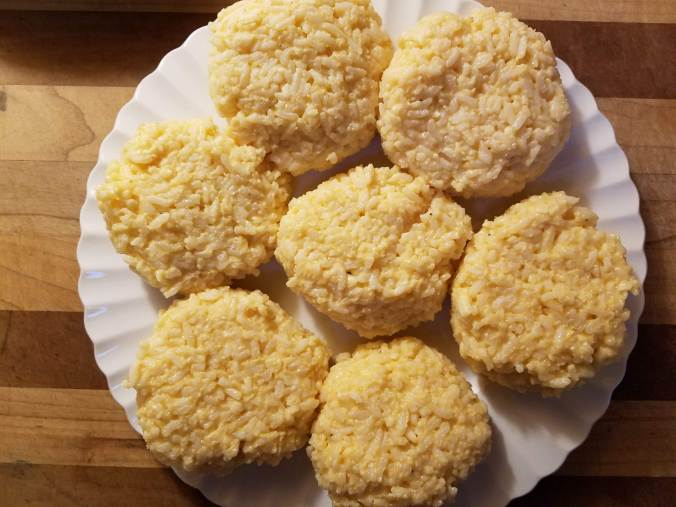
To form the patties that become croquettes, I tried both with and without plastic gloves. The gloves worked better! My croquettes looked like this, but you can make yours any size or thickness that suits you.

patties.jpg

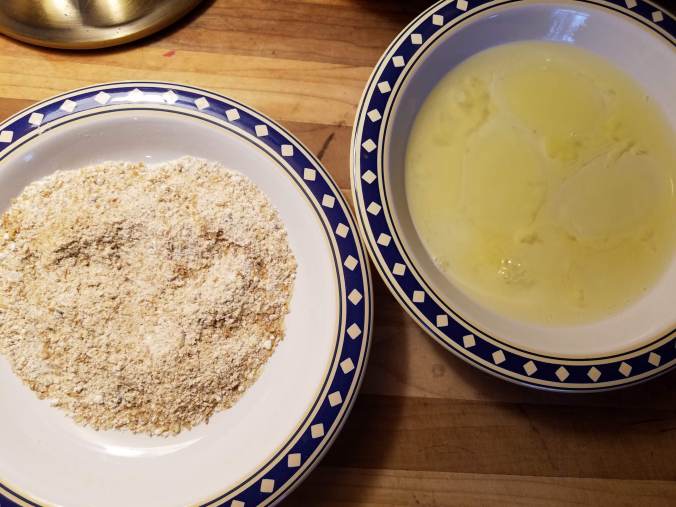
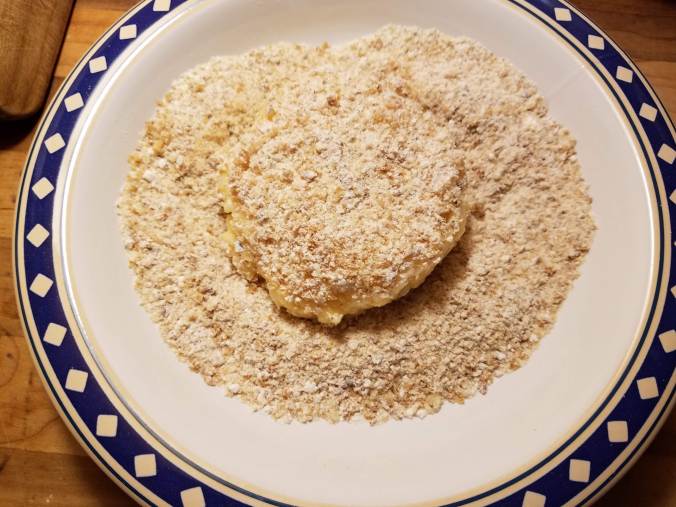
The egg whites are for the breading process. Dredge the croquettes first with egg white, then with crumbs. I like to mix a few tablespoons of flour in with my bread crumbs. I use two forks to move the croquettes from one bowl to the next – carefully. Forks make this part a little less messy than doing it with your hands, but try not to break the croquette! (I broke one today, but someone has to taste-test and that would be me! The broken one serves this purpose very well.)

I use shallow soup bowls for the bread crumbs and egg whites.

egg and bread crumbs.jpg

Once breaded, the croquettes look like this.

patty in crumbs.jpg

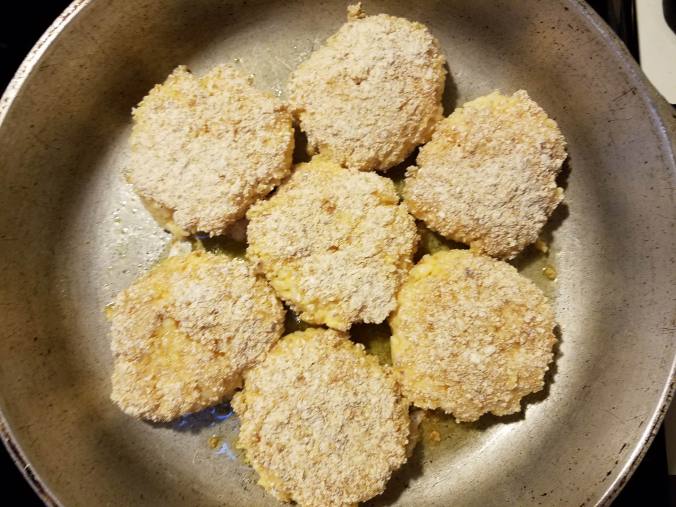
Pour a few tablespoons of olive oil in your favorite flat-bottomed frying pan. Turn on the flame and let the oil get hot for about a minute (not so hot that it’s smoking though!).

And into the pan go the patties!

patties in pan.jpg

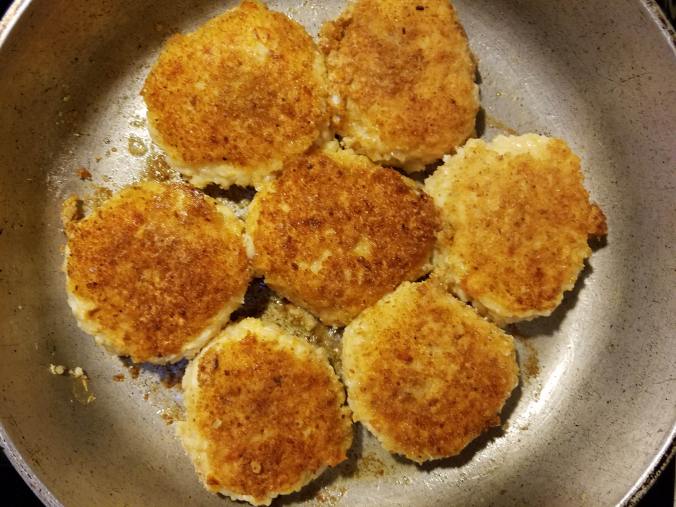
I made so many croquettes today (instead of 2 cups of cooked rice, I started with 8!), I needed two pans. One was my largest copper-bottom Revere Ware that I’ve had for 30+ years. Love that pan. The other (the one you see in these photos) is cast aluminum and has been in my family since 1947. I know this because my grandfather scratched 1947 into the inside of the lid to this pan. Love this pan too.

patties flipped.jpg

Once you flip the croquettes, you start to want to eat them! This is when I discovered an advantage to making so many! No one will notice one more missing…

Just like mac and cheese, these rice and cheese croquettes are a main dish that’s great with a salad next to it. But unlike mac and cheese, if you make a lot like I did, you can freeze some. When you are ready for them in a few weeks, take them out, let them thaw, and reheat on a baking sheet in a 350F oven for 25 minutes. Simple, done, yummy!!
Notes:

*Of course you can use any rice you like: brown, wild, whatever!

**To cook white rice, bring to a boil double the quantity of water as rice. So for one cup of rice, boil two cups of water. When the water is boiling, slowly pour the rice into the water, add a teaspoon of salt, stir to make sure none of the rice is clumping, cover, turn down to low, and set the timer for 20 minutes.

Mom’s Delicious Bracciole

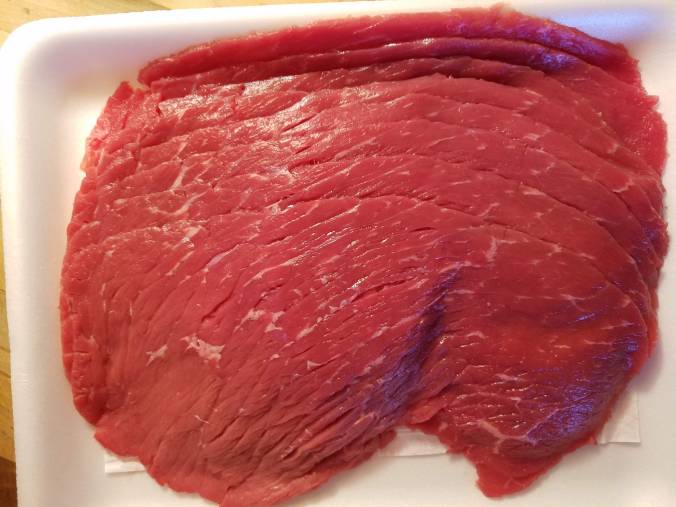
My daughter and her family are coming to visit and it’s Mom’s birthday on Sunday, so I am making a special dish – manicotti (prepared with homemade crepes) – a meal Mom doesn’t make for herself very often. I planned on having a good baguette, warmed up, and a big green salad on the side, as well as some pan-fried Italian sausage, always a delicious extra protein. But yesterday I happened to see “Beef Top Round Thin Cut” in the meat case and thought Why not make bracciole?  That’s what any person would think if they saw meat like this, right?

meat in package.jpg

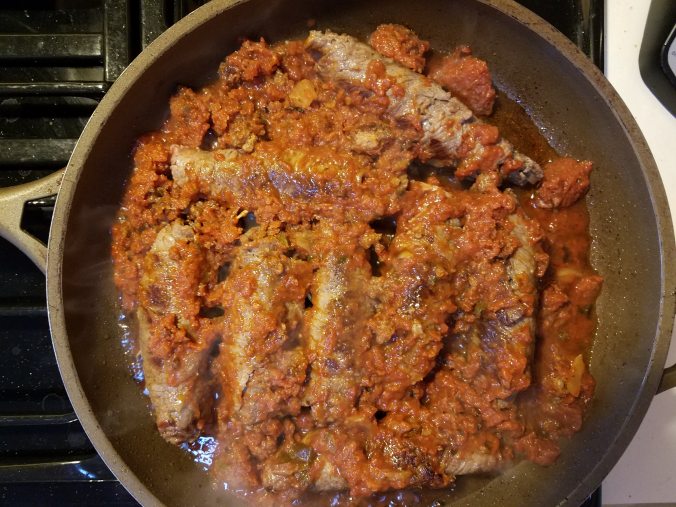
When I was a kid, Mom would make bracciole (pronounced brah-zho-lie) every now and then. I’m not sure why it didn’t appear on the table more often, maybe Mom will tell us. Bracciole is thinly sliced beef, rolled up with yummy parmesan or romano cheese and bread crumbs inside (that cheese was affectionately known in my family simply as “grating cheese”), seared in olive oil, then covered with your best red spaghetti sauce (affectionately known in my family simply as “sauce”) and cooked until tender. Oh yum!

finished.jpg

I asked my sister Lynn for her recipe because it’s not in my cookbook and I wanted to be sure I made them just like Mom used to. Perhaps I don’t have the recipe in my book because it’s so simple I thought I didn’t need the recipe? Lay out the meat, put bread crumbs, grating cheese and salt, pepper and seasonings on top, roll, secure, sear, smother in sauce, cook till done.

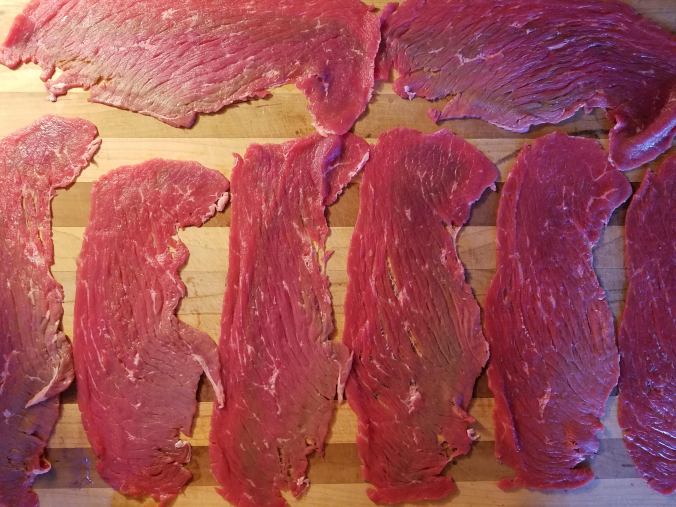
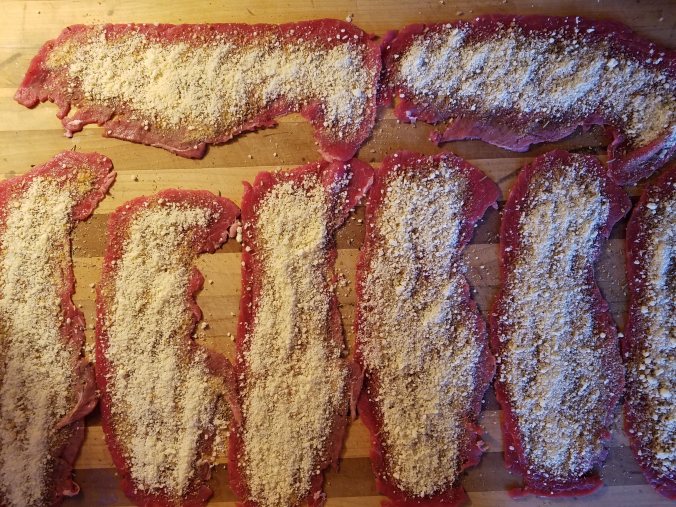
One step at a time, and with measurements, that process looks like this. My package contained eight slices. Start by carefully separating the slices from each other and laying them on a flat surface.

meat.jpg

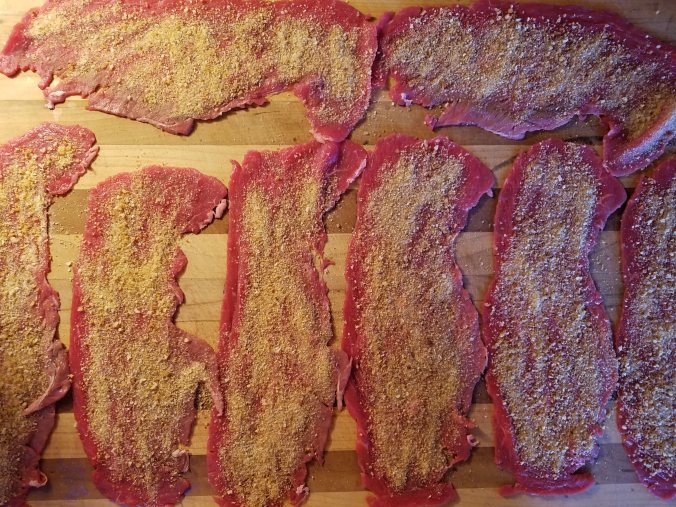
One half cup of bread crumbs was just the right amount to sprinkle on these pieces. Lynn’s recipe called for seasoned bread crumbs but I didn’t have those, so I sprinkled Italian seasoning on the crumbs. If you don’t have Italian seasoning as a mix, use basil, oregano and garlic powder. I bet the Italian seasoning had parsley in it too, but I cannot be sure. Go with parsley too. One tablespoon of the mix was enough for these eight. Some people would use chopped fresh parsley, basil and oregano and minced garlic instead of the dried seasoning. I’m sure this is also wonderful. But in my family we kept it simple.

with bread crumbs.jpg

I sprinkled salt and pepper on them too, then ¾ cup of grated parmesan cheese.

ready to roll.jpg

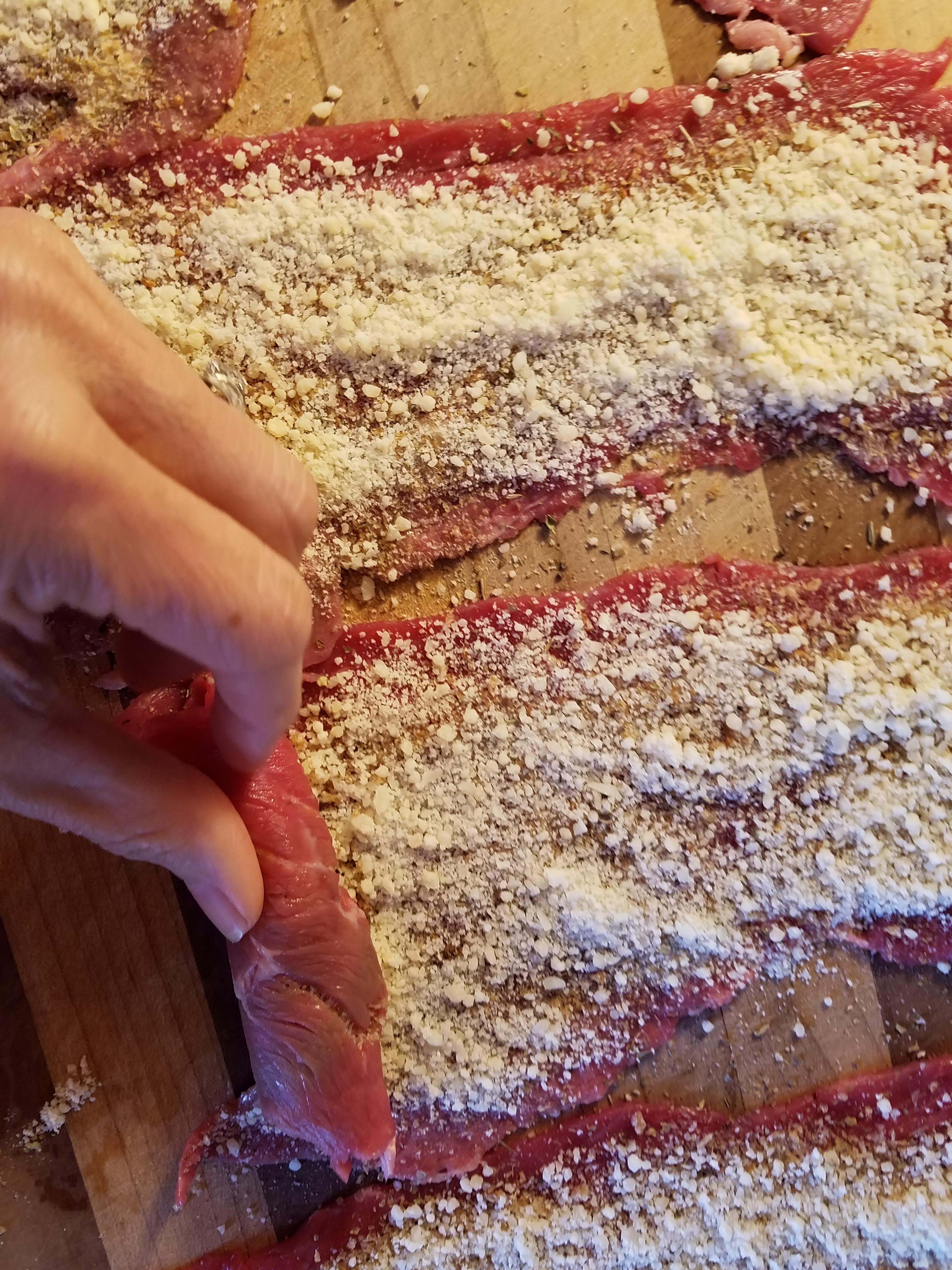
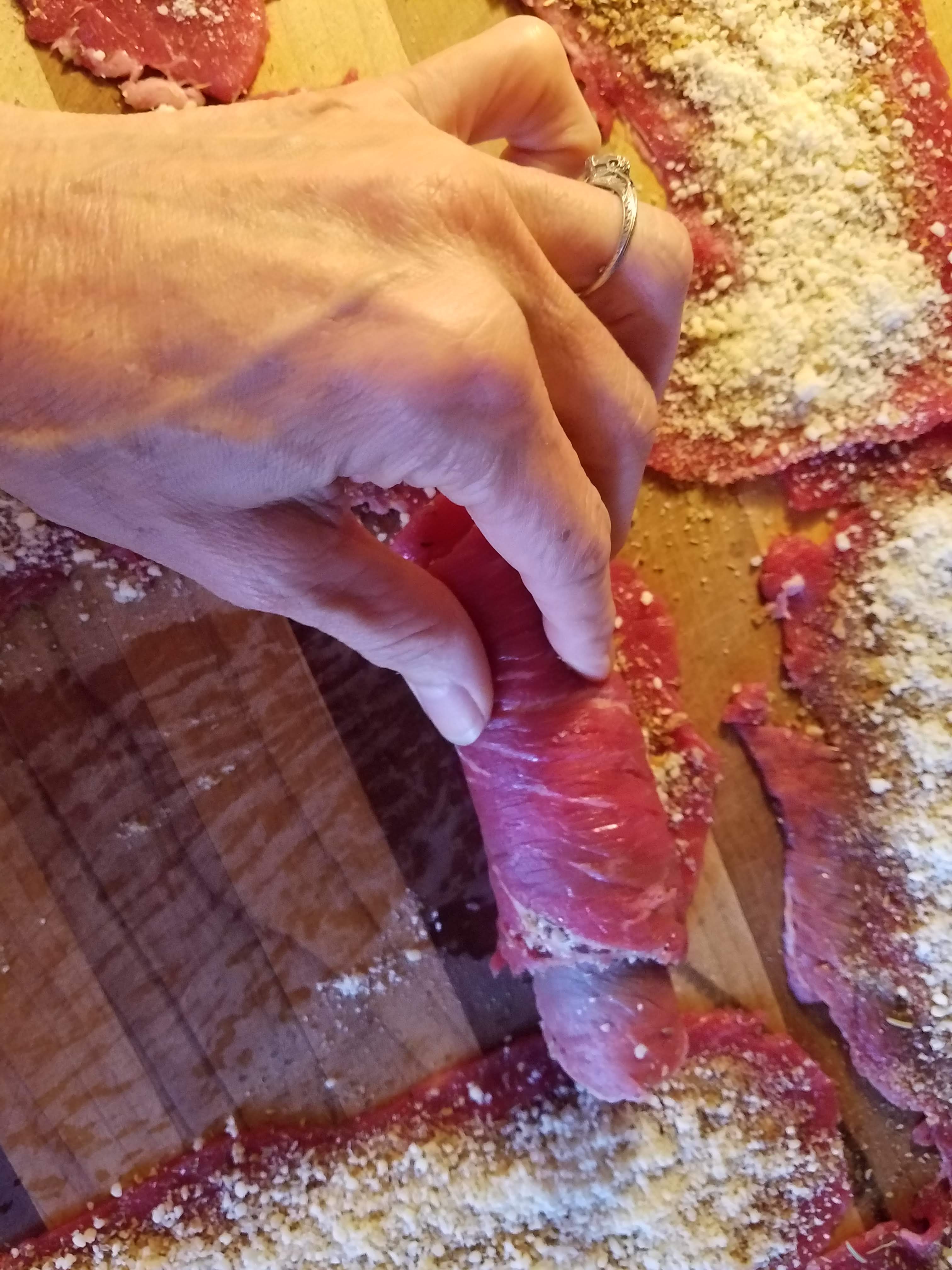
Let the rolling begin!

rolling.jpg

Nice and tight.

Normally I would roll with the fingers of both hands, but it’s mighty challenging to roll with two hands and take a photo with your phone at the same time! I can roll with one hand, but using two goes faster.

rolling3.jpg

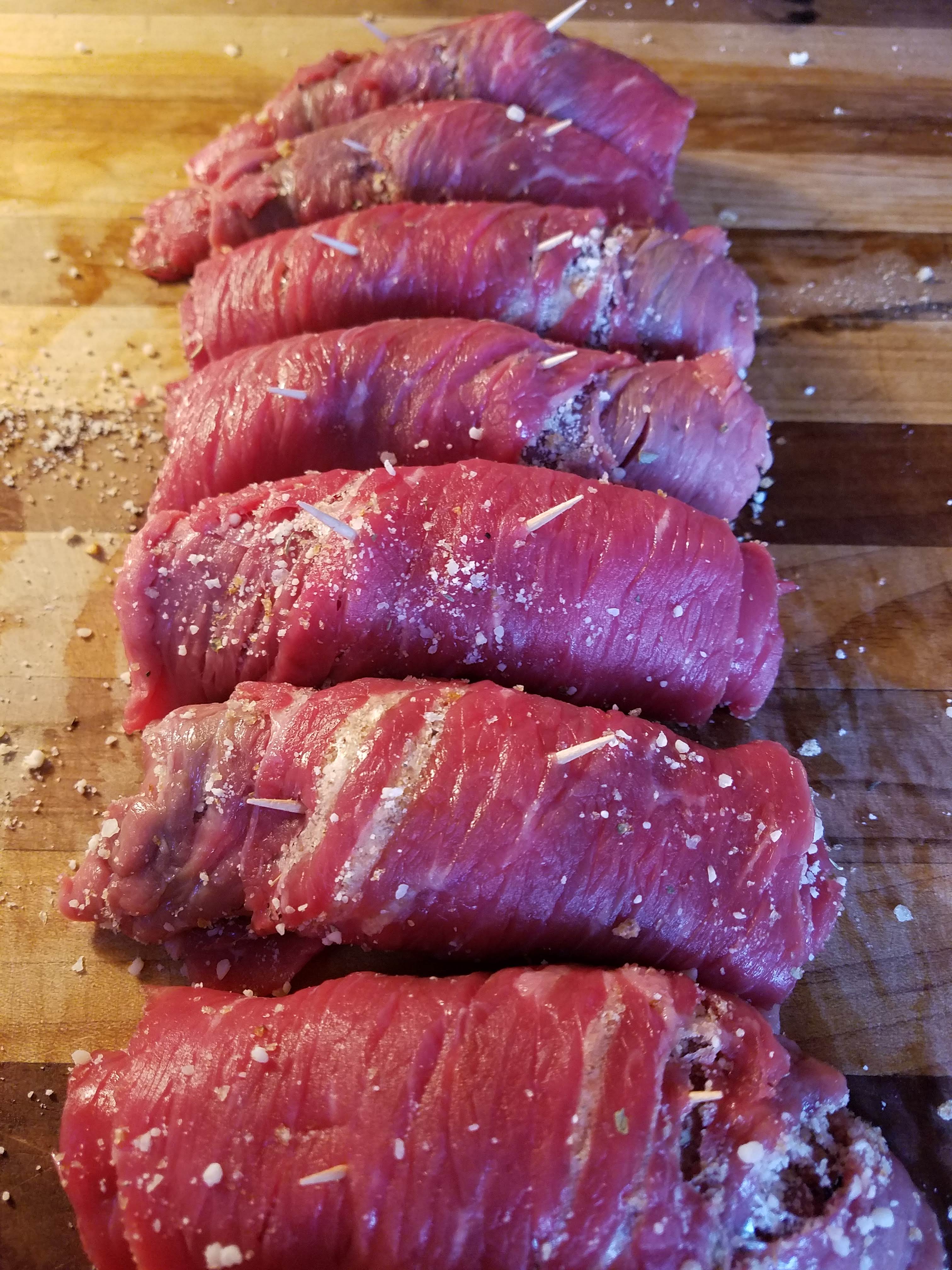
My rolls looked like this.

rolled and ready.jpg

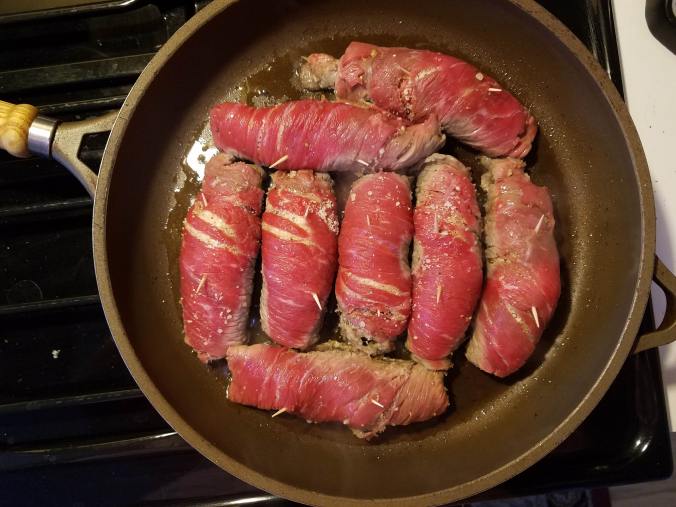
Do you see the toothpicks? I used two in each roll, stuck in at angles so they crossed each other in the middle. This holds the roll together during the searing process. You could also use string, the kind that holds pastry boxes together. I couldn’t find any string so I managed with toothpicks. It’s a little harder to get the sides all seared in the pan when you use toothpicks, but somehow I got through that.

Into the pan I put about 3 tablespoons of olive oil, enough to coat the bottom well, and let it heat up for a minute or so on a medium flame. Then into the hot pan went the meat rolls.

in pan.jpg

Give them a few minutes to brown on that bottom side, then turn them to brown them on another side. Turn again when the second side is brown and let a third side brown. Now depending on two things (1. your level of patience and 2. whether you’ve browned them in thirds or fourths), you might need to turn them one more time.

By this point your kitchen smells really good, by the way.

seared.jpg

Once they are seared to your satisfaction, douse with red sauce (meat or marinara, whichever you like best) and turn the heat down to low. Cover and let this cook about an hour.

I let mine cool, removed the toothpicks, put them in a serving dish and covered them tight. I will heat them up again on Sunday (will probably just put my serving dish in the oven for half an hour on 325F) to serve with the manicotti. I have no doubt they will be scrumptious!

Soon I will show you how to use the same thinly sliced meat to make rouladen, the German variation of this dish, also totally delicious, but rouladen would not go with manicotti!

A New Twist on Cole Slaw

You can never be quite sure what’s going to do well in the garden. Last year I had cucumbers galore, this year not so many. Last year the beets were few and far between, this year lots. I planted both red and green cabbage this year. The reds were so pitiful, I didn’t bother even trying to salvage anything from them. But the greens!

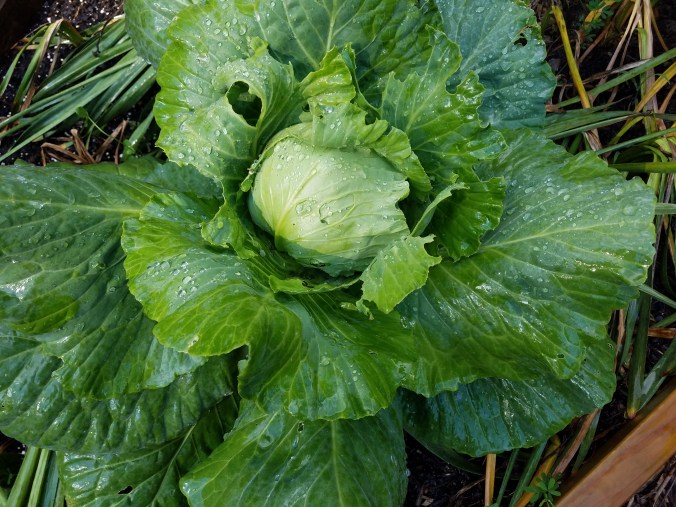
6 (9).jpg

It’s hard to tell size from this picture, but that head is almost as big as a volleyball.  They don’t come one at a time. I had six at once in June. What do you do with six large heads of green cabbage?

I shredded one head and sautéed it with sliced onion and a little bacon for flavor. A little salt and pepper and 45 minutes on a low flame (covered) makes a very fine side dish. I wrapped three heads carefully and put them in the fridge downstairs. That left two. Cole slaw is nice, I thought, but I am not as wild about using mayonnaise in dressings, and I don’t buy bottled dressings. Vinegar and oil would work, but I wondered about lemon, so I experimented.

I chopped up two heads very fine, added chopped red onion and shredded carrot and made a lemon dressing. Yum! Two heads of cabbage make a lot of cole slaw, so after the meal I packed the remainder in wide-mouth quart-sized mason jars and refrigerated it. I found that the flavors got even better the next day and the next. I gave one jar to my neighbors Jen and Quin, and one to Lincoln and Julia, and they loved it too.

A few weeks later I made more, using the last of the garden heads, and we enjoyed it just the same. That was in August. Today I got a hankering for Lemon Cole Slaw again.

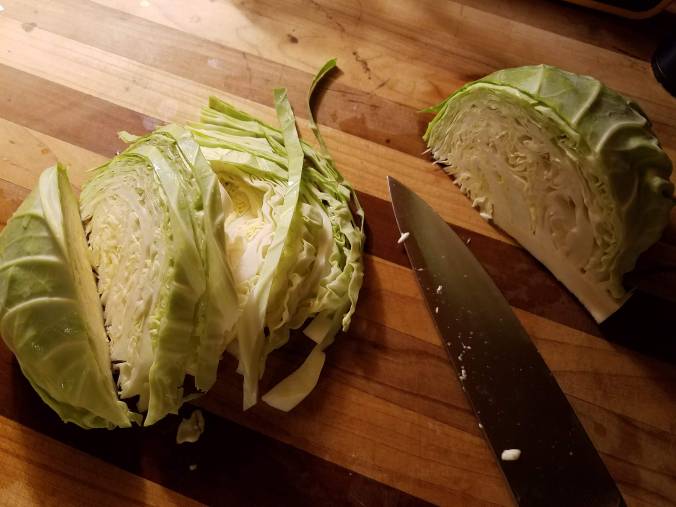
Get yourself a nice head of green cabbage. (It’s very cheap!) Chop it fine. I use my 10-inch chef’s knife, preferring to do it by hand because 1. I control the size of the chop and 2. I get a bit of a workout which makes me feel better about dessert 😊

Start by quartering the head and cutting out the core. Slice like this first:

chopping.jpg

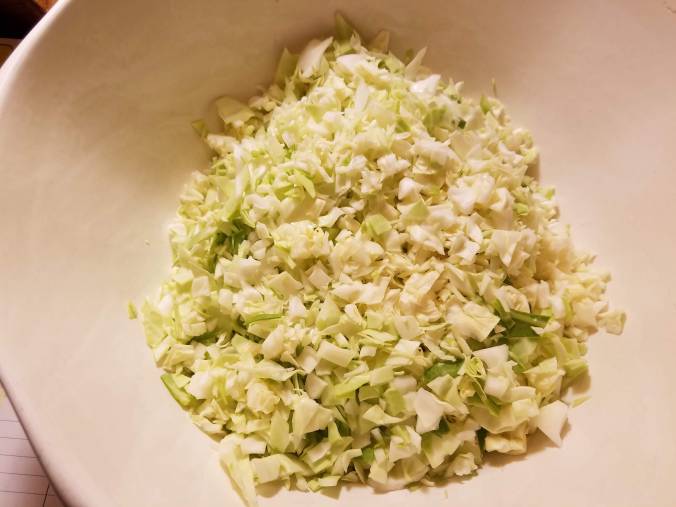
Then crossways until it looks like this.

chopped fine.jpg

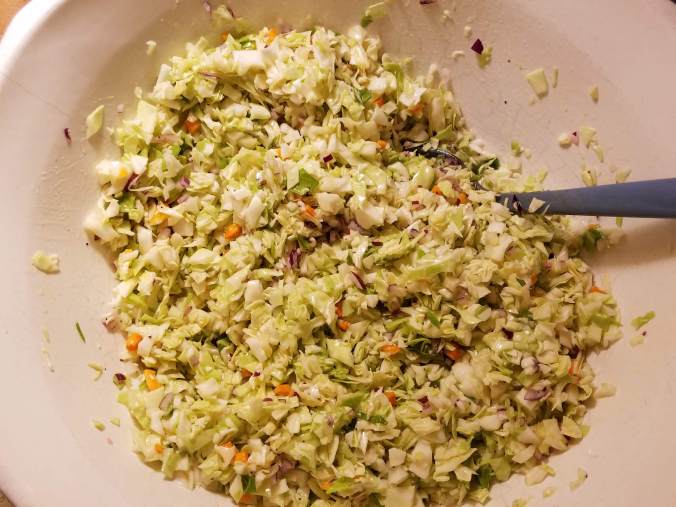
Certainly you may use a food processor or some other chopping device. I like to add red onion and carrot for both color and flavor. To the one head of cabbage I bought and chopped finely today, I added two finely chopped red onions (each onion was the size of a golf ball) and four small carrots from my garden. Use however much of each as seems reasonable to you. Use a big bowl. The biggest one you have is probably best.

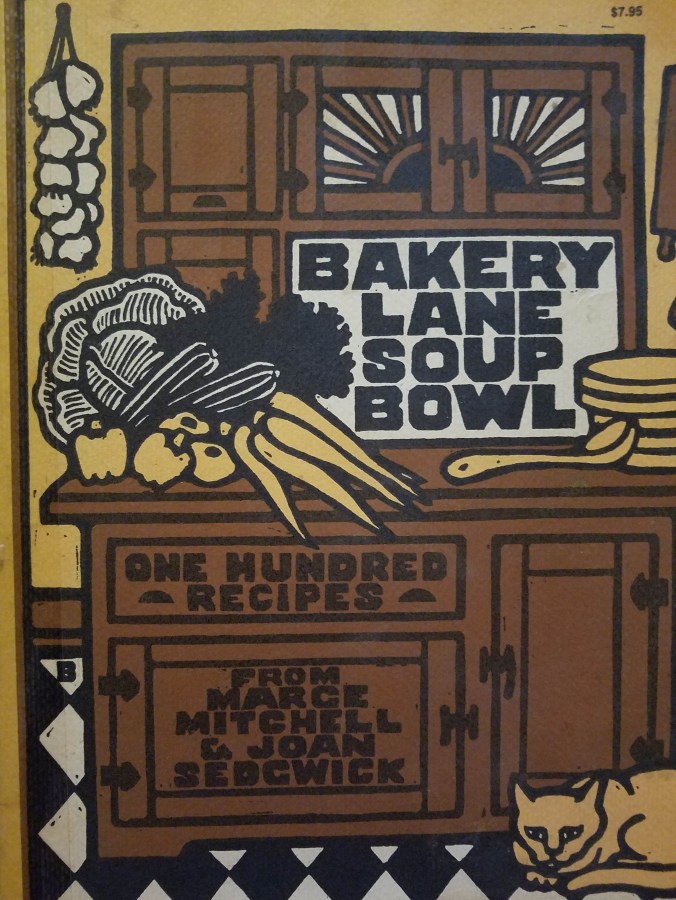
For the dressing, I adapted the sweet-sour dressing I use for Carrot-Raisin Salad from a favorite old (1976) cookbook called Bakery Lane Soup Bowl.

bakery lane (2).jpg

For the lemon dressing I used 1/3 cup sugar, ½ cup lemon juice, ¼ cup olive oil and salt and pepper to taste (for me that’s about 1 ½ tsp salt and ¼ tsp pepper). The salad looks pretty once you mix it all up with the dressing and it tastes light and refreshing.

in bowl.jpg

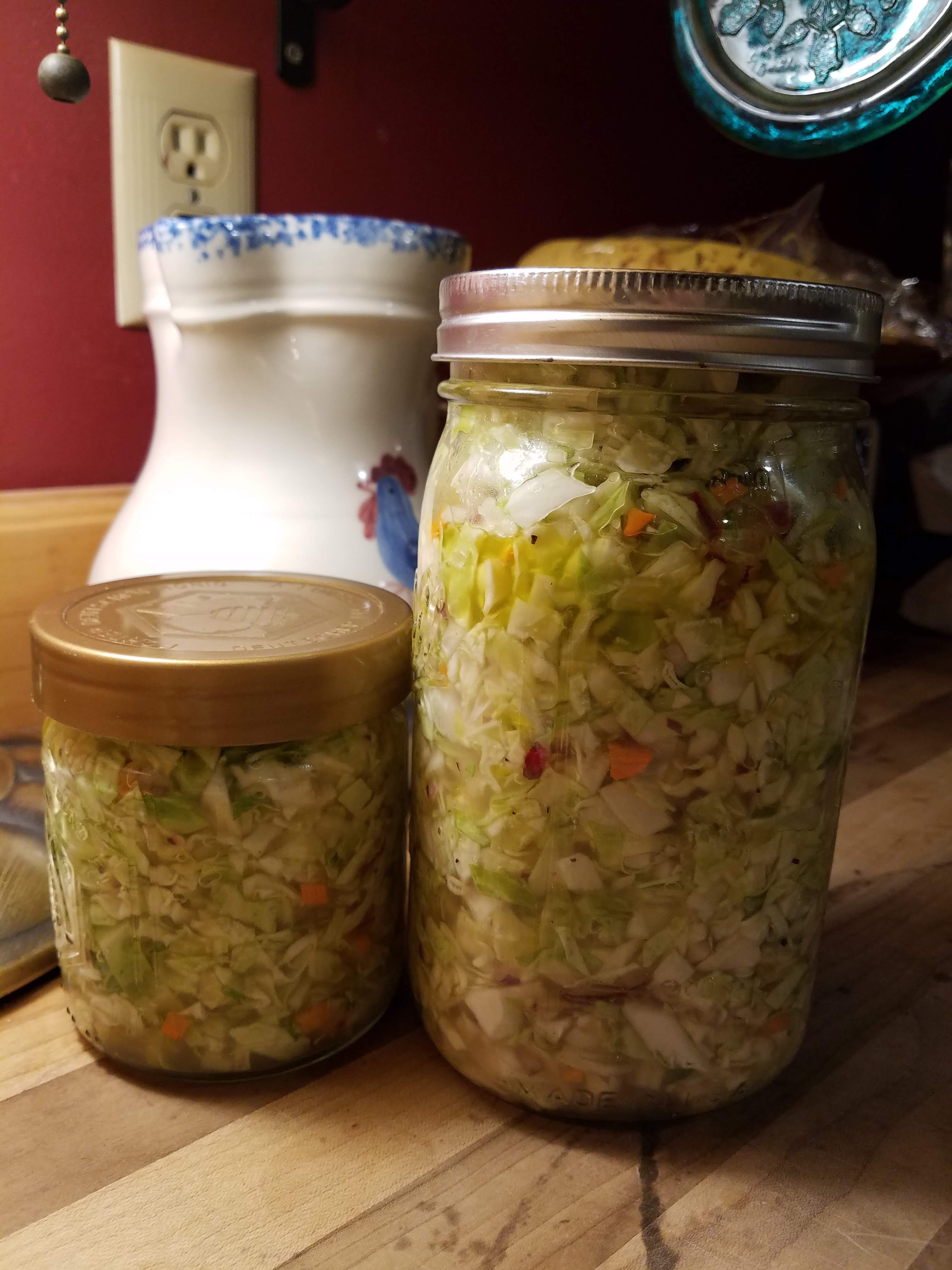
We had some for dinner and I put the leftover in one small jar and one large jar. Pack it in tightly! It keeps well stored in the fridge. I can’t say how long, but am guessing a week or so. Mine doesn’t last that long!

jars2.jpg

The smaller jar here is special to me because Claudia’s dad makes his own honey on their farm in Betzigau in southern Germany and packs it in these jars. I save the jar of course because it reminds me of him and his wonderful gift to me. This jar is from the honey Claudia brought last year. One time when I was returning from a trip there and had forgotten that even creamed honey is considered a liquid and put it in my carry-on so that I could be more careful with the glass jar (do you see where I’m going!?), I had to watch the airline security official throw it in the trash (!!!!) because it was a “liquid.” “It’s honey!” I told the woman, “It’s like gold to me!” She just threw it in the trash… Moral of this story: Put honey in your checked bag!

If you want to make Carrot-Raisin Salad, peel and shred 2 pounds of carrots and mix with this same dressing only using cider vinegar instead of the lemon juice (same quantity). Mix in a cup of raisins (golden or regular) just before serving. Some people don’t like the raisins, so I usually divide it in half and add raisins to only one of the bowls. If you have leftover of the one with the raisins and you store it in the fridge, the raisins will absorb some of the dressing and be soft and all puffed up the next day. I don’t mind this at all, and it doesn’t hurt anything, just know it will happen.

These salads-in-a-jar are so nice to have on hand. No last-minute salad prep when it’s time for dinner. Oh, look, here’s salad!