No matter how old we are, there is something new around every corner. This is especially true if you are traveling to places that are not so familiar. Delightful discoveries keep things so interesting. They make you see the world differently. They keep you young, reminding you that you have not arrived yet, that there is yet something to learn, to puzzle over, to marvel at, to be astonished about and even in some cases to cringe about (see below!). Let us never lose our sense of Are you kidding me?
In San Francisco, a bird looked dead on the street. I felt a moment of sadness. But as in Berkeley, where I questioned why the cooler-on-wheels was moving along the sidewalk on its own and Drew said nonchalantly Oh, that’s a robot delivering smoothies, I was equally taken aback by this bird on the street as we walked to the Embarcadero Ferry Building.
It sure looked dead to me. But no, Drew said, it’s just sleeping.
Sleeping? Whoever heard of a bird sleeping in a road? What kind of bird sleeps in a road? This kind apparently. Get a little closer. Is this bird sleeping?

Doesn’t it know that a road is a bad place to sleep? Didn’t its mother teach it the basics? If you want a long life, stay in high places away from humans and large, fast-moving vehicles. Get close only when you see lots of grass and the humans are tossing food about. Well, I don’t see grass here and no humans are offering food, but something must have clued it in, maybe even the person who then walked close to it, because in the time it took for us to get past, that bird turned around, faced the sidewalk and got out of harm’s way.
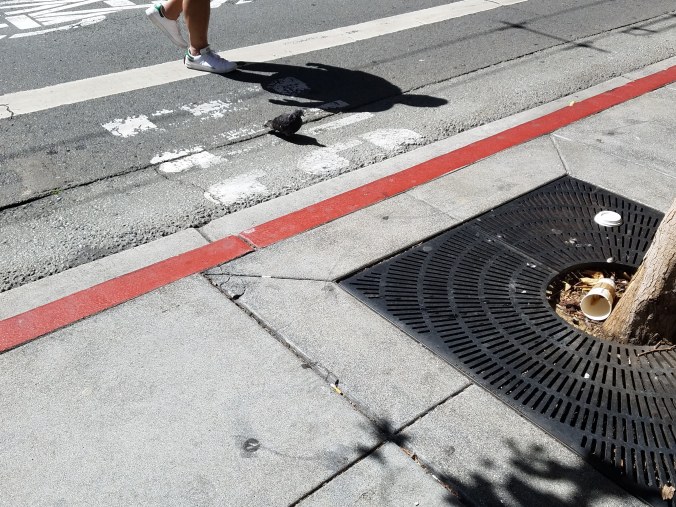
Smart bird? Or dumb bird got lucky?
Approaching the Embarcadero, we encountered a massive polar bear, part of the Salesforce descent upon the city this week. It isn’t every day you see a massive polar bear. There is something both majestic and adorable about polar bears, even when they are fake. You must agree, this is massive.
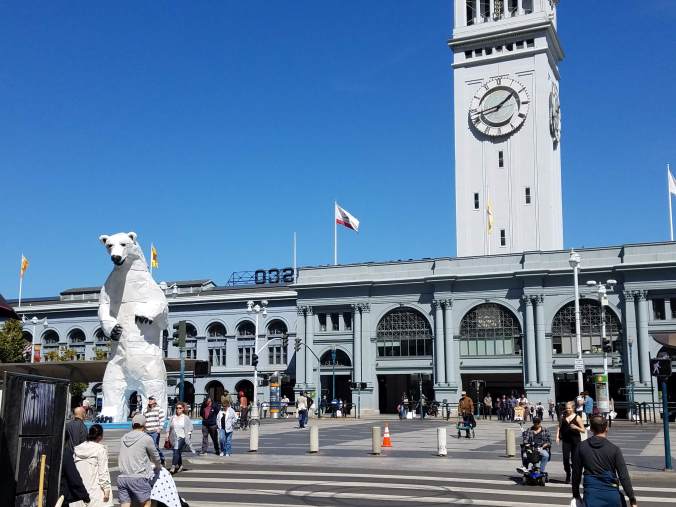
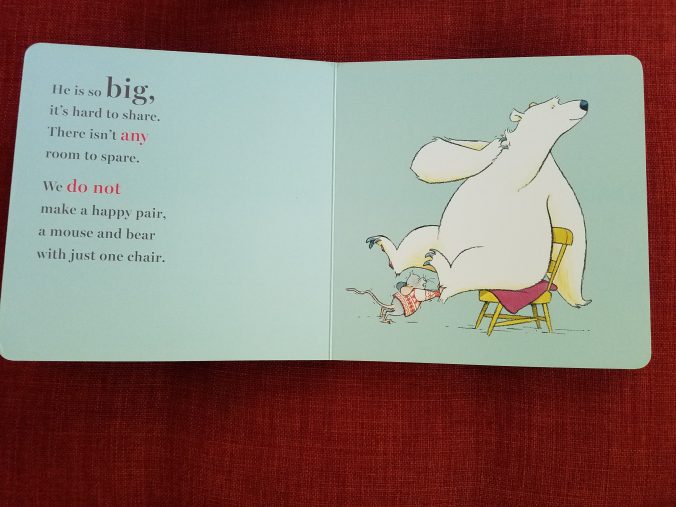
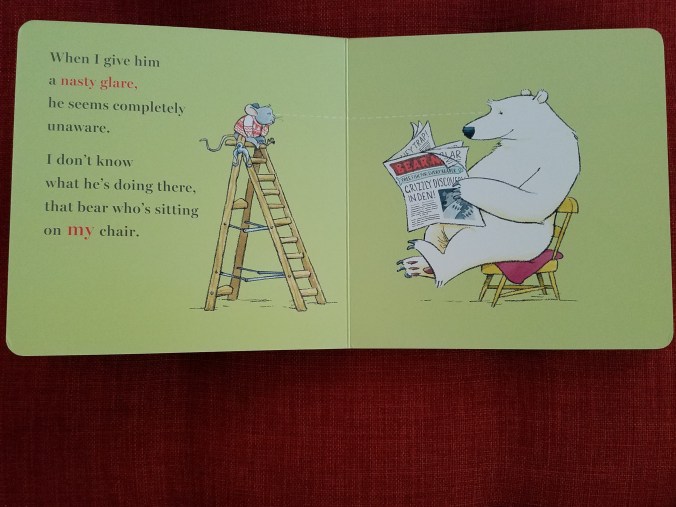
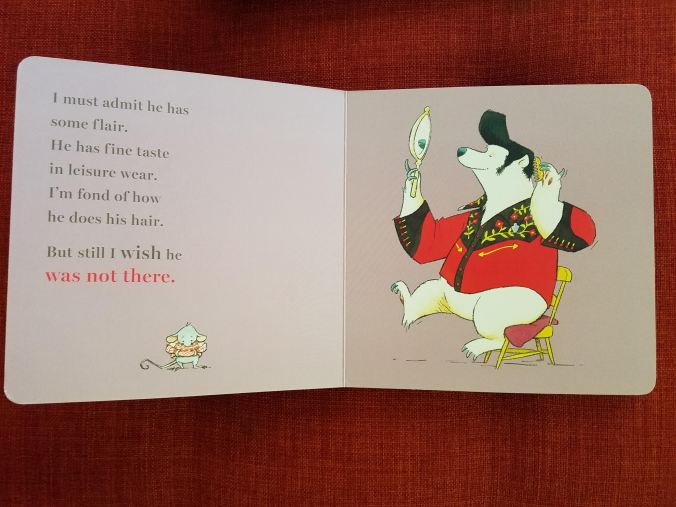
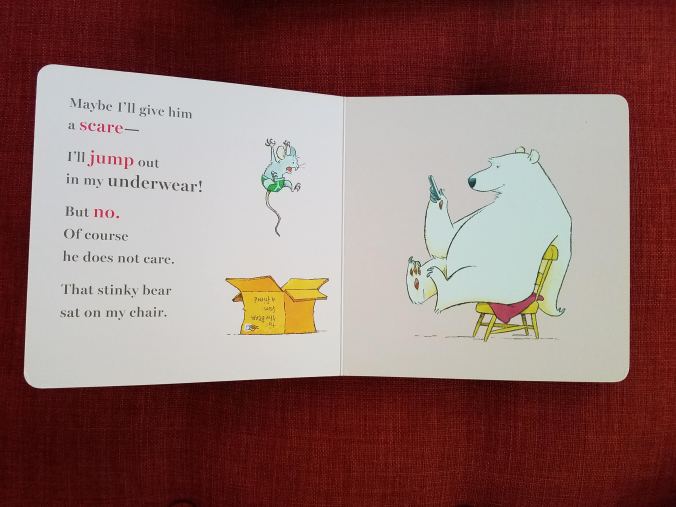
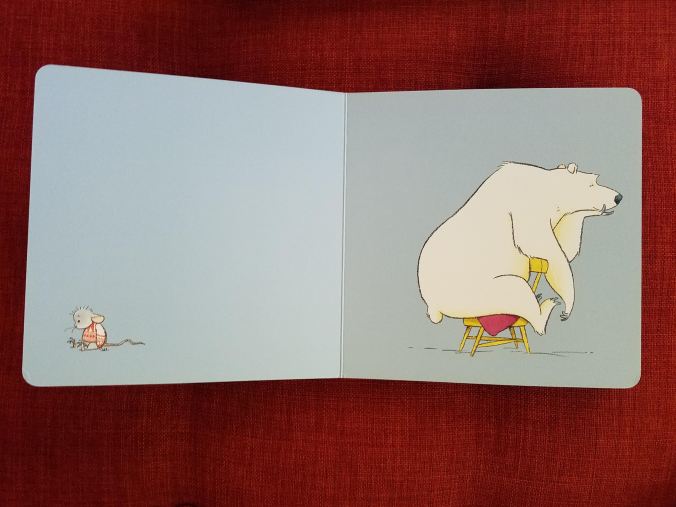
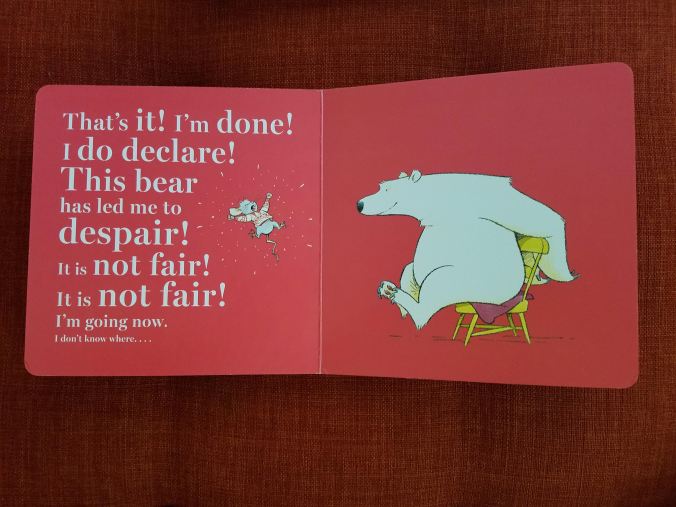
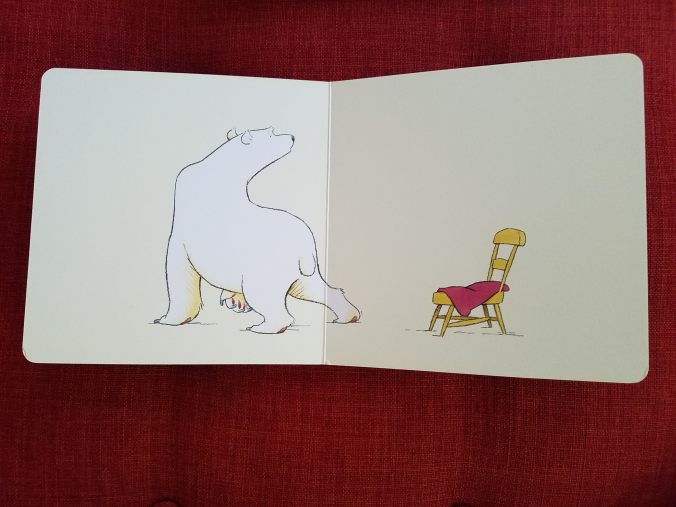
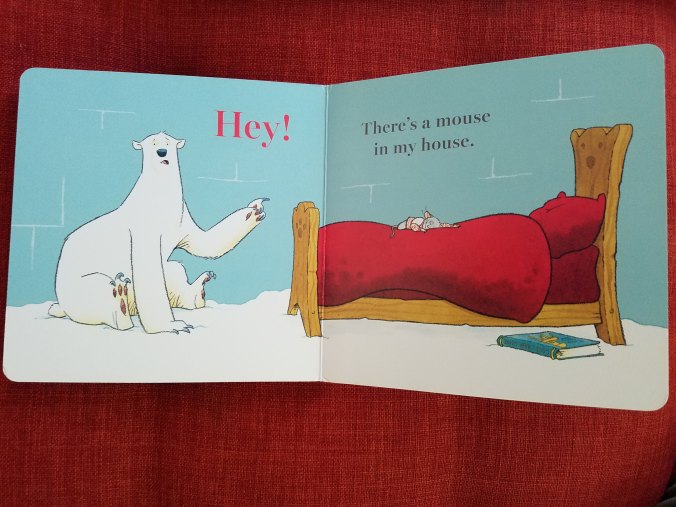
It also leans toward adorable rather than majestic, as does the one in a fairly new book called There’s a Bear on My Chair by Ross Collins that I discovered at Marie’s house. It has joined my all-time-favorite-kids’-books list. I will show you the pages at the end.
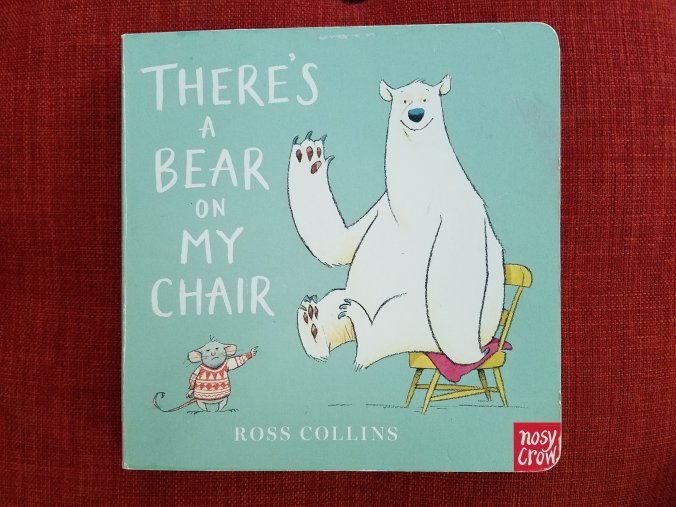
I am a huge fan of children’s books. The good ones are as good for adults as they are for kids. This one has it all: rhyme, cadence, delightful illustrations, originality, silliness, cleverness (the kind kids show you at the most unexpected times), hilarity and subtle yet powerful parallels to the “real” world, though you have to think about it a little to arrive at these.
It is impossible to be around children, as I am here now in Boise, without discovering something new in something old. Another book on my list, one that has been there for decades, is Mike Mulligan and His Steam Shovel. Unsurprisingly, someone thought to make it an audio book. That’s all well and good. What would never have occurred to me is using the London Philharmonic Orchestra in the background with bagpipes, and a narrator with an Irish accent! I never thought of that! Mike Mulligan. Irish. Go figure! Ellie loves listening to Mike Mulligan on the way to school. The music meshes with the story perfectly.
If you have a child in your life – your own or a neighbor having a birthday or a niece or nephew – get both of these books and the philharmonic audiobook to go along with Mike Mulligan. You cannot go wrong.
While on the adorable track, I must mention the three-year-olds at soccer practice, another reality of the world that somehow escaped me before now. I am sure I didn’t do any organized sport myself until I was at least nine or so, but these days they have soccer at three. They do in Boise anyway. Ellie loves it. All those cones are for foot control, by the way. You put your foot in the open end and lift it off the ground and hold it up. Who knew?
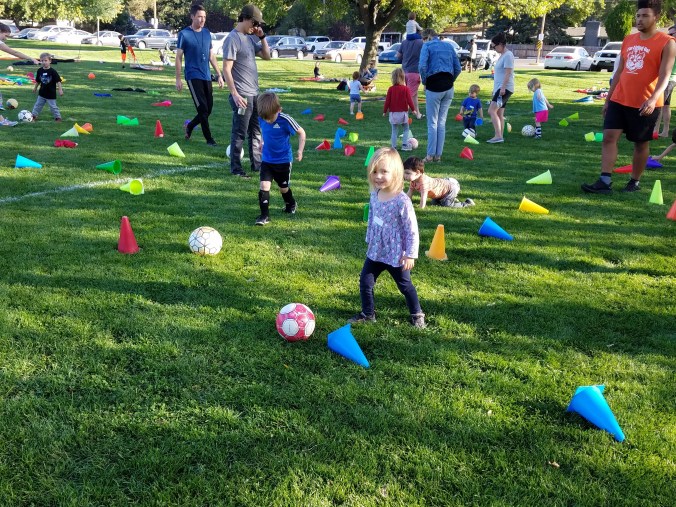
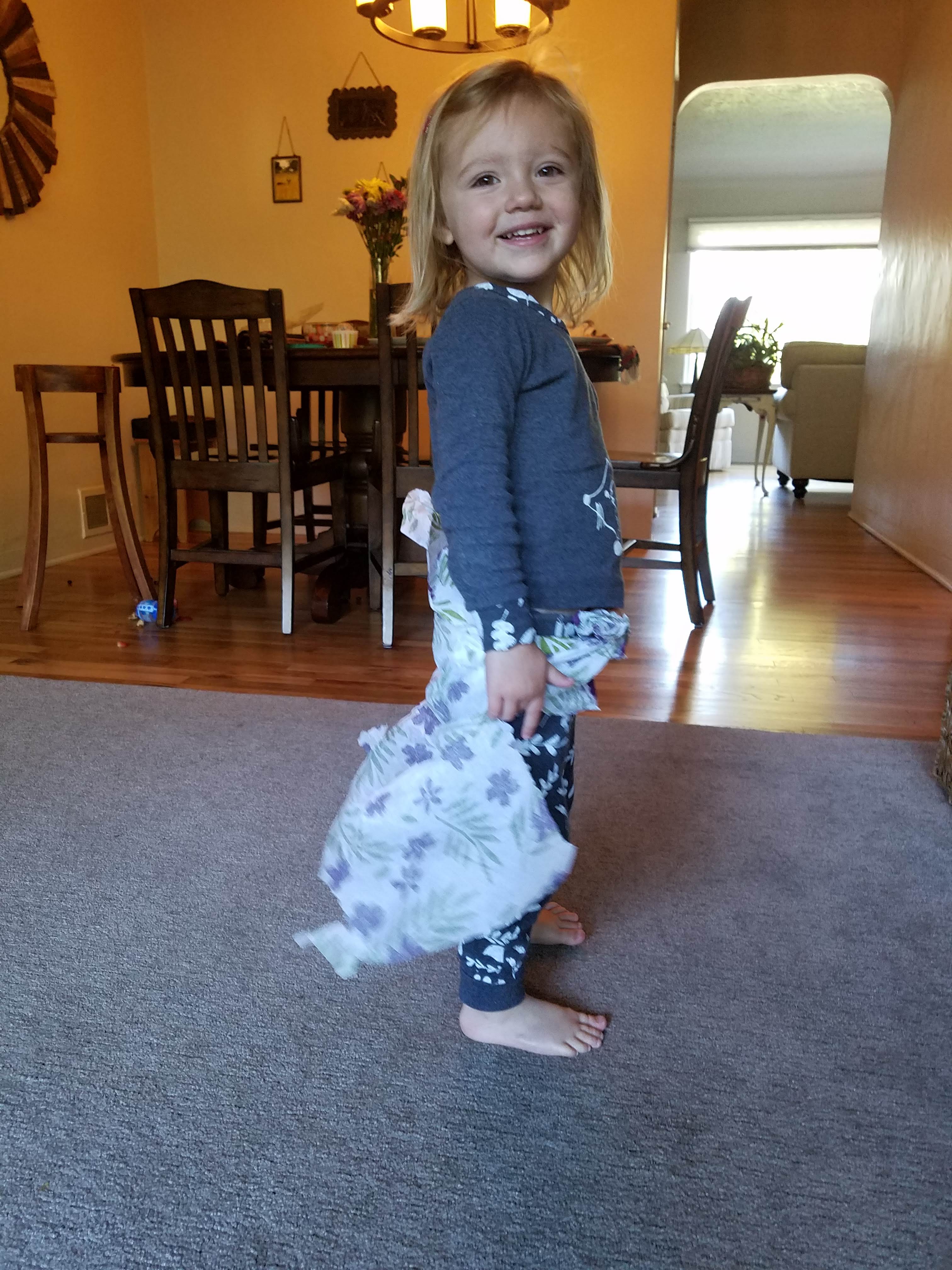
This is the same child who loves to wear a paper skirt, by the way.
Anyway, in case you didn’t know it, soccer for three-year-olds in Boise sometimes involves “making a pizza” on a parachute (after you walk around in circles for a bit to make you hungry enough to eat the pizza),
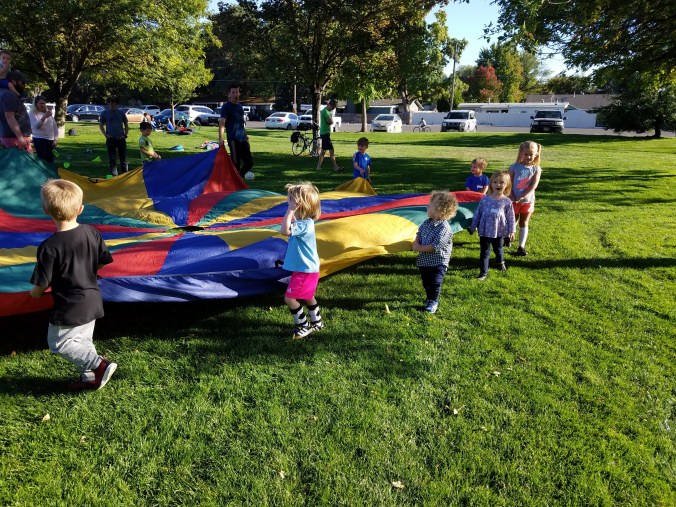
the last part of which is kicking the “meatballs” on top of the pizza. What’s your guess? Will these children grow up to love soccer or some other active organized sport? I think so!
Not everything that is new is adorable. Not everything is even pleasant. Whether just contemplating it or actually taking a drink from it (I couldn’t!), this exhibit at the Exploratorium in San Francisco challenges your grossness meter. According to the sign, the standard drinking fountain on the right and the one attached to this toilet (which has never been used as a toilet) are identical. Both clean, both usable, both dispensing fresh water. But who can bring themselves to drink out of the fountain attached to the toilet? “A Sip of Conflict,” they call it. I’ll say!

I can hardly look at it without cringing, let alone take a drink! So enough of grossness, let’s head back to Boise for something else I did not expect.
Here is a very old tortoise. How do I know he’s old? I have no idea actually. Tortoises are always old, right? This one was at the downtown zoo, active as a sloth, dry as the sand he stands on. Ellie was fascinated with him.

Why did I not expect a tortoise at the zoo? You expect giraffes, llamas, zebras. But a tortoise? Possibly I am overwhelmed with newness and adorableness all around me (save for above toilet, we can all agree) and I didn’t even have time to have expectations. I just know that this amazing animal took me by surprise.
Lastly (you knew there had to be food somewhere in here), we made a stop this morning at a French bakery in Boise called Janjou Pâtisserie. I know: French bakery in Boise, something else you would not expect. But what was even more unexpected, what was totally new to me, was a spiral croissant with olives and manchego cheese. Oh yum! I have never seen or had olives and cheese in a croissant before, let alone in a croissant of award-winning quality. Who thinks of this? Why didn’t I think of this?!
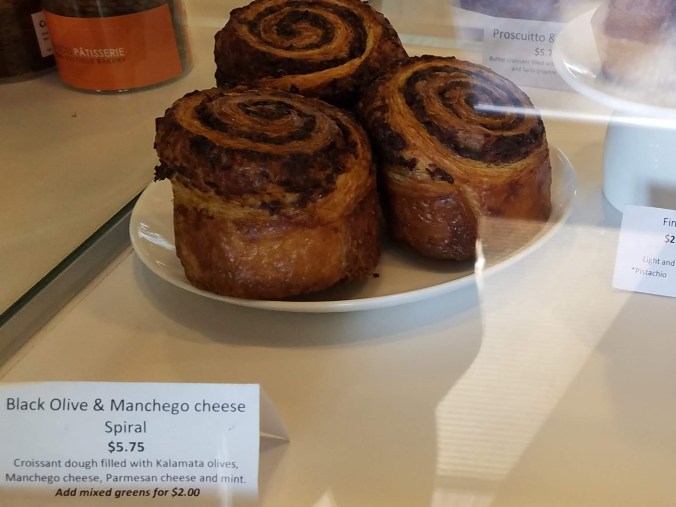
I cannot describe this adequately. You will just have to imagine the soft/crisp, buttery/flavorful, done-to-absolute-perfection nature of this pastry. Drool if you have to. I won’t tell.
I would like credit for having restrained myself in this post with regard to the many awesome trees and other plants one finds while traveling. I know I covered the eucalyptus trees in Berkeley and the Boise rose garden recently, but Boise has more awesome flora, and it is with serious effort that I hold back the low-lying spikey things, the weird wisteria, the blob tree – I spare you this time!
But I have to show you the pages of the adorable polar bear and mouse book. Thank you, Ross Collins, for your marvelous book!
Take your time now. Read slowly, deliberately and out loud if you can. Get a good rhythm going. Look at how the illustrations coordinate with the text. Pretend you have a child on your lap… Better yet, pretend you are the child.




 An Unboring Path