Home is Home Because

When you have been away from home for an afternoon, you don’t necessarily think about how wonderful it is to return to your own space. But when it’s been sixteen days, that’s a different story. It’s wonderful! Maybe it’s even more wonderful when you are away much longer than that, but for now I can speak only to the sixteen-day effect.

I have always felt that your own space – the place you call home – should be a place of peace (as much as is in your power to make it so) and a place of sanctuary, where you can be safe and you can be yourself. It should reflect your personality and preferences, and you should be able to move about easily and be (let’s hope) happy there. I want to think that everyone is kind and welcoming to guests.

It’s fun to see other people’s homes. The ones I was in while away have much in common with mine. They have a place for street shoes just inside the door as I do, well-equipped kitchens, comfortable beds and chairs, a large table for eating together, some soft furniture, a good deal of bright lighting, images of family members on the walls or shelves, overlooked smudges and scuffs and selective disorder (or shall we say less-than-optimal order in certain areas? Just like mine!).

Yet they are all different than mine. Most profoundly, my children’s homes all felt like their homes, not mine. This made me think about what it is about your own home that sets it apart from others. Some things are practical, some harder to pin down.

In your own home, you know where things are. We all have our patterns, our routines. We keep certain things front and center and other things in their designated places because our patterns and routines run more smoothly if we know where things are. You know where the outlets are for plugging in your phone charger. You know where extra soap is to replace the empty one that’s perched at the back of the sink. When my children were little, I had a thing about my scissors. If you need scissors, you need scissors, and nothing else serves. If you need to use my scissors, put them back where you found them.

Yesterday I needed a crowbar at one point. (We all need a crowbar sometimes, right??) Naturally I went to the shed to get one. There are a couple of screws for hanging the crowbars in there. See them, under the blue box?

screws for crowbars_LI.jpg

Do you see crowbars hanging from them? Neither did I. Being deep (sometimes literally) into the Big Dig (my foundation repair project) as we were yesterday, I groaned, thinking I might have to waste time looking. There are only so many hours of daylight in October, so dammit, where’s the crowbar? Thankfully, when I glanced in the other direction, I found one in the five-gallon bucket that holds a dozen or so random tools like the big loppers. It was the second most logical place to put it if you forgot the right place. Whew! I was spared the frustration.

In your own home, your stuff is familiar. You know what to expect. Fewer surprises are more relaxing. In each household I visited they all drink coffee and/or tea and therefore have something for boiling water. I saw two electric kettles, one stovetop kettle and one Keurig. All of them work, though I am not convinced that the water coming from the Keurig is as hot as it should be. That aside, my own kettle is familiar to me. I can be a bit more on auto-pilot with mine. My muscles know when the weight of it indicates enough water for one cup, two cups or a whole pot of tea. My ears know the sound of it as it gets close to the boiling point. My hands remember how hot the handle can get depending on how much water is in it.

20180708_125656.jpg

It is NOT the end of the world to use different water-boiling equipment. It just doesn’t feel like home.

When it comes to tea (and presumably coffee), there is also something about the water itself. Your own water in your own home, whether it comes from a municipal system or straight out of the earth from your well, has its own taste, and you get used to that. When my friend Fred stayed here, he drank tea more than he usually does, and decided he would drink more once he got home. The day before he left, he bought some of the same loose black tea as I have in my house. It tasted different at his house, and the only explanation for that is that his water is different. To get closer to the tea he wanted, he decided to use bottled water. That made it better, though still not quite the same.

In your own home, it smells right. I don’t mean to suggest that other homes smell bad. They don’t. They just smell different. Houses take on smells of the foods prepared there recently (or frequently), of the cleaning products applied there, of the people themselves and the shampoo or cologne they use, of the animals that share the spaces.

Not everyone bakes (imagine!). Not everyone even cooks! But there’s a reason they tell you to have just made a batch of cookies when you are trying to sell your house and have potential buyers coming soon. When there are onions sautéing in butter or fresh bread becoming golden in the oven, or whenever the smells that seem warm and homey and yummy to you are wafting from the kitchen, it’s a kind of embrace that you are drawn into, one that’s hard to resist, one that feels like home.

In your own home, you know the paces and the peculiarities. You know how to navigate regardless of the lighting, how far it is to the bathroom, what flooring is under your feet at what point, what obstacles you might possibly encounter (dog? toys? edge of table?). You know the flow of traffic, where the choke points are and how to avoid them and what’s the best way from Point A to Point B.

The top step of Bradley’s basement staircase has a wider tread than the others. Don’t forget that when you go up or down; it’s a slight adjustment of your footing. The lights in Marie’s living room get turned on by way of a small remote; the first morning when I got up early (still on east coast time), for the life of me I couldn’t figure out how to turn the lights on! Drew’s kitchen sink is the oddest shape I’ve ever seen, like a pac-man in the corner, and it doesn’t fit a large pot, so you find another way to clean that pot.

In my house the screen door gets out of whack sometimes. You have to lift it gently but firmly into place every time you go in and out until a good friend (thank you, Sandy!) fixes it. My kitchen countertop is old and white and gets stained, and it sags just a bit over near the stove. The condensation caused by a thawing container of anything sends a slow, predictable ribbon of water toward one corner. It’s better to put thawing things in my sink (until I get a new countertop!).

In your own home, you remember the way it used to be. You have a history with the property, inside and out. You know what was there before. You see changes incrementally. Marie just got new windows in several rooms. They are very nice, but I don’t remember the old ones. She does and is so happy they are gone. Bradley gutted his house before they moved in, moved all the rooms around, creating a new floor plan. Beth did all the electrical work. If you knew the house before, you wouldn’t know it’s the same house. They have vivid images in their minds of what it looked like when they bought it. I needed photos to show me. Drew has a fabulous new rug, adding warmth to his place in a way that he says is much better than what he had before, which I never saw. I’ll take his word.

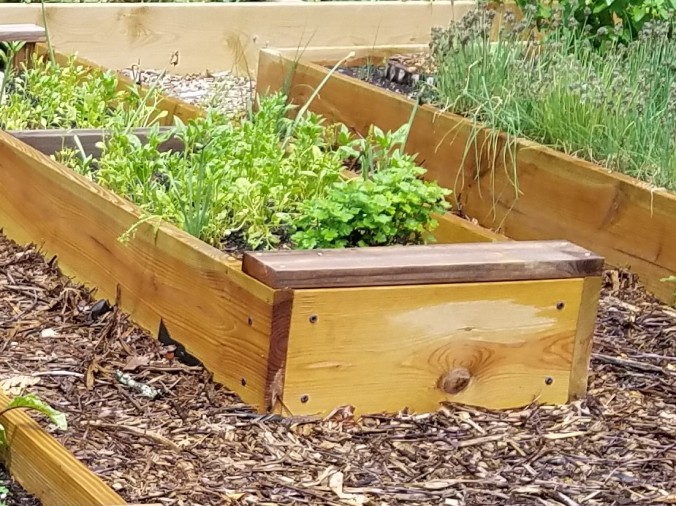
If they came to my house right now and saw this mum (yes, that’s my chrysanthemum!),

mums gigantus (2).jpg

they wouldn’t know, unless I told them, how three weeks ago it looked like this:

mums 9.19.jpg

And three months ago, you could barely see it in front of the beets.
mums in May.jpg

I loved seeing my children in their own homes, seeing them comfortable, making their spaces their own. But it is always good to come home. This time, it was good to find a beautiful plant in the garden because there was a big hole in front of my house! More on the Big Dig soon!
One Bag Only

I did it. I gave in. I packed a medium flat rate box and will ship it to my home from Sugar Land, Texas, tomorrow.

On this sixteen-day trip I flew from Charlottesville to San Francisco, from San Francisco to Boise, from Boise to Seattle, from Seattle to Houston, and tomorrow from Houston back home. I chose to fly the cheapest way possible, using the new option to take only what can fit under the seat in front of you. One bag, one bag only. Everything I need for sixteen days in various climates has to fit on my person or in my bag and under that seat. (It was 47 degrees when I left Seattle. At 10:06pm it’s still 82 here in Sugar Land.)  I like books. I brought two along. I won’t lie. My shoulder is not happy. It might be somewhat bruised from the weight I carried each time.

Everything was fine – all the airlines let me through with my one bag plus my purse — until the most recent leg to Texas on United. I get that the airlines have to generate revenue however they can, and capping the carry-on max so that they can charge for overages is one way to do it. I get that I should not have bought slippers in Berkeley or a book at the de Young Museum in San Francisco or allowed my daughter to give me two other books in Boise (though I left one of mine with her, the net result being four books instead of two). I get that my laptop is huge.

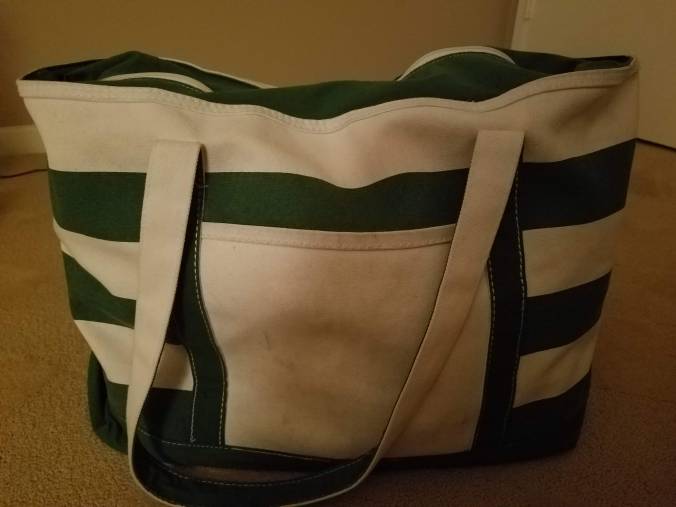
I put everything in my striped canvas bag that zippers across the top. It zippered without my having to pull it closed this last time, meaning there was room for more, right? I love this bag, but one of these days the zipper will fail or rip out. I have asked a lot of this bag over the years.

bag

I put the new slippers, my lunch and the book I planned to read in the plane in a small blue canvas bag (which worked better than my purse for these items) and walked up to the kiosk at the Seattle airport to get my boarding pass. They do not even let you check in via your mobile device when you have these cheapo tickets because they have to make sure you meet the luggage requirements.

The lady at the kiosk was skeptical. You have two bags, she said. This one just has my lunch and a few small things that will fit in the big bag, I said. She asked me to show her that my bag fit in the slot designated for poor travelers like me. It did! I smooshed down the top a little to show her there was room for the other stuff. They won’t let you through if everything is not in that bag, she said. You’ll have to pay $50. You might want to put your lunch in your pockets.

I did not like the stress. Never again, I said to myself. I’ll use a real carry-on like other people next time and pay for the privilege. But for now I was stuck, and you can bet your bottom dollar I wasn’t paying $50! But, yeah, getting that stuff in and getting the bag closed again without busting the zipper would be a trick. I might be able to do it, but it would be a squeeze to then get the bag under the seat, and anyway I had a better idea.

Already, to make this work, I was wearing two shirts, two sweaters, my scarf, my hat and my raincoat, so I figured Why not just wear more? There was no ladies room near my gate so I couldn’t do this as privately as I would have liked, but I stuck the slippers, side by side, into the waistband of my pants in the back – under the shirts, sweaters and raincoat – and the book into my waistband in front, under the shirts and the non-cardigan sweater and the scarf.

I just became a larger person temporarily. Lots of people are larger than I am. They get on planes.

I put my cell phone, my apple, my bread and my cheese in the pockets of my raincoat, got on the line (last boarding group, of course) and sailed through the checkpoint with my green striped bag over my shoulder and nothing else but the boarding pass in my hands. When I got to my seat near the back of the plane, I rearranged my weight. The slippers went back in the small canvas bag along with my lunch, and I sat and enjoyed my book.

(Outstanding book, by the way. Educated by Tara Westover. I will come back to this one of these days and tell you more about it.)

I left the plane with my green striped bag in one hand and my little blue canvas bag in the other. No one cared.

I have not bought anything in Texas to add to the problem, though I was sorely tempted today in Galveston to buy one on the 1900 hurricane, sorely tempted! Nonetheless, we stopped at the post office to get one of those flat rate boxes because I am not going through that stress again. I put all the books but Educated in the box, along with anything else that fit. I stuffed it full. It will cost me $13.85 to send home. I will be so relaxed tomorrow with one bag only!

Pumpkin Comfort

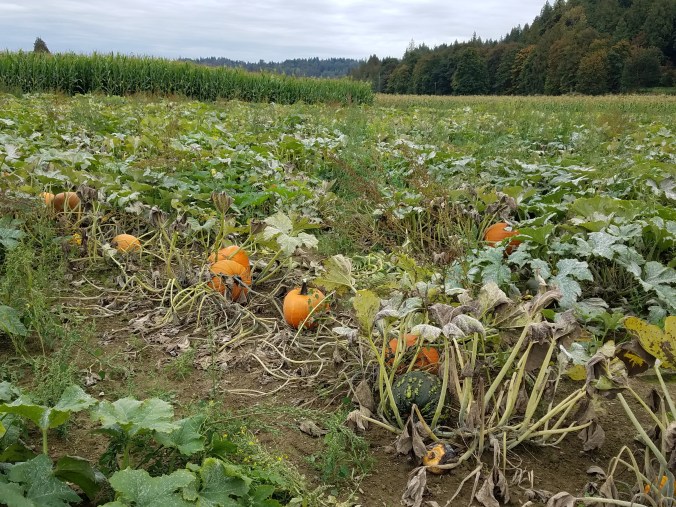
I have never before thought of pumpkins as comforting. They are not cuddly, adorable or delightful bundles of energy like my darling grandbabies. They do not talk me through struggles like a good friend or warm my insides like a good cup of tea. But traipsing through a patch of these characters this past weekend reminded me of another facet of comfort, one that pumpkins embrace wholeheartedly: With all the changes in our world, it was good to see that pumpkins are still mostly orange.

Duh.

pumpkin2.jpg

No, I mean it. For those who play with genetic modifications, it must be tempting to make a purple pumpkin or a red one, or to elongate them like way-overgrown zucchinis, the kind that hide under those big leaves and you don’t find until they are as big as a baseball bat. Someone must be working on a seedless variety that will revolutionize the ritual of pumpkin-carving – imagine if you could draw the scary face on the side and be able to cut into it without having to deal with all those stringy, slimy, seedy guts that insist on adhering to the inside flesh?

Lots of things change in this world. They change at an astounding rate. Isn’t it nice to know that some things stay the same? There is comfort in sameness. Sugar is sweet. Rain is wet. Pumpkins are orange. All right, mostly orange. There are a few renegades in every group.

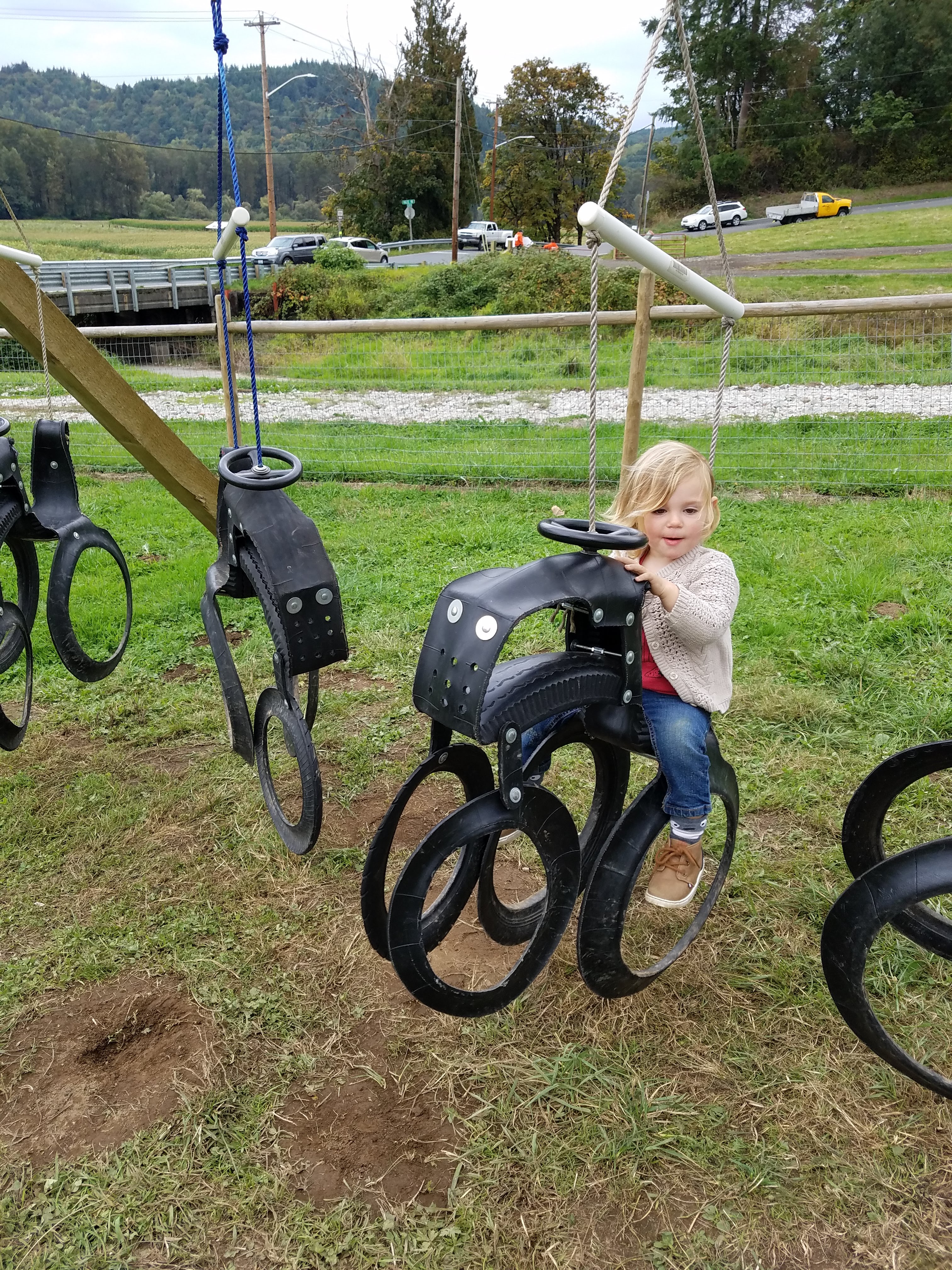
In Snohomish, Washington, we found a wonderful 40-acre pumpkin patch at Bob’s Corn and Pumpkin Farm. Bob’s grows corn and pumpkins, yes, but they seem to make their money (or at least a fair share of it) on people wanting to come and play amidst corn and pumpkins. They have newfangled, farm-themed tire swings


tractor tire.jpg

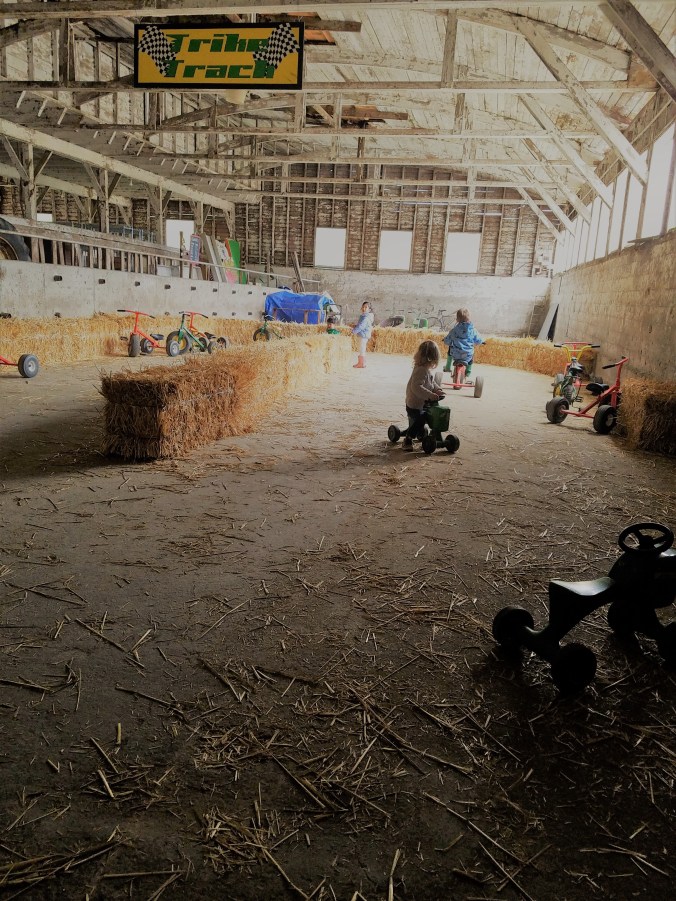
a “trike track” in one of the barns with lots of little tricycles in many sizes

trike track (2).jpg

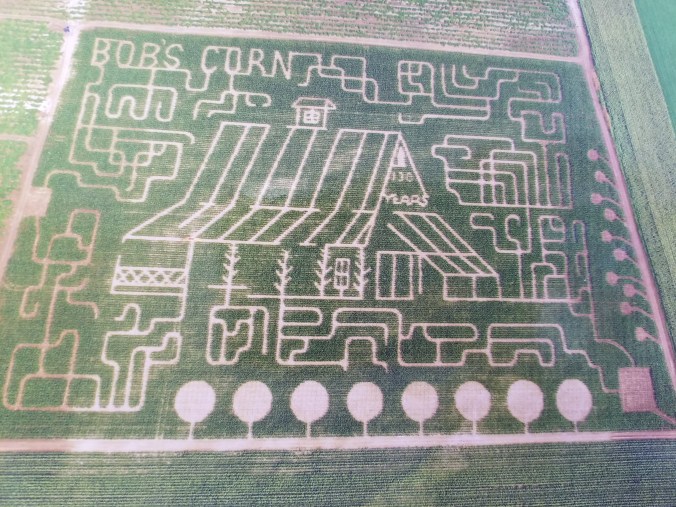
a gigantic John Deere for climbing into, tubes to slide down, all sorts of yummy fall treats to indulge in (and take home) and a ten-acre corn maze with firepits and private areas for group gatherings. We will come back to the pumpkins, but for the moment, look at the aerial view of the maze and think about this.

maze.jpg

Their web site says, “We have a total of 18 firepits inside the maze which can be rented for private groups and birthday parties. We provide the firewood and tiki torches. We even build and maintain the fire for you, you get to sit back, relax and enjoy the evening.

“Bring your roasting sticks, food and supplies. Leave them at the group check in area on the north side of Bob’s Country store, and we will transport them to your firepit so you don’t have to carry them through the maze.

“When you are finished, leave them at your pit, enjoy the second half of the maze. When you return from the hayride, your supplies will be waiting for you in the group check in area on the north side of Bob’s Country store! How easy is that??”

I want to know: If there are 18 firepits within the maze, how do you find the firepit that has your name on it or that has been otherwise designated for you? Or do you just land at one and let them know you have arrived, and then they bring your stuff?

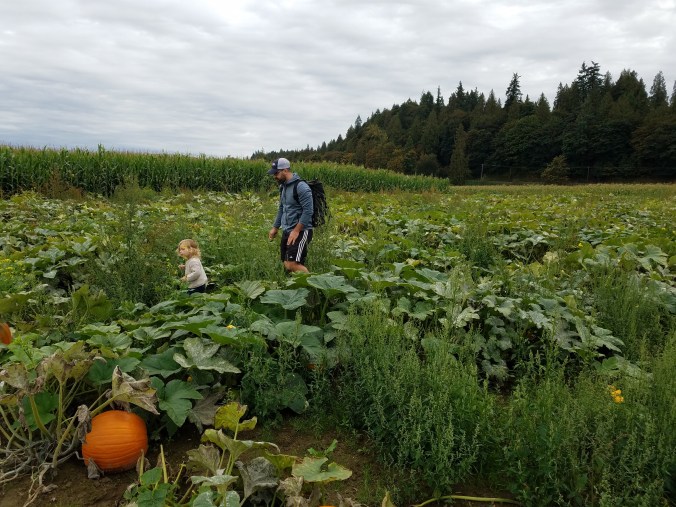
Wondering about the firepit protocol happened fleetingly for me. I saw the three staff members at the entrance of the maze (a fraction of the total work force present on the day of our visit), heard them telling some other visitors about this opportunity, registered the comments, thought “wow” and promptly transferred my attention to the forty acres of pumpkins next to the corn. Bradley and Piper and I explored a small part of it. Apparently there are 60+ varieties of pumpkins here.

pumpkin patch Brad Piper2.jpg

You have your Classics, and lots of these. They have smooth skin with longitudinal valleys, as if each pumpkin has its own special time zones. The ones we saw were not monster size, but maybe up to about 25 pounds. They are perfect for carving and setting on doorsteps, lots of different sizes. Bob’s gives you a wheelbarrow, by the way, for hauling your picks. I expect they have strong people who will put them in your barrow for you if you want, and probably then in your car.

pumpkin1.jpg

You have your Brights. Perhaps a gen-mod engineer had a little fun with this one (below)? It not only leans toward neon but also is rather flattish.

pumpkin6 (2).jpg

You have your Gnarlies here and there.  Okay, maybe there’s more genetic modification going on than I thought at first. Just how do they get the green warts?

pumpkin3.jpg

I get that Bob’s wants to mix it up a little, so they throw down some seeds of these crazy kinds. This one has yellow warts, making the orange rind seem to veer toward the yellow end of the spectrum.

pumpkin10.jpg

If you showed the photo below to a hundred people, I think you would be hard pressed to find most of them saying quickly and definitively, “That’s a pumpkin.” Beth said it looked like a monkey’s butt. It is another orange that is desperately trying to be yellow instead. Just to stand out. You know how pumpkins can be.

pumpkin4.jpg

Most of the yellow ones turn orange eventually, the way you can see this green one on its way to becoming orange.

pumpkin8

Real pumpkins, big orange pumpkins, are comforting not only in their sameness. Think about 40 acres of pumpkins – what is going to happen to most of them? For a few weeks, some will decorate entryways, tabletops, fence posts, schools, hotels, stores and offices. Some will become jack-o-lanterns a day or so before Halloween. A few will become delicious pie – but not many. I wonder how many never leave the field they grew in. Think about what pumpkins say about the abundance of food in our land, that so much space can be given over to a crop that provides such a small amount of actual food value. How blessed we are.

A row of pumpkins anywhere, but especially along a cider donut stand, is one of the joys of fall. Maybe you’d like one of Piper’s donuts? Too late! All gone!

Ela's photos (25).JPG

Ela’s Apple Star Bread

I love learning something unexpectedly. Today I helped Ela make a beautiful, sweet, cinnamony, apple bread that is formed in such a cool way!

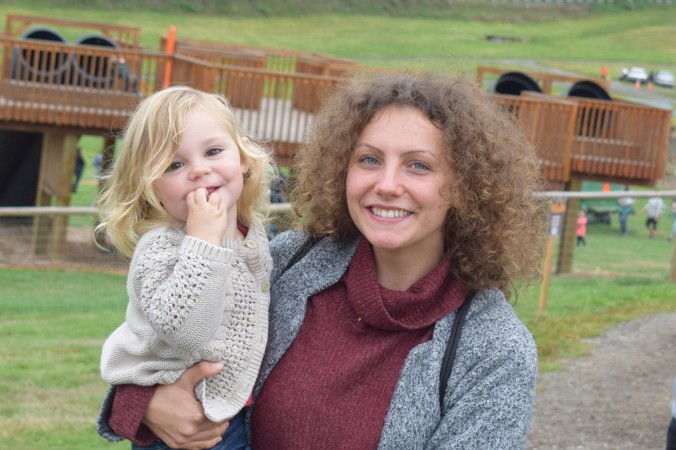
Ela was my granddaughter Piper’s German au pair from the time Piper was a few months old until this past January. It says a lot about their relationship that she would choose to spend her vacation here in Seattle with the family. I was delighted to finally meet her. This is Ela with Piper yesterday when we went to Bob’s Corn and Pumpkin Farm in Snohomish.

DSC_9941 (2).JPG

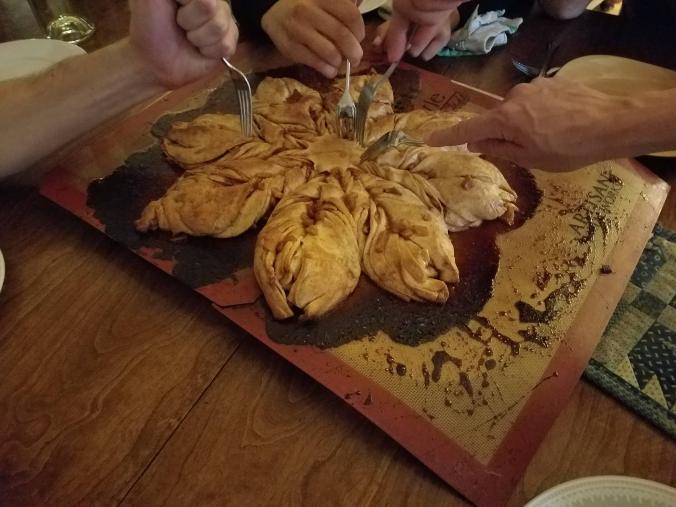
Ela is not only Piper’s fun friend, she is a great baker! Her apple star bread was devoured after dinner tonight. We all were anxious to dig in. (It’s a pull-apart bread, thus the forks.)

forks in, ready to go.jpg

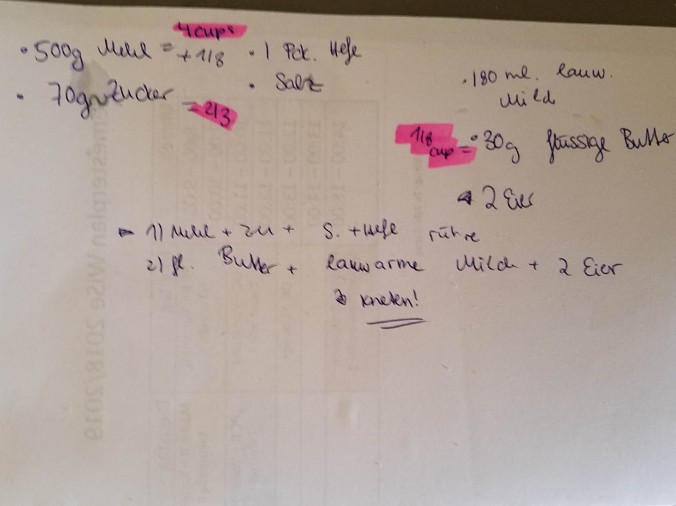
That shape was so fun to make. I have to show you how it was done. Her recipe might be a little hard to read.

recipe (2).jpg

It says to combine 4 cups flour, 2/3 cup sugar, a package of dry yeast and a bit of salt (say half a teaspoon). In a small pan combine ¾ cup milk with 2 tablespoons butter until just warm. Add the milk, butter and 2 eggs to the dry ingredients. Mix and knead. Ela let the beast of a mixing machine that Brad and Beth have on their counter do the kneading.

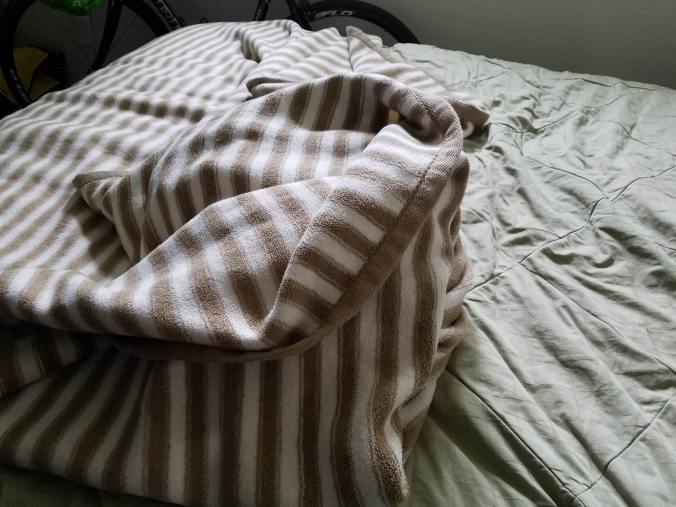
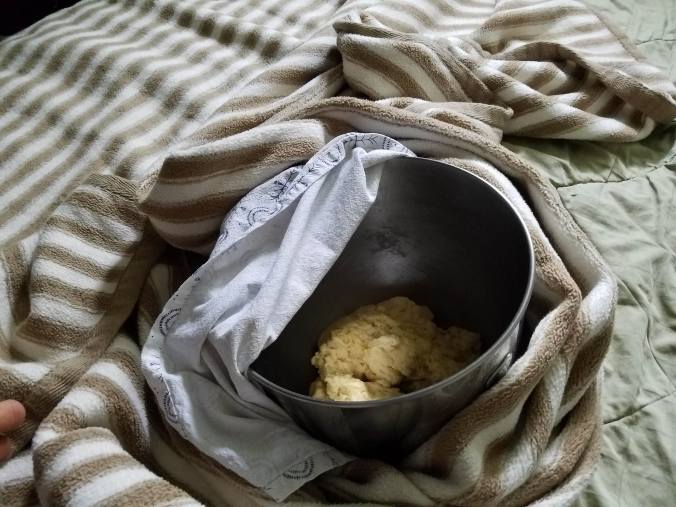
Then, and this is the part she says her grandmother always did, put the dough to rest in bed! You read that right. This lump in the bed is hiding the bowl.

dough in bed.jpg

Yes, underneath that lump, deep within the warmth of the bed, is the dough. Ela left it there for a few hours, all covered up.

dough in bed1.jpg

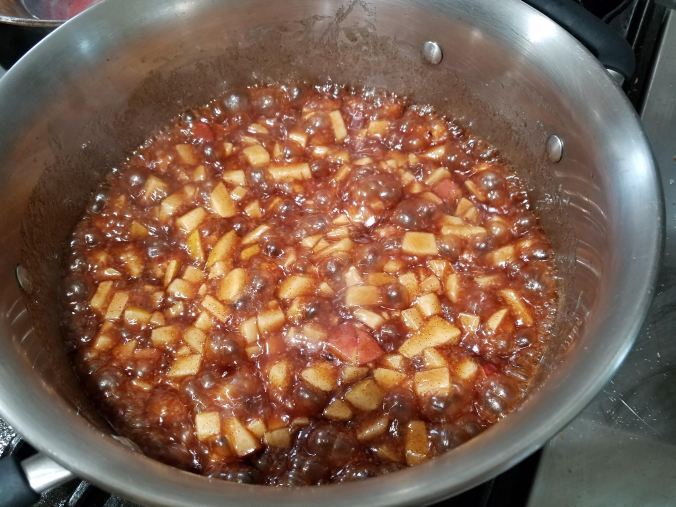
While the dough is resting, cut two apples up in small pieces and put them in a saucepan with two cups of sugar and 1 tablespoon cinnamon. Turn on a medium heat and cook until it’s bubbly, like this.

apples cooking in pot.jpg

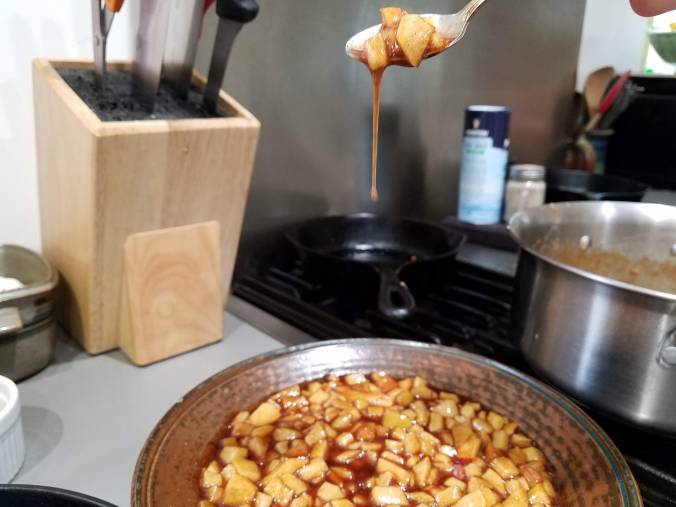
Cook down until you have a sugar syrup that drips off the spoon like this.

sugar syrup.jpg

Do you see how it holds its shape in mid-air? It should do this a few seconds before falling. That’s what you want.

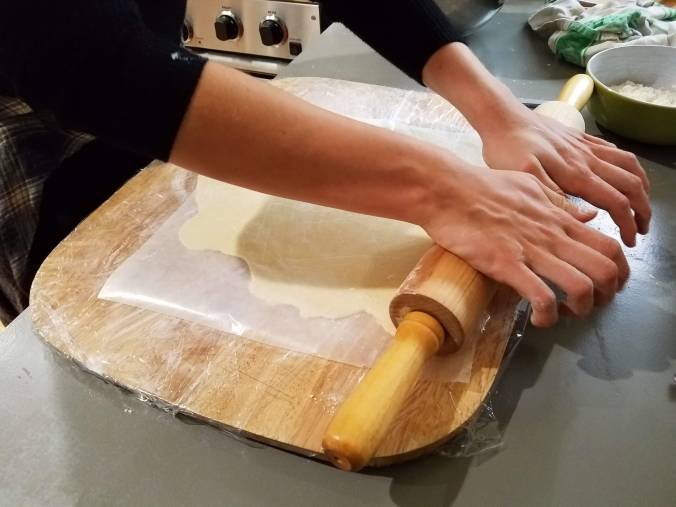
Divide the dough in four parts. One at a time, roll out each quarter of the dough into a circle. Ela put plastic wrap around the board she was rolling on to keep the dough from sticking, then put a piece of waxed paper over it, like this. You want each layer of dough as thin as possible.

roll with waxed paper.jpg

Transfer the dough to a large piece of parchment paper, which we didn’t have. Parchment would have been better because you can more easily cut on it, and there is cutting required later. You shouldn’t cut on silicone mats. Ela put two mats together and placed them directly on the oven rack. She cut very carefully when the time came for cutting.

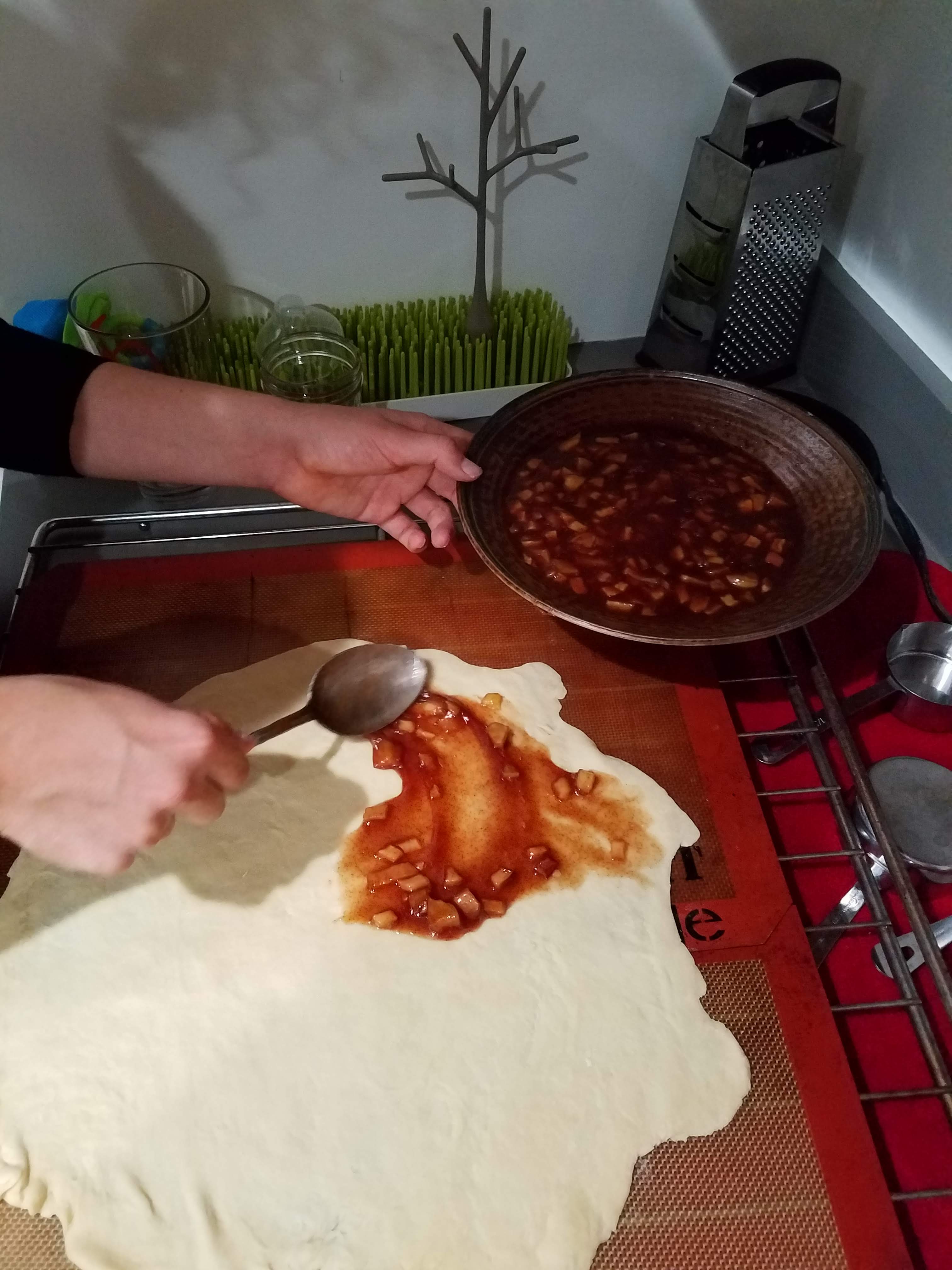
So, first layer, then spread apples.

first layer spreading.jpg

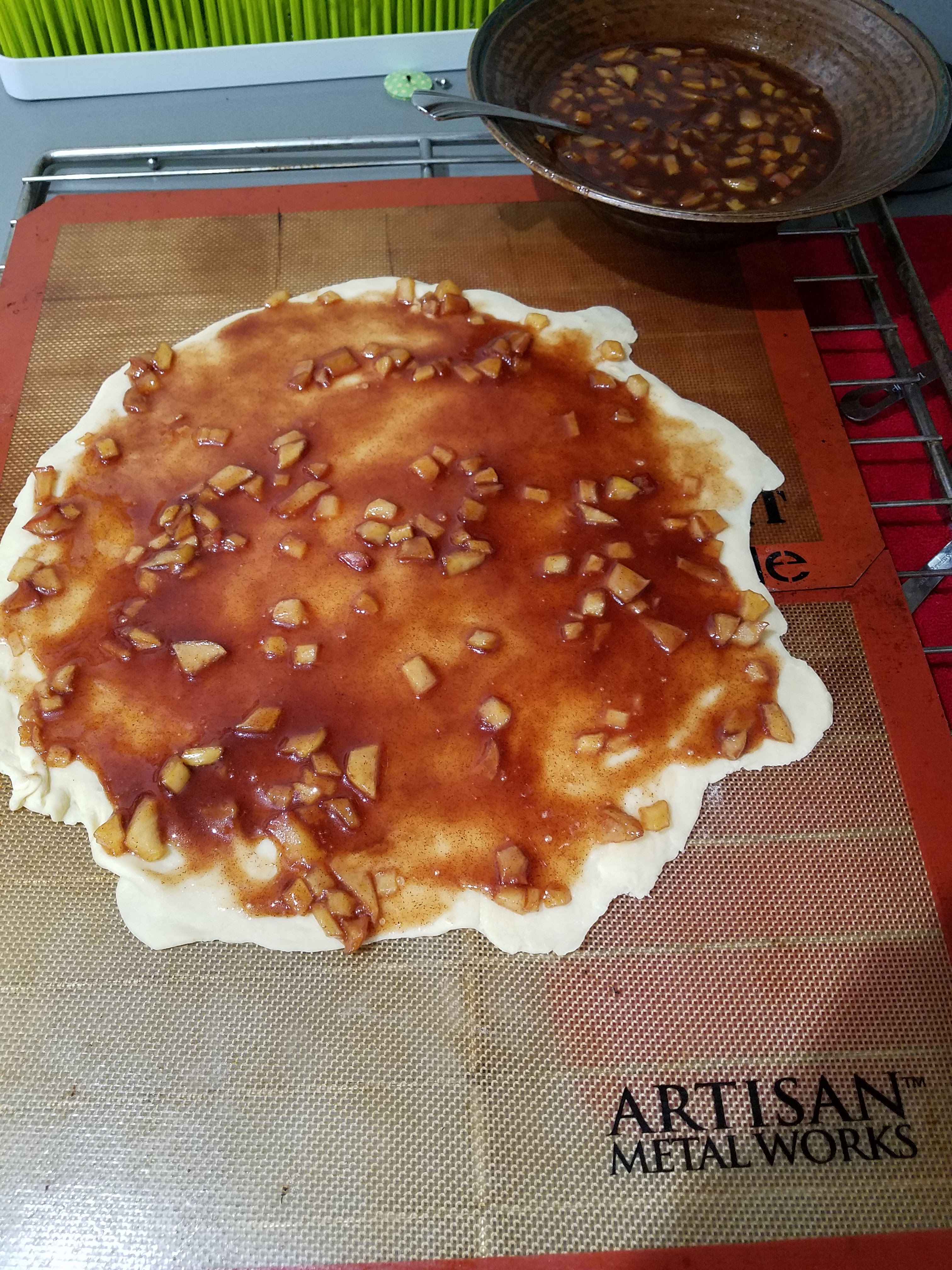
Keep adding spoonfuls of the gooey, sticky apple mixture until the layer is covered.

first layer.jpg

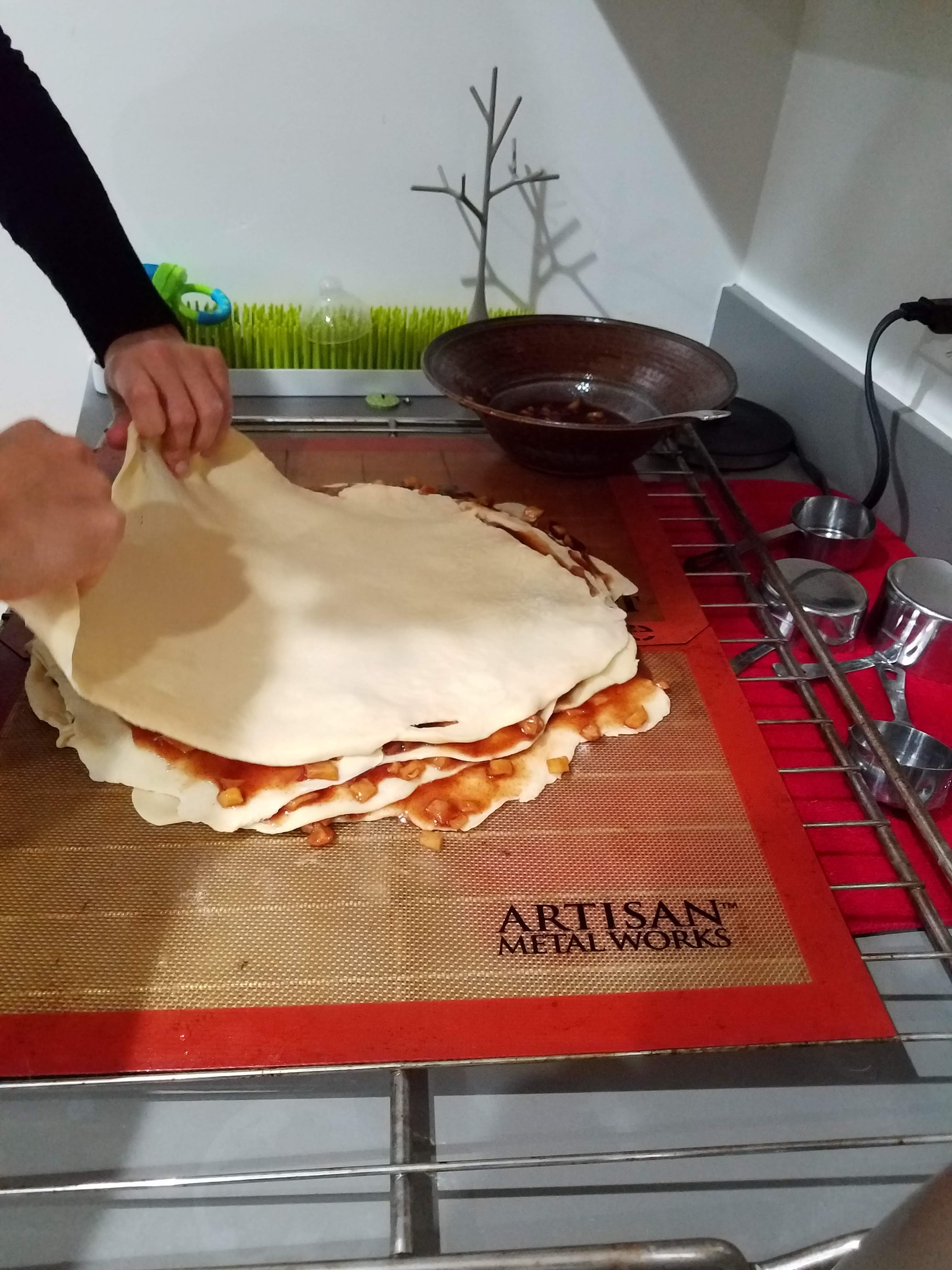
Do layer after layer until you have dough-apples-dough-apples-dough-apples-dough.

dough4.jpg

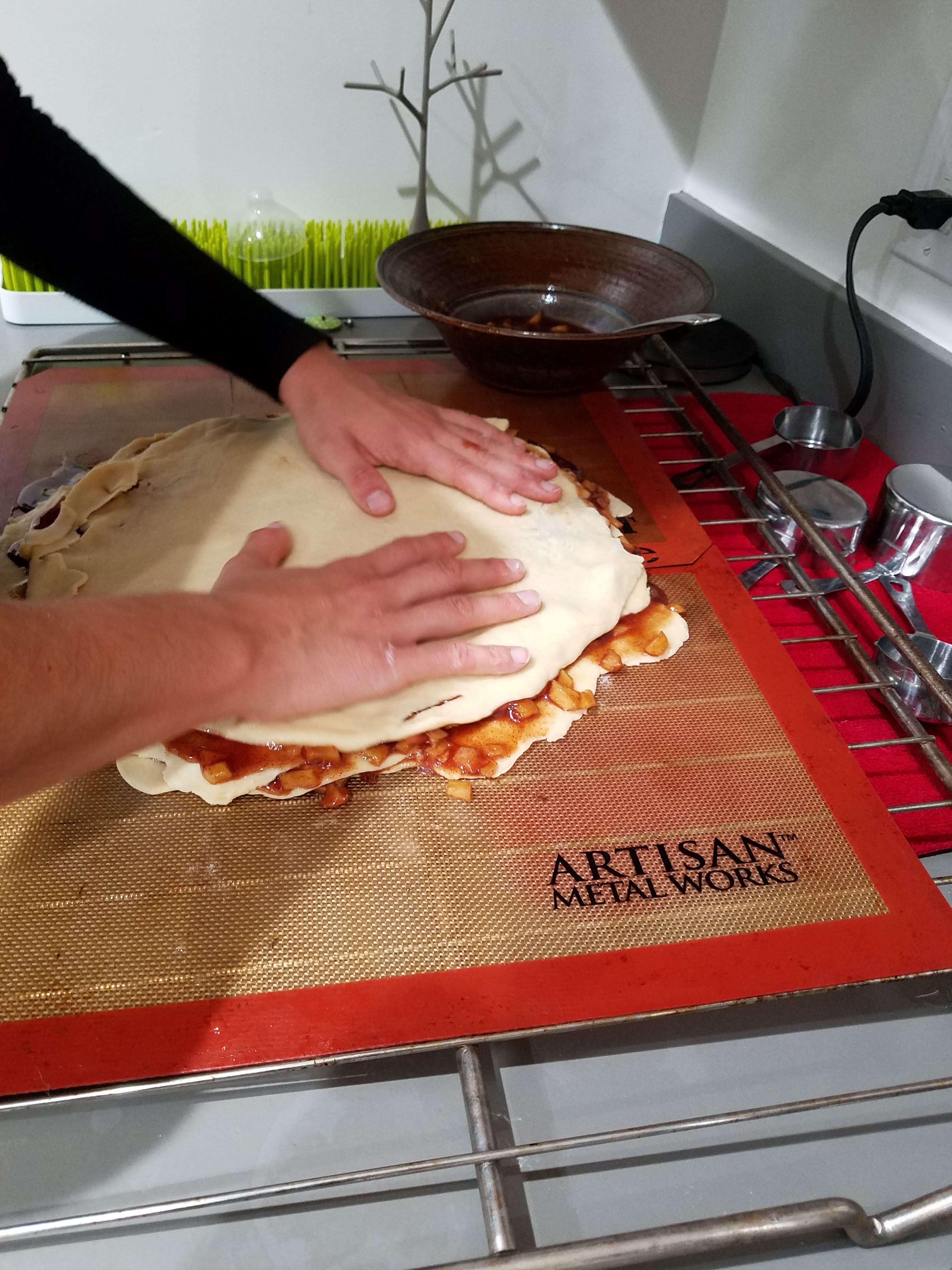
You’ll have to press a bit to get the layers to stretch to the edge.

pressing4.jpg

To make it easier for cutting, we carefully slid the ensemble back to the wooden board she rolled the dough on. Ideally, put this in the refrigerator for an hour or so. It would make the cutting part much easier.

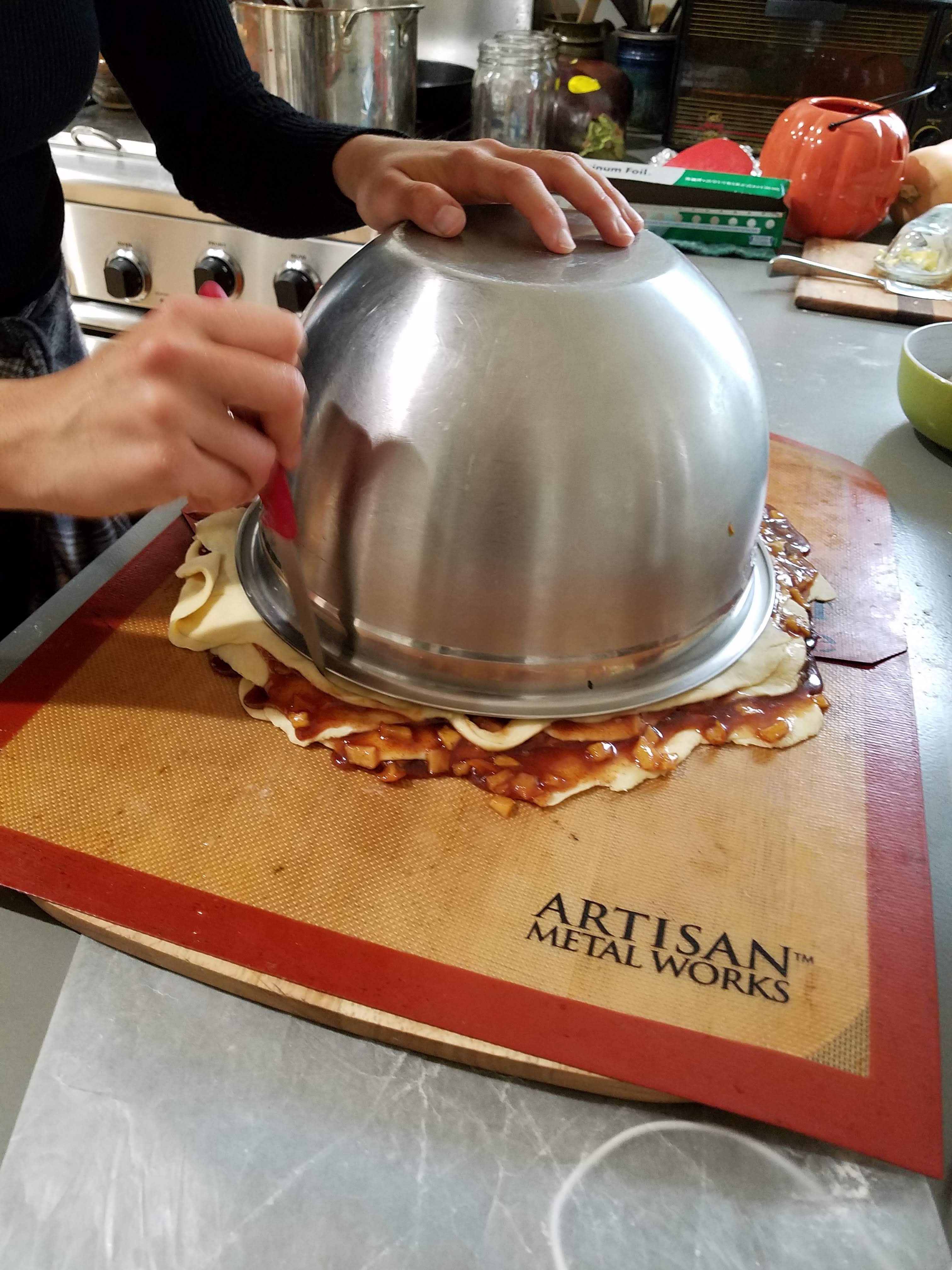
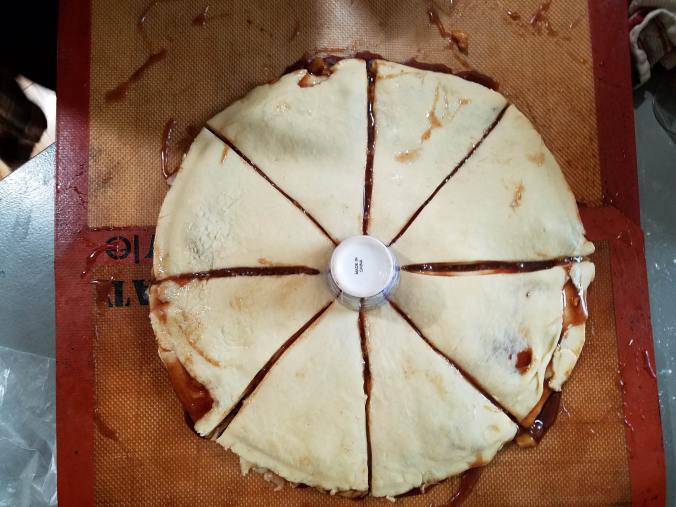
Ela then found a bowl that was as big as the ensemble to give herself a template for cutting a circle. You want as little waste as possible.

circle.jpg

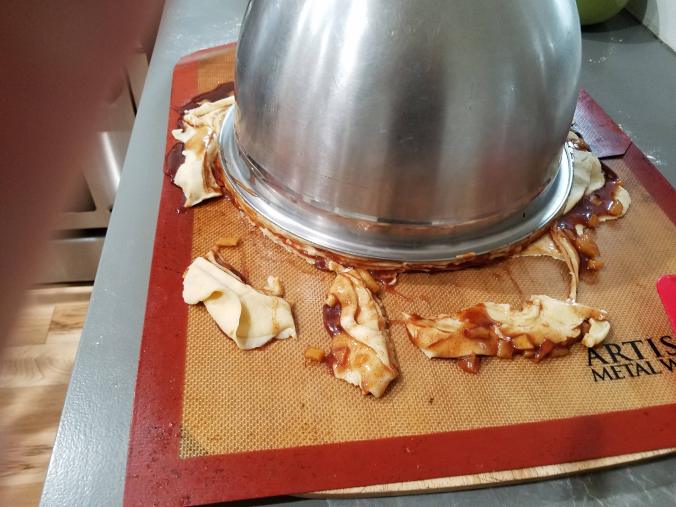
She then (carefully!) cut through the layers of dough until she had a circle. You are going to have leftover. These sugary dough bits look a mess, but just put them in muffin tins and let them rise just the same as the bread and they will taste very fine (not altogether different than the monkey bread we made last week!).

trim excess.jpg

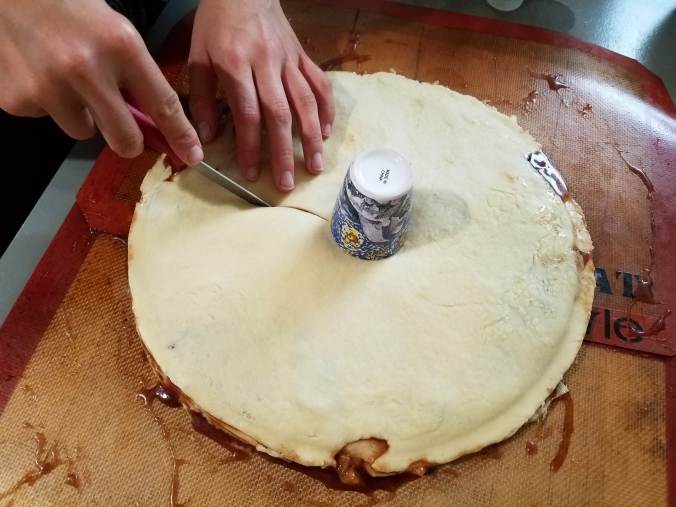
Ela then found a small cup (a shot glass is about the right size) for the center.

cutting.jpg

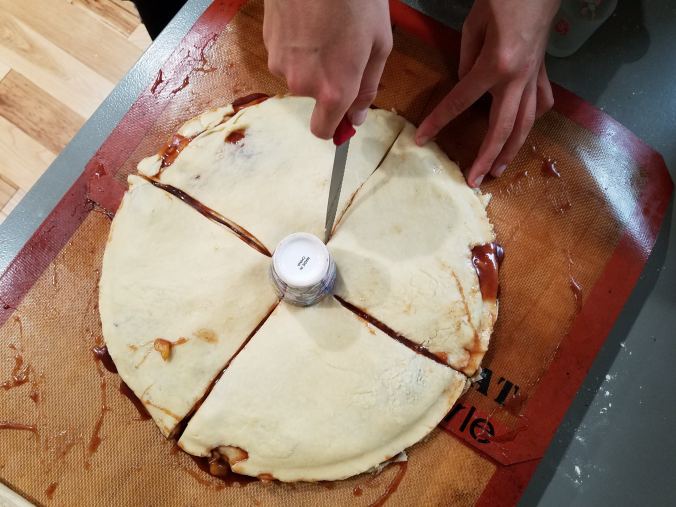
She then started cutting again (carefully!), first four lines, starting at the cup and working outward.

cutting four.jpg

Then eight, rotating the board to make it easier.

cutting 8

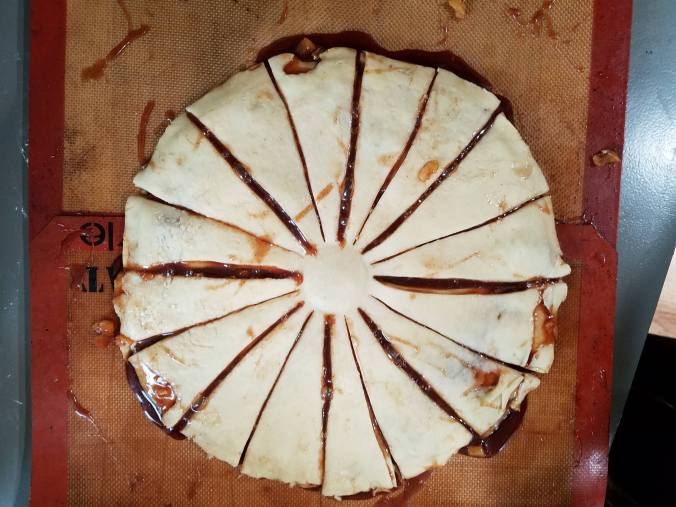
Then sixteen. That’s when she took the cup away.

cutting 16 with cup removed.jpg

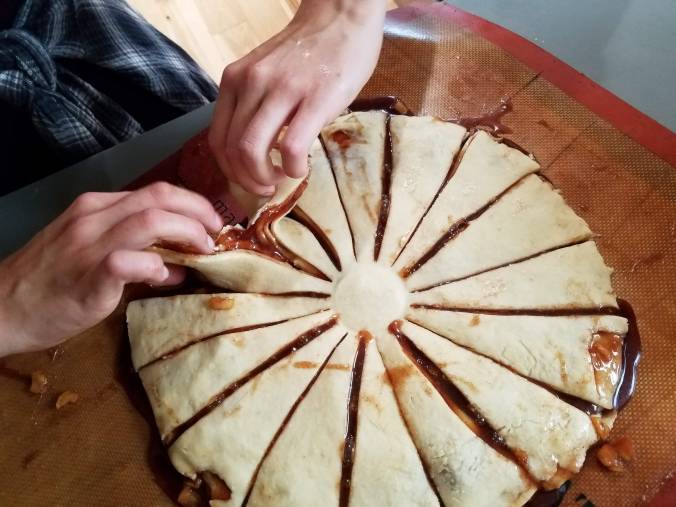
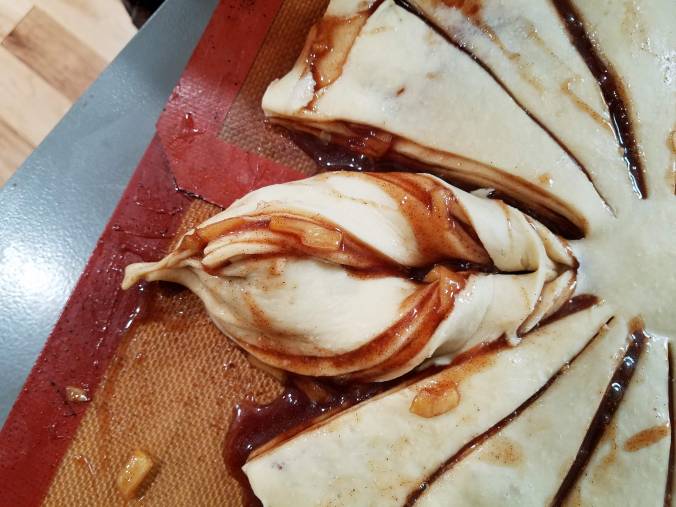
Now for the funnest part! Take two pieces that are side by side, lift them, twist once,

pick up two.jpg

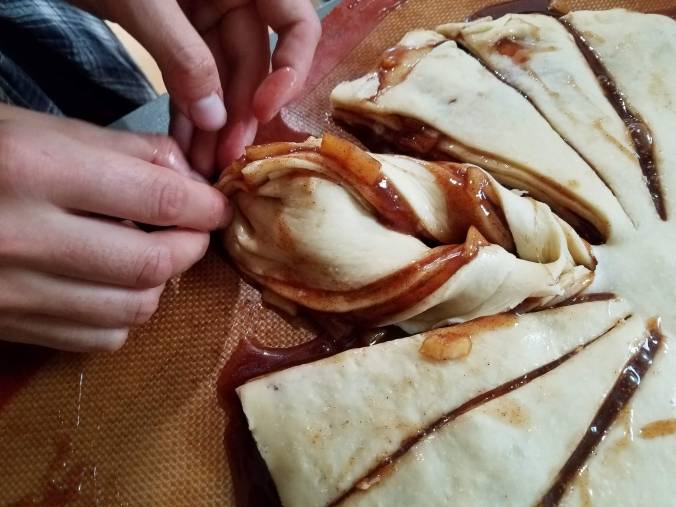
And again. You make two full twists.

twist twice2.jpg

And then pinch the ends together.

point of star 2.jpg

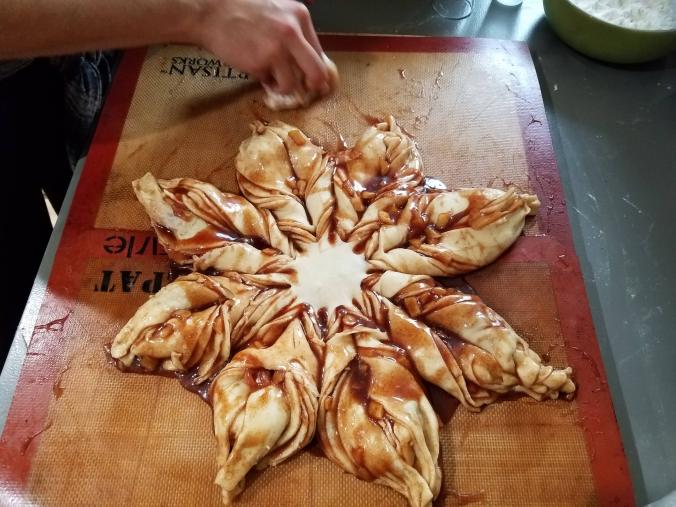
Do this all around until it looks kind of like this.

all stars.jpg

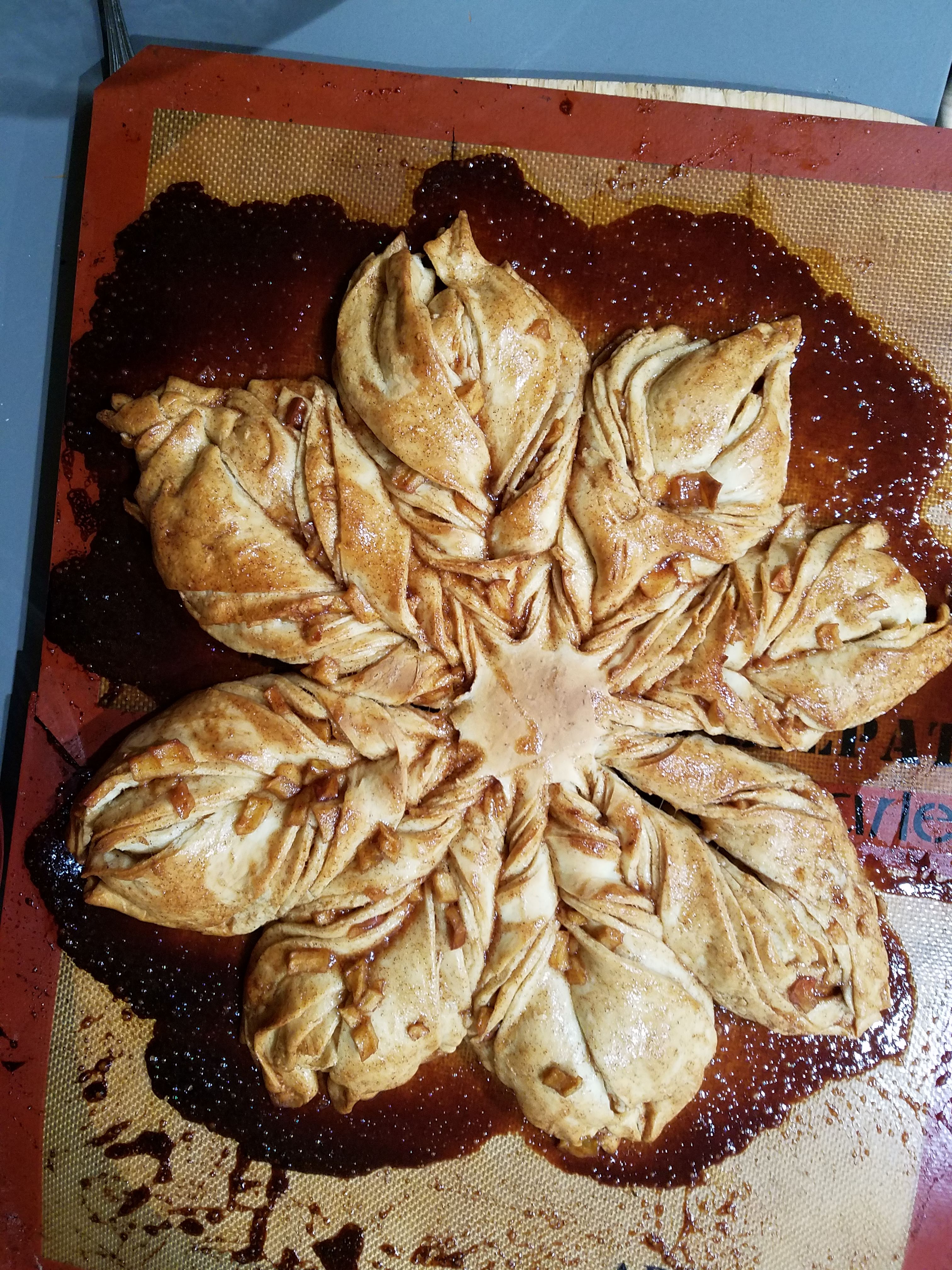
How beautiful is that!! Ela cleaned up as much of the excess sugary syrup as she could with a paper towel, but when it bakes, some of the sugary syrup is going to leak out anyway. Do the best you can. Let the star rise/rest (not in bed this time!) about an hour, longer if you need to time it so it comes out right as you finish dinner. This is best warm out of the oven. The syrup that leaked out forms thin candy which looks almost burned, but isn’t quite.

done.jpg

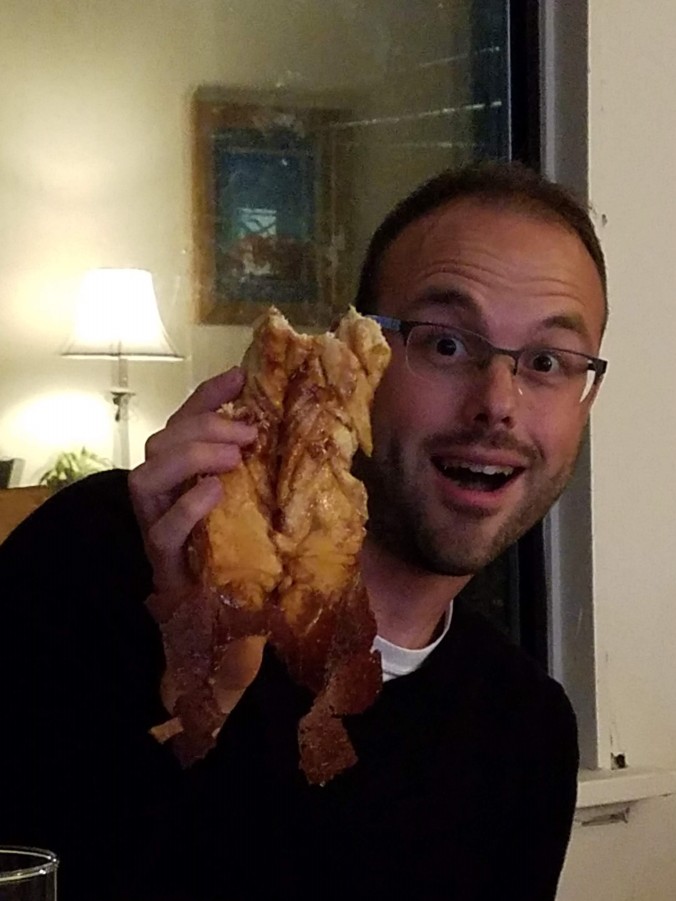
Well, maybe part of it is. If you pull a piece of the star off the pan carefully, it looks kind of like a lobster with claws.  Zach had the best lobster. We all enjoyed this star bread very much! Thank you, Ela!

Zach with his piece (2).jpg


The Rodbusters

Do you ever wonder how parking garages can hold all the weight of the cars? For me it’s one of those things – like open heart surgery or jet engine maintenance – that has science and skill behind it but is in that large set of things I will never understand. I know I just have to trust that the people who do this work do it right.  As you carefully drive from one end to the other of a parking deck, making tight turns at the ends to get to the next level to eventually find your spot, do you wonder how those concrete columns are connected to entire floors of concrete, and how the floors of concrete hold up vehicle after vehicle in neat rows?

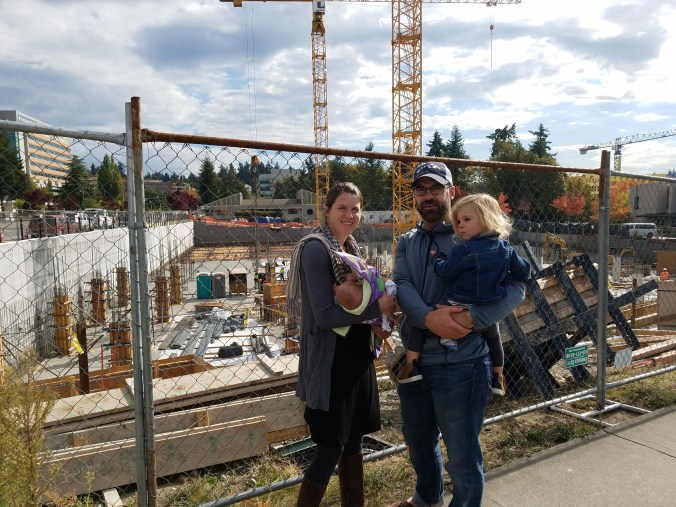
I don’t wonder about parking garages every day, but today I watched the ongoing construction of one in Kirkland, Washington, just outside Seattle and I am less foggy about them. I watched with great interest not only because I saw various stages of the process, but also because my son Bradley, who built the cottage on my property six years ago, is managing this project. Here he is with his family at the job site. Beth is holding two-week-old Zoe and Brad has two-year-old Piper, who was not as fascinated with the rodbusting as I was.

family.jpg

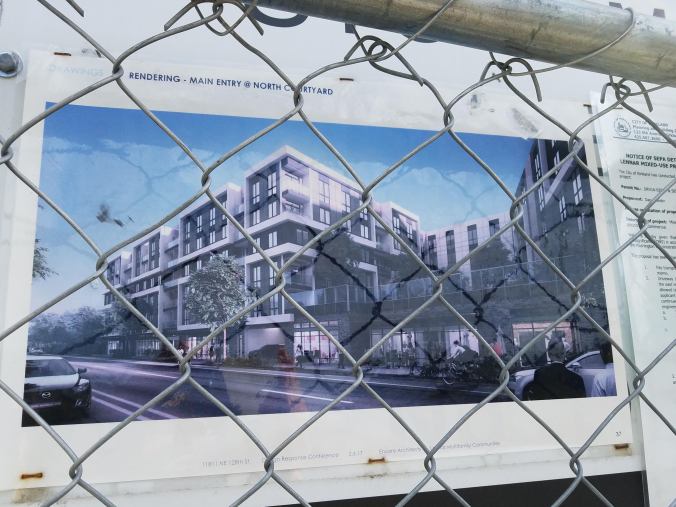
Eventually this site will become a six-story, mixed use building, meaning in this case retail on the ground level and apartments above. Its architectural rendering is posted behind the fence.

future view.jpg

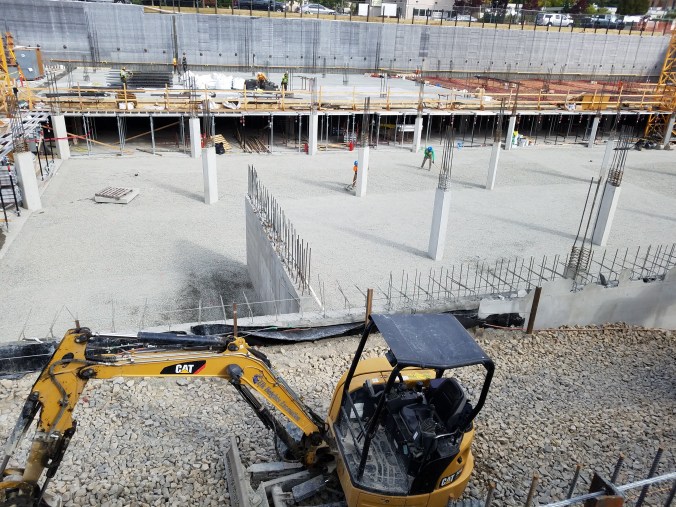
Right now it’s a hardhat area at the beginning stage of construction.

9.jpg

This was my first view of the job site.

24.jpg

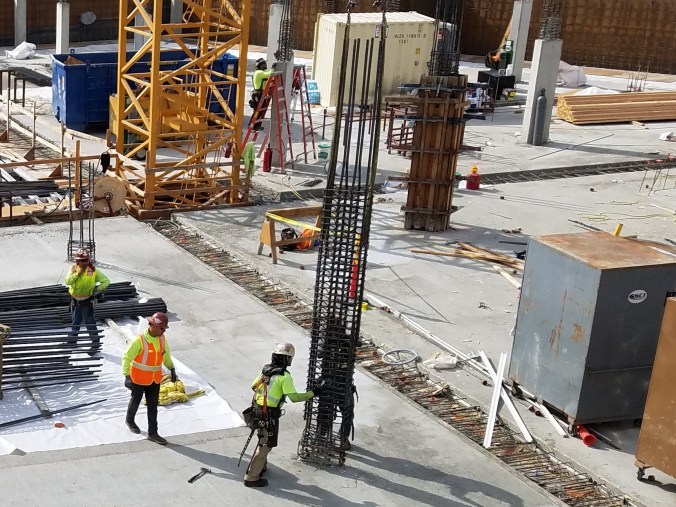
The white concrete columns – see them? – are standing on the lower level of what will be the underground parking deck of the new building. (The people who will live in the apartments above will need a place to park their cars below.) If you look a little closer at the columns (next photo), you see rods sticking up from them. The rods stick up much taller than the concrete of the column because…

24 (2).jpg

…once you put the floor of the second level in, the rods from the first level need to stick up through the floor, like this. You’ll see why shortly.

3.jpg

Those rods are strong steel called rebar that’s caged in by more strong steel. Before the concrete encases it and forms the strong concrete column, the assembled steel looks like this …

12 (2).jpg

The guys in the photo below, who cage the rebar, assembling the strong innards of each concrete column, are the “rodbusters.” They are using a kind of cable tie to connect the rebar to the steel caging pieces around it.

11 (2).jpg

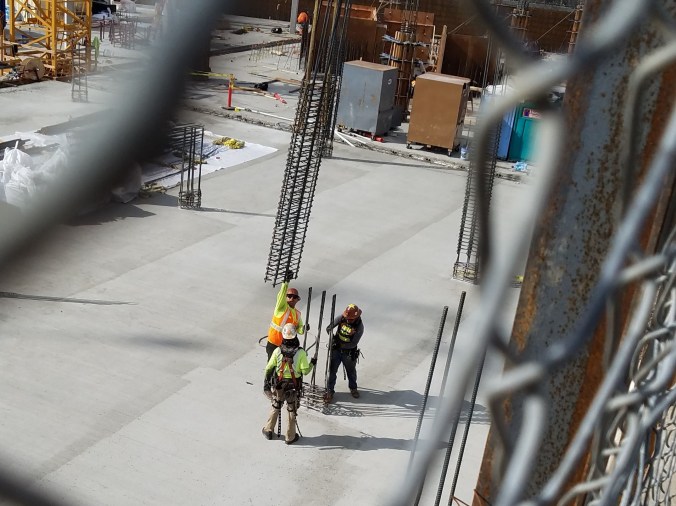
When they finish one, the crane comes along, picks it up and brings it to its mate, i.e. to the rebar that’s sticking up from the level below. The workers in the next photo are helping the crane operator to guide the caged rebar to the exact spot, and…

6 (2).jpg

…Ah, there it goes.

4 (2).jpg

Each assembled steel column is then surrounded by a wooden concrete form. See the rows of wooden forms below? The height of the form will be the height of the concrete column.

19 (2).jpg

A gigantic cement truck comes along next with its very long arm and pours concrete into each form. When the concrete is dry, the workers remove the forms and set them aside for the next use. The steel inside adds a lot of strength to the column. Notice again how the rods stick up much taller than the concrete of the column. The part that’s sticking up becomes the base for the next level.

Now for the floor. You know what a concrete floor looks like. But under the concrete are cables, very strong steel cables. They are red in the picture below. Just as the steel rebar in the columns makes the columns much stronger, the steel of the cable makes the floor much stronger – in fact strong enough to support all the weight of the cars.

8.jpg

After the concrete is poured onto the wooden platform, making the floor, the cables are pulled from all sides and secured (sealed) at a specific tightness. This provides the support so the floor doesn’t collapse. After the concrete dries, the no-longer-necessary wooden platform (now underneath) is removed.

Rebar is great for adding strength to the columns, but cables are preferable to rebar for the floors. To gain the same strength/support using rebar, you would have to make the floors much thicker, which uses more concrete and makes the building overall taller. The curve of the cables plus the tension gained from the pulling means the floor can be thinner (less concrete is used and the building is not as tall overall), which is a more efficient use of materials and space. You have to know your math and your science to make this all work of course, and you have to have the right machinery and good materials and the project manager and the inspectors and all the workers, including the rodbusters. Without the rodbusters, forget it.

If you didn’t know all this before, as I didn’t, don’t you feel better now about parking garages? I do!

I also feel very proud of my son.


New To Me and Unexpected

No matter how old we are, there is something new around every corner. This is especially true if you are traveling to places that are not so familiar. Delightful discoveries keep things so interesting. They make you see the world differently. They keep you young, reminding you that you have not arrived yet, that there is yet something to learn, to puzzle over, to marvel at, to be astonished about and even in some cases to cringe about (see below!). Let us never lose our sense of Are you kidding me?

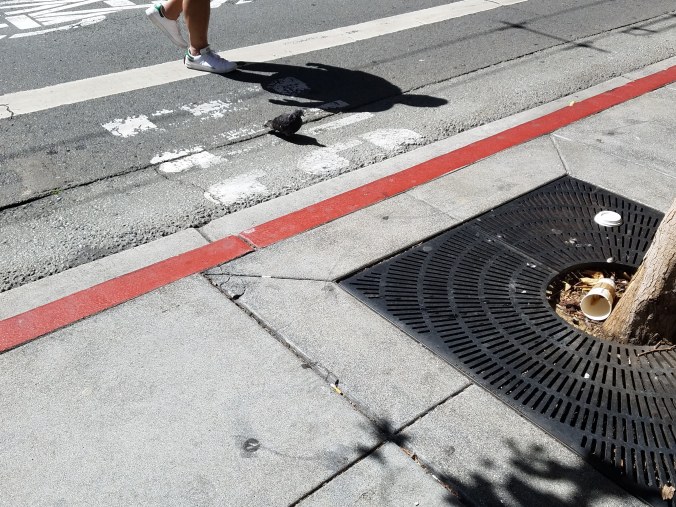
In San Francisco, a bird looked dead on the street. I felt a moment of sadness. But as in Berkeley, where I questioned why the cooler-on-wheels was moving along the sidewalk on its own and Drew said nonchalantly Oh, that’s a robot delivering smoothies, I was equally taken aback by this bird on the street as we walked to the Embarcadero Ferry Building.bird from afar sleeping int he road.jpg

It sure looked dead to me. But no, Drew said, it’s just sleeping.

Sleeping? Whoever heard of a bird sleeping in a road? What kind of bird sleeps in a road? This kind apparently. Get a little closer. Is this bird sleeping?

bird sleeping in the road.jpg

Doesn’t it know that a road is a bad place to sleep? Didn’t its mother teach it the basics? If you want a long life, stay in high places away from humans and large, fast-moving vehicles. Get close only when you see lots of grass and the humans are tossing food about. Well, I don’t see grass here and no humans are offering food, but something must have clued it in, maybe even the person who then walked close to it, because in the time it took for us to get past, that bird turned around, faced the sidewalk and got out of harm’s way.

bird walking away.jpg

Smart bird? Or dumb bird got lucky?

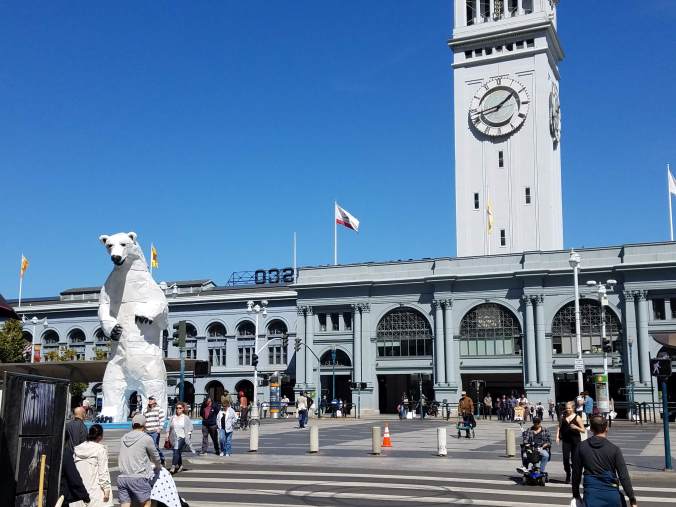
Approaching the Embarcadero, we encountered a massive polar bear, part of the Salesforce descent upon the city this week. It isn’t every day you see a massive polar bear. There is something both majestic and adorable about polar bears, even when they are fake. You must agree, this is massive.

polar bear at embarcadero.jpg

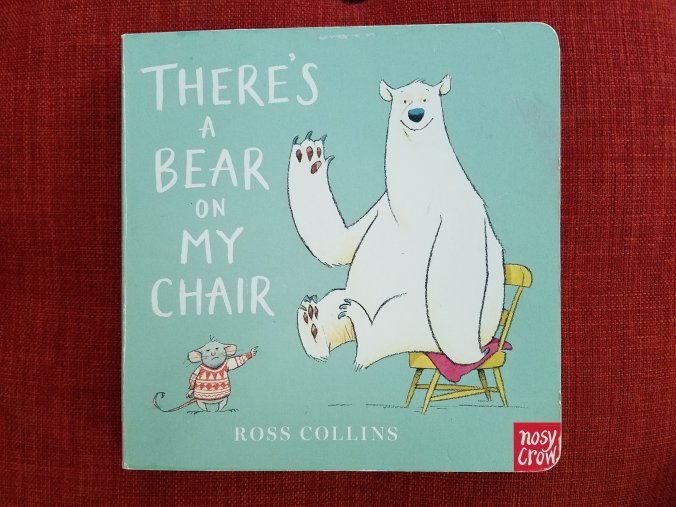
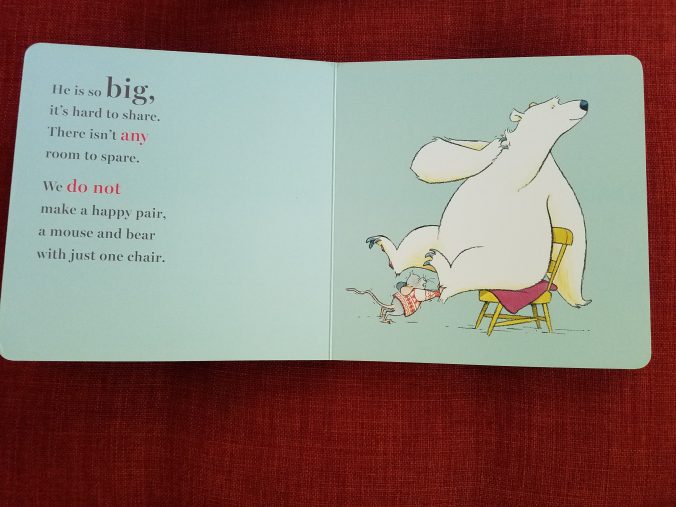
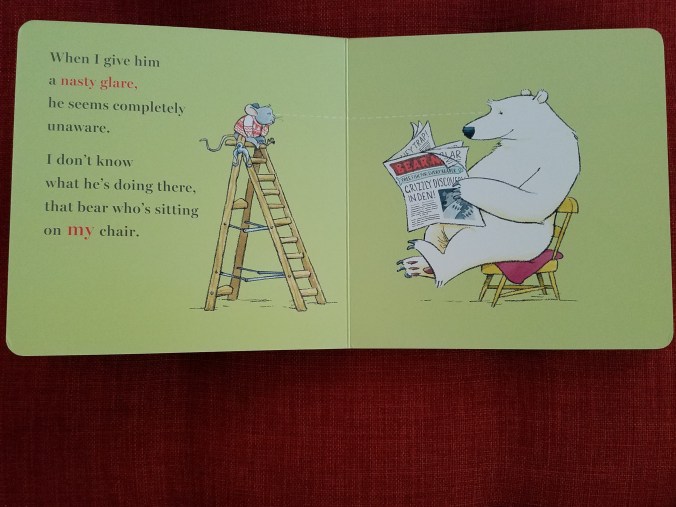
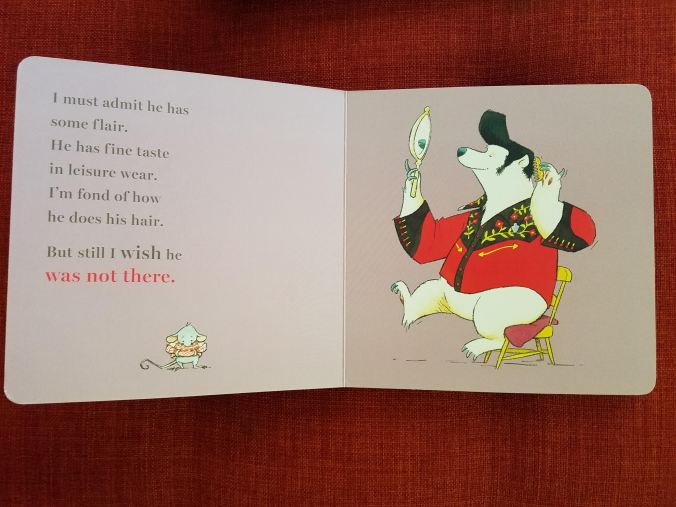
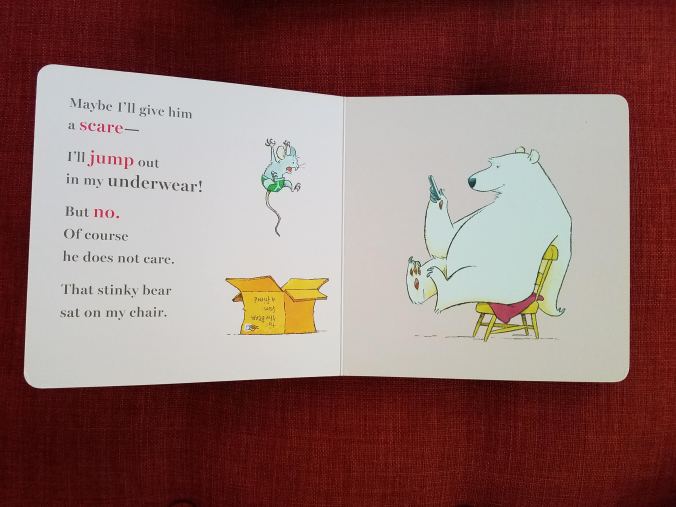
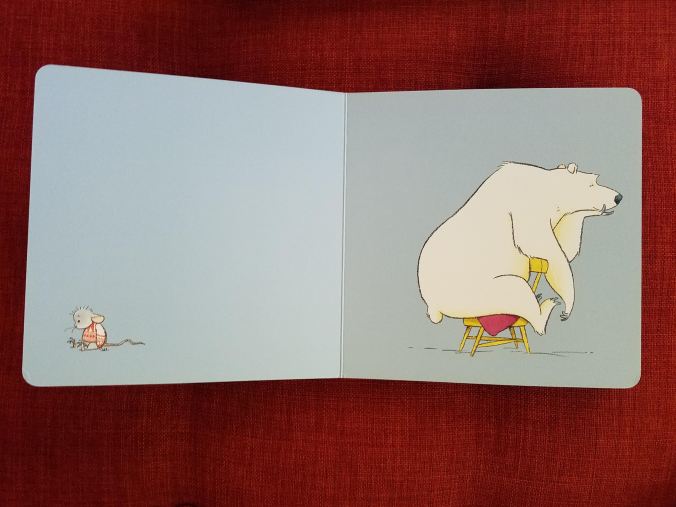
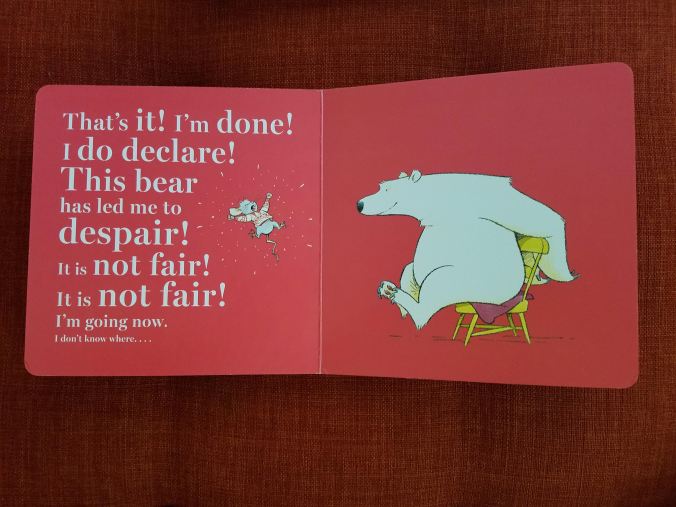
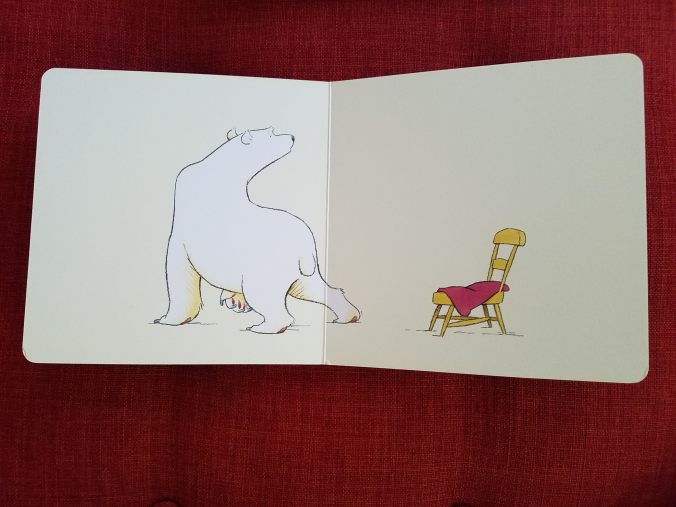
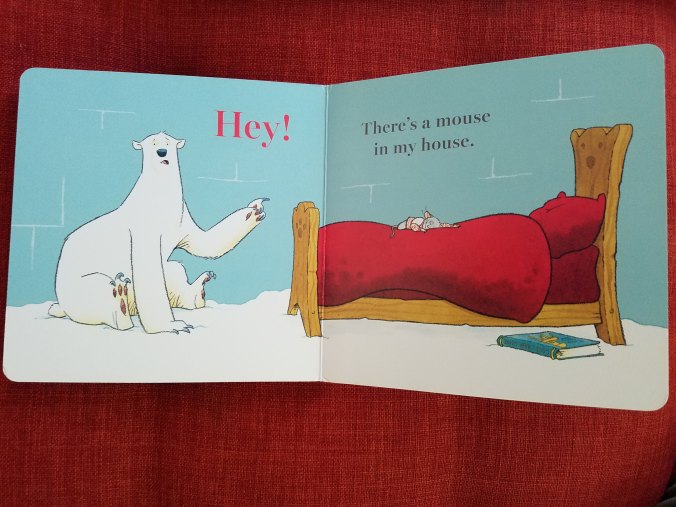
It also leans toward adorable rather than majestic, as does the one in a fairly new book called There’s a Bear on My Chair by Ross Collins that I discovered at Marie’s house. It has joined my all-time-favorite-kids’-books list. I will show you the pages at the end.

cover.jpg

I am a huge fan of children’s books. The good ones are as good for adults as they are for kids. This one has it all: rhyme, cadence, delightful illustrations, originality, silliness, cleverness (the kind kids show you at the most unexpected times), hilarity and subtle yet powerful parallels to the “real” world, though you have to think about it a little to arrive at these.

It is impossible to be around children, as I am here now in Boise, without discovering something new in something old. Another book on my list, one that has been there for decades, is Mike Mulligan and His Steam Shovel. Unsurprisingly, someone thought to make it an audio book. That’s all well and good. What would never have occurred to me is using the London Philharmonic Orchestra in the background with bagpipes, and a narrator with an Irish accent! I never thought of that! Mike Mulligan. Irish. Go figure! Ellie loves listening to Mike Mulligan on the way to school. The music meshes with the story perfectly.

If you have a child in your life – your own or a neighbor having a birthday or a niece or nephew – get both of these books and the philharmonic audiobook to go along with Mike Mulligan. You cannot go wrong.

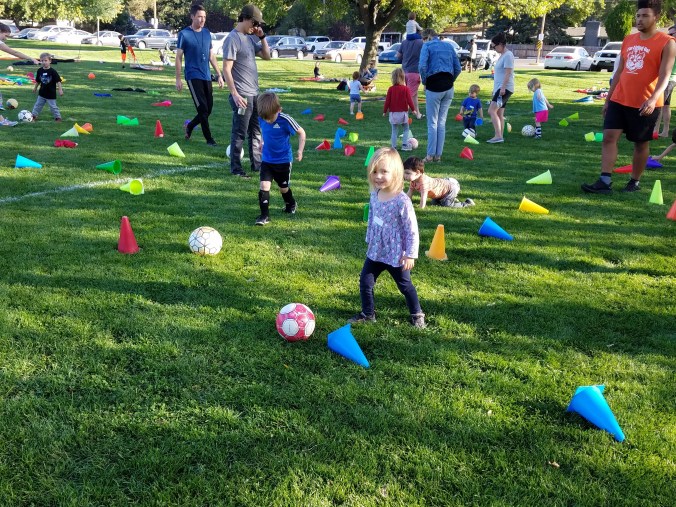
While on the adorable track, I must mention the three-year-olds at soccer practice, another reality of the world that somehow escaped me before now. I am sure I didn’t do any organized sport myself until I was at least nine or so, but these days they have soccer at three. They do in Boise anyway. Ellie loves it. All those cones are for foot control, by the way. You put your foot in the open end and lift it off the ground and hold it up. Who knew?

soccer1.jpg

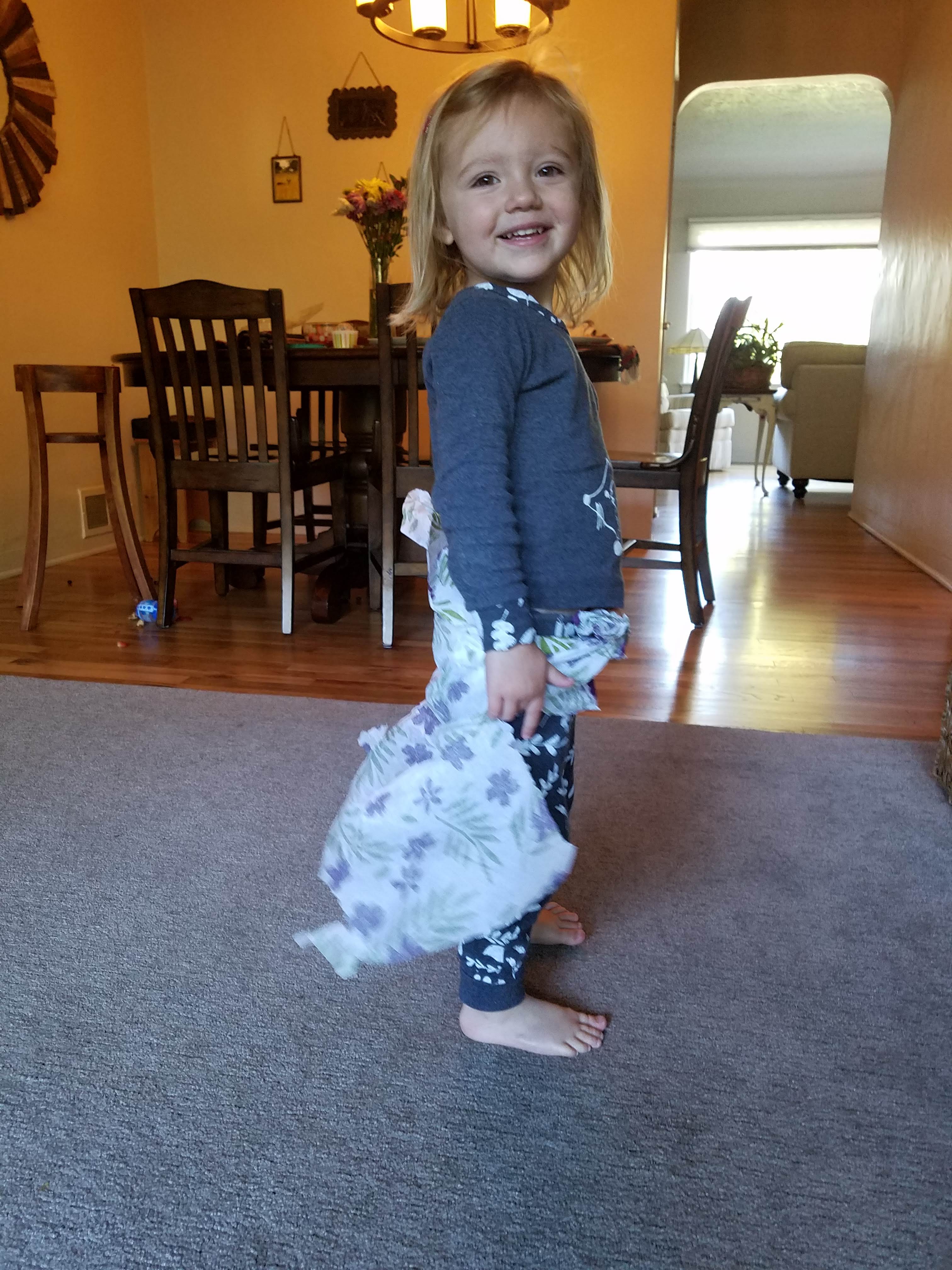
This is the same child who loves to wear a paper skirt, by the way.

paper skirt.jpg

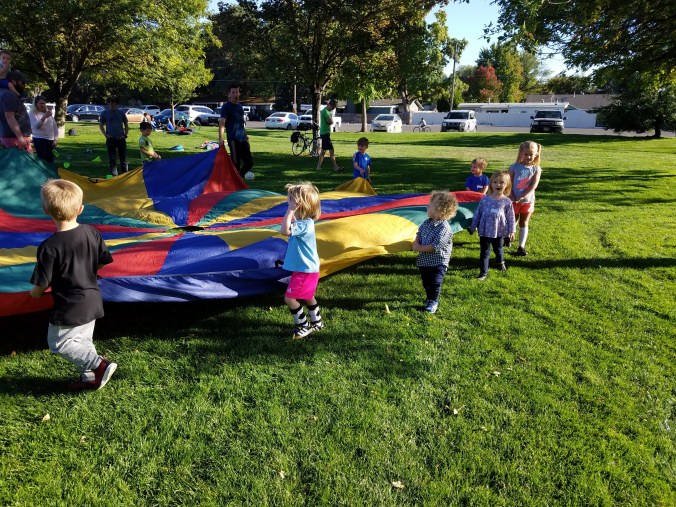
Anyway, in case you didn’t know it, soccer for three-year-olds in Boise sometimes involves “making a pizza” on a parachute (after you walk around in circles for a bit to make you hungry enough to eat the pizza),

soccer2.jpg

the last part of which is kicking the “meatballs” on top of the pizza. What’s your guess? Will these children grow up to love soccer or some other active organized sport? I think so!

Not everything that is new is adorable. Not everything is even pleasant. Whether just contemplating it or actually taking a drink from it (I couldn’t!), this exhibit at the Exploratorium in San Francisco challenges your grossness meter. According to the sign, the standard drinking fountain on the right and the one attached to this toilet (which has never been used as a toilet) are identical. Both clean, both usable, both dispensing fresh water. But who can bring themselves to drink out of the fountain attached to the toilet? “A Sip of Conflict,” they call it. I’ll say!

toilet drinking fountain.jpg

I can hardly look at it without cringing, let alone take a drink! So enough of grossness, let’s head back to Boise for something else I did not expect.

Here is a very old tortoise. How do I know he’s old? I have no idea actually. Tortoises are always old, right? This one was at the downtown zoo, active as a sloth, dry as the sand he stands on. Ellie was fascinated with him.

tortoise.jpg

Why did I not expect a tortoise at the zoo? You expect giraffes, llamas, zebras. But a tortoise? Possibly I am overwhelmed with newness and adorableness all around me (save for above toilet, we can all agree) and I didn’t even have time to have expectations. I just know that this amazing animal took me by surprise.

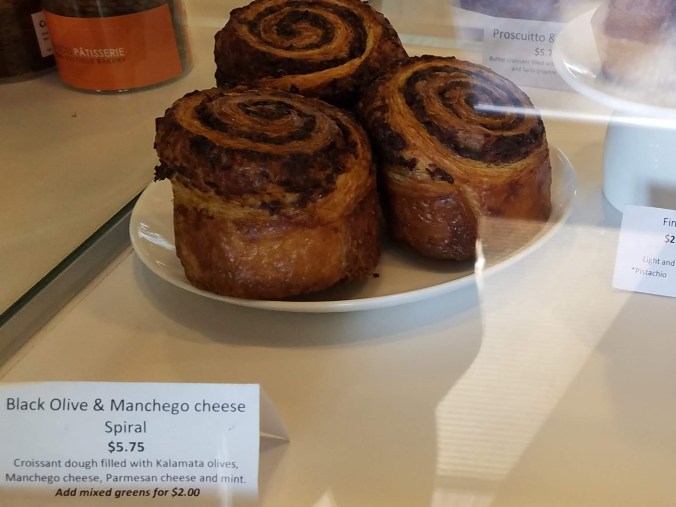
Lastly (you knew there had to be food somewhere in here), we made a stop this morning at a French bakery in Boise called Janjou Pâtisserie. I know: French bakery in Boise, something else you would not expect. But what was even more unexpected, what was totally new to me, was a spiral croissant with olives and manchego cheese. Oh yum! I have never seen or had olives and cheese in a croissant before, let alone in a croissant of award-winning quality. Who thinks of this? Why didn’t I think of this?!

olive and manchego croissant (3).jpg

I cannot describe this adequately. You will just have to imagine the soft/crisp, buttery/flavorful, done-to-absolute-perfection nature of this pastry. Drool if you have to. I won’t tell.

I would like credit for having restrained myself in this post with regard to the many awesome trees and other plants one finds while traveling. I know I covered the eucalyptus trees in Berkeley and the Boise rose garden recently, but Boise has more awesome flora, and it is with serious effort that I hold back the low-lying spikey things, the weird wisteria, the blob tree – I spare you this time!

But I have to show you the pages of the adorable polar bear and mouse book. Thank you, Ross Collins, for your marvelous book!

Take your time now. Read slowly, deliberately and out loud if you can. Get a good rhythm going. Look at how the illustrations coordinate with the text. Pretend you have a child on your lap… Better yet, pretend you are the child.

1.jpg

2.jpg

3 (2).jpg

4.jpg

5.jpg

6.jpg

7.jpg

8.jpg

9.jpg

10.jpg

11.jpg

12.jpg

The Artist in the Grocer

Some people are artists. Some aren’t. But this is not a black and white distinction. Somewhere along the spectrum between Artist Extraordinaire and Person with No Sense Whatsoever for Color, Form and Design is the place where I suspect most of us reside. We may marvel at the artist’s skill – how can human hands can produce something that amazing – yet have a modicum of understanding (a little, anyway? a teeny bit?) as to why the rest of the world marvels with us.

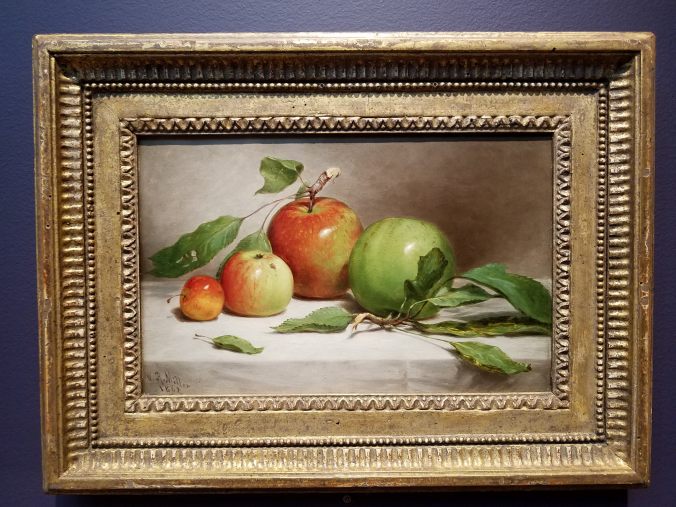
Part of the reason we marvel is that we ourselves (all right, let me speak for myself), I myself, would have all to do to draw a shape vaguely resembling an apple (through it might look more like a pumpkin or a tomato) and color it red (to hopefully distinguish it from the pumpkin at least) and put little green leaves at the top of a brown stem (to hopefully distinguish it from the tomato). In my wildest dreams I couldn’t come up with something like this. I’m not sure I could even imagine this composition, let alone put color to canvas and create it.

apples.jpg

But William Rickerby Miller did. This oil on canvas “Study of Apples” that he painted in 1862, hanging in the de Young Museum in San Francisco, falls into the category of art known as trompe l’oeil. Do you see how the leaf at the edge of the table seems to be coming off of the canvas, almost three-dimensional? Do you see how the apples shine, as if someone just polished them because they wanted a bite? How does he do that??

Trompe l’oeil is a genre of art that is a trick, a trick of the eye, a very deliberate attempt to make you think the objects on the two-dimensional canvas are real, when you know (because you are looking at a painted drawing in a frame) and the artist knows (because of having painted that drawing) that they are not. In theory, this trick reminds you that all art is an illusion, so do not be mistaken: What you are looking at is an image of the thing, and not the thing itself. In turn we can take the broader lesson to be careful in this world: All is not what it seems to be!

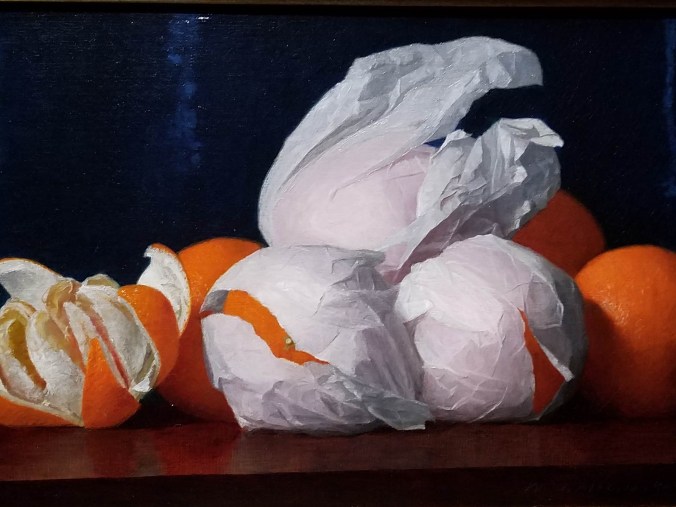
These oranges have the same effect on me. Also a still life, also oil on canvas, it is called “Oranges in Tissue Paper,” painted in 1980 by William Joseph McCloskey. The oranges look so real, even more real than a photograph could render them. The orange color is bright, almost plastic, with a dark background setting them off even more. The tissue paper practically sounds crinkley, the sections of fruit look juicy. I want to eat them! No wonder this painting is part of a group the museum calls “10 Works of Art to Avoid if You’re Hungry.”

oranges (3).jpg

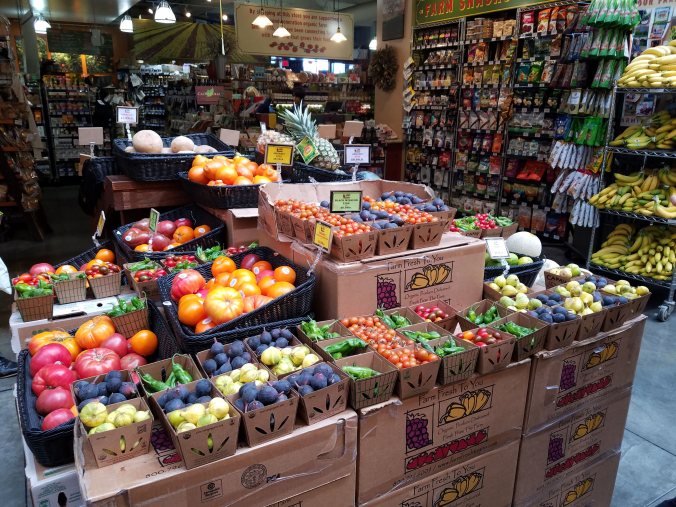
I grant mega-credit to these artists and all great artists. I stand in awe at what they do with tools and color, with hands and minds, with time and effort. But I return to the spectrum – those who cannot be considered in the master class, but nonetheless have an admirable eye for Color, Form and Design and some skill with the same. I present the unnamed person behind the fruit display at a grocer called Farm Fresh to You, one of the extraordinary little businesses at the Embarcadero’s Ferry Building Marketplace.

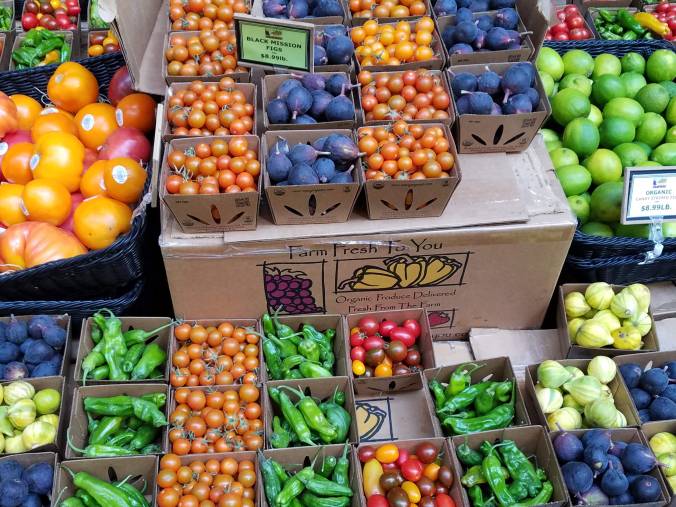
It takes no small skill to arrange the display I observed there. At first glance, and to most passersby, it’s fruit for sale. Indeed it is, but if that’s all it is, why the spattering and alternating of color? Why the angled baskets leading up to the top-most level? Why the bananas all together as almost a backdrop of the familiar but the black mission figs (that look purple to me) alternated among its fellows in sixteen different spots, setting off the yellow-greens, green-greens and oranges of the fruits and veggies around them?

embarcadero fruit1.jpg

Why green apples on one side of the raised, middle carton and large orange/pinkish/reddish tomatoes on the other? Why some small, orangy, cherry tomatoes below some others just like it but in line with the ones above? Why the peppers below the purple figs and multi-colored small tomatoes below some other orangy ones? Why not purple figs here in this one spot, orangy cherry tomatoes there in another spot, big fat tomatoes all together in one basket?

fruit at market Farm Fresh to You.jpg

Because whoever put this display together has an eye for Color, Form and Design. Whoever did this made multiple decisions to put this here and that there, to vary the colors and shapes, to let some look random and some intentional – for good reason! Just like the trompe l’oeil above or any other type of art, it catches your eye, draws you in, gives you pause, and in this case, hopefully causes you to buy something!
Why don’t we see such elaborate displays more often? Because they take time and effort and no small amount of skill. Because the owner of the shop has to pay the person who does it, and that adds to the cost, which some markets cannot bear (but evidently this one can). Because people who can do this don’t come along every day. Because the artist had fun!
Granted, the colors of the natural fruits and vegetables negate the artist having to duplicate them with oil or acrylic on canvas, their natural shapes are 3-D to begin with, and the continually changing nature of the display – the gaps here and there reveal that someone recently bought multi-colored tomatoes, purple figs and green peppers – makes it a continual work in progress for this artist. I do not place this art on par with the paintings above. But whoever does this work (probably all the time) gets new material every day and every season, can rearrange at will and elicits admiration, I venture to say, on a daily basis. I was not the only one taking a picture of it.

I also venture that there is great pleasure in work well done, in creating something both functional and pleasing to the eye, in knowing that some people – just a few maybe, but still some – see the artist in the grocer, the art in the display,  and smile. I did.

Having Eyes, and Seeing Beauty

In downtown Boise (Idaho) is a lovely rose garden. I explored a small part of it today with my daughter and her two little darlings, and I learned something about myself: I’ve changed. There was a time when I would have said Those are pretty flowers, and left it at that. I did not “have time” for such things. I had other things to do. I had seen pretty flowers before.

No more. I could have spent all afternoon admiring the blooms. There were so many! They were every color imaginable. They were so perfect.
pink up close.jpg

Clearly someone (or probably a team) spends a lot of time tending them and does it very well. As we approached on this picture-perfect day, I realized this was no ordinary rose garden. There are over 2000 rose bushes in this special place named after Julia Davis, Boise’s “city mother.”

lo ng view.jpg

You can’t rush through a rose garden because roses are such extraordinary flowers up close. In my case, however, you also can’t take too much time when you have a three-year-old with you and another who’s almost one because the zoo is right next to the rose garden, and that is the actual destination – and guess where they would rather go! Roses do not compete with giraffes when you are three, especially since they have a baby giraffe!

baby giraffe (2).jpg

But Marie graciously gave me some time to use my eyes and see the beauty of the roses. It’s impossible to decide which is the prettiest color. I have always loved the yellow ones.

yellow2 (2).jpg

This one decided to be both pink and yellow.

pink and yellow (2).jpg

Coincidentally, one of the books I brought along to read on this trip is the engaging story of a little girl growing up in pre-WWII Japan (Totto-chan, The Little Girl at the Window by Tetsuko Kuroyanagi, a longstanding bestseller describing the early school days of a woman who went on to become one of Japan’s most popular television personalities).

Totto-chan (2).jpg

Beginning when she is about five – having been expelled from her previous school because her intense curiosity was disruptive to other students – Totto-chan attends an extraordinary school led by a schoolmaster who becomes a hero to her. This man listens carefully, allows for individual differences, advocates for the unsung, celebrates a fresh look on almost anything and creates an environment intent on giving every child the best way to grow, to learn, to shine. How ironic that I come to an extraordinary rose garden the very day after reading these words:

“Having eyes, but not seeing beauty; having ears but not hearing music; having minds, but not perceiving truth; having hearts that are never moved and therefore never set on fire. These are the things to fear, said the headmaster.”

I did have eyes and I did see beauty, and for the beauty I saw I am very grateful. But I did not see only beautiful roses in the rose garden. In the middle of the path leading to the gazebo sits this fountain. I don’t like the blue water because it looks artificial to me, but I soon saw past that. Look carefully around the edge and you will see imbedded plaques.

park2

The etched words were mostly in memory of loved ones, such as this one.

sign2 (2).jpg

But this is the one that moved me nearly to tears:

sign1 (2).jpg

At first I thought maybe Linda’s Uncle Fred was one of the gardeners, and maybe he was. But it could also be that they strolled this garden together and it was all the better for having done it together. In the end, for these two people, together was best. And I thought: Would the zoo today have been as wonderful if I had not been able to listen to Ellie’s gasp when she saw the lion?

lion (2).jpg

Would I have enjoyed watching the anteater look for his own lunch in the dirt if we had not been together on benches next to him eating ours?

anteater2.jpg

Being together today, I stood next to my daughter holding her daughter who’s feeding the llama – most definitely a sight more beautiful than any rose – and the roses are very beautiful! I am so blessed to have eyes to see it all, to enjoy their sweet company, to spend this week together.

Marie and Ellie feeding the lama.jpg

“Having eyes, but not seeing beauty; having ears but not hearing music; having minds, but not perceiving truth; having hearts that are never moved and therefore never set on fire. These are the things to fear, said the headmaster.”

Monkey Bread: A Baking First

It was not the original plan to make monkey bread this morning. I have never even made it before. Other than having seen it (though not purchased it) at Vive la Tarte yesterday, I only vaguely even heard of it. Having only random fragments in my mind about a thing, disconnected from personal experience, generally would not translate into Let’s Make That Thing.

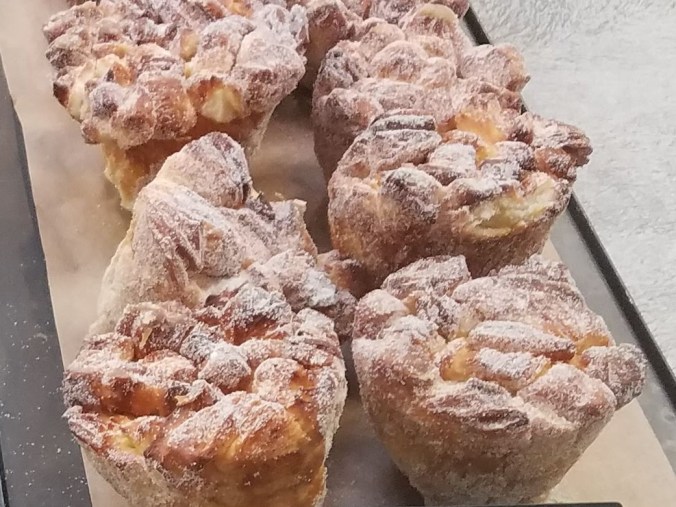
But if you had seen the monkey bread yesterday, you might be motivated to try it too. This is what we saw.

croissants monkey bread (2)

You have small chunks of dough individually coated with cinnamon, sugar and butter all baked together into one multi-chunk, sweet treat.

Drew and Nicole and I had started talking about the buttery, sweet, cinnamony goodness of monkey bread, and I said to myself: It Can’t Be That Hard.

Suddenly there we were with a plan. Early morning grocery run for yeast, butter and other essentials followed by fun in the kitchen. Meet at 8, eat by about 10, right?

Oh, dear. Jet lag is real, and I still have it. Every morning since I got to the west coast I have woken up by about 4am. Thinking about the monkey bread project, I was allowing two hours for all of the following: a four-block walk to the store, shopping, walk back, prep of dough, rising of dough, assembly of sweetened dough chunks into muffin tins, re-rising of dough and baking – all to make something I have not made before and in somebody else’s kitchen! Yeah, I was way off. Can I blame this on jet lag?
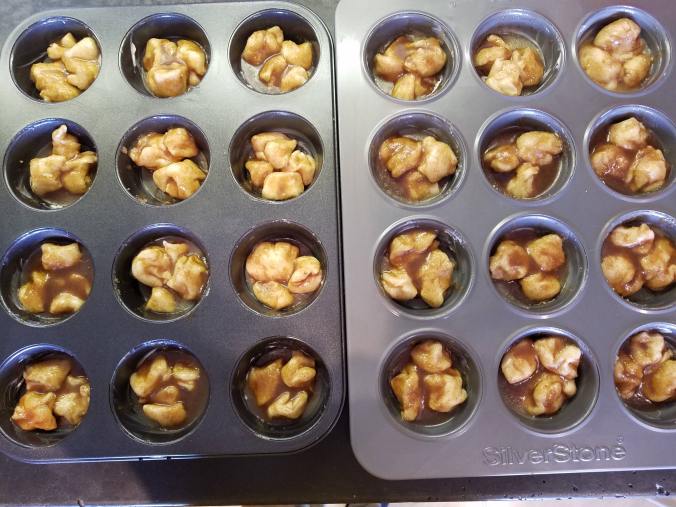
All to say, the idea-to-results sequence took way longer than anticipated. Nonetheless, we would have our monkey bread.

When you have never made something before, it’s a good idea to have a good recipe. I read a few online. They were all different, but basically we’re talking about a sweet, soft dough that is smothered in butter, sugar and cinnamon and baked into delicate, pull-apart, heavenly rolls. I have a great recipe for soft dinner rolls. Add the sweet element and that should work, I thought. It was going to be, shall we say… experimental. Thankfully my sister Lynn came to the rescue. She is a great cook, has made monkey bread many times and gladly sent me her recipe. See below.

I had no doubt that this was the best plan. And perhaps if I had followed the instructions, these would have been even better than they were.

You read that right: IF I had followed instructions…

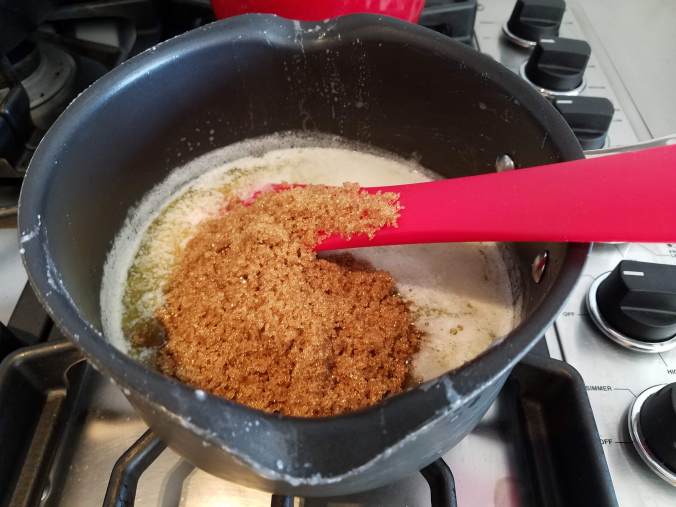
Let me back up. I love my phone. I think smart phones are amazing. But one downside is that they are very small. I opened up the recipe on my phone and it was really hard to read. I did not have a printer or a larger screen. My eyes aren’t that good. Then you set the phone down to do the next thing, and by the time you do that next thing, the screen has gone black. You open it again, get to the download again, try to read the tiny writing again. It was problematic. I know I got the ingredients right, but why I thought to put the brown sugar in with the melted butter in preparation for rolling the dough balls, I am unsure.

This was my deviation, putting the brown sugar into the melted butter. Then Drew added the cinnamon and I got to stirring.

sugar into butter

I actually got quite excited about how beautiful the sugar and cinnamon looked as I was swirling it in there with the butter. That’s about the time I got a flashback to the actual words of the recipe which was something to the effect of “Dip the dough balls in butter, then roll in the sugar/cinnamon mixture.” Oops.

swirling in pot

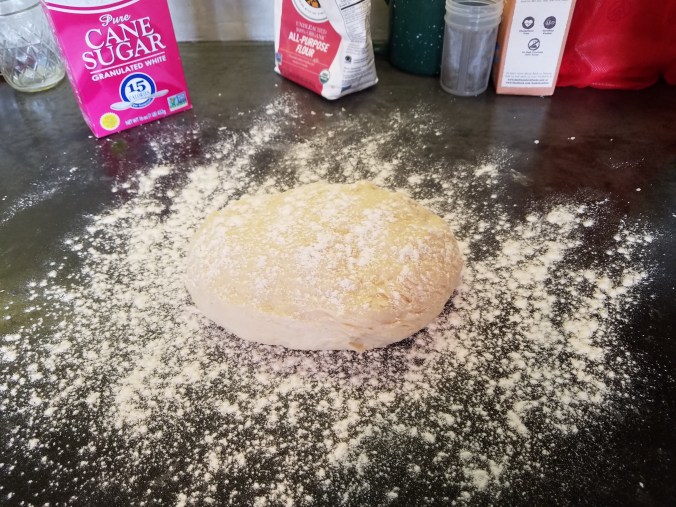
I did most everything right, I promise. The dough was soft and elastic.

dough

I covered it and let it rest.

covered dough

I buttered the muffin tins. Lynn’s recipe says to use a bundt pan, but I wanted ours to be like Vive la Tarte’s, so I used muffin tins. See all the pieces of butter waiting to coat the inside of each cup?

buttered pan

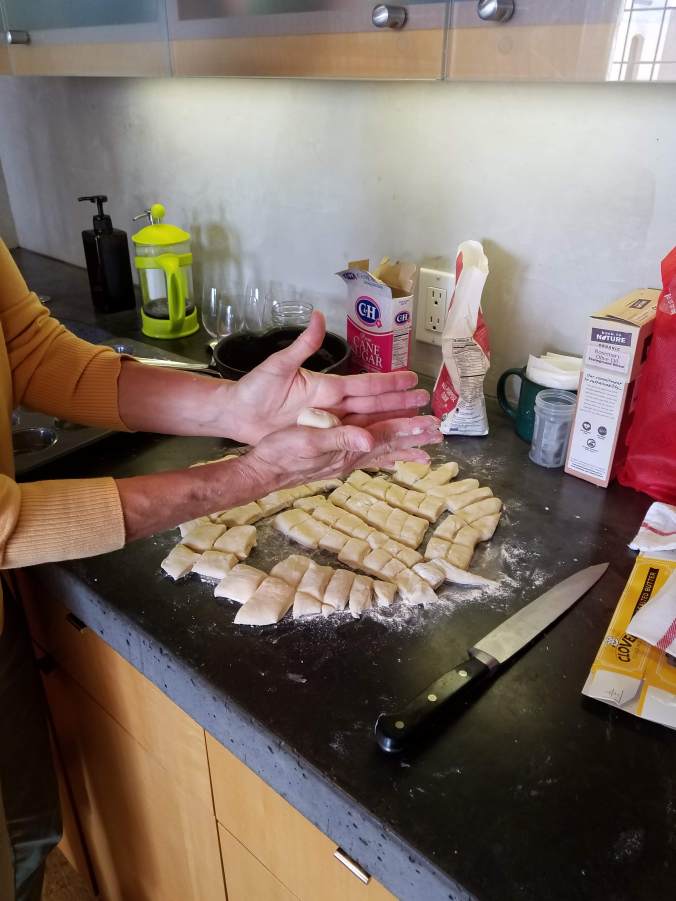
I cut the dough up into pieces and formed little irregular balls.

cutting up dough and forming balls

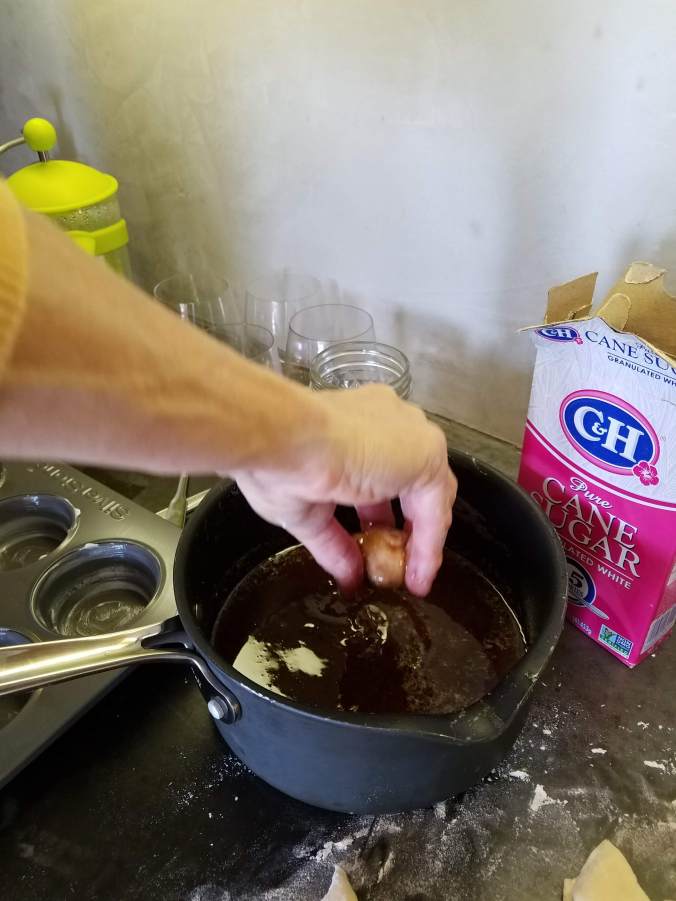
But then I had no choice but to dip the pieces one by one into the butter/sugar/cinnamon goo

dough ball

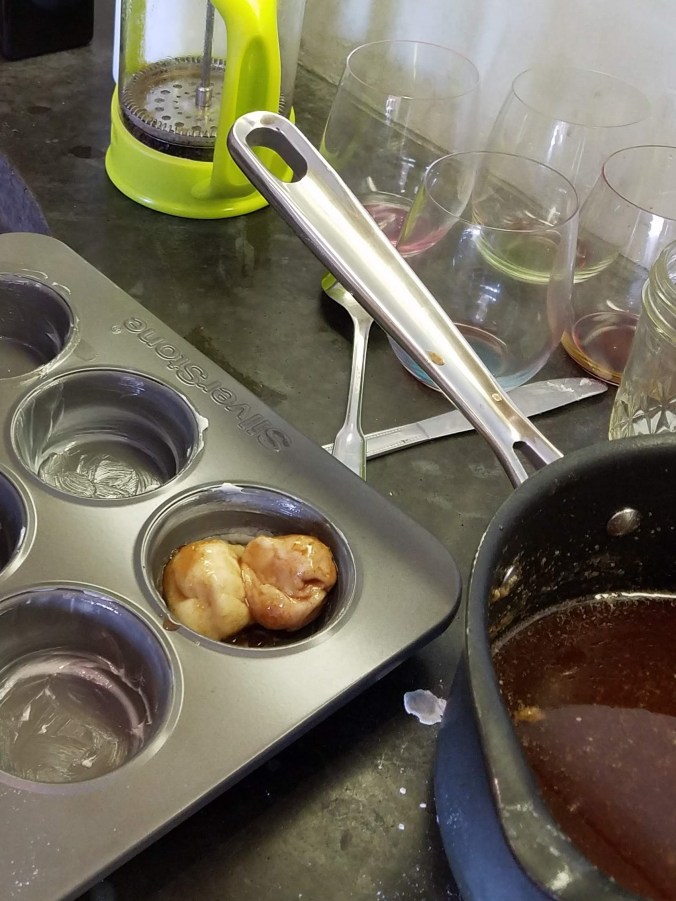
and put them in the cups of the muffin tins

balls in pan (2)

until they were all in.

in pans unbaked

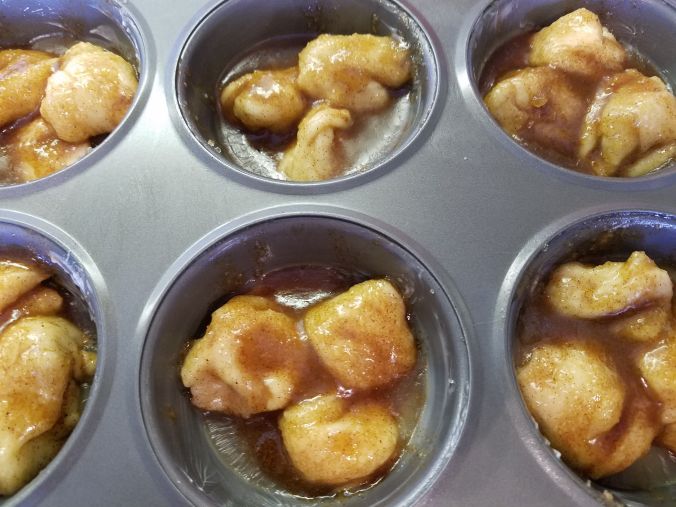
Up close it looked like this.

up close unbaked

Baked, like this. We had waited so long by this time. It was long past when we had had the rest of the brunch we’d planned. I didn’t take the time to put powdered sugar or a glaze on top.

baked on plate

Still, they pulled apart like nothing. The dough was soft as a pillow. The sweetness surrounding the dough was divine (seemingly none the worse for having been done wrong). If I had sprinkled powdered sugar on this plate, or put the suggested glaze on them, it would have looked better, but hot out of the oven Drew and Nicole loved them. Loved them. Do wait a few minutes until they are not quite so hot but still warm. Yes, do eat them warm out of the oven.

Still, I was not perfectly happy with them and will try again another time. I think more balls per cup would be better. Letting them raise longer would have been better (we were in a hurry to get to the Exploratorium so I rushed that part). Following instructions about the butter-dipping and sugar-rolling might have been better (not sure, that part seemed okay).

And this is how we learn. Try it, work with what you have, try to recover if you make an oops, see what happens. Try again another time, a little smarter than the first time. This is how we learn anything.

Lynn’s recipe:

Monkey Bread

DOUGH:

  • 4 tablespoons butter, divided, 2 tablespoons softened and 2 tablespoons melted
  • 1 cup milk, warm (about 110 degrees)
  • 1/3 cup water, warm (about 110 degrees)
  • 1/4 cup granulated sugar
  • 2 1/4 teaspoons instant yeast
  • 3 1/4 cups all-purpose flour, plus extra for work surface
  • 2 teaspoons salt

BROWN SUGAR COATING:

  • 1 cup packed light brown sugar
  • 2 teaspoons ground cinnamon
  • 8 tablespoons butter (1 stick), melted

GLAZE:

  • 1 cup confectioners’ sugar 2 tablespoons milk
  1. Butter a Bundt pan with the 2 tablespoons softened butter. Use a pastry brush or a paper towel or anything that will really help get inside all of those nooks and crannies. Set aside.
  2. In a large measuring cup, mix together the milk, water, melted butter, sugar, and yeast. Mix the flour and salt together in a standing mixer fitted with dough hook (see below for instructions to make the dough by hand). Turn the machine to low and slowly add the milk mixture. After the dough comes together, increase the speed to medium and mix until the dough is shiny and smooth, 6 to 7 minutes. If you think the dough is too wet (i.e. having a hard time forming a cohesive mass), add 2 tablespoons flour at a time and mix until the dough comes together (it should still be on the sticky side, just not overly wet). Coat a large bowl with nonstick cooking spray. Place the dough in the bowl and turn to coat lightly with the cooking spray. Cover the bowl with plastic wrap and let the dough rise until doubled, 1-2 hours (alternately, you can preheat the oven to 200 degrees, turning it off once it reaches 200 degrees and place the covered bowl in the oven to speed up the rising time).
  3. For the sugar coating, while the dough is rising, mix the brown sugar and cinnamon together in a bowl. Place the melted butter in a second bowl or shallow pie plate. Set aside.
  4. To form the bread, gently remove the dough from the bowl and press it into a rough 8-inch square. Using a bench scraper or knife, cut the dough into 64 pieces.
  5. Roll each dough piece into a ball (it doesn’t have to be perfect, just get it into a rough ball-shape). Working one at a time, dip the balls in melted butter, allowing excess butter to drip back into the bowl or pie plate. Roll the dipped dough ball in the brown sugar mixture, then layer the balls in the Bundt pan, staggering the seams where the dough balls meet as you build layers.
  6. Cover the Bundt pan tightly with plastic wrap and let the monkey bread rise until puffy and they have risen 1-2 inches from the top of the pan, 1-2 hours (again, you can use the warm oven approach to speed this up).
  7. Heat the oven to 350 degrees F (remove the pan from the oven if you placed it there to rise). Unwrap the pan and bake until the top is deep brown and caramel begins to bubble around edges, 30 to 35 minutes. Cool the monkey bread in the pan for 5 minutes (any longer and the bread will be too sticky and hard to remove!), then turn out on a platter or large plate and allow to cool slightly, about 10 minutes.
  8. For the glaze, while the bread cools, whisk the confectioners’ sugar and milk together in a small bowl until the mixture is smooth. Using a whisk, drizzle the glaze over the warm monkey bread, letting it run over the top and sides of the bread. Serve warm.


Vive la Tarte

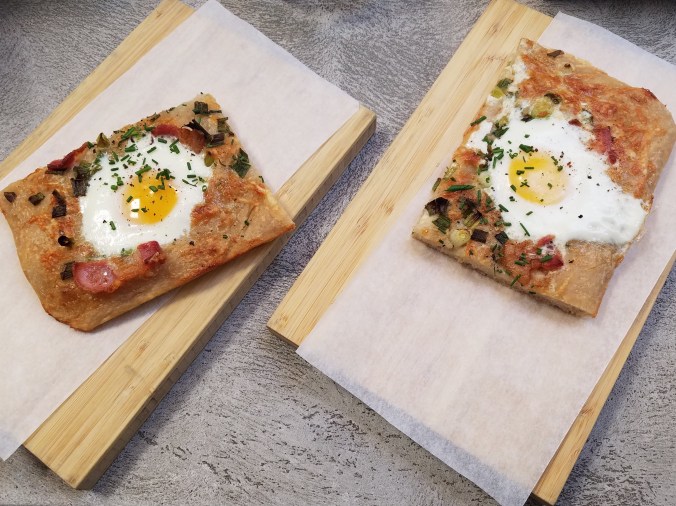
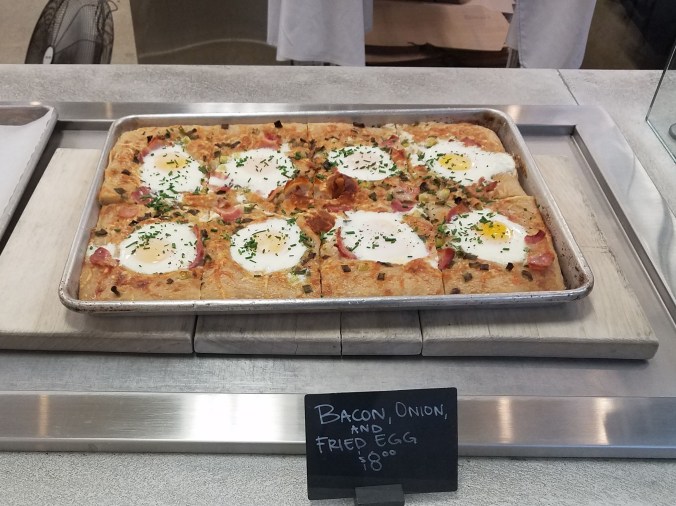
It isn’t every day you have pizza for breakfast. It isn’t every day your breakfast pizza includes an egg. I want to think that the eggs on our breakfast pizza today came from chickens as happy as mine at home in Virginia, but of this I cannot be sure. Regardless, this breakfast pizza with its bacon, egg and shallots, was (note past tense) an excellent way to start a Saturday in San Francisco. It was absolutely the perfect balance of its three simple toppings on a soft-on-the-inside, crisp-on-the-outside, bread-like crust. What else can you say but Oh yum!?

breakfast pizza (2)

The full pan of them looked like this. Drew told me that by 11am, these, and all the delectables you see below, will be gone, disappeared into the happy stomachs of Vive la Tarte’s customers. Notice they don’t call it breakfast pizza. I think they should. Drew did.

breakfast pizza2 (2)

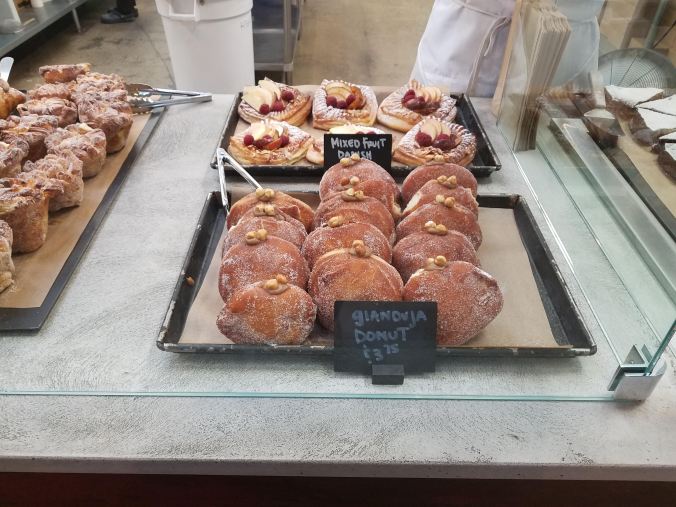
Vive la Tarte is one of those places you hope the residents of this city are very grateful for.  It’s popular for good reason — its food shares the same basic descriptors as most good foods, the most important descriptors: simple and delicious. You know you have come to a wonderful place when you want to eat one of every single thing they offer. I’m talking croissants,

croissants up close


more croissants, monkey bread,

croissants monkey bread

donuts, Danish,

donuts danish

quiches,

quiches

and the pizza, which was at the end of the line and became mine because walking through the line again would not have made it any easier to choose.

Seeing all of these wonders makes me want to bake more at home, to play around with different ingredients. That middle quiche has goat cheese in it. Why didn’t I ever think to put goat cheese in mine? And monkey bread – what’s monkey bread? Think pieces of soft bread dough baked together with cinnamon, sugar and butter in such a way that the adjectives to describe it include: soft, sweet, gooey, sticky, golden, cinnamon, buttery and last but not least sinful.

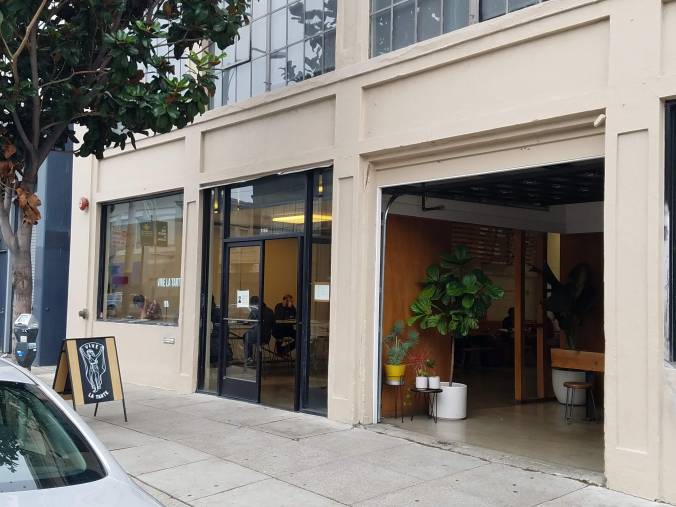
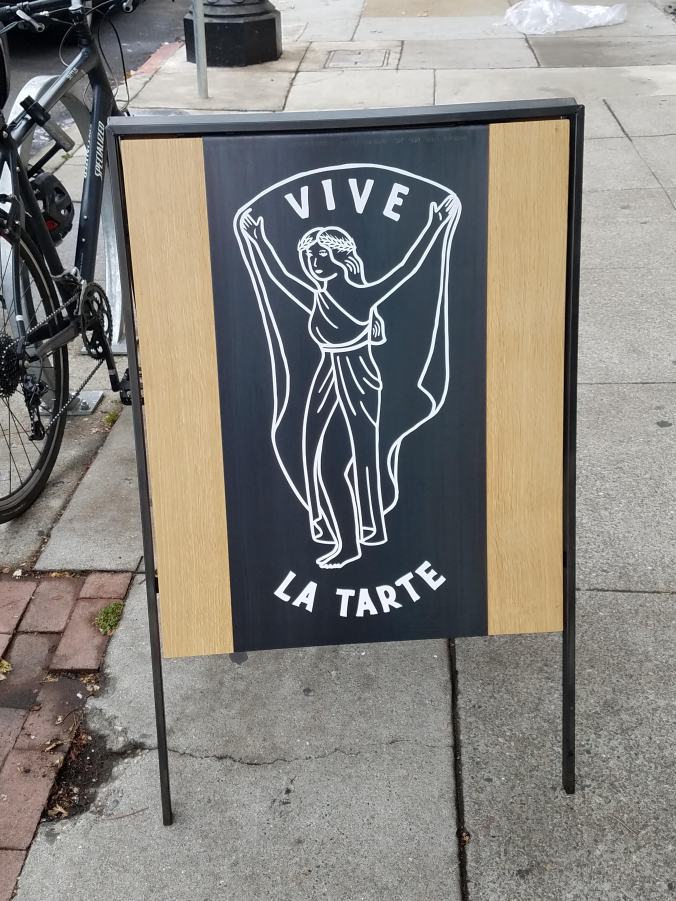
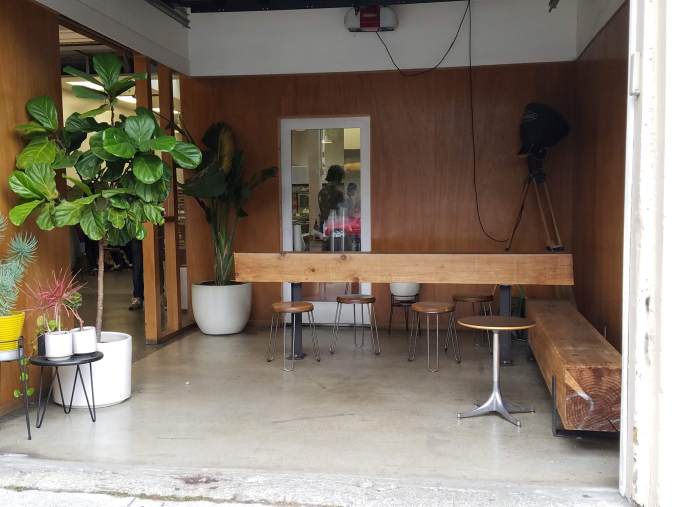
From the outside, Vive la Tarte doesn’t look like much.That large open space on the right, that’s called the sunroom. It was too cloudy a morning for me to attest as to any sun that might on a different day stream in there, but if they want to call it the sunroom, so shall it be. There’s an opening within the sunroom that leads into the restaurant, besides a main entrance. See the sandwich board outside the main entrance?

outside2

As you are walking down Howard Street, that’s your indicator. This is the place to be.

sandwich board

The same simple block-lettered name in the window identifies the bakery. Look elsewhere for fancy.

outside1

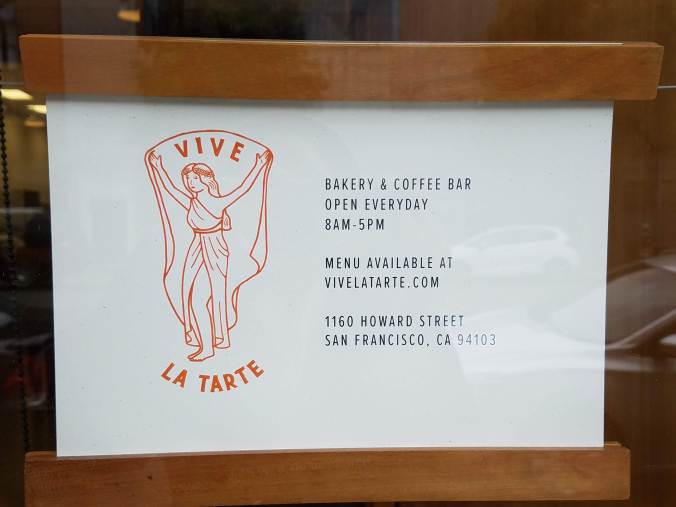
Two simple signs hang in the windows. One has the basics.

window sign.jpg

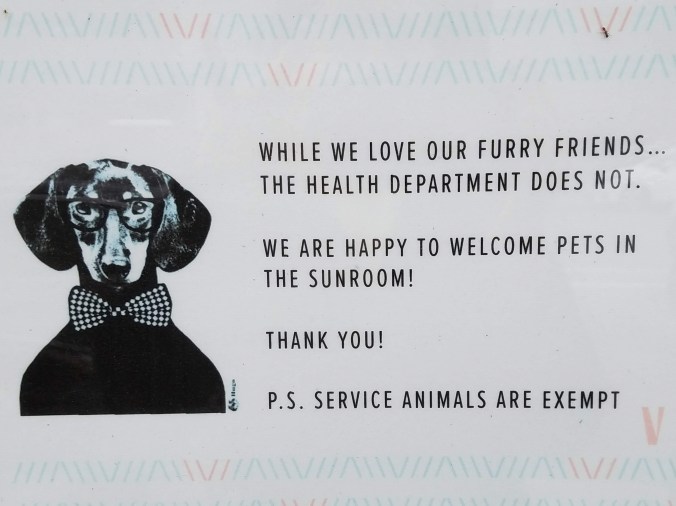
And one informs you of the dog policy.

dog policy (2)

Not to worry if you have your dog with you. That open garage door, a.k.a. the sunroom, is indoor-outdoor space is just for you and your dog. No takers while we were there.

sunroom

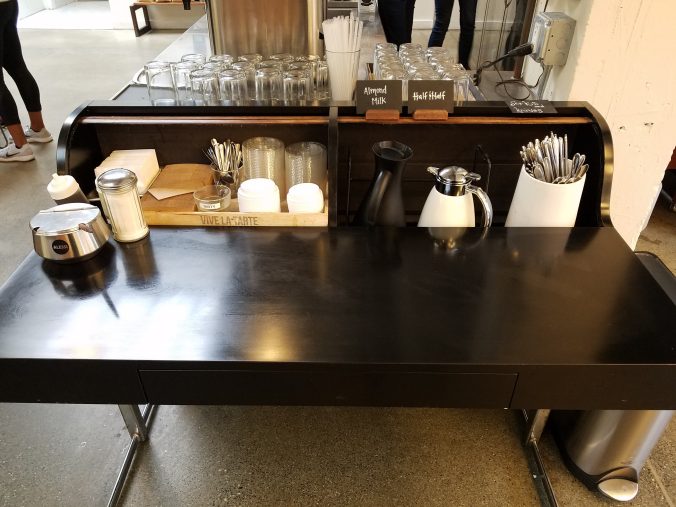
I am especially enamored of San Francisco’s evident commitment to producing less waste. The coffee station does not have sugar in packets that become trash, plastic or wooden stirrers that become trash, or half and half in little plastic cups that become trash. I know these things have their place, but the less of them the better.

milk and sugar

You have real spoons for measuring your sugar out of a glass jar (and for stirring), a cup to put the dirty spoon in, ceramic cups and real glasses to drink from and a helpful staff to get you anything you need that you don’t see.

coffee station

After I finished my pizza and tea (which I grant does not, without context, sound like a good combo but you know what my pizza looked like), I stood back and took the whole scene in. It’s huge and wide open.

long view inside

The kitchen is in full view as you approach the counter. I like when you can see what they are doing.

kitchen

I watched the lady banging her huge whisk to get most of the meringue off it. It’s a quantity of meringue that is inconceivable in a home kitchen, but oh how delightful a dollop of it is on a lemon tarte. Meringue is a kind of free-form marshmallow fluff, a simple mix of egg whites and sugar beat up till it’s fluffy as a cloud. Oh, the incredible ways people have come up with to make food so delicious!
meringue2 (2)

I wish I could come here for breakfast every day.

No, I don’t.

If I did, at least two things would happen that I don’t want to happen.

1. Vive la Tarte wouldn’t be special any more. It would be normal, every-day-ish, and I want places like this to always be special to me. (Once a week maybe I could live with though…!)

2. I would not be incentivized to play in my own kitchen or somebody else’s, which a visit here has very much made me want to do. For starters, monkey bread… So guess what we are going to do tomorrow in Drew and Nicole’s kitchen! I’ll let you know how it comes out 😊