I haven’t bought a jar of salad dressing in years. The reasons for this include 1. Cheap runs deep – I can make my own for so much less cost, 2. Fear of the Unknown – I worry about ingredient lists on labels that are too long, lists that contain words I cannot pronounce (and therefore are mystery ingredients, though I am not a nut about this, see below*) and 3. Culinary Whimsy – I like to play with food, making my own concoctions on a whim.
(BTW, Hats off to Robin at Haphazard Homemaker for her recent Berry Vinaigrette Salad Dressing post and the inspiration she gave me to share my own method.)
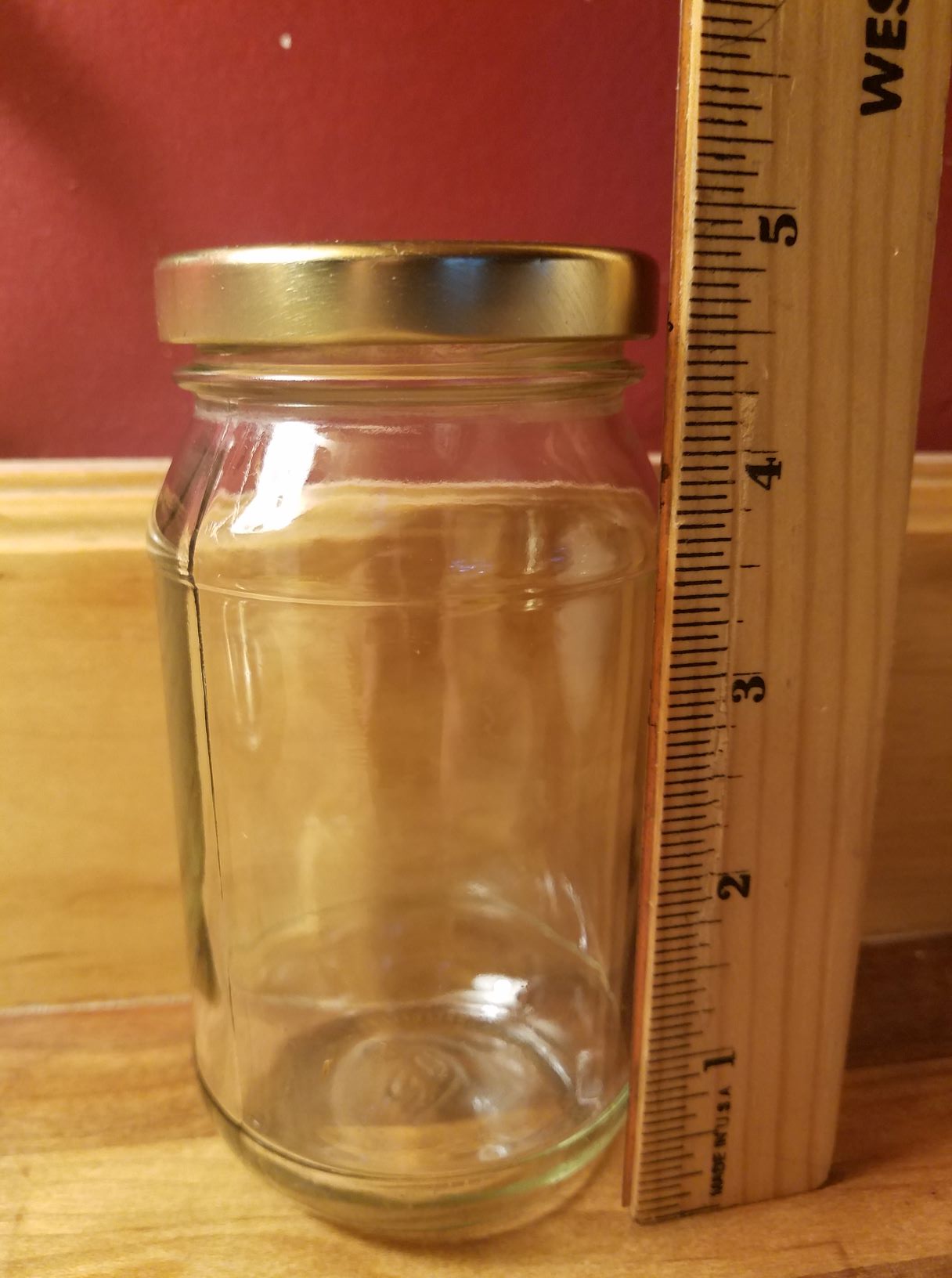
Salad dressing for me starts with a jar. Pick a jar, any jar. No, not any jar. Pick a jar that fits nicely in your hand. A pint-size mason jar works well. My jar, as you might guess, is not a jar I purchased as a jar but is a jar that was left over from something else, I forget what. Use a jar that came with pickles or capers or jam (or something like that) after you have finished up the pickles or capers or jam. This is my jar. It lives in a specific corner of my cabinet that is just to the right of the stove, where other, handy, easy-to-access things like salt and pepper and (in the non-blazing-hot months) butter also live.
I will explain the ruler.
Not including salt and pepper, a given for me, salad dressing includes four components. I will call them the base, the sour, the sweet and the embellishments. I do not always embellish. Like a balloon ride, if you took one every weekend, what would be the fun after a while? I take that back. It’s true that I do not always embellish, but in fact I almost always embellish, somehow or other. Go ahead – embellish to your heart’s content – life is short!! Also, sweet is optional, but allow me to say again: Life is short!! A little sweet cuts the sour, tempers the sour, makes more palatable the sour – that’s how I see it. (Oh, and I would love to take a balloon ride someday!)
You start with a base, meaning your first decision is whether you want your dressing creamy or not. (Possibilities for each of the components are listed in a chart below.) Creamy bases start with yogurt, sour cream or mayo; non-creamy starts with the best oil you can get (at the hotel we called it EVO or EVOO for Extra Virgin Olive Oil). Before we start combining, a word about measuring. I am not the Queen of Measuring – understatement of the year right there – when it comes to salad dressing (or some other things not presently at hand). I do, however, have eyes that see reasonably well. They, combined with the jar, have proven a perfectly adequate measuring tool for me. Thus the ruler, just to demonstrate.
Imagine there are lines on the jar. Does anyone remember the bottles that people had for Wish-Bone dressings back in the day? I think it was Wish-Bone, but the company history on their web page doesn’t note this development, so I am perhaps wrong. In any case, they had little lines/marks on the side: Pour oil up to this line, then vinegar up to the next line, then pour in the packet of seasonings, put the cap on, shake it up and dress your salad. That’s what I do: I pour in the base, then the sour, then the sweet up to the lines on the jar that I “see” because I have done this often enough. Feel free to mark your jar with colored tape or whatever works for you. You can of course buy a “salad dressing jar” with markings already on it, but maybe their markings don’t represent the proportions you prefer, and proportions are different for different dressings. Your call.
Lest you think I measure minimally or haphazardly (no offense, Robin!), please understand I did not invent the eyeballing of salad dressing ingredients and I don’t hold a candle to Claudia or my mom when it comes to winging it. Claudia puts her various ingredients one at a time into a coffee cup, then stirs it up with a spoon. Mom does not use a cup or a jar (to this day, far as I know). She just puts the lettuce, cukes, whatever into the bowl, opens the bottle of oil and pours some – in a zigzag manner – over the top, the same with the vinegar, and then takes the salt canister (the big one with the spout) and again zigzags over the top of the bowl, shakes some pepper in and tosses it up. She never uses a sweet element but I always love her salads (and Claudia’s too – oh, you want to drink the dressing that’s leftover with hers, that’s how good it always is!). It’s all good.
As with many things that are both spectacular and inexact, when you are tempted to think about the quantities, think instead about proportion. I use about the same amount of base as sour, almost always. And again that much sweet when the sweet is maple syrup (probably because I like/love(!) the flavor it adds). When the sweet is honey, I use less. When it is straight-up sugar, I don’t use much at all, a teaspoon or so. You don’t need much. But to me, a little bit of sweet cuts the sourness/ sharpness of the vinegar just enough to bring the whole salad to another level. Same as a bit of salt can make all the difference.
Some people, some recipes, suggest more base proportional to the sour, some have no sweet at all (love you, Mom!!) or just a touch of sweet, some just a hint of salt or absolutely-must-be freshly ground pepper. The point here is that you will make your own salad dressing, and it will be exactly the way you like, with the components you like, in the proportions you like.
You just have to play around a little to figure out what that is. And then practice. It might be best to consider the chart below, decide what sounds good to you, try it, try it again, try it till you feel comfortable playing with a slightly different combination or proportion. Experiment, play, practice, practice, play, experiment…
For an example (and only an example), I will show a basic dressing, one that I use quite often. Assuming a salad that will serve three or four people, and using olive oil as the base, apple cider vinegar as the sour and maple syrup as the sweet, I start with pouring the oil into my jar up to a level I know to be about right for that amount of salad. Then I add about the same amount of sour, then about the same amount of sweet (a little less, it usually turns out to be, but again, inexact here!). More or less of any ingredient changes the result slightly – play around and figure out what you like.
Once I put in the oil, vinegar and syrup in the jar, I add salt and pepper, put the cap on the jar, shake it up, pour it over my salad and toss. Voila! Quick and simple and yummy.
If you use base or sweet components that are non-liquid (like sour cream, yogurt, mayo, sugar or jam), spoon it into the jar. Then add the rest and shake like mad. Note: if/when you use jam, you might want to break it up a little (with a fork or the back of a spoon) before you start shaking so it will end up evenly distributed in the dressing.
All right, I tried making a chart and then converting it to the right format so I could insert it here, plain and simple, but these things are not plain and simple for me so, forgive me if this is less pretty, but here are lists instead.
To dress a basic salad of lettuce, tomato, red onion, cucumber, sweet pepper (and whatever you put in it), consider the following choices:
BASE
(extra virgin) olive oil (EVO)
other oils (grapeseed, canola, etc)
(plain, unsweetened) yogurt
sour cream
mayonnaise
SOUR
vinegar (cider, red, white, balsamic, rice, etc)
lemon juice
SWEET
maple syrup
honey
jam (any berry, fig, etc)
sugar (brown or white)
boiled (reduced) apple cider
EMBELLISHMENTS
pickled cucumbers or pickled anything else (mushrooms, artichokes, okra, beets, asparagus, beans, etc)
capers
dried fruit (raisins, craisins, dried cherries, etc)
herbs (endless possibilities: basil, oregano, thyme, etc)
grapes (cut in half) or other fresh fruit like apples or strawberries
olives
cheese
ham or salami
pepperoncini
Some good combinations (and don’t forget salt and pepper):
- EVO, cider vinegar, maple syrup (on a leafy green salad)
- Sour cream/plain yogurt, lemon juice, bit of sugar (on shredded cucumbers)
- EVO, cider vinegar, oregano (on cooked, peeled and shredded beets)
- Sour cream/plain yogurt, cider vinegar, sugar or honey, embellished with raisins (on broccoli salad or shredded carrots)
- EVO, red wine vinegar (on leafy green salad embellished with olives)
- Mayo, cider vinegar, bit of sugar, embellished with celery seed
- EVO, balsamic vinegar, embellished with basil
- EVO, rice vinegar, any herbs you like…
My guess is (my hope is!) that for some of you, making your own salad dressing becomes normal, commonplace, routine. You pick a jar, use the jar, find a special place for the jar. You buy your olive oil and vinegar in large bottles (way cheaper that way), transferring portions at a time to smaller bottles that are easier to pour from. You figure out over time which combination(s) you like best and make a habit of reaching for your jar when the time comes to dress the salad.
Have fun! Good luck! Enjoy every bite!
_______________
*Re: I am not a nut about mystery ingredients: It has always seemed impracticable on my end and surely must irritating on the other end when a “diet” is so restrictive that I/you/anyone can’t even go to a neighborhood barbeque because the food there would no way be within the scope of what’s currently allowable/ fashionable/ desirable. My son Lincoln recently gave his own version of Anthony Bourdain’s enjoy-food-and-don’t-impose-your-inane-restrictions-on-everyone-else: “Nothing wrong with having your own preferences or boundaries, but I follow the 80/20 rule on that. 80% of the time (or more) I can control what I eat but I allow for 20% to be determined by the people I’m with or the social situation.” No one likes a fanatic. So as much as I can, within reason, I eat what I feel good about, what seems reasonable to me, but if I am out and about in a restaurant or someone’s home, and they didn’t make that bread with the best flour or there’s some ingredient I wish weren’t there, it’s probably not going to kill me.
 An Unboring Path