I want a dog. I need a dog. I should get a dog. How hard is that? The time is right for me to get a dog of my own again. I think. I thought.
I was never much of a small-dog person, but Coco changed my mind. After she became a nice dog due to Samuel’s efforts, I grew to like her. I grew to enjoy her snuggling next to me on the couch. I grew to find her adorable. Don’t you?
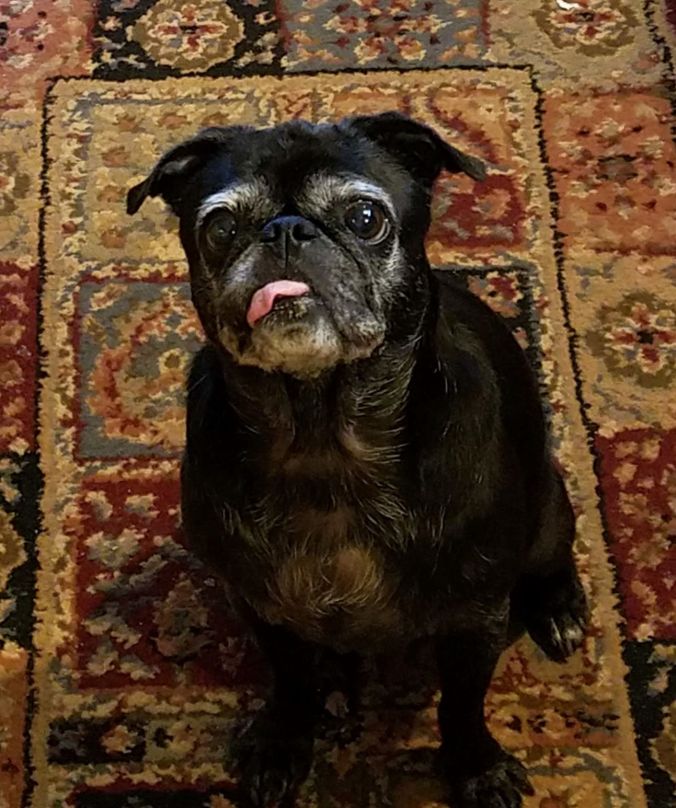
It’s okay if you don’t. She’s a ridiculous creature, but if you love a dog of your own, you know that doesn’t matter. If you don’t, then there is no use my explaining it. Dogs work their way into your heart. The thing is, she may be small, she may be ridiculous, but she is not foo-foo. I cannot do foo-foo. And she is nice. Nice matters. Coco made me consider a small dog instead of the larger breeds I’d had and been comfortable with: German shepherds (Jesse, then Adam), golden retrievers (Lucy and Candy), a St. Bernard (Mona), then another golden (Bridget).
We knew for the entire duration of Samuel’s Lambda (computer coding school) experience that when he finished and got himself a job, he would be leaving this house and finding a place of his own. I am exceedingly grateful that he found a job locally, but still, he will be leaving, and there will go my snuggler Coco. If she wasn’t such a nice dog, I would not be in such a fix right now. I had a problem to solve. Toward the end of my CASA training, right about when the tragedy of Micah’s death occurred and the 5K hospice race was happening and Max died, I distracted myself by thinking about my next dog.
Coco is nice. Pugs are nice. I looked up “pug rescue” and discovered an organization that currently had a mother-daughter bonded pair available. The description said:
Pimm & Polly are a bonded pair that must be adopted together. Both are up to date on vaccines, microchipped, spayed, and heart-worm negative.
Pimm & Polly are a super sweet bonded mother & daughter. They were surrendered to our rescue because their former owner passed away.
They both get along great with other small breed dogs and kids. Both are around 14 and 15 lbs silver pugs. Polly (Mother) is with limited vision having lost one eye as a puppy. She also has some alopecia from a skin condition during her puppyhood.
Pimm is her daughter, she is playful liking stuffy and chew toys. Both are potty trained. Pimm takes a daily eye drop for dry eye. Both are very sweet ladies perfect snuggle pugs.
We recommend gentle older children due to Polly’s vision. A fenced in first-floor home would be ideal for her and her daughter Pimm. Other small breed dogs like another pug would be best suited for these little ladies.
Pimm & Polly are looking for a loving family that will have the time to give these sweet girls lots of love and snuggle time!
Based on this description, it seemed reasonable to keep going, so I did. Two dogs are generally better than one anyway, so I started the ball rolling – sent in the application, retrieved old vet records, opened my home to inspection. One thing led to the next. I passed their rigorous process. Last Saturday, a week ago, Mom drove with me to Williamsburg to meet them.
We waited in the parking lot next to Pet Smart. Pimm and Polly approached via stroller, pushed by smiling rescue folks doing an admirable thing trying to find these poor little dogs a home. The pugs were dressed up to meet me: full-fledged matching tutus with polka dots, shiny blue nail polish too. In this photo taken just before I took them home you can see we took the tutus off. And in case you are wondering, Pimm’s tongue hangs out that far because there are no teeth to hold it farther in.
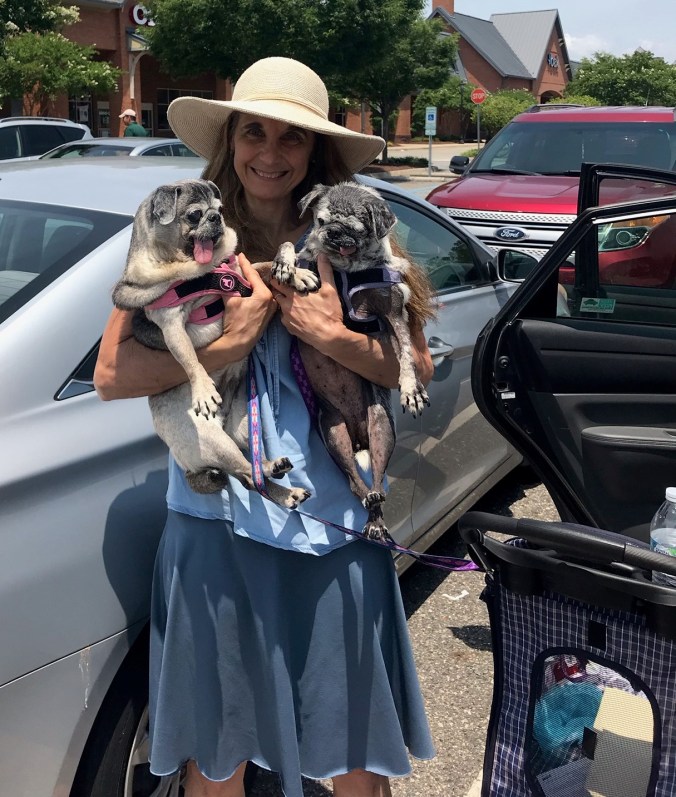
I can look beyond the trappings, beyond the shall-we-say unattractiveness of Polly’s hair loss and one eye. (Never mind that some people told me I could enter her in the Ugliest Dog contest and probably win.) I could see that they are sweet dogs, older dogs that have had a rough time. Their former owner did not detect (or blatantly ignored) mange in Polly to the point where the hair follicles are irreversibly damaged. There will never again be hair on the top of her head or on her belly or legs.
But okay. I signed the contract that included numerous points in regard to their well-being, medical care and safety, including promises that I would inform the rescue organization of any change in address or phone number and never allow the dogs to ride in the back of an open pickup truck. It was unequivocally clear that I was never to transfer ownership and that the rescue organization would remain the second contact on the microchip. The pugs would be mine or theirs, no one else’s. Not that I would re-home them, but that all felt a little like Are they really my dogs then?
Just as I put them in my car, I got what is for me an uncommon thing. Some people would call it intense anxiety. I paused. My heart beat faster than usual. I struggled to remain composed. “I don’t know why I have such cold feet,” I told the rescue folks. “But I have such cold feet.”
“Don’t worry,” they said. “Take them home and give it a week. Take two if you need to. Consider yourself a foster family for now until you are sure.”
“What about my money?” I asked, referring to the $425 adoption fee, which I understand helps cover the costs incurred during their year-plus of foster care.
“We won’t cash your check until you tell us you are sure,” they said. Mom didn’t say anything, didn’t want to interfere. I did not remember the words Samuel had said before I left: Make sure, if it’s a yes, it’s a strong yes. It wasn’t a strong yes, it was far from a strong yes, but off we went with stroller, food, meds, bed and a suitcase full of other clothes – matching sundresses, raincoats, fleece coats, parkas, sailor outfits, etc, all marked Pimm or Polly.
Okay. For two days I watched them exploring my house, enjoyed their very sweet natures and the facts that they eat well, do their business in appropriate places (i.e. not in my house) and really just want to snuggle almost all the time. I noticed that Polly only occasionally moved beyond her familiar bed and that neither was able to walk up or down stairs, even on a leash. But they are only about 14 pounds each, not heavy pugs. I carried them when we went outside, picked them up when they wanted to be with me on the couch.
Right away on Monday morning I called my own vet and made an appointment for that afternoon. Dr. Stewart is seasoned, wise and sensible. I trust her judgment and wanted her assessment. The “limited vision” referred to in the description is apparently an understatement. Polly is not only one-eyed to begin with. The best way to imagine the extent of her vision in the remaining eye is to imagine what you can see by looking through a straw – an extremely small field of vision, my vet said, and even that, we can’t be sure how clear it is. She is essentially blind. Pimm’s vision is quite compromised too. A kind of pigmentation happens in the cornea, which should be transparent. Neither cornea is close to transparent, so for her too, the world grows darker and darker.
I chide myself that I did not, as soon as the vet pronounced this factual state of affairs, put two and two together. I was perhaps in the thrall of their sweet, quiet pugness, perhaps heard the voices of our age commending me for this rescue effort. I did not remember how I assist Evelyn (101 years old and completely blind) from her chair to her couch every week when I go there to read to her, how tentatively she steps as she feels along the table in between, how she cannot simply put a fork into her food because for her the world is dark. I did not think about my house, the pugs’ new environment. I did not think about the danger of the open landing at the top of my spiral, cast iron staircase.
A continual mental flagellation has been happening all week, a little bit like the way President Kennedy reportedly walked around the White House after the Bay of Pigs fiasco saying over and over How could I have been so stupid?
The day after the vet visit, I was in the kitchen when I heard an unusual sound, a creaky thumping coming from the front foyer. Yes, the front foyer where you find the spiral, cast iron staircase. Polly was at the bottom, miraculously standing, miraculously with only a small cut on her head.
That night at the dinner table I had a light bulb moment and announced, “Polly fell down the stairs. It’s all very plain now. I just don’t have the right house. It’s not safe for them here.” I sent a note off the next day to the rescue folks, expecting them to come running with supreme concern – if they wouldn’t want them in the back of an open pickup, they wouldn’t want them falling down stairs, right? They didn’t. Instead I got “Is there a way to keep the girls in area with a pet or toddler gate?… At some point any pug you adopt will develop vision issues or issues getting around.”
Vision issues, she said. Um, blindness.
But she gave me pause and okay, maybe a gate, maybe a barrier. But I can’t create a hazard while trying to block a hazard. We go up and down those stairs all the time. And there are stairs on the back deck, stairs on the front deck. A saloon-type barrier might work across a small space but wouldn’t work everywhere.
Several things happened along with the incessant self-flagellation that continued, along with the constant undercurrents of stress, with the voices in my head saying one shouldn’t give up… one should make these things work… they really are very sweet… every dog needs a home… but it’s not safe here… it’s mostly good here… but what if someone forgets to close the gate?
I did my best to set aside other considerations, to remember the central question drilled into us at CASA training, the foremost goal of the volunteer work aimed at helping abused and neglected children: figuring out what is best for the children. I tried to focus on What is best for the dogs?
I also did what I do when a weight is on my shoulders. I consulted. I sought the wise counsel of those I trust and respect. I laid out the facts and got a resounding chorus in reply: This is not a good situation. They need a different home.
It pained me to write the note last night, but I did it. So far I have not heard back….
Maybe the time is not quite right for me to get a dog of my own again.
 An Unboring Path